
Always do whatever’s next. —George Carlin
Monthly Archives: August 2012
“Legitimate Rape”

Rep. Todd Akin (R-Mo) tells us all about women’s bodies.
Why does the U.S. House of Representatives increasingly look like a monkey house in the zoo, with ignorant congressmen swinging from the branches and shocking us civilized people with their bestiality? My parents tell me that, when I was a little tyke, we visited the Bronx Zoo in New York and were assailed by dung thrown at the visitors by the gorillas. It was an early instance, I guess, of gorilla warfare.
What Representative Todd Akin did that upset so many people in both political parties is to hint, by his choice of language, that (1) there is such a thing called “legitimate rape,” which sounds in his words as if it were a good thing and (2) women can, when being raped, shut down their baby-making factory at will. Therefore there is no valid justification for abortion in the event of rape.
Women have tried for so hard and so long to win the equality that they deserve that it has become shocking when a troglodyte like Akin steps forward and makes chattering sounds that betray his ignorance. And he wants to join that Gentleman’s Club known as the U.S. Senate! I don’t think he’ll make it.
It’s back to the bananas for monkey boy.
You Can’t Win Them All

Cityscape of JUST IMAGINE in the distant future: 1980
Some films are better known for stills than for the films themselves. One of them is Fox’s Just Imagine (1930), a science fiction musical set in the distant future year of 1980. Today, Martine and I attended a screening at the American Cinemathèque’s Aero Theater in Santa Monica. The event was to honor the late art director Stephen Goosson (1889-1973), who was responsible for designing such pictures as Lost Horizons, Meet John Doe, It Happened One Night, and Mr. Deeds Goes to Town. (Yes, all the above were directed by Frank Capra at Columbia Pictures.)
Just Imagine, however, was directed by the less talented David Butler. Except for Goosson’s outstanding design work, the film was corny to the max. In fact, Martine walked out of the picture about three quarters through because she couldn’t stand it any more. I gamely sat through all of it and cringed through El Brendel’s vaudeville-style comedy routines. Although Brendel received top billing, he was a major drag on the picture.
Late next week, I will be attending Cinecon 48 in Hollywood and sitting through upwards of fifteen films from the silent era and the early days of sound, with a few outliers that were more recently made. This was, for me, a foretaste of the film orgy to come.
More on the Higgs Boson
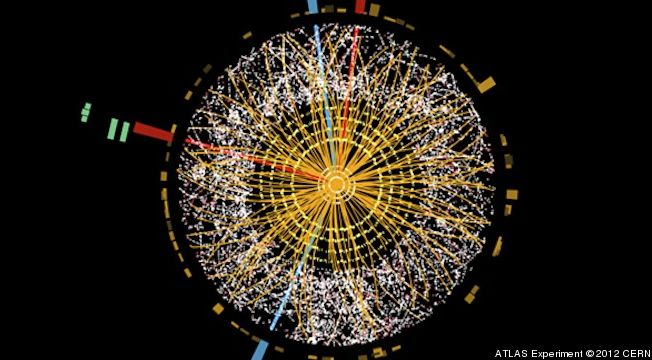
Higgs Boson Particle Encounter
A few weeks ago, I posted this humorous piece on the Higgs Boson on my blog site at Multiply.Com. I will repeat the text here because, on December 1 of this year, Multiply will delete all my postings and retreat to Southeast Asia. Not being a Filipino, I just decided not to Tagalog:
It’s not every day that physicists around the world can celebrate the discovery of a particle such as the Pigg’s Boatswain, the so-called Dog Particle. Emerging accidentally from the Somewhat Large Hadron Collider (SLHC) at BERN in Switzerland, the Pigg’s Boatswain lurched into existence for several Gilliganseconds when a technician accidentally tossed a soft drink cup into the Collider. At once several subatomic particles generally referred to as ø-cokes and µ-pepsis attained a measurable mass (and vastly increased calorie content).
Swedish physicist Bjorn Oswald Pigg had actually speculated on the existence of the PB in 1961, when he backed his Saab over a dumpster. The so-called resulting Piggs Field was identified as a promising area for future research, but it was not until three weeks ago when the SLHC made it all possible.
When asked about the implications of the discovery, B. O. Pigg, now 92 years old, admitted, “Well, probably nothing, but for dang sure it’ll get me a Nobel—if I should live so long!”
As to whether there were any practical applications, Pigg shrugged. “At present, the immediate result of the PB transformation is a microscopic, but still pungent pile of dog puckie, which requires a sophisticated cleanup that my colleagues claim that there are not sufficient euros minted to accomplish. Maybe in a few more years….”
In the meantime, Ixtaccihuatl joins the scientific community in hailing another great discovery. All the greater because of the humor involved watching journalists trying to wrap their minds around the story.
It was my mistake to call the particle the Pigg’s Boatswain, but then I’m not much of a physicist. I guess it’s just a character quark on my part.
This afternoon, I just finished reading Lisa Randall’s Kindle book entitled Higgs Discovery: The Power of Empty Space. Now I can claim to know even less than I did when I wrote the above. You see, in addition to Higgs Bosons, there are Higgs Fields, the Higgs Mechanism, and Higgs “I’m With Stupid→” T-Shirts (Sizes S, M, L, XL, and LHC).
The Higgs Field is not much like a field at all. Perhaps the best comparison would be a overfilled cat litter box. Imagine what happens when a Spin-0 particle hits it at the speed of light, causing a quality that advanced physicists refer to as Pungency. You might say it really hits the fan, and the resulting Higgs Boson particles shoot in every direction and make a big mess.
Many of the latest discoveries are the result of the RLHC (Ridiculously Large Hadron Collider) in what used to be Greece before Angela Merkel decided to use the real estate for a more useful purpose that cost fewer Euros than housing a bunch of defaulting Greeks. At a power level approaching 3.1416³ TeraGilligans, the number of collisions in the Higgs Field grows to the point that subatomic physicists refer to it officially as a Sh*tload.
The whole point of the RLHC collisions is twofold:
- They do not appear to be insured, and
- They add mass to particles which previously had none.
There is some question as to what the purpose of this added mass is, but some scientists speculate that’s how all mass in the universe was created, including all the plants and animals to which you are allergic and which sneak up and bite you while you are sleeping. Nice going, guys!
Imaginative Infamy

Soviet-era postage stamps honoring Sergei Kirov
No one could say that Josef Stalin was unimaginative when it came to being one of the greatest tyrants in living memory. You may have heard of the old saying “Keep your friends close, but your enemies even closer.” In the 1920s and 1930s, Sergei Kirov was a rising star in the Communist party, and reputed to be one of the dictator’s best and closest friends. They even took working vacations together on the Black Sea.
But there was this nagging problem: Kirov was getting much too popular. At the Seventeenth Party Congress early in 1934, both positive and negative votes for various leaders were cast; and it appeared that a large number of negative votes were cast against The Man of Steel (Stalin). In fact, some party leaders approached Kirov and suggested that he take over the reins of power. As a loyal party member, Kirov reported this to Stalin, who thereupon rigged the vote count so that he himself won.
On December 1, Kirov was shot in the back of the head just outside his second-floor office at the Smolny Institute in Leningrad. When Stalin was contacted in Moscow, he rushed at once to Leningrad and took over the investigation in person. The gunman was, in all probability, Leonid Nikolaev.
But it didn’t stop there. Stalin saw Kirov’s death (which he may or may not have engineered himself) as the perfect opportunity to rid himself of some enemies from the earliest days of the party. Hurled into prison were Lev Kamenev and Grigorii Zinoviev, two of the early Bolsheviks whom Stalin accused of masterminding a massive conspiracy leading to his friend’s death. Before it was all over, upwards of several thousand enemies and families and friends of enemies of Stalin were fingered by the NKVD and either imprisoned, exiled, or shot outright.
In the meantime, Stalin make a big show of grieving for Kirov, being one of his pallbearers, and retrospectively naming him as one of the Heroes of the Revolution. Also he authorized some postage stamps honoring his memory (see illustration above), renamed streets around the Soviet Union to honor him, and even changed the name of the Maryinsky Ballet in Leningrad to the Kirov Ballet.
This was only the beginning of what came to be known as Stalin’s Purges, which reached their peak in 1937-1938. In the end, untold millions of lives were affected, and the literature of the era has given birth to many great novels in which these events were mirrored, books such as Arthur Koestler’s Darkness at Noon, Victor Serge’s The Case of Comrade Tularev, and Anatoly Rybakov’s Children of the Arbat and Fear. And these in turn gave birth to Alexander Solzhenitsyn’s many works about the Gulag Archipelago.
I have just finished reading Amy Knight’s excellent Who Killed Kirov? The Kremlin’s Greatest Mystery, in which she concludes:
The story of Kirov’s murder did not end with the trials of January 1935. On the contrary, the murder and its aftermath marked the beginning of a nightmare that would consume the Soviet Union for the next four years. Some historians insist that the police terror that unfolded after Kirov’s assassination was not the product of any grand strategy of Stalin’s, but rather a haphazard, frenzied process that fed on itself. But when one considers how Stalin meticulously pored over transcripts of interrogations and indictments and how he systematically meted out retribution to his real or perceived enemies, a picture of a carefully planned vendetta emerges.
Friendship with those who are too powerful and too paranoiac has its price.
Little Victories
 Little by little, I am getting the hang of WordPress. There are a lot more design options than in Multiply, but there is also more help and a relatively logical organization of the material. That makes a big difference. The organization at Yahoo! 360 was rich, but totally cockamamie. At Blog.Com and Multiply, there wasn’t much help to be gotten; and what there was seemed more oriented toward software engineers.
The heat wave in Southern California—indeed, across much of the United States—continues unabated. I would like to be more active, but the monsoonal clouds indicate a sharp uptick in the humidity, and nights are uncomfortable. Even more so because our 60-year-old building is uninsulated, and we have no air conditioning.
Oh, well, this too shall pass.
A Face In The Crowd

Identifying Faces from Google Picasa
As this has been a slow afternoon at work, I decided to try to identify my friends on the thousands of photographs I have stored on my second work computer. These are faces of people in Chinatown parades, Obon Carnival line dances at the West Los Angeles Buddhist Temple, military re-enactors, or just people in the background of many of my shots. They may be people who cut me off on the highway, served me lunch, speakers at the Los Angeles Times Book Festival, or what have you.
After one has been looking for a while, one keeps wondering whether the face is the face of a friend or acquaintance. Then I bring up the original photograph, and it’s just a tiny face in the background greatly enlarged by the mighty Google face recognition software.
Even so, I am surprised at how many faces I recognize of people I haven’t encountered for years. Have they dropped off the edge of the earth? Or have our paths simply diverged, as they frequently do, for reasons relating to geography, changing interests, or whatever other reason. Some of them represent friendships I will take up again. Perhaps some of the people I see most now will be somehow re-prioritized in life’s endless reshuffling of the deck.
None of the faces above are familiar to me, but several look as if they possibly could represent people I met once (and filed away in my mind as “do not make any special effort to remember”).
There is a term in demographics called cohort. The term refers to a group of people one is affiliated with at a particular time. For example, I belong to the cohort of Hungarian-Americans born in 1945 in Cleveland, Ohio. I also belong to the cohort of people who attended graduate school in film at UCLA but never attained their degree objective. There is also the cohort of people who regularly attend the Chinese New Year Parade on Hill Street every February, people who go to the Obon Festival, people who attend military re-enactments, or people who just read obscene numbers of books because they love to.
All the people in the thumbnails above intersected, however briefly, with my life at one time or another when I was sporting one of my digital cameras. Every one of those faces represents a different world which intersected mine.
How many faces will we see in our lifetimes? How many millions? How many people are wondering about my image as they edit their Uncategorized Picasa photos? Who knows? The answer is blowing in the wind.
64 Years of Independence

This is my first blog written for WordPress, and I thought it would be fitting to use it to celebrate the sixty-fourth anniversary of India’s independence. It has been a long and turbulent ride for both India and Pakistan, which were both created at the same time in 1948. At the time there was mass violence as millions of Muslims and Hindus emigrated to avoid getting stuck behind the wrong boundary line. Read Ved Mehta’s books about that time for background, especially Daddyji (1972) and Mamaji (1979). He may be blind, but Mehta saw more than most sighted people.
I thought I would also mark at this time the rather complicated history of my blogging activities. I started in 2005 writing for Yahoo! 360, which is no more. The name I used was Solnabanya, which is Slovak for “Salt Mine,” after the salt mine where my father worked from the age of ten.
Then when Yahoo! 360 blinked out of existence in 2008, I moved to Blog.Com, where I wrote under the same name I’m using now, namely: Tarnmoor. There weren’t too many people at Blog.Com, so I felt as if I were an elf fart at the bottom of a deep well. When Blog.Com started getting a bit shaky, I moved to Multiply.Com, where perhaps you knew me as Ixtaccihuatl, after the Mexican volcano next door to Popocatepetl.
So here I am—as Tarnmoor once again. Here, from something I wrote for Blog.Com, is my explanation of the name Tarnmoor:
Many years ago, when I was a graduate student in Film History and Criticism at UCLA, I collaborated with several of my friends in writing a column for The UCLA Daily Bruin reviewing the various ethnic movie theaters in town. At the time, there were five theaters showing nothing but Japanese films and several showing Mexican and other Spanish language pictures. We adopted as our pseudonym the name Salvatore R. Tarnmoor.
As it happens, we were not the first to use this name. A somewhat better-known author, Herman Melville of Moby Dick fame, published a number of pieces under this name. We even used a line drawing of Melville from a Signet Classics paperback edition as our picture.
At some point in the Cenozoic Era, when I started using the Internet, the name Tarnmoor sprang to mind, and I started using it for various accounts.
Hello world!
Welcome to WordPress.com! This is your very first post. Click the Edit link to modify or delete it, or start a new post. If you like, use this post to tell readers why you started this blog and what you plan to do with it.
Happy blogging!
 Tarnmoor
You must be logged in to post a comment.