From Concord to India

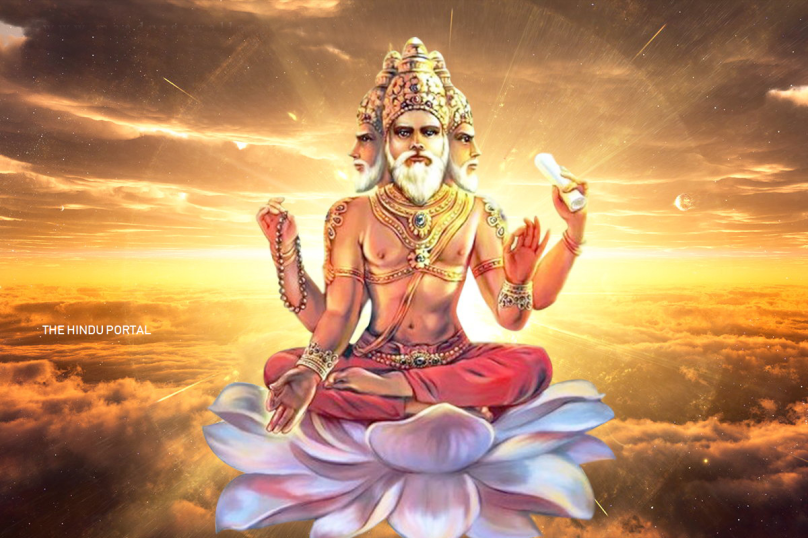
Brahma (from the Hindu Portal)

I ran across this short poem by Ralph Waldo Emerson (1803-1882) about Brahma, the creator of all things in the Hindu religion. He is depicted as having four faces, one facing in each of the directions.

Brahma

If the red slayer think he slays,
Or if the slain think he is slain,
They know not well the subtle ways
I keep, and pass, and turn again.

Far or forgot to me is near;
Shadow and sunlight are the same;
The vanished gods to me appear;
And one to me are shame and fame.

They reckon ill who leave me out;
When me they fly, I am the wings;
I am the doubter and the doubt,
I am the hymn the Brahmin sings.

The strong gods pine for my abode,
And pine in vain the sacred Seven;
But thou, meek lover of the good!
Find me, and turn thy back on heaven.

For some background on “the sacred seven,” check out this website.

Heavy Going

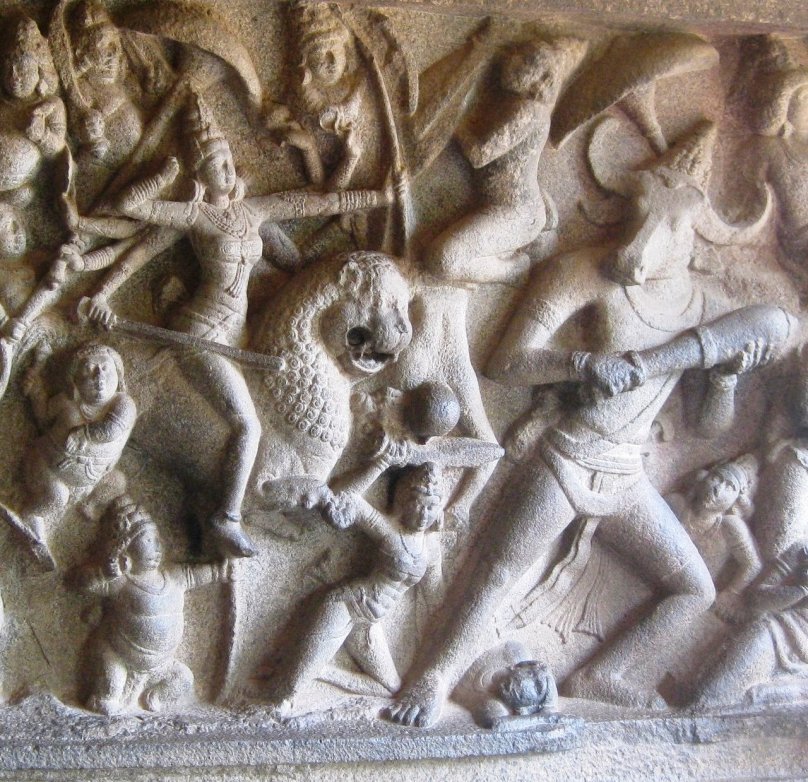
The Goddess Slaying the Monster Buffalo (Māmallapuram)

I have just finished reading Heinrich Zimmer’s Myths and Symbols in Indian Art and Civilization (Washington DC: Bollingen Foundation, 1946), edited by Joseph Campbell and with contributions from Ananda K. Coomaraswamy. It was fairly heavy going for most of its length. Curiously, the most interesting chapters were the first (The Parable of the Ants) and the last (a Hassidic tale). Even if the rest of the book proves way too erudite for you, and if you just aren’t geared up to read Sanskrit, I suggest you check out these two chapters.

Hinduism with its armies of gods, demons, demigods, semigods, and hemigods has always fascinated me, though I always found myself slogging through too much detail. Tales from the Indian scriptures always fascinated me, but I could rarely remember what I read a mere few hours later.

Nonetheless, I will try to read more of this material, including, perhaps, an abridged edition of India’s great epic, The Mahābhārata, which consists of some 200,000 couplets. Wish me luck!

The Angel and the Idolater

Here in its entirety is “The Parable of the Buyer of Nothing” from Farid-Ud-Din Attar’s The Conference of the Birds about which I posted yesterday. Attar’s Sufi beliefs are a far cry from the doctrinaire conservatism which we associate with Islam. In fact, in one line of the work, Attar writes, “These lofty words are an antidote for anyone sickened by extremism’s poison.” And to think this was written in the twelfth century!

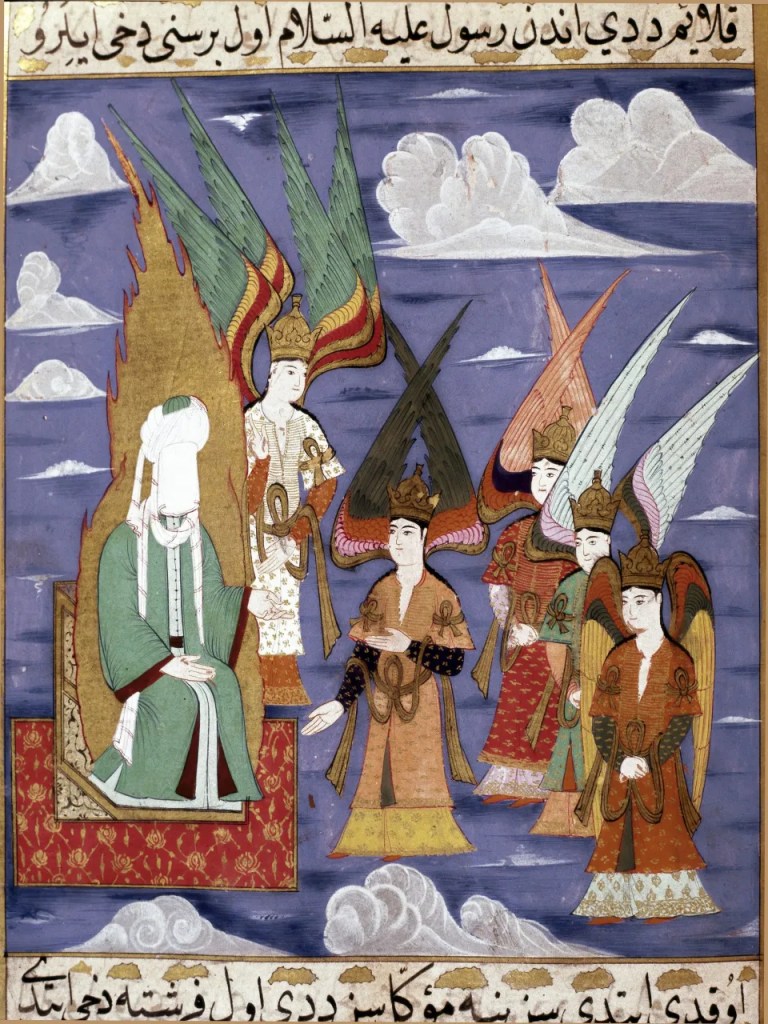
One night as Gabriel rested in Paradise, he heard the Blessed Beauty respond “Here Am I” to a supplicating, prayerful voice. The angel thought, I don’t know who this person may be, but he must be a pure man, dead to his ego and alive in his soul.

Curious, the angel searched the Seven Heavens for the name of this man, but could not find it. He then searched the earth and the oceans, the mountains and the fields, and still failed to find the supplicating soul. Gabriel then hastened back to the Almighty, and again heard the Blessed Beauty’s “Here I am.” The angel’s head spun from envy and he went off again searching the earth once more, but to no avail. Finally, the angel pleaded: “Great One, guide me to this supplicating servant. Who is he?”

The One on High replied: “Go to Rûm, and seek him in a temple of idolaters.”

The angel hastened back to Earth and found a man crying and praying before an idol. Gabriel was moved by what he saw and returned to the Almighty, sobbing and begging: “Self-Sufficient One, unveil this mystery to me. He is praying to an idol, but it is you who in your grace answers him.”

The Blessed Beauty replied: “This man’s heart is darkened by ignorance. He does not know he has been misled. He has committed this error unknowingly, but I do not commit errors. I will now guide him to the Path. My benevolence will lead him to repentance.”

The Almighty then opened the Path to the man’s soul and liberated his tongue so that he could speak the Beloved’s name.

Know that this is the way of the Almighty.
That Great One needs no reason for what it does.
If you have nothing to offer the Great Court,
don’t worry, it doesn’t matter.
Over there the market isn’t keen on only pious deeds.
At the Great Court, nothing is also accepted and bought.

Not To Be Improved Upon

Tibetan Buddhist Nun Pema Chödrön

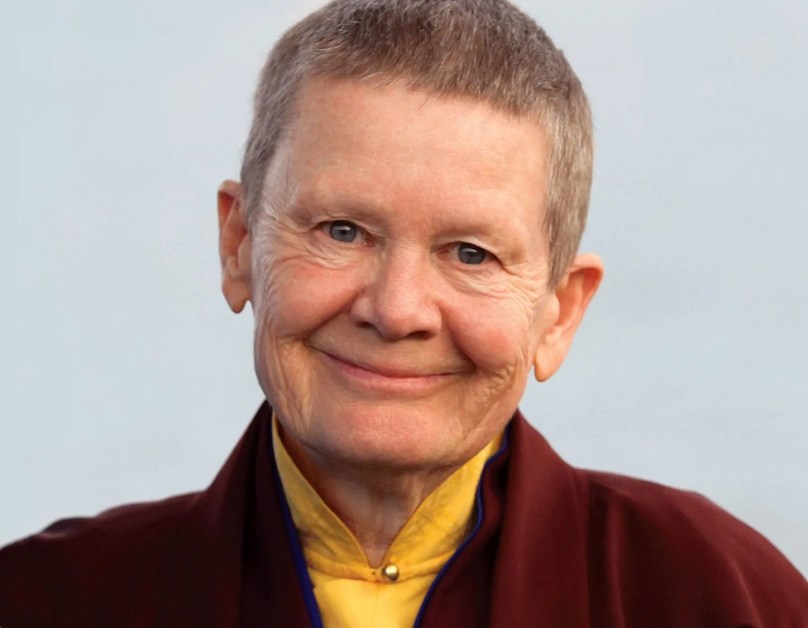
There I was yesterday staring at tulips at Descanso Gardens in between reading selections from The Pocket Pema Chödrön. And who is Pema Chödrön? Now retired, she is an American-born Buddhist nun practicing Tibetan Buddhism. She is a disciple of Chögyam Trungpa Rinpoche who has written a score of books on Buddhist practices. The following selection particularly interested me.

We already have everything we need. There is no need for self-improvement. All these trips that we lay on ourselves—the heavy-duty fearing that we’re bad and hoping that we’re good, the identities that we so dearly cling to, the rage, the jealousy and the addictions of all kinds—never touch our basic wealth. They are like clouds that temporarily block the sun. But all the time our warmth and brilliance are right here. This is who we really are. We are one blink of an eye away from being fully awake.

Looking at ourselves this way is very different from our usual habit. From this perspective we don’t need to change: you can feel as wretched as you like, and you’re still a good candidate for enlightenment. You can feel like the world’s most hepless basket case, but that feeling is your wealth, not something to be yjrown out or improved upon.

Mullah Nasruddin

Islam Is Not All Fundamentalist

This is a repost from March 29, 2023.

Originally, there was a historical Mullah Nasruddin. He was born in Turkey and lived between 1208 and 1284. Stories multiplied about him, and eventually he was widely known between the Balkans and China. In the 20th Century, Idries Shah published a charming series of books featuring anecdotes about the Mullah. Here are two of them:

TWO IN ONE

Nasruddin was taking a shortcut home through the cemetery, where a burial was in progress. As he walked past the group of mourners, he overheard one of them saying: “Today is a sad day for us all. We have buried an honest man and a politician.”

A sad day indeed, Nasruddin thought to himself. I didn’t realise that the situation was so dire that they are now compelled to bury two people in the same grave!

GOD’S WISDOM

One hot summer’s day, Nasruddin was relaxing in an orchard under the shade of an apricot tree. Looking around him, and marvelling at nature’s bounty, he wondered why apples, cherries, and other small fruit grew on trees, while large melons and pumpkins grew on vines at ground level.

Sometimes it is hard to understand god’s ways, he pondered. Imagine letting apricots, cherries, and apples grow on tall trees while large melons and pumpkins grow on delicate vines!

At that precise moment, the mullah’s reverie was interrupted by an unripe apricot falling from the tree and bouncing off his bald head. Roused from his musings, Nasruddin stood up, raised his hands and face towards heaven, and said humbly: “Forgive me, god, for questioning your wisdom. You are all-knowing and all-powerful. I would have been in a sorry state now if melons grew on trees.”

Meditation

I am currently reading one of the Buddhist scriptures in its entirety, written in the Pali language as The Questions of King Milinda somewhere between 100 BCE and 200 CE. The book’s description of meditation caught my eye:

The king said: “What, Nâgasea, is the characteristic mark of meditation?”

“Being the leader, O king. All good qualities have meditation as their chief, they incline to it, lead up towards it, are as so many slopes up the side of the mountain of meditation.”

“Give me an illustration.”

“As all the rafters of the roof of a house, O king, go up to the apex, slope towards it, are joined on together at it, and the apex is acknowledged to be the top of all; so is the habit of meditation in its relation to other good qualities.”

“Give me a further illustration.”

“It is like a king, your Majesty, when he goes down to battle with his army in its fourfold array. The whole army—elephants, cavalry, war chariots, and bowmen—would have him as their chief, their lines would incline towards him, lead up to him, they would be so many mountain slopes, one above another, with him as their summit, round him they would all be ranged. And it has been said, O king, by the Blessed One: ‘Cultivate in yourself, O Bhikkus, the habit of meditation. He who is established therein knows things as they really are.’”

“Well put, Nâgasena!”

Walking in Beauty

Ship Rock Near Farmington, New Mexico

In the spirit of the Christmas season, I am posting a Navajo Blessing Ceremony prayer called “Walking in Beauty.” I have always found it to be beautiful and inspiring.

In beauty I walk
With beauty before me I walk
With beauty behind me I walk
With beauty above me I walk
With beauty around me I walk
It has become beauty again


Hózhóogo naasháa dooShitsijí’ hózhóogo naasháa dooShikéédéé hózhóogo naasháa dooShideigi hózhóogo naasháa dooT’áá altso shinaagóó hózhóogo naasháa dooHózhó náhásdlíí’Hózhó náhásdlíí’Hózhó náhásdlíí’Hózhó náhásdlíí’


Today I will walk out, today everything negative will leave me
I will be as I was before, I will have a cool breeze over my body.
I will have a light body, I will be happy forever, nothing will hinder me.
I walk with beauty before me. I walk with beauty behind me.
I walk with beauty below me. I walk with beauty above me.
I walk with beauty around me. My words will be beautiful.


In beauty all day long may I walk.

Through the returning seasons, may I walk.
On the trail marked with pollen may I walk.
With dew about my feet, may I walk.
With beauty before me may I walk.
With beauty behind me may I walk.
With beauty below me may I walk.
With beauty above me may I walk.
With beauty all around me may I walk.
In old age wandering on a trail of beauty, lively, may I walk.
In old age wandering on a trail of beauty, living again, may I walk.
My words will be beautiful…

Totem

Detail from Totem Pole in Victoria BC

Totem poles are some of the most accessible images of aboriginal spirits. The best I’ve seen were on Vancouver Island in British Columbia, mostly in Victoria and Cowichan. After seeing them, I read Franz Boas’s book Primitive Art (1927). As I wrote in a previous blog, “It’s a difficult read, but like many difficult reads, eminently worthwhile.”

One of the reasons that totem poles are so stunningly impressive is that they are still being made by Indians in the U.S. and First Nations members in British Columbia. Unlike Hopi Kachinas, which are also still being made, they are a public art form; and many old poles have been gathered together and put on display.

I would love to visit the Alaska panhandle to see the Haida totem poles on Prince of Wales Island, and perhaps also the Haida Gwaii archipelago in British Columbia north of Vancouver Island.

Totem Poles at Cowichan in 2004

One could stand in front of a totem pole and try to guess at what the images are signifying. For instance, in the loincloth-clad figure on the right above, he is cradling a fish (probably a salmon) in his left hand while wearing an oversized hat with blue and red strips along the bottom. What does that mean?

If I were to go back to Cowichan for another look, I would be deeply disappointed. When I did go back a few years later, the totem poles were looking uncared for and there was talk of turning the tribal facility into a conference center. I wonder if that ever happened.

“God and the Devil Are Blood Brothers”

“Satan Before the Lord” by Corrado Giaquinto (1703-1768)

The following is from Mircea Eliade’s “Mephistopheles and the Androgyne or the Mystery of the Whole” in his The Two and the One.

The motif of the association, indeed the friendship, between God and the Devil is particularly noticeable in a type of cosmogenic myth that is extremely widespread and can be summed up as follows: In the beginning there were only the Waters, and on those Waters walked God and the Devil. God sent the Devil to the bottom of the ocean with orders to bring him a little clay with which to make the World. I omit the details of this cosmic dive and the results of this collaboration by the Devil in the work of Creation. All that concerns our purpose are the Central Asian and South-Eastern European variants which stress the fact that God and the Devil are blood-brothers, or that they are co-eternal or, indeed, God’s inability to complete the World without the Devil’s help.