
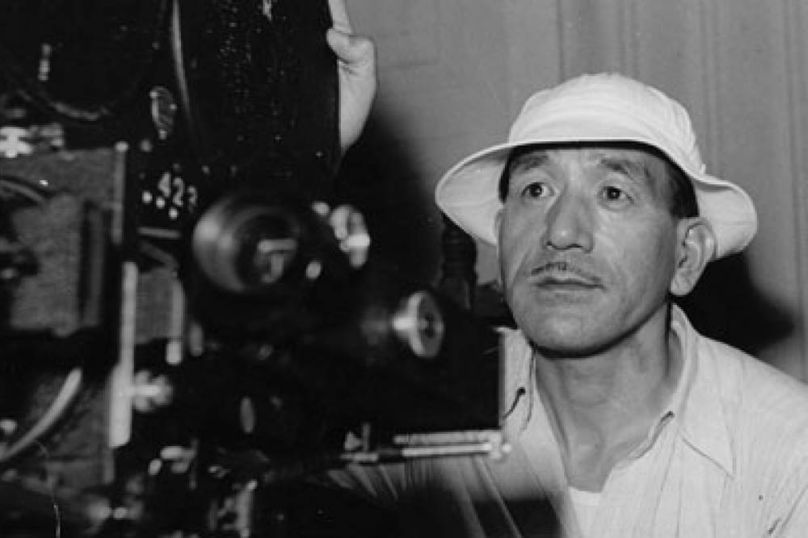
Japanese Film Director Yasujiro Ozu (1903-1963)
I did not post yesterday because I was enthralled by an evening of Yasujiro Ozu films on Turner Classic Movies (TCM). Likely, I will be equally remiss on the remaining Tuesdays in May, because TCM will be screening his films on those days.
If not the greatest filmmaker who ever lived, he is certainly one of the top three. Ever since I saw Late Spring (1949) and Tokyo Story (1953) at Dartmouth College, I have been enthralled by Ozu. I literally cannot let a film of his go unwatched if there is any chance I could see it. Consequently, I was up last night past midnight watching a triple feature of:
- The Ozu Diaries (2025), a biopic directed by Daniel Raim based on the director’s diaries
- I Was Born But … (1932), a silent feature by the director
- The Only Son (1936), the director’s first sound feature
I could have stayed up until 3 am to watch A Story of Floating Weeds (1934), but I was starting to flag past the midnight hour.
What makes Ozu’s films so special?
Most of the dozen or so features I have seen to date concentrate on family relationships, especially where children are involved. This is interesting because Ozu never married. In fact, he lived with his mother until her death in 1961. Yet his portrayals of female characters and children are second to none in the entire history of the cinema. If you see Setsuko Hara as Noriko in Late Spring or the little boys in I Was Born But …, you will know what I mean.
No other filmmaker so lovingly includes scenes in which (apparently) nothing happens. Perhaps there is a scenic shot in which a train passes by. Other times there are empty rooms or laundry hanging up to dry or simple kitchen household objects. In one of his diaries, Ozu admits to being interested in “the spaces between scenes.”
Very Buddhist, this. In fact, Ozu and his mother are buried under a stone in which the only identification is the Japanese character mu, “Nothingness.”
At times, Ozu’s directorial touch is so perfect that even God Himself could do no better if he took a turn behind the camera.


You must be logged in to post a comment.