Depredations of the Nome King

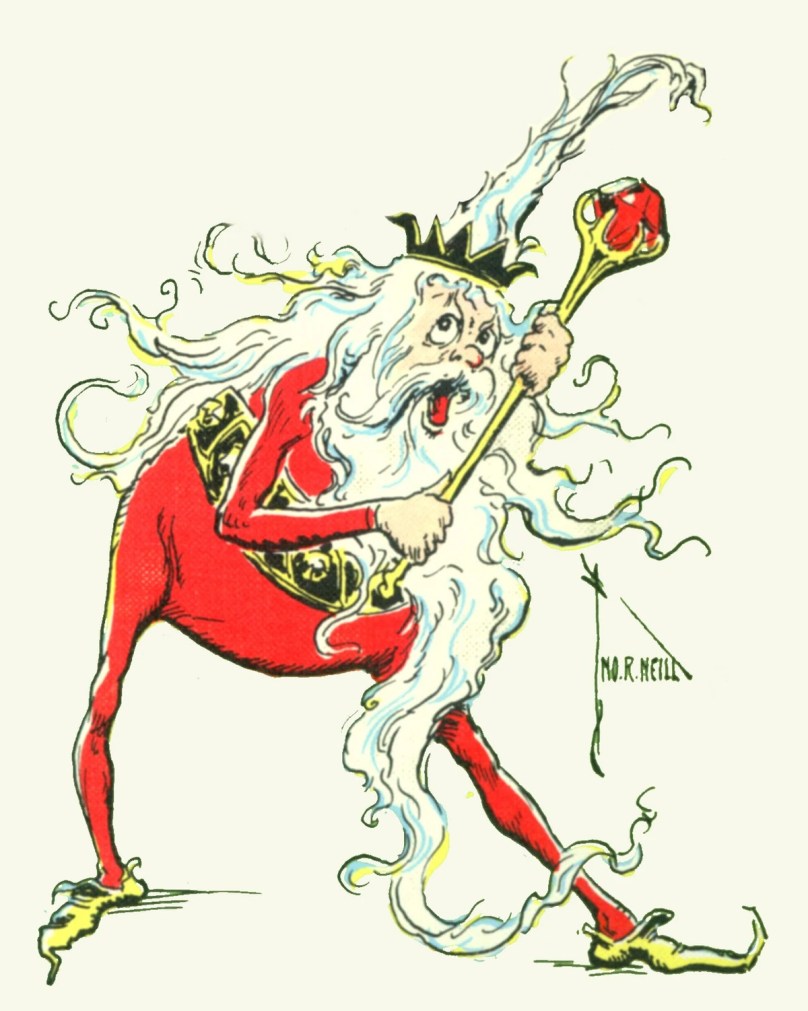
L. Frank Baum’s Nome King

Who would have thought that I would find in L. Frank Baum’s The Emerald City of Oz the most perfect villain of the Donald Trump variety. In an earlier Oz book (Ozma of Oz), the Nome King and his minions had been defeated by Dorothy Gale and Billina who exploit the Nome peoples’ fear of eggs and steal his magic belt.

In The Emerald City of Oz, the Nome King is up to his old tricks: “Therefore the King stormed and raved all by himself, walking up and down in his jewel-studded cavern and getting angrier all the time. Then he remembered that it was no fun being angry unless he had some one to frighten and make miserable, and he rushed to his big gong and made it clatter as loud as he could.”

Further on:

This Nome King was named Roquat the Red, and no one loved him. He was a bad man and a powerful monarch, and he had resolved to destroy the Land of Oz and its magnificent Emerald City, to enslave Princess Ozma and little Dorothy and all the Oz people, and recover his Magic Belt. This same Belt had once enabled Roquat the Red to carry out many wicked plans; but that was before Ozma and her people marched to the underground cavern and captured it. The Nome King could not forgive Dorothy or Princess Ozma, and he had determined to be revenged upon them.

So he calls for his general and when he doesn’t get the answer he wants, he “throws him away.” This consists of the following: “Please take General Crinkle to the torture chamber. There you will kindly slice him into thin slices. Afterward you may feed him to the seven-headed dogs.”

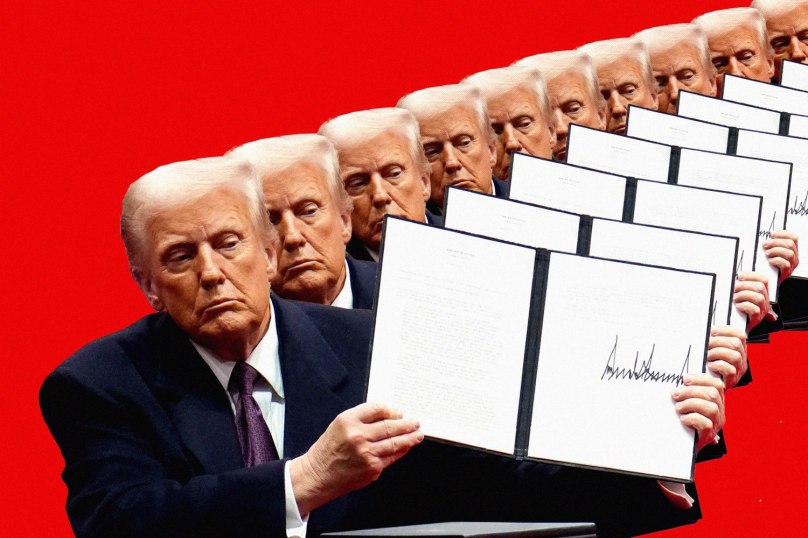
As we know, this is Donald Trump’s favorite way of handling subordinates, such as Kristi Noem, Tulsi Gabbard, Pam Bondi, and John Bolton. The seven-headed dogs are well fed by the orange-haired Nome King of Mar-a-Lardo.

A Recurrent Suspicion

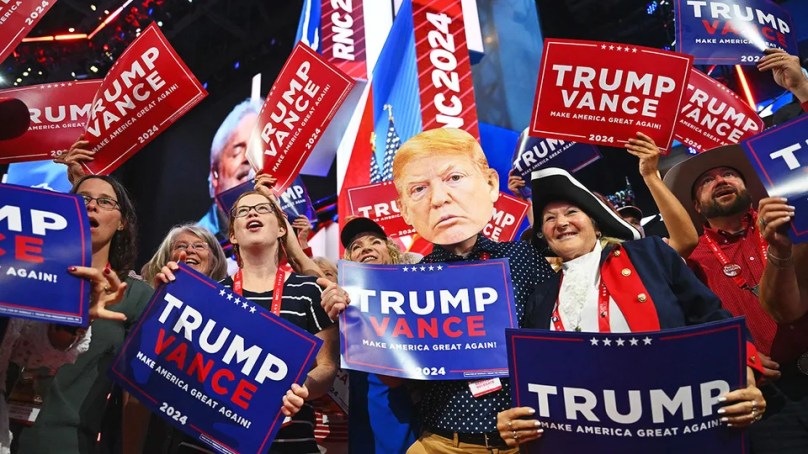
MAGA Rally

In July 1943, the Writers’ War Board asked New Yorker writer E. B. White to make a statement on the subject “The Meaning of Democracy.” Below is White’s statement:

Surely the Board knows what democracy is. It is the line that forms on the right. It is the don’t in don’t shove. It is the hole in the stuffed shirt through which the sawdust slowly trickles; it is the dent in the high hat. Democracy is the recurrent suspicion that more than half of the people are right more than half of the time. It is the feeling of privacy in the voting booths, the feeling of communion in the libraries, the feeling of vitality everywhere. [Italics mine]

In 2016 and 2024, I learned that, according to Mr. White’s statement, we are NOT living in a democracy. I say that because a certain individual was elected president twice by more than half the voters—voters who were not only wrong in electing him, but very probably wrong in their judgments on any subject you care to name.

I suppose I could be forgiving toward the voters who propelled Trump to the presidency, but I don’t feel like it. I have no intention of agreeing that water flows uphill, that the sun sets in the East, or that the Commander-in-Chief of our armed forces can declare war at any time against anybody. In fact, I am feeling very non-committal about our country as it begins to celebrate its 250th anniversary as a former democracy.

The Zoo Lady and the Politicos

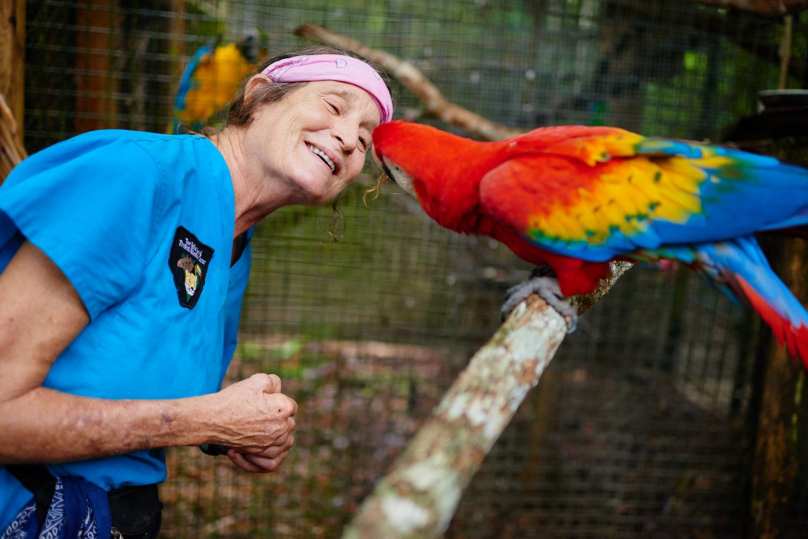
Sharon Matola (1954-2021) and Scarlet Macaw

I just finished reading a book about the difficulty of fighting an environmental battle in a developing country. The book was Bruce Barcott’s The Last Flight of the Scarlet Macaw: One Woman’s Fight to Save the World’s Most Beautiful Bird (New York: Random House, 2008). The story is set in Belize where a naturalist from Baltimore named Sharon Matola founded a zoo consisting solely of critters from within the borders of the country.

Sharon was particularly proud of her scarlet macaws. Now these are a kind of bird that is not endangered in South America; but the Central American variety, a legitimate subspecies, could be found in the valley of the Macal River, where they had their nests. When suddenly it was announced by the Belize government that a dam (to be called the Chalillo Dam) was to be built smack in the middle of the macaws’ nesting territory, Sharon went to war against the forces behind the dam.

These included not only a Canadian firm named Fortis but a number of Belize politicos who stood to gain from kickbacks and other underhanded tricks possible when dealing with large construction projects such as Chalillo. Barcott’s book not only gives us an excellent picture of what the tiny Central American country of Belize—formerly known as British Honduras—is all about, but gives us blow-by-blow accounts of Sharon’s war against the Powers That Be.

Well, in the end, the Powers That Be won, and the dam got built. The politicos were so irate about this gringo lady’s attempt to subvert “cheap electricity for the masses” that they scheduled a massive landfill to be created right next door to the Belize Zoo. Fortunately for the Zoo Lady, that project failed when it was demonstrated that a river important to longtime Belizean residents would become badly polluted.

In the end, she had other irons in the fire, such as reintroducing harpy eagles to Belize. Alas, however, Sharon died of a heart attack at the age of 66. Fortunately, her zoo continues on; and I have earmarked it for a visit if I can take a trip to Belize.

What To Talk About When Politics Is Too Grim

In the Age of Trump This Is Becoming a Real Problem

With most of my friends, I tend to avoid any discussion about the current political situation. That becomes a sticky issue when so many people are glued to news programs. In fact, the only person with whom I am comfortable discussing the news is my brother Dan. And that is because we generally agree on most of the issues.

I am a strange kind of hybrid who is at one and the same time a liberal and a fiscal (but not a cultural) conservative. I do not belong to any political party and have even gone so far as to vote for some Republicans for local (but not national) office. As a result, any political discussion with a dyed-in-the-wool Democrat or Republican is likely to end in discord. For example, my dislike of the tent-dwelling homeless in Los Angeles has made me notorious among the woke Liberals of my acquaintance.

When I was a child in Cleveland, I was raised in a family where there were broad political disagreements. My father was a supporter of Alabama Governor George C. Wallace’s campaigns for the presidency. In 1980, my mother voted for John B. Anderson for the top office. Only my brother and I tended to agree. (In 1968, however, I was so disgruntled about choosing between Nixon and Hubert H. Humphrey that I did a write-in for Otto Schlumpf for president.)

So do I watch the news at all? Not really, unless we are talking about the weather. There are so many television channels with news all or most of the time that they really don’t have much to say, so they tend to repeat their “breaking” news ad infinitum ad nauseam. Martine watches the news a lot, but I think her problems with insomnia are attributable to her news habit.

Victor Hugo on the Patience of the People

A Drawing by Victor Hugo

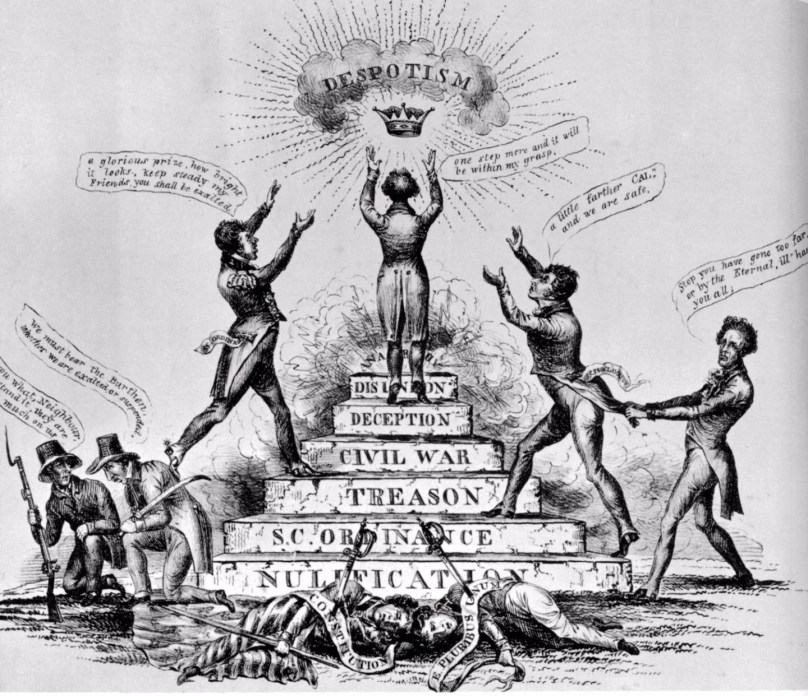
The following poem by Victor Hugo is relevant to today’s political situation with President Trump attempting to test:

The Patience of the People

How often have the people said: “What’s power?”
Who reigns soon is dethroned? each fleeting hour
Has onward borne, as in a fevered dream,
Such quick reverses, like a judge supreme—
Austere but just, they contemplate the end
To which the current of events must tend.
Self-confidence has taught them to forbear,
And in the vastness of their strength, they spare.
Armed with impunity, for one in vain
Resists a nation, they let others reign.

No Triumphalism Here

Wars Go Through Three Phases

It seems that all the wars that involved the United States after 1945 have gone through three phases:

  • “Shock and Awe” and Waving the Flag and Glorifying the Power of Our Armaments.
  • Disenchantment sets in as the carnage continues apace and our boys start coming home in body bags. This is the longest stage of the military engagement.
  • The end where we just walk away call call the mess we have created a Glorious Victory. Followed by recriminations that last as long as the war.

Here is a poem from Lord Dunsany of Ireland, who fought on the British side in the Boer War and the First World War. He is better known as the author of such great fantasy novels as The King of Elfland’s Daughter and The Curse of the Wise Woman—not to mention scores of great short stories.

A Dirge of Victory (Sonnet)

Lift not thy trumpet, Victory, to the sky,
Nor through battalions nor by batteries blow,
But over hollows full of old wire go,
Where among dregs of war the long-dead lie
With wasted iron that the guns passed by.
When they went eastwards like a tide at flow;
There blow thy trumpet that the dead may know,
Who waited for thy coming, Victory.

It is not we that have deserved thy wreath,
They waited there among the towering weeds.
The deep mud burned under the thermite’s breath,
And winter cracked the bones that no man heeds:
Hundreds of nights flamed by: the seasons passed.
And thou last come to them at last, at last!

Objective: Zero

Can You See Three Ayatollahs in This Picture?

Oh oh, there I go again! I said I wouldn’t write about politics, and a few hundred bombs and a thousand casualties later later I got so upset that I couldn’t help myself.

I have just finished reading a book about the Second Punic War, in which a Carthaginian force under the generalship of the brilliant Hannibal Barca, invaded Italy and for seventeen years fought the Roman Republic. In his book Hannibal’s War, British Military Historian John Peddie writes:

Wars, historically, wear many different complexions: they may be ideological or defensive, punitive or vengeful. They may be fought for economic or social causes or for reasons of aggrandisement. But however they may rise, of one thing we may be certain: they cannot be successfully fought without a clear-cut, grand objective [italics mine], within which will lie other, minor, objectives, each one a stepping stone, culminating, hopefully, in victory.

Since the end of the Second World War, the United States seems to have lost sight of this simple fact. What was our objective in Korea? Vietnam? Nicaragua? Iraq? Afghanistan? In every case, we just decided it was just eating up too much in time and resources and just declared a victory. But in every case, was it a victory?

The same is the case with Benjamin Netanyahu’s block by block destruction of Gaza. What has he accomplished to date? Oh, and yes, he is with Trump in invading Iran. And how will that end?

I can just see gas prices rising so quickly that Trump will have to declare a victory prematurely. Wars used to be pretty popular, until we started losing all of them.

Talking Politics at Home

It Has Become Dangerous to Talk Politics, Even at Home

I learned the lesson early in life. My father, otherwise an excellent man whom I loved, was a member of the American Independent Party and a supporter of Alabama Governor George C. Wallace’s politics. There have been presidential elections when my mother, my father, and I voted for different presidential candidates. I got used to loving members of my family irrespective of their politics.

Then, in 1987, I fell in love with Martine Hedges. Born in France, Martine is a typical stubborn Norman, with what the French call a tête Normande, a “Norman head.”. When Martine takes a position, there is no moving her from it. As it happens, she is a Republican who supports many positions taken by Donald Trump.

Do Martine and I talk politics at home? Not unless we want the temperature in our apartment plummet to freezing. She knows my politics, and I know hers. ’Nuff said.

As a result of traveling extensively in South America to countries which have suffered through heinous dictatorships and bloody insurgencies, I have learned not to take positions. In Argentina, there was the rule of the generals and the “disappearances”; in Chile, there was the rightist rule of General Pinochet Ugarte; in Peru, there was the insurgency of the Sendero Luminoso, or the Shining Path; and in Uruguay there were the Tupamaros.

And now the United States has become one of those countries where talking politics could be dangerous. There are guns everywhere, usually in the hands of people who are mentally disturbed. Back in the 1960s, I actively participated in protests against the Vietnam War. At one time, I was in a protest on Wilshire Boulevard in Los Angeles that was attacked by Cuban rightists who converted their signs to clubs and commenced cracking skulls. Now I prefer to be more peaceable.

Although I have strong feelings about politics, I don’t write much about them in my Tarnmoor blog. Why should I? My readers will have no trouble finding vituperative blogs of different shades of opinion. I would prefer to write more about things that interest me.

Pirates of the Caribbean

Move over, Cap’n Jack Sparrow, you’ve met your match! Ol’ Fuzzywig has now committed international piracy by seizing an oil tanker off the Venezuelan coast.

Is it full of gold doubloons? Or possibly silver from the Cerro Rico of Bolivia? No, me buckos, it is full of all kinds of grief for our Presidente, who now has to be worried about being called to the International Court at the Hague to answer for his crimes.

Every day, a new outrage!

“Affordability Crisis”

We might not be very good at solving problems in our economy, but we are great at inventing flashy terms that keep us from facing the problem. I can express the problem with an anecdote from my past. When I started working for an accounting firm in 1992, I went out to eat lunch in Westwood Village with my co-workers. We tried and usually succeeded in limiting the cost to $5.00 or less. A third of a century later, the cost of lunch has risen sixfold to approximately $30.00.

And what makes it worse, the food is nowhere near as good as it used to be.

Politicians talk of flattening the inflation rate. But even if they do so, the damage has been done. No one talks about rolling back prices. By relentlessly concentrating on the present day, they are ignoring the fact that the problem we are facing is not “affordability,” but poverty.

And this is what threatens the Trump administration. Our biggest danger is not our borders with our neighbors, but what we ourselves do (or neglect to do) within those borders.

The President can say that he has reduced inflation over a carefully selected stretch of time, but he has done nothing to enable the people who voted for him (and, more particularly, those who didn’t) to live better. Now he thinks that cash giveaways are the answer, even when the amount stated is too low. If your costs will balloon by $5,000 over the next year, what good will $2,000 do? Will he have to repeat the giveaway next year?

And given the present administration’s known problems dispensing cash, I foresee new opportunities for fraudsters.

I know that talking about economics is boring. Just consider this: When I retired in 2018, I thought I had enough in my pension that tide me over for 10-15 years. It didn’t. Next month, I will have to look into getting public assistance.