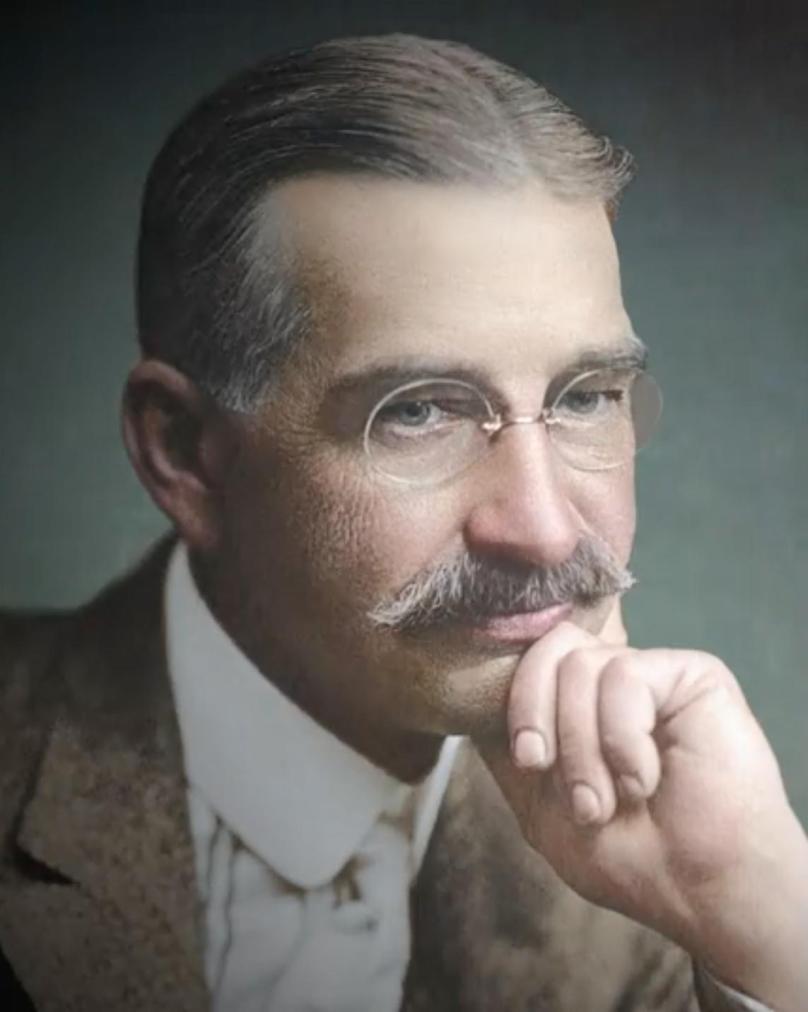
The history of the American West is full of restless and heroic figures. One such was a Hungarian count who, among other things, founded the California wine industry when he established Buena Vista Wineries in 1856. He was also sheriff and U.S. Marshal in San Diego and the first U.S. assayer of rare metals. His ending was a tragic one: He disappeared in Nicaragua, where he was active in starting a rum distillery business. Rumors were that he was dragged under by an alligator.
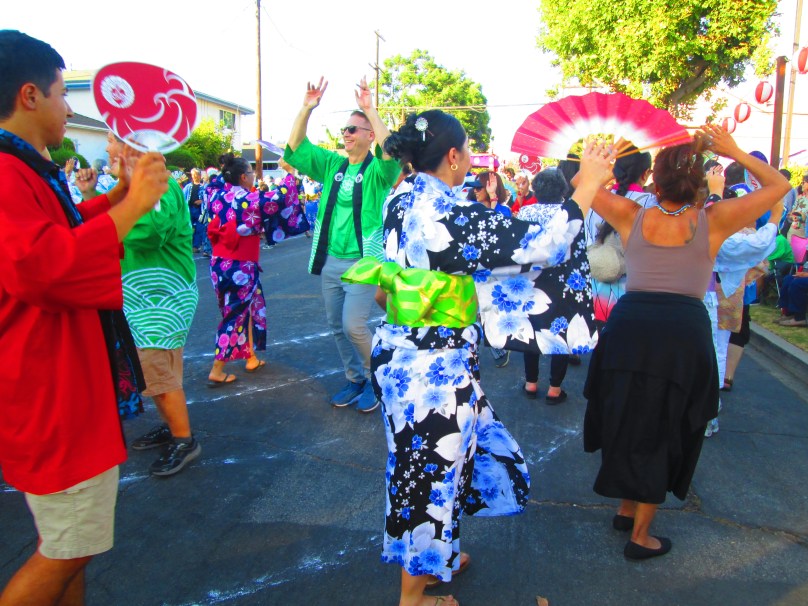
Today Martine and I attended the Majalis Fesztival at the Grace Hungarian Reformed Church in the San Fernando Valley. There I met up with an acquaintance who is active in the Karpatok Hungarian Dance Ensemble. He told me that they were developing a song and dance concert celebrating the life of Agoston Haraszthy.
This afternoon, they previewed one of the numbers in costume:
The Dancer in the Top Hat Plays Haraszthy
I had known a few things about Haraszthy going back to the early 1970s when I fancied myself a wine connoisseur. But, curiously, in time I became more interested in rum, like the Hungarian count. I guess I just have to stay away from Nicaragua and Alligators.
The Festival of Books One Hour Before Opening Time
It is six days now since I attended the Los Angeles Times Festival of Books, which was held at the University of Southern California (USC) campus. By opening time at 10 AM, there were tens of thousands of people in evidence, many of them walking their dogs or pulling wagons stuffed with their progeny. There were even several people who thought I was the late actor Wilford Brimley brought back to life.
Originally, I had intended to visit the Festival on both Saturday and Sunday. After Saturday’s crowd, however, I thought I would spend Sunday far from any mob scenes. It was so bad that I could not see the books I wanted to see from the booths sponsored by such vendors as Vroman’s Books, the Kinokuniya Bookstore, and Book Soup. Those booths actually had lines of people waiting to see what was on sale.
Ever the skeptic, I could not believe that most of these people ever read any book worth reading. Most of the books that people had in their hands were of no appreciable literary quality.
In the end, I wound up spending most of my time at Small World Books’s Poetry Pavilion. A good thing, too! It was there I met Persian poet and translator Sholeh Wolpé, whose rendering of Farid-Ud-Din Attar’s Conference of the Birds I eagerly devoured this last week and reviewed for Goodreads.Com.
One effect of listening to all those poets read their work (three per hour) has led me to include more poetry in my reading. I used to be all for prose, but now I begin to realize that poetry is a better way of expressing anything. Not that it’s easy to read poetry, but it is in the end likely to prove itself more rewarding.
I’ve come a long way since my teen years when I was afraid of tasting my Mom’s home-made lecsó, which was made with rice and Hungarian banana peppers, some of which were fiercely hot. Now, most of what I eat is seasoned with chiles. Today I finished up my Spanish Rice, made with fire-roasted hatch chiles and dry Chiles Japoneses. This morning, I had home=made quesadillas with Mexican jalapeños en escabeche.
Yesterday I dropped in for lunch at a popular Culver City restaurant called Tito’s Tacos in Culver City. I suddenly realized that I had come a long way from my early days. The two hard shell tacos tasted like unseasoned hamburger with a bit of shredded lettuce. Where were the chiles? Nowhere, to be exact. There weren’t even any bowls of pickled jalapeños to spice things up.
In the space of half a century I have morphed into a chile-head. Interestingly, my brother Dan is one as well. I remember going with him to a farmers’ market in Templeton, California and being offered a sample of olives stuffed with habañero chiles, which, as you may know, are probably the hottest chiles in common use, except for special purpose lethal items like the Carolina Reaper.The man offering the stuffed olives expected us to crumple with flames coming out our orifices. When Dan and I looked at each other and expressed approval, we asked for another sample—to the consternation of the seller.
Few of the people I know are able to match me on the Scoville Scale, where I am quite comfortable at tyhe 100,000 Scoville heat units level. For a look at the Scoville scale, check out Wikipedia.
This was absolutely the best time to visit Descanso Gardens in La Cañada-Flintridge: The tulips, lilacs, and camellias were all in bloom. Of the three, tulips are my favorites, followed by lilacs—mostly for their scent.
For this year, the tulip plantings were nowhere near as intensive as in previous years. One thing I noticed that was different was that the tulip garden area had cards indicating that certain plantings were in memory of some person known to the donor. My guess is that there weren’t as many donors, or volunteers, or employees as the Gardens management anticipated. Or whatever.
Still, what was there was indescribably beautiful. I spent an hour sitting on a bench in the shade just staring at the tulips or reading a book of Tibetan Buddhist teachings by Pema Chödrön. It was peaceful and sublime—even though there were visitors by the thousands to the Garden this afternoon.
Tulips are interesting to me not only because of their looks, but because there was a time almost 400 years ago when they impacted the economic history of Europe. I am talking about the tulip mania that gripped the Netherlands. According to Wikipedia, “At the peak of tulip mania, in February 1637, certain tulip bulbs sold for more than 10 times the annual income of a skilled artisan.” To this day, the term “tulip mania” is associated with an economic bubble that is not linked in any way to the actual intrinsic value of the item traded.
It also has an interesting footnote in literature. In 1850, Alexandre Dumas Père published a novel about the 17th century Dutch tulip fever entitled The Black Tulip. It is the fascinating story of a Dutchman who attempts to develop a black tulip during the period.
Spring in Southern California is not as distinctive a season as it is back east, where it is associated with an end to snow and slush. All this week, the temperature has been near 100° Fahrenheit (37° Celsius), even near the beach. Further inland, heat records were broken with dismaying regularity.
The one distinctive spring weather pattern is associated with the terms “Marine Layer” and ”June Gloom.” The wind comes from the ocean and blows clouds inland. Tourists visiting Southern California in the spring always say that they always heard the sun is always shining here. In fact it is, but between the sun and the ground there are clouds and the weather tends to be cool.
I say “tends” because over the past few years, the pattern has been changing. There have been tropical heat waves in the winter, rain falling earlier and later than usual, and even an occasional cold snap. I have no idea where the weather is tending, whether California will become even more desert-like, or whether the rainy season will result in a wetter climate.
It’s always quite beautiful when we’ve had a good rainy season. The California Poppy Preserve in the Antelope Valley becomes full of wildfires. Even the Mohave Desert can appear to be carpeted with tiny, but utterly lovely wildflowers.
But then, all these climactic weather megatrends will not be clear until long after I am gone. All I know is that the weather is very different from when I first moved here in 1966. Will the San Andreas or Cascadia fault result in massive earthquakes? Will the Central Valley be flooded? Or will water become increasingly scarce and make the big cities of California unlivable? (My bet is on the latter.)
Today at Marina Del Rey’s Chace Park I was able to escape the heat for a couple of hours. The weatherman said that there would be the beginnings of an onshore flow (sea breeze), and he was right. It was utterly delightful, except that the coolness attracted a lot of young men who were loudly attesting to their street cred, making it difficult for me to read.
That’s all right, I walked to a bench in the shade at Stone Point, where the cool breeze that has not been present all week during the current heat wave cooled my head. Funny thing, as I returned to my parked car, I felt the wind die down and the temperature rise every hundred feet (30 meters). By the time I sat in my car, I felt I was in a sauna.
When the weather is unrelievedly hot, the thing to do is make like a lizard. But, since we are at the edge of the sea, make like a sea lion. I watched the sea lions for a few minutes, trying to determine whether they were in fact harbor seals. As soon as I heard one of them make the characteristic barking sound, I knew that they were in fact sea lions. The other identification is to check whether they have visible ears, but I wasn’t close enough to be 100% certain.
In any case, these sea lions were doing the right thing on a hot day.
There are several ways that Mother Nature punishes Southern California for its (otherwise) mild climate:
Earthquakes, such as the giant temblors that hit the San Fernando Valley in 1971 and 1994
Wildfires
The Santa Ana Winds (sometimes called the Devil Winds)
The Santa Ana Winds and the wildfires are closely connected. In January 2025, the Pacific Palisades and Eaton fires were aided and abetted by dry wind gusts that reached up to 100 miles per hour (161 km per hour). I strongly suspect that earthquakes have a role to play in this devil’s brew of calamities, but I am at this point not sure exactly how.
According to Wikipedia, the Santa Ana Winds are what are called katabatic winds:
A katabatic wind (named from Ancient Greek κατάβασις (katabásis) ‘descent’) is a downslope wind caused by the flow of an elevated, high-density air mass into a lower-density air mass below. The spelling catabatic is also used. Since air density is strongly dependent on temperature, the high-density air mass is usually cooler, and the katabatic winds are relatively cool or cold.
In yesterday’s blog post, I stated that dry weather and gusty winds were predicted for today. The prediction was accurate. I sat around for much of the day sneezing and blowing my nose. Hopefully, the dry winds from the northeast will die down and I will be able to breathe normally.
This morning. I watched John Ford’s Stagecoach for the nth time. It is a film I love, partly because it was the director’s first great Western and the film that made John Wayne a star. (Of course, Ford had been making Westerns since 1917, when he filmed Straight Shooting with Harry Carey, Senior.)
I particularly love the scenes at the beginning, when the full stagecoach is making its way with a cavalry escort to Apache Wells. The scenes were shot in Arizona’s Monument Valley, which Ford made famous with his films. Every one of the characters on the stagecoach is interesting and has his or her say, from John Wayne to Thomas Mitchell, John Carradine, George Bancroft, Berton Churchill, Andy Devine, to Claire Trevor and the lovely Louise Platt.
When the stagecoach is attacked by Apaches as it nears Lordsburg, the Indians are real Indians—mostly Navajos.
In the years to come, Ford made many more great westerns, films like My Darling Clementine (1946), Fort Apache and Three Godfathers (1948), She Wore a Yellow Ribbon (1949), Wagon Master and Rio Grande (1950), The Searchers (1956), Sergeant Rutledge (1960), Two Rode Together (1961), and The Man Who Shot Liberty Valance (1962).
John Ford received more best director Oscars than any one else, yet none of them were for a Western. One of those Westerns, The Searchers, is considered by many (including myself) to be the greatest film ever made. (Will I be watching the Oscars on March 15? Nope!)
I will continue watching John Ford’s Westerns again and again, and they will continue to amaze me.
Many’s the time I drove past the Angelus Temple on Glendale Boulevard and wondered about its founder, the late Aimee Semple McPherson. She regularly packed the five thousand seats of the temple with her fiery preaching. Then, suddenly, in 1926, she was reported missing after swimming in the Pacific at Venice Beach. Feared drowned, she was reported quite alive in Douglas, Arizona a month later under highly suspicious circumstances.
You can read the story of her re-emergence in this article from Arizona Highways magazine.
Whatever the reason for her disappearing act, she is one of the reasons that Southern California got such a squirrely reputation in the 1920s. That and Nathanael West’s The Day of the Locust and Evelyn Waugh’s The Loved One. I always wanted to read a biography of Aimee, but never got around to it. Maybe next Thursday, when I go to the Central Library for one of my Mindful Meditation sessions. (Wait! Does that make me sound like a squirrely Southern Californian?)
McPherson’s Angelus Temple in Echo Park
The Angelus Temple built for McPherson’s International Church of the Foursquare Gospel is situated just north of Echo Park Lake, which was the shooting location for a number of Laurel & Hardy two-reelers, most notably “Men O’War” (1929).
Within a few hundred feet is my favorite French restaurant in Los Angeles: Taix, pronounced “Tex.” It was founded in 1927, during Aimee’s “second act,” and is due to close forever on March 29 of this year.
Two weeks ago, Martine and I visited Descanso Gardens in La Cañada-Flintridge. In full bloom were the camellias and the daffodils. The latter were in the Lilac Garden, which is still some weeks from coming into bloom.
This evening, I just finished reading an exceptional book which took the journals that Dorothy Wordsworth wrote when she lived with her poet brother William at Grasmere and interspersed them with William’s poems, The book, published by Penguin, is called Home at Grasmere: Extracts from the Journal of Dorothy Wordsworth and from the Poems of William Wordsworth. For instance, on April 15, 1802, Dorothy wrote:
When we were in the woods beyond Gowbarrow Park we saw a few daffodils close to the water-side. We fancied that the sea had floated the seeds ashore, and that the little colony had so sprung up. But as we went along there were more and yet more; and at last, under the boughs of the trees, we saw that there was a long belt of them along the shore, about the breadth of a country turnpike road. I never saw daffodils so beautiful. They grew among the mossy stones about and above them; some rested their heads upon these stones, as on a pillow, for weariness; and the rest tossed and reeled and danced, and seemed as if they verily laughed with the wind, that blew upon them over the lake; they looked so gay, ever glancing, ever changing. This wind blew directly over the lake to them. There was here and there a little knot, and a few stragglers higher up; but they were so few as not to disturb the simplicity, unity, and life of that one busy highway.
And here is the poem William wrote based on that walk he took with his sister:
The Daffodils
I wandered lonely as a cloud That floats on high o’er vales and hills, When all at once I saw a crowd, A host, of golden daffodils; Beside the lake, beneath the trees, Fluttering and dancing in the breeze.
Continuous as the stars that shine And twinkle on the milky way, They stretched in never-ending line Along the margin of a bay: Ten thousand saw I at a glance, Tossing their heads in sprightly dance.
The waves beside them danced; but they Out-did the sparkling waves in glee: A poet could not but be gay, In such a jocund company: I gazed—and gazed—but little thought What wealth the show to me had brought:
For oft, when on my couch I lie In vacant or in pensive mood, They flash upon that inward eye Which is the bliss of solitude; And then my heart with pleasure fills, And dances with the daffodils.
You must be logged in to post a comment.