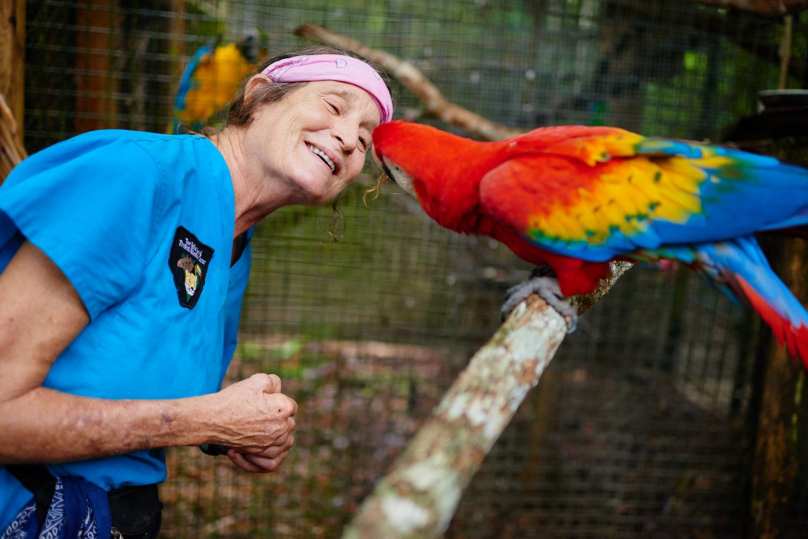
Sharon Matola (1954-2021) and Scarlet Macaw
I just finished reading a book about the difficulty of fighting an environmental battle in a developing country. The book was Bruce Barcott’s The Last Flight of the Scarlet Macaw: One Woman’s Fight to Save the World’s Most Beautiful Bird (New York: Random House, 2008). The story is set in Belize where a naturalist from Baltimore named Sharon Matola founded a zoo consisting solely of critters from within the borders of the country.
Sharon was particularly proud of her scarlet macaws. Now these are a kind of bird that is not endangered in South America; but the Central American variety, a legitimate subspecies, could be found in the valley of the Macal River, where they had their nests. When suddenly it was announced by the Belize government that a dam (to be called the Chalillo Dam) was to be built smack in the middle of the macaws’ nesting territory, Sharon went to war against the forces behind the dam.
These included not only a Canadian firm named Fortis but a number of Belize politicos who stood to gain from kickbacks and other underhanded tricks possible when dealing with large construction projects such as Chalillo. Barcott’s book not only gives us an excellent picture of what the tiny Central American country of Belize—formerly known as British Honduras—is all about, but gives us blow-by-blow accounts of Sharon’s war against the Powers That Be.
Well, in the end, the Powers That Be won, and the dam got built. The politicos were so irate about this gringo lady’s attempt to subvert “cheap electricity for the masses” that they scheduled a massive landfill to be created right next door to the Belize Zoo. Fortunately for the Zoo Lady, that project failed when it was demonstrated that a river important to longtime Belizean residents would become badly polluted.
In the end, she had other irons in the fire, such as reintroducing harpy eagles to Belize. Alas, however, Sharon died of a heart attack at the age of 66. Fortunately, her zoo continues on; and I have earmarked it for a visit if I can take a trip to Belize.



You must be logged in to post a comment.