Irresponsible

Romney: The Choice of Millionaires Everywhere

A nation survives based on its ability to levy taxes to provide services to its citizens. Among those services are a standing army and navy, a postal service, and embassies and consulates around the world. Within the last century, new services have been added, at least here in the United States: Social Security, Medicare, and (to a diminishing extent) public assistance.

When a man who is running for the presidency shows himself to be disingenuous about the taxes he himself has paid—and when what he reveals shows himself to be a minor contributor to his nation’s success—then perhaps that candidate is too irresponsible to hold the reins of government.

Let’s face it: Mitt Romney is playing this game for himself and for his class of the Super Rich. He is waving the flag of his experience as CEO of Bain Capital to show how experienced he is. But experienced at what? Hiding money in offshore accounts in the Cayman Islands? Outsourcing U.S. jobs to Southeast Asia? Whose president would he be?

Certainly not mine. I am not a member of Mitt and Ann’s Country Club set and would not stand to gain from what he proposes to do. Who would gain? Only those One-Percenters who have done so much to destroy America’s pre-eminent position in the world since the end of World War II.

It troubles me that so many millions of other voters who would not gain from a Romney presidency are still backing him. The only reason I can think of is that, for many Americans, the right to be free entails a form of economic and moral suicide, mixed with overtones of racism and anti-authoritarianism.

This man promises to bring America back to its greatness by pillaging the nation’s piggy bank, enriching himself and his cronies, and moving on. Isn’t this the very picture of an American CEO? And this qualifies a CEO to be president?

No, Mitt, if you don’t want to contribute to this country’s greatness by paying your just share of taxes, I don’t think you deserve to be anything but the Bain of American politics.

A Yellow Rose

Borges

Neither that afternoon nor the next did the illustrious Giambattista Marino die, he whom the unanimous mouths of Fame—to use an image dear to him—proclaimed as the new Homer and the new Dante. But the still, noiseless fact that took place then was in reality the last event of his life. Laden with years and with glory, he lay dying on a huge Spanish bed with carved bedposts. It is not hard to imagine a serene balcony a few steps away, facing the west, and, below, marble and laurels and a garden whose various levels are duplicated in a rectangle of water. A woman has placed in a goblet a yellow rose. The man murmurs the inevitable lines that now, to tell the truth, bore even him a little:

Purple of the garden, pomp of the meadow,
Gem of spring, April’s eye …

Then the revelation occurred: Marino saw the rose as Adam might have seen it in Paradise, and he thought that the rose was to be found in its own eternity and not in his words; and that we may mention or allude to a thing, but not express it; and that the tall, proud volumes casting a golden shadow in a corner were not—as his vanity had dreamed—a mirror of the world, but rather one thing more added to the world.

Marino achieved this illumination on the eve of his death, and Homer and Dante may have achieved it as well.—Jorge Luis Borges, El Hacedor

O Canada

Canoe

I no longer think that Canadians lack their own identity. They are not just Northern Yankees. Over the last four hundred years, they have developed an identity of their own based on their bilingual history, largely forged by the French and Indian War that preceded our own Revolution, and added to by the Scottish Highland Clearances, the arrival of the Loyalists (whom we call Tories) from the Thirteen Colonies, and waves of Eastern European immigration similar to our own.

“Canada” is a poem by Billy Collins, a native New Yorker who has a special feeling for the north.

Canada by Billy Collins

I am writing this on a strip of white birch bark
that I cut from a tree with a penknife.
There is no other way to express adequately
the immensity of the clouds that are passing over the farms
and wooded lakes of Ontario and the endless visibility
that hands you the horizon on a platter.

I am also writing this in a wooden canoe,
a point of balance in the middle of Lake Couchiching,
resting the birch bark against my knees.
I can feel the sun’s hands on my bare back,
but I am thinking of winter,
snow piled up in all the provinces
and the solemnity of the long grain-ships
that pass the cold months moored at Owen Sound.

O Canada, as the anthem goes,
scene of my boyhood summers,
you are the pack of Sweet Caporals on the table,
you are the dove-soft train whistle in the night,
you are the empty chair at the end of an empty dock.
You are the shelves of books in a lakeside cottage:
Gift from the Sea by Anne Morrow Lindbergh,
A Child’s Garden of Verses by Robert Louis Stevenson,
Anne of Avonlea by L. M. Montgomery,
So You’re Going to Paris! by Clara E. Laughlin,
and Peril Over the Airport, one
of the Vicky Barr Flight Stewardess series
by Helen Wills whom some will remember
as the author of the Cherry Ames Nurse stories.
What has become of the languorous girls
who would pass the long limp summer evenings reading
Cherry Ames, Student Nurse, Cherry Ames, Senior Nurse,
Cherry Ames, Chief Nurse, and Cherry Ames, Flight Nurse?
Where are they now, the ones who shared her adventures
as a veterans’ nurse, private duty nurse, visiting nurse,
cruise nurse, night supervisor, mountaineer nurse,
dude ranch nurse (there is little she has not done),
rest home nurse, department store nurse,
boarding school nurse, and country doctor’s nurse?

O Canada, I have not forgotten you,
and as I kneel in my canoe, beholding this vision
of a bookcase, I pray that I remain in your vast,
polar, North American memory.
You are the paddle, the snowshoe, the cabin in the pines.
You are Jean de Brébeuf with his martyr’s necklace of hatchet heads.
You are the moose in the clearing and the moosehead on the wall.
You are the rapids, the propeller, the kerosene lamp.
You are the dust that coats the roadside berries.
But not only that.
You are the two boys with pails walking along that road,
and one of them, the taller one minus the straw hat, is me.

Billy Collins, “Canada” from The Art of Drowning. Copyright © 1995 by Billy Collins. All rights are controlled by the University of Pittsburgh Press. Reprinted without the permission of the University of Pittsburgh Press,

Do Not Pity Me

You must not pity me because my sixtieth year finds me still astonished. To be astonished is one of the surest ways of not growing old too quickly.—Colette

Looking For Bullwinkle

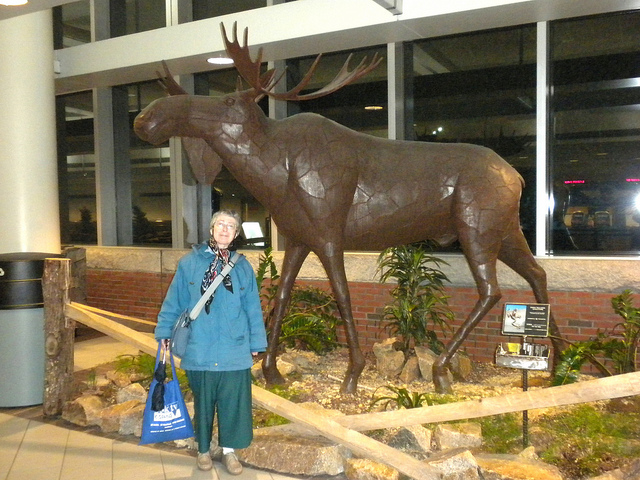
Martine at Manchester/Boston Airport with Moose Sculpture

Wildlife tourism tends to be a bit tricky, because most wildlife is not terribly interested in interacting with humans. We had no problem seeing the Magellanic penguins in Argentina last November, mainly because penguins by nature just look at us quizzically until we make a threatening move toward them. And then the beaks come into play. We easily saw over 100,000 of the cute avians at their Punta Tombo mating grounds in coastal Chubut province.

On the other hand, we have had no luck with puffins or moose. We went to Orkney in Scotland to see the puffins in 1997, but they weren’t there yet. Then I went by myself to their Vestmannaeyjar Islands breeding grounds in September 2001, but they were just leaving.

Moose are a different matter altogether. They do not migrate, which I suppose is a blessing as they are so very large (nine feet or so). One could see them if one gets up early enough or late enough. The problem is that we always look for them around noon, when they are safely ensconced in their forest fastness digesting their last meal. At the B&B we were staying at in Chéticamp, Nova Scotia, a whole moose family walked past the picture window of the dining room around 7 am the day before we arrived. But they did not stage a repeat performance the next two days, even though I was up early looking for them, having been pledged to wake Martine up if I saw any. Nothing doing!

In 2008, we had visited a wildlife park at Shubenacadie in Nova Scotia, where there was (allegedly) a moose in an enclosure. If he was there, he was hiding around the back of the pen, where we were not allowed to walk because (supposedly) they were working on the walkway. So once again, nothing doing.

We actually did see a moose two years ago at Glacier National Park in Montana, but it was from the rear and from about a quarter of a mile away. It had just drunk some water from Fishercap Lake and was headed back into the woods. I photographed the beast with my 7X zoom:

Distant View of Moose

Well, there’s always next year!

Poking Fun At Apple

MAD Magazine Parody of Famous New Yorker Cover

Over the years, I have tended to regard Apple Computer fanboys as members of some sort of odd cult. Since Steve Jobs’s demise, the world’s largest computer company has run into some (relatively) hard times. Most recently, its release of Apple Maps has caused just derision in the marketplace. But when MAD magazine parodied the famous Manhattan-centric Saul Steinberg New Yorker cover, I could barely keep from guffawing.

The closer you look at it, the more it resembles something some hapless grade schooler would devise—one who had no knowledge of U.S. or world geography.

I hope you enjoy it.


It Will Never Be Easy

Sir Winston Churchill

Never, never, never believe any war will be smooth and easy or that anyone who embarks on that strange voyage can measure the tides and hurricanes he will encounter. The statesman who yields to war fever must realize that once the signal is given, he is no longer the master of policy but the slave of unforeseeable and uncontrollable events… incompetent or arrogant commanders, untrustworthy allies, hostile neutrals, malignant fortune, ugly surprise, awful miscalculations.—Sir Winston Churchill

Where Lobster Is King

Maine lobster license plate

The most pleasant surprise of our recent vacation was my discovery of North Atlantic shellfish, particularly lobster, crab, clams, shrimp, and mussels—but particularly lobster. Whenever I had eaten lobster or shrimp caught is warm Pacific waters, I started feeling a scratchy throat that would last for several hours. In Maine and Maritime Canada, however, that was not the case. Martine and I sat down to seafood feasts at least once a day, and sometimes more.

Why I could not eat California lobster and why North Atlantic lobster from Maine and Nova Scotia was so succulent, I cannot guess.

The standard option was something called a lobster roll. This reached its most Lucullan proportions at the Main Street Market & Grill in Bar Harbor, Maine. Inside a sesame seed bun was a several inches thick congeries of lobster pieces, mostly from the claw. There was minimal mayo and other garnishes to detract from the experience.

Throughout the area, the clam chowder was a standout. We also tried lobster bisque (good) and lobster stew (which is a soup, and outstanding), mussels, crab rolls, and other shellfish menu items. What neither Martine nor I know how to do is to perform surgery on a lobster or crab carapace and hoist out all the tasty bits using a dazzling array of tools. No matter: It’s the meat we were after.

On the mad dash from Bar Harbor back to the airport at Manchester, New Hampshire, we detoured to Kennebunkport, Maine, and had our last fling at Mabel’s Lobster Claw, having to pass the famous Clam Shack because they had no indoor seating, and we were in the middle of a rainstorm. That detour cost us dear, as it seems that every stretch of road was under repair, and fat men in raincoats stood by like so many Paddington Bears in their yellow slickers while we fumed away in traffic.

When I saw how much Martine enjoyed lobster, I decided to make a slight change in our itinerary so that we could visit a lobster museum and hatchery in Bar Harbor called the Oceanarium. (I would provide a link, but their website appears to be having problems.) We spent two hours learning about how lobsters are hatched and trapped; and then we were off to the Main Street Market & Grill to have ourselves some.

Note: Regarding my last post, I finally got in touch with my physician, who prescribed some additional antibiotics and some Advair and Albuterol to keep the asthma down. It seems to be working, such that last night I managed to sleep for ten and a half hours—my first good sleep for two weeks.