Thinking Like a Rat

Richard Feynman

All experiments in psychology are not of this [cargo cult] type, however. For example there have been many experiments running rats through all kinds of mazes, and so on—with little clear result. But in 1937 a man named Young did a very interesting one. He had a long corridor with doors all along one side where the rats came in, and doors along the other side where the food was. He wanted to see if he could train rats to go to the third door down from wherever he started them off. No. The rats went immediately to the door where the food had been the time before.

The question was, how did the rats know, because the corridor was so beautifully built and so uniform, that this was the same door as before? Obviously there was something about the door that was different from the other doors. So he painted the doors very carefully, arranging the textures on the faces of the doors exactly the same. Still the rats could tell. Then he thought maybe they were smelling the food, so he used chemicals to change the smell after each run. Still the rats could tell. Then he realized the rats might be able to tell by seeing the lights and the arrangement in the laboratory like any commonsense person. So he covered the corridor, and still the rats could tell.

He finally found that they could tell by the way the floor sounded when they ran over it. And he could only fix that by putting his corridor in sand. So he covered one after another of all possible clues and finally was able to fool the rats so that they had to learn to go to the third door. If he relaxed any of his conditions, the rats could tell.

Now, from a scientific standpoint, that is an A-number-one experiment. That is the experiment that makes rat-running experiments sensible, because it uncovers the clues that the rat is really using — not what you think it’s using. And that is the experiment that tells exactly what conditions you have to use in order to be careful and control everything in an experiment with rat-running.

I looked into the subsequent history of this research. The next experiment, and the one after that, never referred to Mr. Young. They never used any of his criteria of putting the corridor on sand, or of being very careful. They just went right on running rats in the same old way, and paid no attention to the great discoveries of Mr. Young, and his papers are not referred to, because he didn’t discover anything about rats. In fact, he discovered all the things you have to do to discover something about rats. But not paying attention to experiments like that is a characteristic of cargo cult science.—Richard Feynman, 1974 Commencement Address


Spider Webs and Mucus

Feels icky when they’re in your lungs

Doesn’t sound terribly appetizing, does it? But that’s only half the problem: Since we’ve returned from vacation, my lung feels as if it were filled with spider webs interspersed with globs of mucus. The choking that drove me crazy during the trip has gone down. What remains are juicy coughs which, instead of bringing up the gunk in the chest, seems to redistribute it among the spider webs.

In addition to another, shorter, course of antibiotics, I have been on Advair and Albuterol to fight the asthma that accompanied the choking spasms of coughing. I just wonder how long it will take before the coughing stops. After all, it has been going on for a little over three weeks now.

It is amazing what life can throw at one when one isn’t prepared. And how is one ever prepared to fend off an infection or a virus? They just seem to come higgledy-piggledy and have their way with you.

I have seen several of my best friends afflicted similarly in this last year—all with different things. One had MRSA; another, incipient Alzheimer’s; and yet another, a broken hip and wrist from a fall. When one is young, one could just don jogging shorts and go through all the approved little exercise routines, patting oneself on the back for doing the right thing and preventing any illnesses. One eats one’s prepackaged salad greens with the desired sugary/fatty dressing, the right breakfast cereal. I guess it helps, but there are no guarantees in this life.

One has to be eternally vigilant, but one is still mortal.

Photo Credit: The photo above comes from the National Geographic for Kids website.

At Kuruvungna Springs

The Oasis at Kuruvungna Springs

Today was the “Life Before Columbus” Festival of the Gabrielino-Tongva Indian Tribe. (Appropriate, as tomorrow is Columbus Day, one of America’s more uncelebrated holidays—except by banks and the Civil Service).

About half a mile from our apartment is a site sacred to the Gabrielinos, who once occupied Southern California between Catalina Island and Cajon Pass, between Santa Barbara and Orange County. I am speaking of what is variously called Kuruvungna Springs, Tongva Sacred Springs, and Serra Springs. It is tucked into the Southeast corner of the University High School campus in West Los Angeles.

The Gabrielinos are not one of the better-known Indian tribes, but as Professor Paul Apodaca of Chapman University remarked at the festival, there are two hundred separate Indian tribes in the State of California, and something like a hundred Indian reservations. The tribes belong to some eight language families. My guess is that the Gabrielinos, like other smallish tribes, have not been able to gather the political support to have their own reservation or casino. And, in fact, many political entities do not recognize them. I can understand their budgetary collywobbles to some extent, but I recognize them, as does the City of Los Angeles. (The little Tongva cultural center at Kuruvungna Springs has a series of official scrolls attesting to their status by various governmental entities.)

That does not hide the fact that, when Richard Henry Dana in Two Years Before the Mast landed in L.A. in the mid-1830s, it was the Gabrielinos he encountered. They were named by their affiliation with Mission San Gabriel, which they helped to build. They were one of the few maritime bands in California, rowing in their plank canoes to Santa Catalina and the Channel Islands off Santa Barbara.

The little oasis around the springs (which form part of the water supply of the City of Santa Monica) is a serene and peaceful place in the great wen that is Los Angeles—which, by the way, is called Yangna in the Gabrielino tongue.

Bougainville on the Indians of the East

Louis Antoine de Bougainville

I see no difference in the dress, ornaments, dances, and songs of the various western nations. They go naked, excepting a strip of cloth passed through a belt, and paint themselves black, red, blue, and other colors. Their heads are shaved and adorned with bunches of feathers, and they wear rings of brass wire in their ears. They wear beaver-skin blankets, and carry lances, bows and arrows, and quivers made of the skins of beasts. For the rest they are straight, well made, and generally very tall. Their religion is brute paganism. I will say it once for all, one must be the slave of these savages, listen to them day and night, in council and in private, whenever the fancy takes them, or whenever a dream, a fit of the vapors, or their perpetual craving for brandy, gets possession of them; besides which they are always wanting something for their equipment, arms or toilet, and the general of the army must give written orders for the smallest trifle,—an eternal, wearisome detail, of which one has no idea in Europe.—Louis Antoine de Bougainville as quoted in Francis Parkman’s Montcalm and Wolfe


The Life of the Party

No, I was not the life of the party

Last night, Martine and I attended the wedding of my best friend’s second son, Eric. The ceremony and reception were held at the Heritage Museum of Orange County in Santa Ana, about 45 miles south of where we live.

Since Eric is more than a generation removed from us, it was interesting to see the differences between a social event for the young compared to old poops such as myself. To begin with, once the DJ cranked up the music, my communication skills were all but shut down. Although we were seated at a table full of people we knew and liked, I was unable to hear anything.

And insofar as dancing went, I have never had the skill the move in time with music—ever since I was banned from the folk dancing class at the First Hungarian Reformed Church in Cleveland back in 1950 for accidentally stomping on the feet of my dance partners. And, dear readers, I have not improved since then.

So, far from being the life of the party, I felt as if I were immured in a carbon prison like Han Solo in Star Wars III: Return of the Jedi. What made it worthwhile was being with old friends, not to mention honoring the wedding of someone I have liked since he was an infant. I find, after the wedding, that he is even more of an upstanding person than I had thought.

I wish him well as he treads the dangerous paths of this life.Fortunately, he has a killer sense of humor that I think will carry him and his young wife through in style.

Photo Credit: No, this was not taken at the wedding. It is an ad from a website called People Skills Decoded which offers to teach you how to be the life of the party. I suppose they could do that if they replaced my hearing and subtracted a few decades from my age.

Irresponsible

Romney: The Choice of Millionaires Everywhere

A nation survives based on its ability to levy taxes to provide services to its citizens. Among those services are a standing army and navy, a postal service, and embassies and consulates around the world. Within the last century, new services have been added, at least here in the United States: Social Security, Medicare, and (to a diminishing extent) public assistance.

When a man who is running for the presidency shows himself to be disingenuous about the taxes he himself has paid—and when what he reveals shows himself to be a minor contributor to his nation’s success—then perhaps that candidate is too irresponsible to hold the reins of government.

Let’s face it: Mitt Romney is playing this game for himself and for his class of the Super Rich. He is waving the flag of his experience as CEO of Bain Capital to show how experienced he is. But experienced at what? Hiding money in offshore accounts in the Cayman Islands? Outsourcing U.S. jobs to Southeast Asia? Whose president would he be?

Certainly not mine. I am not a member of Mitt and Ann’s Country Club set and would not stand to gain from what he proposes to do. Who would gain? Only those One-Percenters who have done so much to destroy America’s pre-eminent position in the world since the end of World War II.

It troubles me that so many millions of other voters who would not gain from a Romney presidency are still backing him. The only reason I can think of is that, for many Americans, the right to be free entails a form of economic and moral suicide, mixed with overtones of racism and anti-authoritarianism.

This man promises to bring America back to its greatness by pillaging the nation’s piggy bank, enriching himself and his cronies, and moving on. Isn’t this the very picture of an American CEO? And this qualifies a CEO to be president?

No, Mitt, if you don’t want to contribute to this country’s greatness by paying your just share of taxes, I don’t think you deserve to be anything but the Bain of American politics.

A Yellow Rose

Borges

Neither that afternoon nor the next did the illustrious Giambattista Marino die, he whom the unanimous mouths of Fame—to use an image dear to him—proclaimed as the new Homer and the new Dante. But the still, noiseless fact that took place then was in reality the last event of his life. Laden with years and with glory, he lay dying on a huge Spanish bed with carved bedposts. It is not hard to imagine a serene balcony a few steps away, facing the west, and, below, marble and laurels and a garden whose various levels are duplicated in a rectangle of water. A woman has placed in a goblet a yellow rose. The man murmurs the inevitable lines that now, to tell the truth, bore even him a little:

Purple of the garden, pomp of the meadow,
Gem of spring, April’s eye …

Then the revelation occurred: Marino saw the rose as Adam might have seen it in Paradise, and he thought that the rose was to be found in its own eternity and not in his words; and that we may mention or allude to a thing, but not express it; and that the tall, proud volumes casting a golden shadow in a corner were not—as his vanity had dreamed—a mirror of the world, but rather one thing more added to the world.

Marino achieved this illumination on the eve of his death, and Homer and Dante may have achieved it as well.—Jorge Luis Borges, El Hacedor

O Canada

Canoe

I no longer think that Canadians lack their own identity. They are not just Northern Yankees. Over the last four hundred years, they have developed an identity of their own based on their bilingual history, largely forged by the French and Indian War that preceded our own Revolution, and added to by the Scottish Highland Clearances, the arrival of the Loyalists (whom we call Tories) from the Thirteen Colonies, and waves of Eastern European immigration similar to our own.

“Canada” is a poem by Billy Collins, a native New Yorker who has a special feeling for the north.

Canada by Billy Collins

I am writing this on a strip of white birch bark
that I cut from a tree with a penknife.
There is no other way to express adequately
the immensity of the clouds that are passing over the farms
and wooded lakes of Ontario and the endless visibility
that hands you the horizon on a platter.

I am also writing this in a wooden canoe,
a point of balance in the middle of Lake Couchiching,
resting the birch bark against my knees.
I can feel the sun’s hands on my bare back,
but I am thinking of winter,
snow piled up in all the provinces
and the solemnity of the long grain-ships
that pass the cold months moored at Owen Sound.

O Canada, as the anthem goes,
scene of my boyhood summers,
you are the pack of Sweet Caporals on the table,
you are the dove-soft train whistle in the night,
you are the empty chair at the end of an empty dock.
You are the shelves of books in a lakeside cottage:
Gift from the Sea by Anne Morrow Lindbergh,
A Child’s Garden of Verses by Robert Louis Stevenson,
Anne of Avonlea by L. M. Montgomery,
So You’re Going to Paris! by Clara E. Laughlin,
and Peril Over the Airport, one
of the Vicky Barr Flight Stewardess series
by Helen Wills whom some will remember
as the author of the Cherry Ames Nurse stories.
What has become of the languorous girls
who would pass the long limp summer evenings reading
Cherry Ames, Student Nurse, Cherry Ames, Senior Nurse,
Cherry Ames, Chief Nurse, and Cherry Ames, Flight Nurse?
Where are they now, the ones who shared her adventures
as a veterans’ nurse, private duty nurse, visiting nurse,
cruise nurse, night supervisor, mountaineer nurse,
dude ranch nurse (there is little she has not done),
rest home nurse, department store nurse,
boarding school nurse, and country doctor’s nurse?

O Canada, I have not forgotten you,
and as I kneel in my canoe, beholding this vision
of a bookcase, I pray that I remain in your vast,
polar, North American memory.
You are the paddle, the snowshoe, the cabin in the pines.
You are Jean de Brébeuf with his martyr’s necklace of hatchet heads.
You are the moose in the clearing and the moosehead on the wall.
You are the rapids, the propeller, the kerosene lamp.
You are the dust that coats the roadside berries.
But not only that.
You are the two boys with pails walking along that road,
and one of them, the taller one minus the straw hat, is me.

Billy Collins, “Canada” from The Art of Drowning. Copyright © 1995 by Billy Collins. All rights are controlled by the University of Pittsburgh Press. Reprinted without the permission of the University of Pittsburgh Press,

Do Not Pity Me

You must not pity me because my sixtieth year finds me still astonished. To be astonished is one of the surest ways of not growing old too quickly.—Colette

Looking For Bullwinkle

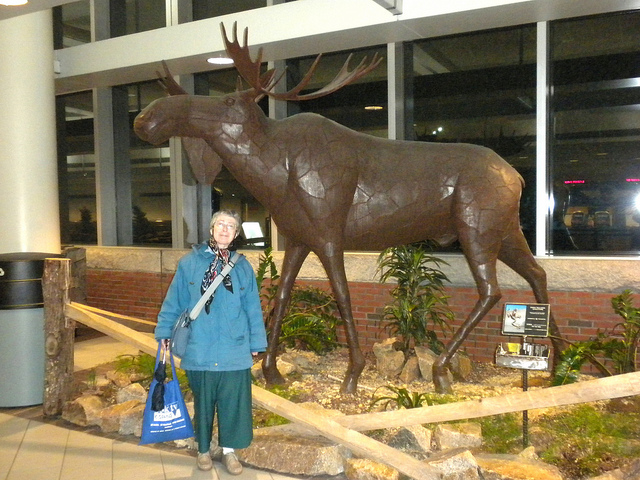
Martine at Manchester/Boston Airport with Moose Sculpture

Wildlife tourism tends to be a bit tricky, because most wildlife is not terribly interested in interacting with humans. We had no problem seeing the Magellanic penguins in Argentina last November, mainly because penguins by nature just look at us quizzically until we make a threatening move toward them. And then the beaks come into play. We easily saw over 100,000 of the cute avians at their Punta Tombo mating grounds in coastal Chubut province.

On the other hand, we have had no luck with puffins or moose. We went to Orkney in Scotland to see the puffins in 1997, but they weren’t there yet. Then I went by myself to their Vestmannaeyjar Islands breeding grounds in September 2001, but they were just leaving.

Moose are a different matter altogether. They do not migrate, which I suppose is a blessing as they are so very large (nine feet or so). One could see them if one gets up early enough or late enough. The problem is that we always look for them around noon, when they are safely ensconced in their forest fastness digesting their last meal. At the B&B we were staying at in Chéticamp, Nova Scotia, a whole moose family walked past the picture window of the dining room around 7 am the day before we arrived. But they did not stage a repeat performance the next two days, even though I was up early looking for them, having been pledged to wake Martine up if I saw any. Nothing doing!

In 2008, we had visited a wildlife park at Shubenacadie in Nova Scotia, where there was (allegedly) a moose in an enclosure. If he was there, he was hiding around the back of the pen, where we were not allowed to walk because (supposedly) they were working on the walkway. So once again, nothing doing.

We actually did see a moose two years ago at Glacier National Park in Montana, but it was from the rear and from about a quarter of a mile away. It had just drunk some water from Fishercap Lake and was headed back into the woods. I photographed the beast with my 7X zoom:

Distant View of Moose

Well, there’s always next year!