Back from the Dead

The Luftwaffe Drew This Card Too Often

The Luftwaffe Drew This Card Too Often

I have always enjoyed visiting aircraft museums. The one in Palm Springs is nothing short of spectacular. The Western Museum of Flight in Torrance is smaller, but fun to visit. Until 2002, there was a great Museum of Flying on the north end of Santa Monica Airport. Then it closed down. We heard that they were looking for a place to move somewhere in the desert. It appears they never found one.

Then, all of a sudden, we heard that it was re-opening on the south side of Santa Monica Airport. Finally, Martine and I paid it a visit yesterday afternoon. The new Museum of Flying is about one-fourth the size of the old one and focuses heavily on the airport’s history with Douglas Aviation, back when it was named Clover Field. Still it was sufficiently interesting to engage our attention for a few hours.

Russian Yakovlev Yak-3 Fighter from World War Two

Russian Yakovlev Yak-3 Fighter from World War Two

Among other displays, they had a Russian Yakovlev Yak-3 fighter parked outside (above). The much beloved plane was preferred by Russian pilots over the planes supplied by the United States during the days of Lend-Lease, such as the P-51 Mustang and the Supermarine Spitfire.

It was good to see the Museum of Flying back from the dead. I hope they can accumulate enough money and volunteers to grow back to what they used to be before a greedy landlord snuffed them out of existence to get a higher rent.

 

The Wrong Type of Book-Lover

old books1

Some People Just Like to Read Books, Not Snool Over Them

Yesterday, I visited the antiquarian book fair held at the Santa Monica Civic Auditorium. I had visited book fairs in the past, and actually found some good buys—most notably a four-volume edition of the works of Sir Thomas Browne—but I found that most of the books exhibited were not my cup of tea. Well, this time it was even worse.

It seemed that the median price of the books on sale was around $650, and virtually all the books were:

  • Signed first editions of famous 20th century authors
  • Lavishly illustrated oversize books filled with old engravings
  • Leather-bound books like the ones in the photograph above
  • Seemingly endless books about the Old West

I got the impression that the book fair was primarily for those whose notion of a book does not go beyond the dust jacket, the binding, the front endpapers, and the page showing the edition and printing. That impression was confirmed when I heard some of these people talking to the dealers in the kind of pseudo-cultivated tone adopted by the very wealthy who wish to impress others with knowledge they don’t have. For one thing, they don’t actually read books!

The upshot was that I didn’t buy anything there, though I spent $10 for parking and $5 for admission. Right afterwards, I drove to a real bookstore, Sam Johnson Books in Mar Vista, where I had difficulty choosing what to buy. I finally settled on an interesting-looking book by Adam Sisman entitled The Friendship: Wordsworth and Coleridge. I had previously read Sisman’s book on James Boswell and loved it.

Anutha Dubya

DubyaShower

George W. Bush Paints Himself Taking a Shower

As some of you may remember, I did not think very much of George W. Bush’s presidency. Since he yielded the office to a (somewhat) better man, he has faded from the limelight. For one thing, he has taken to painting. As Hrag Vartanian wrote at Salon.Com:

Maybe it shouldn’t surprise us that the man who brought us a vision of compassionate conservatism would turn to art to express the angst of a crappy presidency that got us into two wars; used homophobia, racism, and sexism as an electoral tool; crashed our economy; and made the world hate America. This is a man who is obviously feeling his mortality. He sits in the bathtub alone. Nothing to contemplate. Nothing to see beyond reflections of himself and his body. There is almost a melancholy in these images, with their grays, and he is not presented as a strong, heroic person — in fact, quite the opposite. This is not the George W. Bush of Fox News or Sunday morning talk shows. This is Bush the old man, with lots of time on his hands. Once the most powerful man in the world, Bush is now alone, exploring his immediate surroundings in these spurts of introspection. If only he had done this all along, maybe he would’ve been a better leader.

Above is one of his paintings, showing the artist taking a shower. Below, he is sitting in the bathtub:

Dubya in the Tub

Dubya in the Tub

Curiously, these paintings were part of a hacker’s raid into the Internet connections of the Bush clan. There was never an attempt by Bush to promote himself as an artist—although he has nothing to apologize for. In fact, his work seems not all that bad. This is one of those rare cases where an attempt to make the hacking victim look bad has backfired.


Job, God, and the Devil

Something About This Old Testament Book ...

Something About This Old Testament Book …

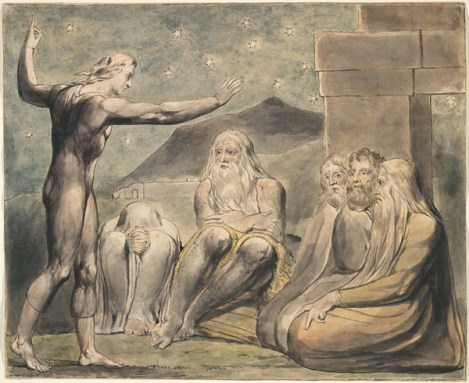
When I first read the Book of Job from the Old Testament, I didn’t think much of it. I still don’t. There was God getting together with Satan to play poker or dominoes or whatever, and making a bet that affected the happiness of one of his most devoted followers. Then, too, there were those “friends” of Job who were zero consolation to the poor man.

I don’t like the idea of a God who is, instead of being the God of Love, some sort of Parimutuel Deity. He “makes it up to” Job in the end, but not before killing off his wife and children and sending him into what for anyone else would have been the pit of despair. We can speculate that the original Mrs. Job was a hag and a shrew; and the first set of children, all strung out on meth; and the replacement wife, a blonde hottie. But we have no grounds for thinking that.

When I was a student at Dartmouth College some time before the Pleistocene Era, I saw a play by Archibald Macleish that brought together the Book of Job with Death of a Salesman. It was called J.B. I would love to have seen the stage version directed by Elia Kazan and starring Raymond Massey, Christopher Plummer, and Pat Hingle (as the Job character). In 1959 it won the Pulitzer Prize for drama.

I know that Job was held up to be the model worshiper, a man who trusted in God through the most incredible adversities. But the God he worshiped was way too snarky for me.

Incidentally, the above illustration is from William Blake’s illustrations of the Book of Job.


Imagine a Puddle

Some More from Douglas Adams

Some More from Douglas Adams

Imagine a puddle waking up one morning and thinking, “This is an interesting world I find myself in — an interesting hole I find myself in — fits me rather neatly, doesn’t it? In fact it fits me staggeringly well, must have been made to have me in it!” This is such a powerful idea that as the sun rises in the sky and the air heats up and as, gradually, the puddle gets smaller and smaller, it’s still frantically hanging on to the notion that everything’s going to be alright, because this world was meant to have him in it, was built to have him in it; so the moment he disappears catches him rather by surprise. I think this may be something we need to be on the watch out for. We all know that at some point in the future the Universe will come to an end and at some other point, considerably in advance from that but still not immediately pressing, the sun will explode. We feel there’s plenty of time to worry about that, but on the other hand that’s a very dangerous thing to say.—Douglas Adams, Speech

Accepting New Technologies

What Determines Which Technologies We Accept?

What Determines Which Technologies We Accept?

Douglas Adams, whose Hitchhiker’s Guide to the Galaxy was one of the most risible landmarks in my young life, came up with three predictors as to what technologies people will accept. My version comes from the Futility Closet website:

  • Anything that is in the world when you’re born is normal and ordinary and is just a natural part of the way the world works.
  • Anything that’s invented between when you’re 15 and 35 is new and exciting and revolutionary and you can probably get a career in it.
  • Anything invented after you’re 35 is against the natural order of things.

Reading the above sends a chill racing up and down my spine. I accepted computers around the age of 20 and, in fact, found myself a career in computing.

But do I accept tweeting and touch-screen smartphones? No. Will I ever accept them? Possibly. I’ve accepted Facebook, but only with great suspicion and periodic reviews of security parameters. And I use Facebook primarily for announcing new blogs and flagging the books I am currently reading via Goodreads.Com.


A Belated New Year’s Resolution

On Retiring from Politics

On Retiring from Politics

I have finally decided to stop writing about politics. I find I get too involved reacting to idiocies, mostly from the Right—but I do not exempt so-called Progressives either. I think I’ve already said just about everything bad I can think of about the people, parties, and media that, over the last thirty years, I have come to detest. So, to hell with them all! Bad cess on them and their vile progeny!

The world is a wondrous place: I don’t want to spoil my enjoyment of that wonder by venting my bile at the slightest provocation.

Oh, I will still actively participate in politics by voting, signing petitions, and so on—but what passes for political discourse in this country will henceforth be closed to me.

And this on a day when there were so many stupid things said or proposed, any one of which could have set me off. I don’t care any more if an Idaho legislator wants to make Ayn Rand’s Atlas Shrugged mandatory reading in order to graduate from high school in his state. It no longer matters that an Alabama legislator wants to ban abortion because his interpretation of the Bible is that the souls of aborted fetuses will wind up in hell. I no longer care what Wayne La Pierre and his pasty crew of gun collectors say about anything—it’s bound to be crap in any case.

Let these simpletons stew in their own juices. I just refuse to take them seriously any more. Life is for living, not for crass stupidity.

Nasty and Pungent

To What Extent American? To What Extent Hungarian?

To What Extent American? To What Extent Hungarian?

A few days ago, I went into one of my Hungarian moods, most likely from feeling extremely dissociated from the Scotch-Irish Confederates that seem to be making so much of the political news. My old friend Lynette commented that she felt I was mostly an American who just happened to think of himself as a Hungarian.

To be sure, if I stepped off the plane at Budapest’s Ferihegy Airport, I’m sure I would think of myself as mostly American, especially if I got a whiff of Hungary’s own Right Wing, the (un)worthy descendants of World War Two’s Arrow Cross, which bid fair to out-Gestapo the Gestapo.

I find it helps to think of myself as a Hungarian whenever I take a sustained look at America’s ugly politics. Think of it as a distancing maneuver. Here is the America of Donald Trump, Wayne La Pierre, Ann Coulter, Rush Limbaugh, John Boehner, and the Tea Party—and there I am, off to the sidelines, with an expression on my face of having stepped into something particularly nasty and pungent. Me? I’m a Hungarian, folks: I had nothing to do with this stramash except, perhaps, to admit to having nothing to do with it.

Some people might say that instead of standing off to the side, I should be more directly active politically. Here’s where I must sadly shake my head and say, “Sorry, folks! I’m not really a people person.” I’m fully as capable of damning Progressives as I am of damning Tea Partiers, except that I hate the latter even more.

Some day, the last raggedy elements of the Confederate States of America will sink into the mire. I will probably no longer be around to celebrate. Besides, knowing American history as I do, I am sure it will be replaced by other tendencies equally repellent.


Old Bones

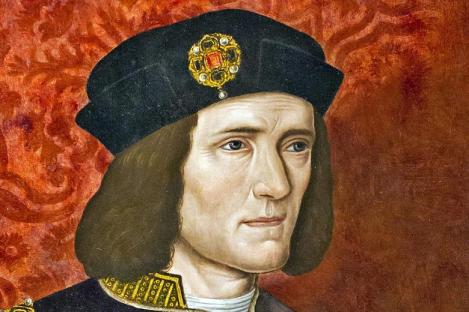
Richard III (1452-1485)

Richard III (1452-1485)

I was on a Laker Airlines flight from London Gatwick to Los Angeles in October 1976 when I read Josephine Tey’s novelized biography of Richard III entitled The Daughter of Time. In it, Tey’s Inspector Allan Grant, while recovering in a hospital, decides to investigate the life of Richard III. Based on the picture above, he could not believe that Richard could be such as arrant villain as Shakespeare portrayed him in his play.

There is little doubt that Richard seized the crown that properly belonged to his young nephews, the so-called Princes in the Tower, whom he may or may not have ordered to be killed. As king, he was not so very bad; but there is always that suspicion of evildoing at its outset.

Richard is one of the few kings of England who have a fan club dedicated to restoring his reputation.

Well, it appears that they have found and identified the remains of Richard, which were discovered in a shallow grave in a parking lot where Greyfriars Abbey once sat before Henry VIII had it razed. DNA was taken and compared with that of a lineal descendent in Canada and found to be a match. And, what is more, Richard’s body was slightly misshapen, not quite an out-and-out hunchback, but near to it.

Now, was he a good king or a bad king? Or was he merely indifferent? The question rages on.


The Grittiness of Outer Space

Endeavour in its Hangar at the California Science Center

Endeavour in its Hangar at the California Science Center

Today, Martine and I did something a little different. I was curious to see the NASA Space Shuttle Endeavour, which was on display in a large hangar at the California Science Center in downtown Los Angeles. To get there, we took the relatively new Metro Expo Line from its current end of the line in Culver City to the Expo Park/USC Station.

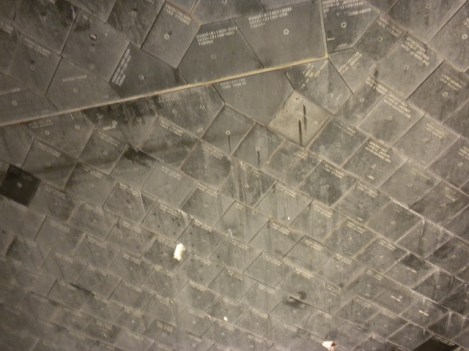
The Endeavour was amazing. There was nothing Disneyfied or cleaned up about its appearance. The shuttle had spent some 296 days in space between its maiden voyage in 1992 and its arrival in Los Angeles in September 2012. It had circumnavigated the earth 4,671 times for a total of 123 million miles. Instead of looking nice and neat and clean, there was something gritty about its looks, especially around the nose cone: The heat of re-entry placed the most stress on the protective tiles tiles (see below) that covered its surface.

Some of the Heat Protecting Tiles on the Underside of Endeavour

Some of the Heat Protecting Tiles on the Underside of Endeavour

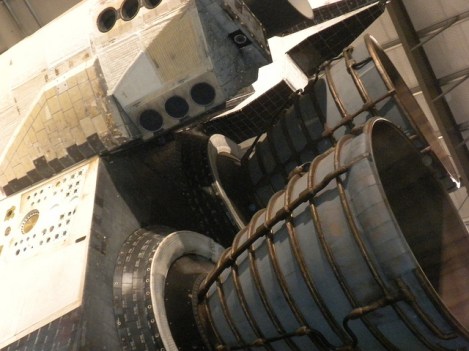
Most amazing was the area around the rear engines (see below). Never again will I think of outer space as something squeaky clean: It’s either too hot or too cold, and the stress of re-entry is enough to wreak havoc on just about any made-made materials.

One of the Rear Engines of Endeavour

One of the Rear Engines of Endeavour

It was an awe-inspiring experience to see Endeavour and to appreciate the work of thousands of talented men and women who, for a period of some twenty years, guided its destiny.

Martine thought that the Endeavour should have been cleaned up a bit more before it was presented to the general public. I, on the other hand, liked it just the way it was.