
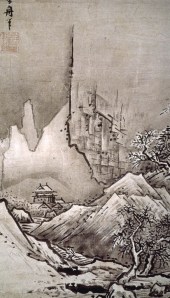
“Winter Landscape” by Sesshu Toyo
Imagine a wayfarer. He has been brought to a standstill at the foot of a mountain, tremendous, impassable. It is this mountain ….. no, it is not his destiny to cross it, but he has set his heart upon the crossing; for his wishes, his longings, his desires, his very soul, which has an easier mode of conveyance, are already on the other side; it only remains for him to follow. Imagine him coming to be seventy years old; but the mountain still stands there, unchanged, impassable. Let him become twice seventy years; but the mountain stands there unalterably blocking his way, unchanged, impassable. Under all this he undergoes changes, perhaps; he dies away from his longings, his wishes, his desires; he now scarcely recognizes himself. And so a new generation finds him, altered, sitting at the foot of the mountain, which still stands there, unchanged, impassable. Suppose it to have happened a thousand years ago: the altered wayfarer is long since dead, and only a legend keeps his memory alive; it is the only thing that remains—aye, and also the mountain, unchanged, impassable. And now think of Him who is eternally unchangeable, for whom a thousand years are but as one day—ah, even that is too much to say, for they are for Him as an instant, as if they did not even exist….
Anyone not eternally sure of Himself could not keep so still, but would rise in His strength, Only one who is immutable can be in this manner so still.
He gives men time, and He can afford to give them time, since He has eternity and is eternally unchanging.—Søren Kierkegaard, Judge for Yourselves!

 Tarnmoor
You must be logged in to post a comment.