
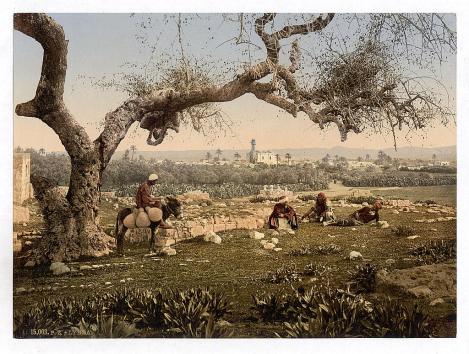
The (Former) Palestinian City of Lydda (ca. 1900)
It looks idyllic, doesn’t it? And it was, until 1948. At that point, the newly formed Israel Defense Forces expelled the inhabitants of this peaceful city in which Jews and Palestinians had lived side by side for generations. In an article for the New Yorker published in the October 21, 2013 issue entitled “Lydda, 1948,” Ari Shavit writes:
But, looking straight ahead at Lydda, I wonder if peace is possible. Our side is clear: we had to come into the Lydda Valley and we had to take the Lydda Valley. There is no other home for us, and there was no other way. But the Arabs’ side, the Palestinian side, is equally clear: they cannot forget Lydda and they cannot forgive us for Lydda. You can argue that it is not the occupation of 1967 that is at the core of the Israel-Palestinian conflict, but the tragedy of 1948. It’s not only the settlements that are an obstacle to peace but the Palestinians’ yearning to return, one way or another, to Lydda and to dozens of other small towns and villages that vanished during one cataclysmic year. But the Jewish State cannot let them return. Israel has a right to live, and if Israel is to live it cannot resolve the Lydda issue. What is needed to make peace now between the two peoples of this land may prove more than humans can summon.
I sit here in West Los Angeles, within hailing distance of the Gabrielino Indians’ shrine at Kuruvungna Springs on the grounds of the present-day University High School. In June and July of this year, I vacationed in Iceland, where a resurgent Viking population drove out the Irish monks that had originally settled the island. (Now there is no trace of their ever having done so.) If all goes well, my next vacation will be in Peru, where the Spanish looted and destroyed the Inca Empire. Their criollo descendants still control the economy and the political power, leaving the Andean serranos and jungle tribes near the headwaters of the Amazon as second-class citizens.
Unfortunately, with its burgeoning West Bank settlements, Israel is continuing the process it began in 1948 of squeezing out, to the maximum extent possible, the indigenous Palestinian population. I cannot condone Israel’s settlement policy, especially with its Likud Party racist underpinnings; but I cannot afford to be too absolute because I realize there is a faint trace of blood on my own hands and on those of my forebears.
 Tarnmoor
Until 1948, Lydda was an Arab town with a population of around 20,000—18,500 Muslims and 1,500 Christians. – http://en.wikipedia.org/wiki/Lod
Which Jews and Arabs lived there side by side?
The New Yorker article named a number of Jewish institutions, such as Atid, Kiryat Sefer, the Herzl Wald Olive Groves, and Ben Shemen. The Wikipedia article on Lod applies as much to neighboring Ramla (now called Lod) as it does to the former Lydda.