Cellphone Hell Is … Other People

Another Technical Innovation That Has Overstayed Its Welcome

Another Technical Innovation That Has Overstayed Its Welcome

We’ve all seen it. That shit-eating grin and the walkie-talkie walk that says, “I have somebody with whom to carry on a meaningless conversation—and you don’t!” And now the FAA and FCC have okayed the use of mobile phones on planes. Is this a good thing? For every call that actually has to be made, there will be half a thousand stating “We’re in the air over Kansas right now” and “We’ve just landed at ORD and are taxiing to our gate.”

Then there will be the fake business calls just to make the caller look important. I can just imagine the guy at the other end, “What are you saying, Jason? You don’t own any stock, and last I heard you were in bankruptcy proceedings.” Of course, we never hear the tired, slighty pissed off voice at the other end of the line, just the mock triumphalism of the caller.

There are several ways of fighting these self-important a-holes who force you to listed to their bloviating:

  1. Sneeze all over them without covering your mouth.
  2. Spill part of your drink on them and offer to pay their dry-cleaning bill, giving them a false name, address, and telephone number.
  3. Read out loud from your book, making occasional significant gestures in their direction, as if it were all for their benefit.

In the end, I suspect this will not become a major problem, if only because most people are virulently against it. In today’s news, two airlines have come out against allowing cell calls on flights: Delta and JetBlue. If any other airlines join them, I may well vote with my feet, choosing only airlines that place restrictions on the nefarious habit.

It would be nice we could do something about that other noise-making nuisance on long flights: crying babies and whining small children. But on humanitarian grounds, I think I’ll just shut up for now.

“All That Moveth, Doth in Change Delight”

William S. Hart (1864-1946)

William S. Hart (1864-1946)

Today Martine and I went to the William S. Hart Ranch and Museum in Newhall. Around this time of year, the docents and other volunteers make the place all Christmassy. With the Grier Musser Museum yesterday, a visit to the Hart Museum today made it a real holiday weekend.

As I was watching a video of Hart’s Hell Hinges (1916) in the Ranch House, a somber thought came to me. Hart’s career lasted only about twelve years, from 1915 to 1927. How many people alive today remember him, have seen his films, or even know who he is? Hollywood does not even make Westerns more than once in a Blue Moon. The lovely house on a hill in Newhall, which Hart called La Loma de los Vientos (“The Hill of the Winds”), may fall into ruin because it commemorates the life of a silent movie star who is all but forgotten.

At the same time, I am reading Marcel Proust’s final volume of In Search of Lost Time series, Finding Time Again. In this book, Marcel finds his world has all but disappeared with the start of the First World War. At one point Marcel the narrator muses:

In short, fashionable society had become disenchanted with M. de Charlus, not because it had seen through, but because it had never begun to penetrate his uncommon intellectual worth. People thought him ‘pre-war,’ old-fashioned, because the very people who are least capable of assessing merit are the ones who, in order to classify people, are quickest to follow the dictates of fashion. They have not exhausted, nor even skimmed the surface of the men of merit in one generation, and suddenly they have to condemn them all en bloc, because now there is a new generation, with its new label, which they will not understand any better than the last.

As I watch Marcel working his way through a Paris, lit by floodlights, zeppelins, bi-plane fighters, and a young generation in charge that has seemingly sprouted out of nowhere. In the same way, I marvel at all the young people crossing the busy street while checking their e-mail or texting to their buds.

I should know better. Edmund Spenser said it all half a millennium ago when he wrote about mutability:

Mutability

When I bethink me on that speech whilere,
Of Mutability, and well it weigh:
Me seems,that though she all unworthy were
Of the Heav’ns Rule; yet very sooth to say,
In all things else she bears the greatest sway.
Which makes me loathe this state of life so tickle,
And love of things so vain to cast away;
Whose flow’ring pride, so fading and so fickle,
Short Time shall soon cut down with his consuming sickle.

Then gin I think on that which Nature said.
Of that same time when no more Change shall be,
But steadfast rest of all things firmly stayed
Upon the pillars of Eternity,
That is contrare to Mutability:
For, all that moveth, doth in Change delight:
But thence-forth all shall rest eternally
With Him that is the God of Sabbaoth hight:
O that great Sabbaoth God, grant me that Sabbaoth’s sight.

As the year 2013 winds to a close, think for a moment of all the changes that sweeping your world away. I wouldn’t worry excessively about it, because the same winds of change will likewise sweep the fashions of the newest generation away. All the Ugg Boots, Jeggings, Razor Scooters, Smart Phones, and Google Glasses will go the way of suspenders, cowcatchers on locomotives, transistor radios, and pogo sticks. Right now, all these things are in the ascendent—but they won’t be for long.

An Angelic Christmas

Angels at L.A.’s Grier Musser Museum

Angels at L.A.’s Grier Musser Museum

There are actually three angels in this picture: Reflected in the mirror between the two angel statuettes is Martine. This afternoon, we visited the Grier Musser Museum near downtown L.A. to see their annual display of Christmas-related decorations and figures. We enjoy seeing what Rey and Susan Tejada have collected and arranged for display at their antiquarian Queen Anne style house and museum on Bonnie Brae Street.

But first, we ate at Langer’s Deli which is nearby at the corner of 7th and Alvarado, just cater-corner from MacArthur Park. It is incongruous to find a classic Jewish deli in the middle of the Pico-Union Central American neighborhood. Just when it seemed that it might be fading away like so many Los Angeles landmarks, the opening of the MTA Red Line brought customers from other parts of town, though they are no longer open in the evenings. Martine has not been feeling good all week due to a flare-up of her irritable bowel syndrome; and this was the first day she could eat anything other than bananas, rice, apple sauce, and toast. (She calls it the B.R.A.T. diet.)

After we toured the museum along with six other guests, we sat down to punch and cookies in the kitchen and chatted for a couple of hours. Over the years, Rey and Susan have become good friends of ours. We enjoy the museum, which always holds surprises for us, and we enjoy their company.

Afterwards, we drove back the slow way, right down Wilshire Boulevard so that Martine could see the holiday decorations in Beverly Hills before we did the turn-off toward West Los Angeles via Santa Monica Boulevard.

It was a good day and made me think that this would be a good Christmas for us. As I hope it will likewise be for all my readers.


Surrender Monkeys? Freedom Fries?

Admiral François Joseph Paul de Grasse

Admiral François Joseph Paul de Grasse

At some point in the recent past, Americans have decided that the French were “surrender monkeys” for their lack of interest in acceding to George W. Bush’s invasion of Iraq. Around the same time, French Fries were officially renamed Freedom Fries in the U.S. Congressional Cafeteria.

To me, this is very much a “But what have you done for me recently?” type of judgment. We seem to have forgotten that if it weren’t for French help during the American Revolution, we would be calling them Chips instead and revering the memory of King George III. Not only did we have the help of Lafayette and the Comte de Rochambeau, but a substantial French fleet headed up by Admiral de Grasse (shown above) precipitated Cornwallis’s surrender at Yorktown.

When the French had their own revolution a few years later, they paid us the supreme compliment of imitating our Constitution.

In the years since those heady times, we have decided that the French don’t like us. In defense, we’ve decided not to like them. Most of our present attitude is a misconception based on the notion that the French pretend not to understand good plain American English and persist in their twonky little European language. (Far be from us to learn another language, especially since we are the world’s only legitimate certified superpower.)

Martine and I have visited France twice (actually, Martine was born there), and we’ve always met with courtesy, even in Paris. Of course, we both speak French after a fashion—ungrammatical, perhaps, but sufficiently clear. We’ve even been praised for our valiant attempts at speaking the language. I suspect the French know that Martine and I like them, and it shows in our demeanor.

I remember one visit to Paris when I decided to risk ordering a tripe dish. After I nibbled away at it for a bit, I simply mentioned to our waiter, “Monsieur, j’étais trop brave.” (“Sir, I was too brave.”) The waitstaff and surrounding diners broke out laughing, and I joined them. Another time, we were at a little brasserie in Montparnasse, and I found I didn’t have enough francs (that was before the euro) for a tip. Instead, I asked our waiter if he would accept Paris Metro tickets as a tip in lieu of cash—since we were headed out to the airport immediately afterwards. He gratefully accepted and wished us a safe journey back.

With the French, I suspect it’s simply a case of showing attitude and getting attitude in return. Best to leave our attitudes behind in the States and enjoy ourselves among an intelligent and courageous people.

The Yuck Factor

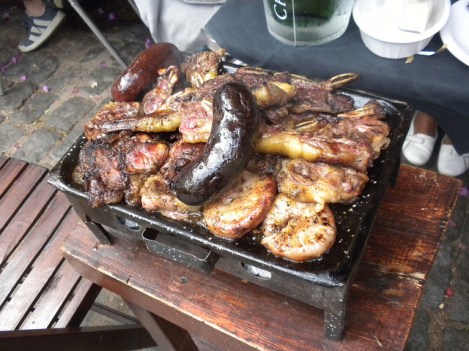
A Mixed Grill for a Couple in Colonia del Sacramento, Uruguay

A Mixed Grill for Two in Colonia del Sacramento, Uruguay

I shot the above in Colonia del Sacramento, Uruguay, in November 2011. It represents a mixed grill ordered by a young couple who graciously allowed me to photograph their lunch with a broad smile on their faces. It represents various cuts of beef, including sausages with a blood sausage in the middle accompanied by various organ meats.

The number of people who would find such a meal disgusting is growing by leaps and bounds, especially among the young. Let’s face it, meat can be gross—even if the animals are grass-fed the way South American beef and lamb typically are. American feedlots, if anything, result in even stranger meat, including such additives as “pink slime,” which was in the news recently, as well as various exotic antibiotics and hormones.

One of the best American growers with which I am familiar in the Harris Ranch located midway between Los Angeles and Sacramento on Interstate 5. Just north of the hotel and restaurant building is a huge feedlot whose odors have passersby on the freeway quickly pulling up their windows and recirculating their interior air for about two miles. And that is better than most beef you are likely to find at your neighborhood supermarket. I imagine that most Midwestern feedlots would be the mammalian equivalent of Dante’s Inferno.

Now Martine and I are both meat-eaters, but in a relatively small way. You might even say we’re part-time vegetarians. Would we ever become 100% vegetarians? Perhaps, if circumstances forced us, we would. In general, however, we shy away from vegetarian restaurants. It is not because we don’t like vegetarian dishes: It’s just that there is a certain vegetarian cuisine—particularly in the United States—which is almost offensively bland. If one is a vegetarian because one finds meat yucky, then one is likely to eat exclusively blah food.

One example of a vegetarian cuisine that I like is that of India. In fact, whenever I go to an Indian restaurant, I usually concentrate on the vegetarian dishes exclusively, unless some fish is on the menu. Indian food is almost never blah. (One exception: The Govinda’s Restaurants run by the Hare Krishnas, who have managed to banish all flavor from their menus.)

There are two vegetarian restaurants within walking distance of my office. I do not patronize either of them. As I am a diabetic, I have to avoid carbohydrates as much as possible; and American vegetarian food is usually fairly heavily laden with carbs.

As I write this, I am thinking of cooking a Chana Dhal next week (a curry with chick peas), if Martine is willing.

Diverted

Mont St Michel in Normandy

Mont St Michel in Normandy

Yesterday was Martine’s birthday. In the mailbox was a card and letter from her half-sister Madeleine in St-Lô in Normandy. In her letter, she wrote that she hoped her sister could come and see her soon, as she is getting on in years. On a day when she should have been celebrating, there were tears in my little girl’s eyes. As it happened, I had the power to change that around. Martine is afraid of going to France alone because she is not good at transportation planning. As it happens, that is my specialty, and my French is better than hers, even though she was born in Paris.

So, I suggested to Martine that I could take a rain check on Peru and join her in France. I don’t think I could have given her a better gift. Martine started dreaming about croissants and how I could have great cheeses for breakfast (yes, I am a devoted cheese-eater). Within minutes, I came up with a plan: Fly to Paris and stay there for a couple of days while visiting her friend Angéla in Montmartre, then take the TGV direct from Gare Montparnasse to St Lô and visit Madeleine and a couple tourist sights, such as the big rock illustrated above. From there, it’s back to Paris to transfer to the TGV from Gare de Lyon to Avignon. A couple days there, then Arles, Nice, and Monte Carlo. Finally, we could take a train to the Cinque Terre in Italy for several days of peace and rest. Then a train to Milan, from which we would fly back to LAX. Martine approved on the spot.

It would have been easy for me to be selfish at this juncture, but I cannot be happy unless Martine is happy. Else my trip to Peru would have been an anxious dirge. Now there is a chance I can get Martine to accompany me to Peru in the future—if our health prevails. I think the trip to France would be a powerful motive for Martine’s back pain to disappear altogether. (So many ailments have a psychosomatic trigger.)

War on Xmas Begins in Earnest

Papa Bear Told Us This Would Happen

Papa Bear Warned Us This Would Happen

Just as Bill O’Reilly predicted, the War on Christmas has begun in earnest. Guantanamo is being stripped of terrorist chauffeurs and brothers-in-law to make room for the Clauses and their adherents, including a particularly sinister lot of elves. Breaking news has reported the death of Rudolph the Red-Nosed Reindeer, whose bleeding carcass was last seen draped over the front of a Humvee, and of the Little Drummer Boy, who took a load of PAHRUPPAPUMMPUMM between the eyes. Grim, sooty smoke spiraled up from stacks of burning greeting cards and gift wrapping paper. Creches were attacked with anti-tank weapons and blown to smithereens.

People who voted in Obama over Mitt Romney in November 2012 are shaking their heads in dismay. Even losing candidate Mitt Romney commented: “Look, fellas, I may be a Mormon; but we’re all Christians here, aren’t we? Aren’t we?”

You wouldn’t think so if you saw the forces arraigned to fight The Former Holiday, as it’s now being called in the news media. In a brave show of resistance, the Faux News Channel began calling itself The Christmas Station until the Federal Communications Commission threatened to shut them down with an attack column headed toward their broadcast headquarters. With many of its pundits under arrest, including O’Reilly, for promoting Christian values, the channel has turned mostly to agricultural reports and generic ethical sermonizing until the situation is clarified.

According to General Mohammed al Scroogey, the Pentagon spokesman, “We have made contact with the forces of Christmas and, on a large scale, torn down their flocked trees and ripped out their strings of lights. Our aim is to confiscate all Santas, elves, sleighs, bells, snowflakes, and other holiday paraphernalia until all that remains is devoid of religious or other celebratory intent.”

All radios played martial music while the brave heroes of the attack brigades wipe out every trace of the despised holiday. President Barack Hussein Obama offered prayers to Allah for the speedy success of what has come to be known as Operation Grinch.


Things That Might Have Been

Jorge Luis Borges

Jorge Luis Borges

It takes a massively creative mind to imagine not only what has been, but what has not been—though they might well have been! I love the poetry of the late Argentinean Jorge Luis Borges, who died in 1986. Blind for much of his adult life, Borges saw things few poets have seen. Although he wrote less as he aged, everything he wrote is precious.

Things That Might Have Been

I think of things that weren’t, but might have been.
The treatise on Saxon myths Bede never wrote.
The inconceivable work Dante might have had a glimpse of,
As soon as he’d corrected the Comedy’s last verse.
History without the afternoons of the Cross and the hemlock.
History without the face of Helen.
Man without the eyes that gave us the moon.
On Gettysburg’s three days, victory for the South.
The love we never shared.
The wide empire the Vikings chose not to found.
The world without the wheel or the rose.
The view John Donne held of Shakespeare.
The other horn of the Unicorn.
The fabled Irish bird that lights on two trees at once.
The child I never had.

In another of his poems, Borges imagines that Don Quixote never left his library, but imagined all his adventures based on the epics of chivalry he read there.

Read Borges, and before long you, too, will see the other horn of the unicorn.


Noir

"William Irish" Was a Pen Name Used by Cornell Woolrich

“William Irish” Was a Pen Name Used by Cornell Woolrich

Over the past several months, I have been reading the large Library of America omnibus volume entitled Crime Novels: American Noir of the 1930s and 40s. Included were the following titles:

  • James M. Cain’s The Postman Always Rings Twice (filmed by Tay Garnett starring John Garfield and Lana Turner)
  • Horace McCoy’s They Shoot Horses, Don’t They? (Sidney Pollack’s 1969 film of this starred Jane Fonda)
  • Edward Anderson’s Thieves Like Us (made into a great Nicholas Ray film called They Live by Night)
  • Kenneth Fearing’s The Big Clock (made into a great John Farrow film with Ray Milland and Charles Laughton)
  • William Lindsay Gresham’s Nightmare Alley (another great John Farrow film, this time with Tyrone Power)
  • Cornell Woolrich’s I Married a Dead Man (published under the pen name William Irish)

So many of the noir novels of the period were turned into classic films that I begin to think the whole genre is a mirror in which we as Americans see ourselves. Although the British are just as famous with their detective novels, it was an American who invented the genre with Edgar Allan Poe’s stories such as “The Gold Bug,” “The Purloined Letter,” and “The Murders in the Rue Morgue.” And while Arthur Conan Doyle, Agatha Christie, Josephine Tey, and countless others were practicing their craft in Britain, their American counterparts created works that were more urban, more mean, and more essentially American.

Frankly, I came to the novels by way of the films. I was a collaborator (though in a minor way) with my friends Alain J. Silver and James Ursini in their genre-defining book Film Noir: The Encyclopedia published by Overlook Press. Other great resources are the same authors’ The Noir Style (also Overlook) and the Taschen Book entitled Film Noir.

Both the novels and the films generally tend to be excellent and well worth your time.

Looking Backward

PICcrab

Crab

A poet in our times is a semi-barbarian in a civilized community. He lives in the days that are past. His ideas, thoughts, feelings, associations, are all with barbarous manners, obsolete customs, and exploded superstitions. The march of his intellect is like that of a crab, backward. The brighter the light diffused around him by the progress of reason, the thicker is the darkness of antiquated barbarism, in which he buries himself like a mole, to throw up the barren hillocks of his Cimmerian labours.—Thomas Love Peacock, “The Four Ages of Poetry,” Works Vol. III