Stay the Hell Out of Syria

Out of the Frying Pan, Into the Fire

Out of the Frying Pan, Into the Fire

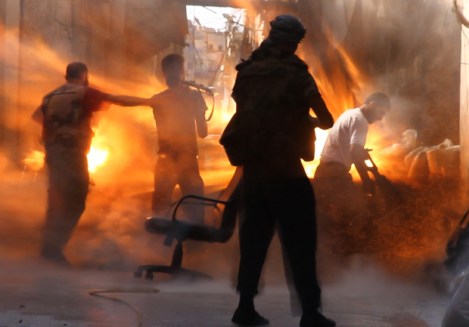
It’s now official: That crazy old man from Arizona, Senator John McCain, is shopping around for another morass for the U.S. military to get stuck in. Let’s look at the possible consequences:

  1. If we align ourselves with the rebels, we are aligning ourselves with Al Qaeda and Wahhabi Sunni Muslim militants.
  2. Fighting against us would be not only Bashar al Assad, but Hezbollah, the Shi’a, and Iran (indirectly).
  3. Russia is supporting Bashar with weaponry, so we will end up with the best that Putin can throw at us.

I can’t see that either side deserves our support. I would not venture a single American life against the whole lot of them. As much as they say they need our help now, what is to keep the rebels from doing a 180° turnabout whenever it suits whoever is in power during a particular fifteen minute slot.

Not only can we not predict who will win, but we can’t figure out what kind of governance would result. My guess is that it would be another Iraq, with sectarian bloodshed lasting for years to come—and with America, once again, identified as the “Great Satan.”

My belief is that we should provide both sides with medical help and sit back with a box of popcorn to see who comes out on top. That would be a refreshing change of pace for once!
 

Martine Remonstrates with the Geese

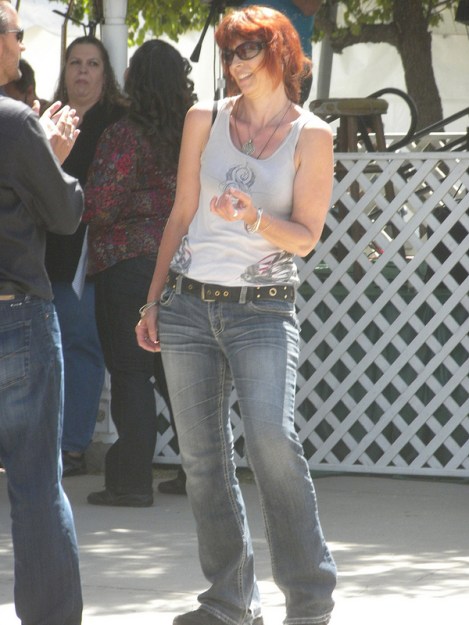
Martine at the L.A. Arboretum

Martine at the L.A. Arboretum

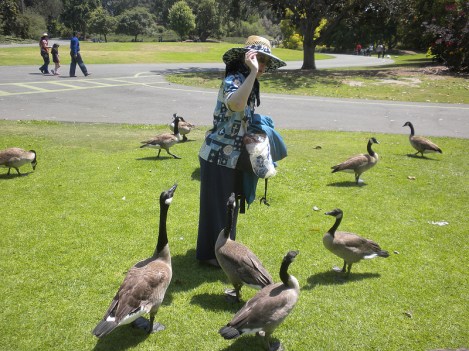
Martine and my father have some interesting things in common. My Dad loved to feed the pigeons and, before he married my mother, had his own pigeon coop. Martine also likes to feed the birds, but she prefers ducks and especially geese.

Geese are not the most cooperative of birds. Years ago, when Martine lived in Twentynine Palms and worked at the U.S. Naval Hospital there, we used to have brunch at the Twentynine Palms Inn. On the premises, there was a little pond and some very obstreperous geese, who used to go after Martine. I would have to run at them shouting “Bo!” until they backed down. (Thus no one would claim that I couldn’t say “Bo!” to a goose.)

The last time we went to the L.A. Arboretum, Martine brought along with her a sack of stale bread which she threw at the resident geese and ducks. Predictably, the ganders were being hyper-aggressive and kept pecking at the females and beta and gamma ganders to monopolize the bread. In return, Martine would remonstrate with those geese and make a special effort to feed the better behaved birds more of the crumbs.

Anyhow, when she does that, I feel a special warmth for my little French girl. There is something so sweet about her criticizing the “bad” geese that my heart warms to her all the more.

Opson and Situs

Seafood Mosaic from Pompeii

Seafood Mosaic from Pompeii

In 1997 classical scholar James Davidson published a fascinating little book about the ancient Greeks entitled Courtesans and Fishcakes. Discussing the eating habits of the ancient Athenians, Davidson makes a distinction between opson (ὄψον) and situs (σίτος).

Opson refers to what we would call meat entrées, particularly when they bare seafood. Beef and lamb were more associated with religious sacrifices, during which the meat was shared with participants and attendants at the sacrifice. But fish was the meat of choice at symposia such as the ones described so vividly by Plato and Xenophon.

Certain guests at a Greek symposium were known for what is called opsophagi, or “opson eaters.” It was considered rude for guests to ignore the situs, usually consisting of what we would call the side dish. (In our culture, it would include potatoes, rice, and bread; for the Greeks, wheat or barley was the usual side dish.)

One interest side to diabetes is that it is affected primarily by the dishes the Greeks would consider to be a part of situs (though barley is a special exception). People with Type II Diabetes, such as myself, have to concentrate on the opson, supplementing it with vegetables and fruit.

You can now consider me an opsophagos, though I wouldn’t call it to my face.


Don’t Let the “Ballet Skirts” Fool You

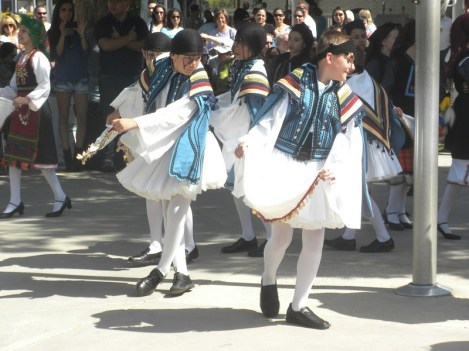
Boys from St. Nicholas Greek Orthodox Church in Macedonian Costume

Boys from St. Nicholas Greek Orthodox Church in Macedonian Costume

Here’s another photo from the Valley Greek Festival in Northridge that Martine and I attended yesterday.

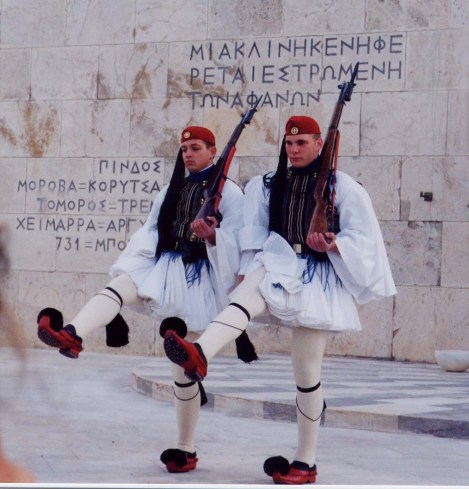
It has always seemed strange to me that the Greeks favored starched white skirts for their male dancers and soldiers. It certainly does not imply any lack of masculinity on their part. As a wartime correspondent, Ernest Hemingway was with the Greek forces invading Turkey in the aftermath of World War One. It was the first time, he wrote, that he had seen “dead men wearing white ballet skirts and upturned shoes with pompoms on them.” Below is a photo of Greek Evzone soldiers on guard duty:

Greek Evzone Troops

Greek Evzone Troops

Don’t let the “ballet skirts” fool you. Although it has not always been well led, the Greek Evzones have always been a formidable fighting force.


The Dance Goes On

Dancing Aphrodite

Dancing Aphrodite

Today was the Valley Greek Festival in Northridge. Martine and I went to St. Nicholas Greek Orthodox Church at Balboa & Plummer and sampled some of the Greek cuisine (very limited in my case, but still most excellent). Also, I watched some of the folk dancing to the live band—I think its name was Olympia.

The young lady in the photograph above seems to be at all the local Greek festivals. It is a joy to watch her dance: Her moves are incredible. Over the years I have been attending these festivals, perhaps as many as eight or ten years, I have nicknamed her Aphrodite. Never having spoken to her, I do not know her real name; but she is poetry in motion, a regular Terpsichore.

We also took the tour of the church for the umpteenth time. There is something about the Orthodox church that appeals to me. If I were to become an active Christian, I might well switch my allegiance from the Church of Rome to the Church of Hellas. (For one thing, the whole child molestation epidemic among the Catholic clergy has repulsed me, even though I know that only a minority of the priests are guilty.)

The next big Greek festival in the area is in Torrance the weekend after I get back from Iceland in July., followed by the L.A. Greek Fest at Saint Sophia Cathedral in downtown Los Angeles early in September. The dance goes on …


“Secret Movements of a Puppet Show”

Charles Churchill (1732-1764)

Charles Churchill (1732-1764)

Peace to such triflers; be our happier plan
To pass through life as easy as we can.
Who’s in or out, who moves this grand machine,
Nor stirs my curiosity nor spleen.
Secrets of state no more I wish to know
Than secret movements of a puppet-show:
Let but the puppets move, I’ve my desire,
Unseen the hand which guides the master-wire.—Charles Churchill, “Night: An Epistle to Robert Lloyd”

Iceland 2001: Rainbows and Waterfalls

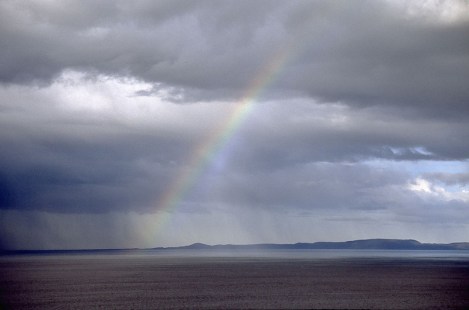
Rainbow in the North of Iceland

Rainbow in the North of Iceland

We were in the north of Iceland, somewhere between Ásbyrgi and Húsavík. By we, I mean our guide Illugi from Lake Mÿvatn, a group of European twenty-somethings, and me, hobbling around with a cane due to severe osteoarthritis. It was a gorgeous day: Bright sunlight interspersed with rain-bearing clouds. A perfect day for rainbows. It was one of those days when one is likely to behold almost more beauty than a human being can stand.

Iceland does that to me. That’s one of the reasons I am bringing up these photographs from twelve years ago. The image of a place that is at once wild and beautiful keeps coming back to me. On a long bus ride along the famous Ring Road, one sees endless waterfalls cascading down from mountains and glaciers; and the changeableness of the weather makes rainbows frequent and spectacular. Sitting here in Westwood during the endless repetition of foggy mornings and hazy sunshine in the afternoon that is typical of L.A. spring weather, I yearn for the crystalline wide open spaces.

Soon. Soon.

The Falls at Dettifoss

The Falls at Dettifoss

Earlier on the same day that I shot the rainbow above, we visited Europe’s most powerful falls at Dettifoss along the Jökulsá á Fjöllum River, one of Iceland’s largest and longest.


Two Jerks from Oklahoma

Senator Jim Inhofe (R-OK)

Senator Jim Inhofe (R-OK)

At the same time that I am appalled at the tornado devastation in Oklahoma, I am also appalled at the weasels that Oklahomans chose to represent them in the U.S. Senate. Jim Inhofe (R-OK) and Tom Coburn (R-OK) both voted against aid to Hurricane Sandy victims in New York, New Jersey, and Connecticut … while at the same time making darned sure that Oklahoma would get all the help it needed. Everyone knows that New Yorkers are all liberals, and they should be made to pay for it!

Hey, bozos, these aren’t the Confederate States of America! We’re all in the same boat—whether it’s an earthquake in California or Alaska, a hurricane in Louisiana, a volcanic eruption in Oregon, a drought in Texas, or a tsunami in Hawaii. We are all Americans and all need help when Mother Nature throws the book at us.

Irrespective of whether global warming is affected by what human beings do, we all suffer more or less equally from the vagaries of nature.

Tom Coburn (R-OK)

Tom Coburn (R-OK)

Either Inhofe or Coburn suggested that Oklahoma should be helped, but that help should be financed by cuts to Federal spending. That could work—under certain circumstances. Let me see: How much does a U.S. Senator earn? I am sure that both gentlemen, out of an excess of patriotism, would be willing to serve without compensation.

Favorite Films: Pickpocket (1959)

A Still from Robert Bresson’s Pickpocket

A Still from Robert Bresson’s Pickpocket with Martin LaSalle

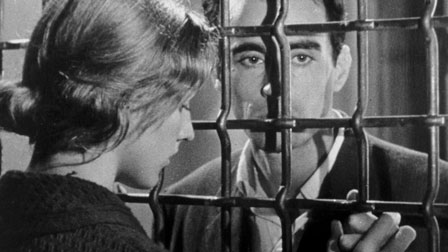
One film I will never tire of watching is Robert Bresson’s Pickpocket (1959). At a time when the French New Wave was in full flower, it was a resolutely old-fashioned film that was—in my opinion—better than any of the New Wave films. It starred two unknowns, the Uruguayan Martin LaSalle and Marika Green, and shows how a young man (who looks startlingly like a young Henry Fonda) falls in with a pickpocketing gang, and with a young woman who loves him.

Bresson only made a handful of films, but fully half of them are among the greatest films ever made. As I say this, I have to interject that you may or may not think as highly of him as I do: His films may seem preternaturally slow, but there is an unmistakeable development of character that seems missing altogether in the films of today. Pickpocket’s Michel and Jeanne are deeply, even tragically, in love with each other, in a world where crime seems to be the only way to get ahead.

If you are interested in seeing some of Bresson’s films, I highly recommend the following titles:

  • Diary of a Country Priest (1951)
  • A Man Escaped (1956)
  • The Trial of Joan of Arc (1962), based on the original trial records
  • Au Hasard Balthazar (1966)
  • Mouchette (1967)
  • Lancelot of the Lake (1974)

Bresson died in 1999, but his films will never die.

Iceland 2001: The Huldufólk

Those Strange Basalt Formations Could Be a Troll ... or the Home of an Elf

Those Strange Basalt Formations Could Be a Troll … or the Home of an Elf

Many Icelanders, particularly those who grew up before the island became cool, believe in the hidden folk. As a matter of fact, despite all that ice, it was once a very hot place—so hot that the residents bake rye bread by burying it in a hole only a couple of feet deep. Many places, like the original Geysir (yes, that’s how it is spelled) are so hot that a single misstep could plunge you into boiling mud.

There are numerous stories about the island’s hidden folk, or huldufólk, namely trolls, ogres, elves, mermen, and others. If you think I’m being tongue-in-cheek while writing this, allow me to refer you to a story that recently hit the news in Reykjavík.

An interest group called Hraunavinir (‘Lava Friends’) is planning to sue over the making of a new road to Álftanes from Engidalur in Garðabær, across the lava field Gálgahraun, and to a roundabout opposite Bessastaðir, the presidential residence.

Seer and piano instructor Erla Stefánsdóttir maintains that the elf boulder Ófeigskirkja will be destroyed in the process and fears that wrath of dwarves in the hidden world will cause accidents on the road, Fréttablaðið reports.

Now this is not the type of story one would encounter in the New York Times. What I found particularly interesting was that there were some serious follow-up stories, including one just a few days ago in which one resident suggested the whole problem could be eliminated by a couple of strategically-placed roundabouts.

In Reykjavík, there is even an Elfschool, which has been open for over twenty years. It is run by Magnus Skarpheðinsson, who is an expert on Iceland’s huldufólk.

When I look at that basaltic plug in the photo above, at Dimmuborgir on the shores of Lake Mývatn in Northeast Iceland, I think that it may well be a petrified troll who hung around after sunset, or the residence of elves, who venture forth from their stony fastness to confound the ways of men.