Of Mexican Beer

One of My Favorites

One of My Favorites

Today I walked into Santa Monica to use a 20% off coupon at the Barnes & Noble bookstore on the Promenade. Because Martine has another bout of irritable bowel syndrome, she is on a diet of chicken and cookies for now (though I am not sure that is the best thing for her). After buying a couple of DVDs (Kenji Mizoguchi’s Sansho Dayu and Federico Fellini’s ) and a Ukrainian mystery novel (Andrey Kurkov’s Death and the Penguin), I decided to stop for a quick lunch at La Lotería Grill.

Although beer is one of the beverages which is discouraged because of my Type 2 Diabetes, I decided to risk ordering a Dos Equis Lager to accompany my two tacos de huachinango (that’s Pacific Red Snapper in Nahuatl). I thought as I sipped the beer how much I loved Mexican beers during my many travels in that country between 1975 and 1991. In Yucatán, there was Carta Clara, Montejo Clara, and Léon Negra by the now defunct Cervecería Yucateca, which sold out to Modelo. In Mazatlán and along the Pacific Coast, I would drink Pacifico Clara. And just about anywhere, I would drink Cerveza Superior from Cervecería Cuautémoc-Moctezuma or Corona, the only good beer produced by Grupo Modelo.

Today turned out to be an unseasonably hot day in Southern California, so the beer went down smoothly, as did the fish tacos. It may be months before I venture another bottle of beer, but I will eventually return for that same sensation. And it will probably be another Mexican beer. I have many happy memories with Mexican beers going back a long time.

I don’t write very much of my travels in Mexico. That is mostly because I would have to convert a ton of Kodachrome 25 slides to digital format. I’ll probably do it eventually, and I will regale you with my adventures in Mexico, mostly in Yucatán and Chiápas, but also including Veracruz, Puebla, Oaxaca, Teotihuacán, and Tula. Those were good times, and that’s when I caught the travel bug big time.

A Hungarian Christmas

A Hungarian Christmas Tree

A Hungarian Christmas Tree

There are fewer things that can elicit such an outpouring of sentiment in me as the sound of the Hungarian language. My own knowledge of my native language is unidiomatic and ungrammatical, with a child’s vocabulary, but nonetheless, there is that rhythm and intonation that makes me think I am home. When I hear the Magyar National Anthem, or Hymnusz, I stand at attention in a way that I do not when I hear that sad old English barroom song that is the National Anthem of the United States. (And I mean no disrespect to my adopted country when I say this.) See what the Magyar Nemzeti Himnusz sounds like when done right:

It’s the same way with Christmas carols. I like many of the English carols—except for that pahruppahpummpumm monstrosity—but the Hungarian carols all sound sweeter to my ears. Try this one on for size from the group Labdarosza (“Ball Rose”?):

I have no idea what those instruments are, but I have heard them in my dreams. Here is one more, whose translated name means “Oh, Fortunate Night!”:

Although the language that is most familiar to me in English, I find that it is a language which I admire but cannot love. I sometimes feel like an exiled person. But then, I think that, to a certain extent, that is true of all of us. We have been rudely banished from childhood and made to grow up in a world which is not altogether responsive to our needs. What we have to do in our lives is to take advantage of that disconnect and use it as a source of our creativity.

Note that behind everything I say is a disconsolate Magyar six thousand miles and a generation away from what sustained him.


Thirteen Trolls for Christmas

The Icelandic Yule Lads Make Up for Santa Claus

The Icelandic Yule Lads Make Up for Santa Claus

Icelanders celebrate Christmas with the thirteen Yule Lads, or Jólasveinarnir. You might say it’s the 13 Days of Christmas, except these begin on December 12. As they come, day by day, they reward good children by placing gifts into their shoes which have been left on window sills. And if the children are bad, there are always rotten potatoes.

Here is a description of the Yule Lads:

  1. Stekkjarstaur, or “Sheep-Cote Clod.” Harasses sheep, but is impaired by his stiff peg-legs. Arrives December 12, leaves December 25.
  2. Giljagaur, or “Gully Gawk.” Hides in gullies while waiting for an opportunity to sneak into the cowshed and steal milk. Arrives December 13, leaves December 26.
  3. Stúfur, or “Stubby.” Abnormally short. Steals pans to eat the crust left on them. Arrives December 14, leaves December 27.
  4. Þvörusleikir, or “Spoon-Licker.” Steals long-handled wooden spoons (þvörur) to lick. Is extremely thin due to malnutrition. Arrives December 15, leaves December 28.
  5. Pottaskefill, or “Pot-Scraper.” Steals leftovers from pots. Arrives December 16, leaves December 29.
  6. Askasleikir, or “Bowl-Licker.” Hides under beds waiting for someone to put down their askur, or bowl, which he thereupon steals. Arrives December 17, leaves December 30.
  7. Hurðaskellir, or “Door-Slammer.” Likes to slam doors in the middle of the night. Arrives December 18, leaves December 31.
  8. Skyrgámur, or “Skyr-Gobbler.” Likes to steal skyr, the yummy Icelandic equivalent of yogurt. Arrives December 19, leaves January 1.
  9. Bjúgnakrœkir, or “Sausage-Swiper.” Prefers to hide out in the rafters and snatch sausages that were being smoked. Arrives December 20, leaves January 2.
  10. Gluggagœgir, or “Window-Peeper.” A voyeur Yule Lad who would look through windows for things to steal. Arrives December 21, leaves January 3.
  11. Gáttaþefur, or “Doorway-Sniffer.” This one has an unusually large nose and an acute sense of smell which he uses to locate laufabrauð. Arrives December 22, leaves January 4.
  12. Ketkrókur, or “Meat-Hook.” As you can probably guess, he uses a hook to steal meat. Arrives December 23, leaves January 5.
  13. Kertasníkir, or “Candle-Stealer.” Follows children around in order to steal their candles (and eat them), Arrives December 24, leaves January 6.

The above illustration differs slightly from the above list, which is taken from Wikipedia, You get the general idea, though. Instead of a quick slide down the chimney with presents to leave under the tree, and leaving as soon as the milk and cookies have been imbibed, these snarky little trolls will take up more than three weeks of your time in all stealing your food, rogering your wife, making your dog pregnant, and causing various other types of mischief.

Just between you and me, I’ll take Santa.

Has the Khmer Rouge Taken Over Congress?

Pol Pot, Tea Party Darling

Pol Pot, Tea Party Darling

The news from Congress is so very strange these days that I am beginning to think that they have been taken over by some extreme guerrilla faction such as the Khmer Rouge or the Sendero Luminoso (Shining Path). The Senate is about to host a three- or four-day pajama party—all night long!—just so they the GOP can express their snit about Harry Reid invoking the “nuclear option” on their right to filibuster Obama’s nominees. As for the House of Representatives, Speaker John Boehner is now aiming daggers at special interest groups that want him to oppose the budget deal put together by Paul Ryan in the House and Senator Patty Murray … even before the details have been released.

Why does it seem that the news from Congress is always bad? The legislative branch of government seems to be permanently broken.

But how does one fix it? Get Mitch McConnell a new burnished turtle shell? Get Boehner a better grade of liquor? Or more handsome and complaisant pages for the Southern senators? What about changing the cooking oil used to make Freedom Fries? (It’s been the same old stuff since Ike was President.) Softer toilet paper for the Congressional stalls? Something’s just gotta give.

One cannot run a government in which two of the three branches of government (yes, I’m including the Supreme Court) are dysfunctional. As Lincoln said:

A house divided against itself cannot stand. I believe this government cannot endure, permanently, half slave and half free. I do not expect the Union to be dissolved — I do not expect the house to fall — but I do expect it will cease to be divided. It will become all one thing or all the other. Either the opponents of slavery will arrest the further spread of it, and place it where the public mind shall rest in the belief that it is in the course of ultimate extinction; or its advocates will push it forward, till it shall become lawful in all the States, old as well as new — North as well as South.

We don’t have slavery any more, just a lot of snarky behind-the-scenes racism. Maybe Lincoln was right: One way or the other, Congress will cease to be so divided. But before that happens, we’ll all need some industrial-strength antacids,

Where Everbody Knows Your Name

Not Always an Advantage!

Not Always an Advantage!

The theme song of the old Cheers TV sitcom touts the advantages of hanging out “Where Everybody Knows Your Name.” But what if you lived in a small city in an even smaller country where you can’t go anywhere without recognizing friends, acquaintances, and co-workers? Such is the case in Reykjavik, Iceland. The population of Reykjavik is only 199,000, and the population of Iceland stands at 322,000.

I was reading an interesting article on The Reykjavik Grapevine by Valur Gunnarsson entitled “Why Is There No Dating in Iceland?” according to which:

If you were to go out on a date with someone, say to the movies or a coffee shop, you would invariably bump into someone you know. Said person would give you a curious glance, perhaps followed by a smirk and then ask everyone you mutually know: “Are those two seeing each other?” The cat is out of the bag by now and your first and perhaps only date suddenly feels more like an engagement ceremony.

Much better then to wait until the lights go out, everyone you know has gone home, is too drunk to care or engaged in their own business. In other words, going out, getting hammered and then heading home with whoever happens to be standing next to you at closing time carries much less social penalty than meeting in broad daylight. It is widely understood that what happens at the bar doesn’t really count. Leave it until the morning after to figure out if you two really have something in common and if the same thing happens again next weekend with the same person, you have yourself a relationship.

One of the reasons the dating scene in Reykjavik is no notorious is that men and women can’t get to know each other in a social setting without being observed and commented on by their peers. Young Icelanders tend to hang out in bars and go home with one another for an “afterparty” around closing time. What happens at or after the “afterparty” is anybody’s guess, but the word is that it’s a pretty wild scene. There is even a book by the notorious Roosh Vorek entitled Bang Iceland: How to Sleep with Icelandic Women in Iceland, which is a popular item among the more randy international travelers.

(Allow me to say that I have had no such dealings with Icelandic women during my two trips to their country. I’m a respectable old man who needs his sleep.)

Gunnarsson continues:

The flipside of drunken sex is that Icelandic relationships actually develop quite quickly. Whereas in bigger cities the whole vetting process may take weeks or even months while you are asked about everything except your bank statements and family history of mental disease (and sometimes even that), people here tend to jump directly into a committed relationship right after the second sleepover, or thereabouts. In fact, it is generally considered bad form not to. Once doesn’t matter, but do it twice without following through and you start to get a bad reputation.

This all goes back to point two again. The smallness. Dating several people at the same time is socially impossible. Everyone would know. Fistfights would ensue. Better to do the trial and error one person at a time, which is why Icelanders tend to have a series of either one-night stands or serious relationships, but no overlapping dates. So now you know.

One result of this non-dating sexual behavior is that there is a large number of illegitimate children born on the island. Fortunately, there is little or no stigma attached to a single parent entering into a marriage. It does have the advantage of stirring up an otherwise rather static gene pool. (In 2013, it was estimated that 93.44% of the population is of Icelandic ancestry.)

The Ineluctability and Persistence of the Now

Maybe Not So Smart

Maybe Not So Smart After All

I have frequently written about the distractions of modern life, especially with regards to all those convenient little electronic devices created to suck away all your moments of quiet contemplation. Meditation? Hah! It is to laugh!

As one who has ripped out all those little electronic tendrils that seek to ensnare me into an ineluctable and persistent “now” consisting mostly of advertising and various types of cultural noise, I try to be immune. But there are always billboards, loud advertising messages from the TV that Martine is watching across the room when I am on my computer, newspaper ads, and so on. Although I have a cell phone, it is probably one of the last LG models that are non-Internet, non-Smart, and non-Kim-Kardashian-compatible. And I have resolved not to buy a Smart Phone unless there is absolutely no other cellular option available.

According to Malcolm McCullough, a professor of design and architecture at the University of Michigan:

A quiet life takes more notice of the world, and uses technology more for curiosity and less for conquest [though I would ask, Who is conquering whom?]. It finds comfort and restoration in unmediated perceptions. It increases the ability to discern among forms of environmentally encountered information. It values persistence and not just novelty. It stretches and extends the now, beyond the latest tweets, beyond the next business quarter, until the sense of the time period you inhabit exceeds the extent of your lifetime.

I do not think I could write these blogs unless I had a more directed thought process. In fact, I fear that the generation now in school could have done permanent damage to their ability to concentrate. If this tendency is irreversible, welcome to a whole new world of barbarism. Not a pretty thought.

Is all that we are capable of concentrating on is Miley Cyrus’s nude body as she swings on a wrecking ball? If so, we are already a new lost generation. Excuse me while I try to find a nice quiet place in the past to hide and shut out all the noise.

South

When Was the Last Time YOU Thought About South America?

When Was the Last Time YOU Thought About South America?

Let’s face it: Most Americans almost never think about South America. Oh, there are a few exceptions, such as when the World Cup comes around and we are reminded how many great soccer football teams there are “down there.”  Also, when Carnival Time in Rio comes close. Also, when we keep hearing about how the forests of the Amazon are gradually being clear-cut.

I think this is a fundamental flaw about being the world’s Number One military power. According to the Stockholm International Peace Research Institute (SIPRI), here are the world’s top ten for 2013:

  1. United States – $682.0 billion
  2. People’s Republic of China – $166.0 billion
  3. Russia – $90.7 billion
  4. United Kingdom – $60.8 billion
  5. Japan – $59.3 billion
  6. France – $58.9 billion
  7. Saudi Arabia – $56.7 billion
  8. India – $46.1 billion
  9. Germany – $45.8 billion
  10. Italy – $34.0 billion

Note that there are no South American countries in the list, though Brazil comes in at 11th place with $33.1 billion. (When was the last time they fought a war?) In other words, there are no major military players in South America. So we don’t have to worry about them, right? And that is the fundamental flaw about being Number One: You tend not to think about smaller countries because they simply don’t impinge on your way of life. In other words, you lay yourself open for a big unpleasant surprise.

I actually remember my first such unpleasant South America surprise. Dwight D. Eisenhower was President from 1952 to 1960. On May 13, 1958, he sent Vice President Nixon to Caracas, where his motorcade was attacked by an angry mob. As a 13-year-old in Cleveland, I was outraged that a no-name country like Venezuela had the nerve to insult the United States. This plus the subsequent insurgency in Cuba and takeover by Castro led to the creation of the Alliance for Progress during the Kennedy Administration. (But we had to undergo a baptism by fire at the Bay of Pigs first.)

Then there was more bad news to come. We were being inundated by cocaine being smuggled in from Colombia and other nearby countries. Then there was this matter of the FARC insurgency in Colombia and the Sendero Luminoso (Shining Path) in Peru. The whole continent appeared to be unraveling like a cheap suit. The Tupamaros in Uruguay and the disappearances in Argentina under Videla didn’t help either, nor did Pinochet in Chile.

At a certain point along the way, a certain positive influence from Argentina turned my life around. It was my discovery of the writer Jorge Luis Borges. Once I started reading his works, I began to see the world through his eyes. There was this battle called Junin that was fought in Peru. Then there were the Unitarios and Federalistas in Argentina. I began to get more interested, and then I actually went to Argentina in 2006 (only to break my shoulder by falling in a blizzard in Tierra Del Fuego) and 2011. Now I want to go to Peru in 2014, if I can swing it financially.

And, of course, I have been reading ever so much more about South America—so much so, in fact, that I look at the globe in an entirely different light. Perhaps South America will gain by all these years of benign neglect. Perhaps not. We still enforce the Monroe Doctrine after a fashion to keep Europe out, but we pretty much leave the continent alone unless our multinational corporations want to cut down their trees or extract their mineral wealth. Eventually, I see the nations down there nationalizing those industries and, with luck, putting the skids on some of the worst abuses. Until then, our corporations will be a stench in their nostrils.


How Elves Came To Be Born

We’re Talking Icelandic Elves Here

We’re Talking Icelandic Elves Here

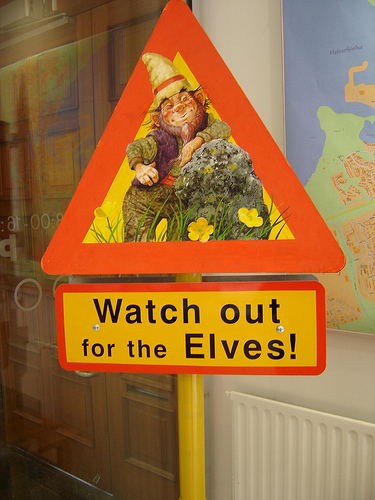
If your idea of elves comes straight out of Tolkien, you might not want to read any further. In Iceland, elves are not quite the smooth white-skinned Liv Taylor, Cate Blanchett, and Orlando Bloom types. Icelandic elves are much more grotty. The following was submitted by my favorite contributor to The Iceland Review, Jóhannes Benediktsson and is a direct quote from his November 14 posting:

There are few theories about where elves come from, according to the Icelandic folktales.

The one most commonly cited, describes God’s journey to Paradise. He visits Adam and Eve, who salute him and show him how they live. They introduce him to the kids, but leave out the dirty ones. God knows about this and states, that what is to be hidden from him, shall also be hidden from everyone else. The unclean children then go on living in hills and stones, and their descendants are what we call elves.

There are more stories about elves and their origin, all referring to some Bible events in one way or another. My favorite is a bit strange. It includes Adam and Eve, like the one mentioned above, but takes another approach. It describes their relationship problem.

I have re-written this story as a two-hander play. I call it Trouble in Paradise and have very high hopes that it will one day reach Broadway.

TIME: Close to midnight.
PLACE: Paradise.
MUSIC: Barry White.

The scene starts with Eve entering the room. Adam is lying on a bed of roses, running his index finger suggestively over Eve’s side of the bed.

ADAM: Hello, cupcakes! How about getting naked?

EVE: You mean lose the fig leaf?

ADAM: Yeah!

EVE: Knock it off, you idiot! I’m not in the mood.

ADAM: Oh, come on! You never are!

Eve starts to get into the bed and goes to sleep, leaving Adam heartbroken once again.  He walks away from her and talks to the audience.

ADAM: This is my life. God has sentenced me to live with a frigid woman for all eternity and calls it Paradise. That’s rubbish! I’m a passionate man, who needs a flame in his life – a fire!  Why didn’t he create someone like that for me? 

He looks at Eve, sights and then looks back to the audience.

ADAM: I guess I’ll have to do with some solo-action once again. Enjoy your popcorn.

Curtains fall.

[Part 2]

TIME: Nine months later.
PLACE: Paradise.
MUSIC: Not Barry White.

Eve walks back and forth on the stage. She is furious. This morning, a bunch of babies appeared out of nowhere on their doorsteps.  They all look like little versions of Adam.

EVE: Who is she?!

ADAM: Who?

EVE: That bimbo you’ve been cheating with!

ADAM: I promise. You are literally the only woman in my life.

EVE: I don’t believe you. How do you explain the children?

ADAM: A miracle of God?

Eve starts throwing apples at Adam, who runs in a silly manner around the stage.  A thundering voice comes from above, overwhelming both of them.  It’s God.

GOD: Stop this nonsense, both of you.  I’ll explain what happened.  Do you remember, Adam, nine months ago when you did that… guy thing?

ADAM:  Erm… are you talking about the …

GOD: Yes, yes!

EVE: What guy thing?

GOD (ignoring Eve): Well… some of that got into a hole in the soil. And that soil somehow got pregnant and… well… these are your children. Their descendants will be known as elves.

ADAM: What!

Eve starts shouting and the throwing of apples once again and Adam seeks a shelter behind a tree. Avoiding the missiles, Adam turns his head humbly to the sky with one final question.

ADAM: God. Can you tell me one thing?

GOD: Sure.

ADAM: Why did you make her like that?

GOD: It amuses me.

ADAM: I thought so.

Curtains fall again. The show’s over.

By the way, Gin unlike Tolkien, Icelandic elves can do nasty things. Perhaps I’ll tell you about some of them one of these days.

A Writer Who Understands People As They Are

Anton Chekhov (1860-1904)

Anton Chekhov (1860-1904)

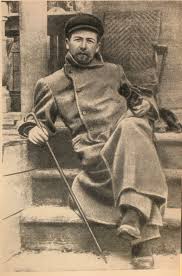
It started last summer, when I reread his novelette The Steppe in a Reykjavik guesthouse. I said to myself, “This is a writer who understands people as they are.” Tonight, I read his play The Seagull, which gives us a rural Russian estate and introduces us to a group of people of are dissatisfied with themselves and one another. If I have my way, I will read a good deal more of Anton Chekhov this next year. It is so easy to be cowed by Tolstoyevsky—as my late mother used to refer to the two giants of 19th century Russian literature—that one is prevented from reading their contemporaries.

This is a great pity, because there are so many great writers to choose from among their contemporaries. I am thinking not only of Chekhov, but also Ivan Goncharov, Nikolai Leskov, Ivan Turgenev, Mikhail Lermontov, and Alexander Pushkin. And I am sure there are half a dozen more that I just don’t know about yet.

Chekhov was a physician, a playwright, and perhaps the world’s greatest writer of short stories. In addition, he wrote a great travel book about a visit to the island of Sakhalin off the East coast of Siberia, which was an early prison colony. In addition to a description of the conditions there, we have his description of the trip there and back in the days before the Trans-Siberian Railroad was built.

Chekhov was a prolific writer who lived a short life. Like so many of his contemporaries, he was a victim of tuberculosis. As a doctor, he knew what was happening to him. Yet his writing never suffered any ill effects.

In addition to his plays, there are a handful of his stories that are well worth seeking out. My favorites are “The Steppe,” “The Lady with the Dog,” and “Ward Number Six.”