The Last Time I Saw Hvolsvöllur

The Mountains Around the Markarfljót Valley

The Mountains Around the Markarfljót Valley

It was around the end of my 2001 trip to Iceland, one of the first days in the month of September. I was sitting around in my Reykjavík guesthouse paging through my Lonely Planet guide when I decided to check out the Saga Center in Hvolsvöllur. I walked over to the BSÍ bus station on Vatnsmýrarvegur and hopped on a bus to Hvolsvöllur, which is about an hour or two east of the capital.

It was before lunchtime, so I decided to walk around the town—really, it was just a village. I ook a wide loop around the area, seeing Icelandic schoolchildren in uniform being taken for a walk on this uncommonly nice fall day (fall starts early on the island that is Ísland). I saw a couple of pizza places, which looked interesting because for some reason Iceland makes really good pizza. (Good bread, good cheese—that’s more than half the battle.) In the end, I settled in at the gas station named after one of my literary heroes—Hliðarendi—and has a sandwich stuffed with hangikjöt, a tasty lunchmeat made with lamb..

Gunnar Hamundarson of Hliðarendi was one of the heroes of Njals Saga, that greatest of the medieval sagas. Outlawed by the AlÞing, he left his home in the Markarfljót Valley, but made the mistake of taking a look back. At once, he made the decision not to leave, because it the sight was so breathtakingly beautiful. He paid for this decision with his life.

Another View of the Area Around Hvolsvöllur

Another View of the Area Around Hvolsvöllur

The Saga Center in Hvolsvöllur was well worth visiting. It is, insofar as I know, one of only two museums in the world dedicated to a single work of literature, in this case Njals Saga. (The other one is in Borgarnes and is dedicated to Egil’s Saga.) The Saga Center was clearly a labor of love. I spent a couple of hours talking to a beautiful young Icelandic blonde who worked there. She was a very sweet lady who was suffering from some strange stomach ailment. I wonder whether she still works there.

That evening, I picked up my tattered Penguin paperback edition of Njals Saga and started re-reading it. In June, I will read it a third time. Why not? It is one of the greatest works to come out of the Middle Ages. I kept re-reading it until my plane landed in Los Angeles.

The First Known Photograph of Dark Matter!

You Saw It Here First!

You Saw It Here First!

It is said that some 24% of the known mass of the universe is composed of dark matter. Now, thanks to my trustee Nikon CoolPix S630, you can see what I saw. Shown above is a closeup of some dark matter congregating toward the lower center (and, I might add, in a highly suggestive pose, but we won’t go there for now).

Until now, astrophysicists had to infer the presence of dark matter by its behavior, namely gravity and radiation. Now that I have discovered that dark matter shows up so well in my photographs, I have decided to request a Federal grant to quantify the amount of dark material in the universe by beginning with a census conducted in my back yard and extrapolating from that to the infinite reaches of outer space.

I have great confidence in my ability to get this grant because most of the Federal budget consists of dark matter, from both the Democrat and Republican sides of the aisle.

Travel Changes You

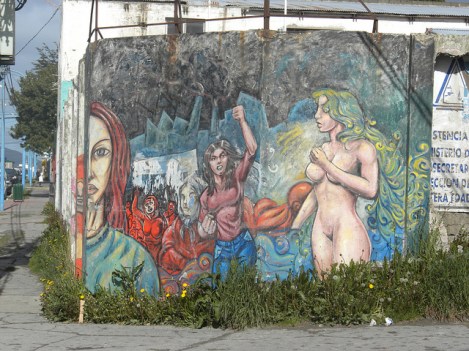
Mural Along Rivadavia in Ushuaia, Tierra Del Fuego

Mural Along Rivadavia in Ushuaia, Tierra Del Fuego

I remember my first vacation on my own. Despite protests from my parents, who, of course, wanted me to come to Cleveland and slip into the family ways like putting on a glove. But I was thirty years old, and I wanted to travel.

As a child, my travels were limited to places my parents wanted to go, places like Detroit; Lake Worth, Florida; Niagara Falls; and Passaic, New Jersey. My only choice as a child was a day trip to Schoenbrunn Village in Central Ohio, site of the first settlement in the state. (And the folks did not enjoy it, although my brother and I did.)

So, in November 1975, I decided to spend eighteen days in Yucatán visiting ancient Mayan ruins. It was a great trip, and it turned me around completely. No longer was I going to be satisfied by hanging out in Cleveland, a city from which all my friends had fled after high school.

Above is a mural on Rivadavia, a north/south street in the Tierra Del Fuego capital of Ushuaia. It also happens to be the street where I slipped on the ice in 2006 and cracked my right humerus, just one block north. No matter: Five years later I returned with Martine, stayed at the same bed & breakfast (the Posada del Fin del Mundo), and had a wonderful time.

It’s like those Tibetan pictures of devils deliberately intended to frighten you, like the following:

Tibetan Demon

Tibetan Demon

According to the Tibetan Book of the Dead, if you are frightened of the demons, your soul will gravitate toward a copulating couple; and you will be reborn as their child. If you are not moved by fear, there is a chance that you will obtain Nirvana.

That’s why I would have no fear about traveling to Turkey, to Russia along the Trans-Siberian Railway, and any number of places. Of course, I have no intention of visiting Syria, North Korea, Somalia, or Mali. That would not be prudent.


Perfect Landscapes

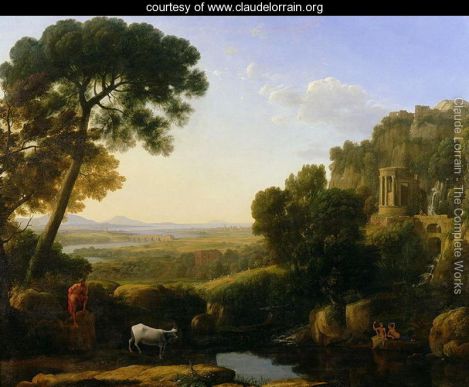
Claude Lorrain’s “A Landscape with Argus Guarding Io”

Claude Lorrain’s “A Landscape with Argus Guarding Io”

It doesn’t matter what the painting is called. It’s by Claude Lorrain (1600-1682), so it’s a landscape with classical overtones and various people picturesquely arranged across the foreground as if they were born to grace that landscape the moment they walked across it.

There is something so perfect about Lorrain’s landscapes that I was enthralled to discover a website called Claude Lorrain: The Complete Works. Granted that the pictures are all identified across the top and side, as in the example above, it is still wonderful to see so many of the master’s works all in one place. Take a look at the website and enlarge some of the landscapes: They are perhaps the best ever painted.

I don’t write about painting much, but that’s not because it isn’t important to me. It’s the same reason I don’t write much about music. Both art forms, especially music, tend to defy the world of words—and that’s where I tend to live.

This last weekend, I spent a whole day putting together an MP3 collection of some of my favorite music, including Brahms, Sibelius, Mahler, Tchaikovsky, Beethoven’s Symphonies and Late Quartets, Prokofiev, Elgar, Welsh choral music, and Argentinian tangos sung by Carlos Gardel. They will keep me company on my lonely travels across Iceland.

An Old Man

It’s the Same Everywhere

It’s the Same Everywhere

An old Man,
Is loath to bid the world goodnight, hee knowes the grave is a long sleepe, and therefore would sit up as long as hee could. His soule has long dwelt in a ruinous tenement, and yet is so unwilling to leave it that it could be content to sue the body for reparitions. He lives now to be but a burthen to his friends, as age is to him, and yet his thoughts are as farre from death as he is nigh it. Howsoever time bee a continued motion, yet the Dyall of his age stands still at 50, that’s his age for ten yeares afterward, and love’s such a friend that like a flattering glasse tels him hee seemes farre younger. His memory is full of the actions of his youth, which hee often historifies to others in tedious tales, and thinks they should please others because himselfe. His discourses are full of parenthesis, and his wordes fall from him as slowly as water from an Alimbecke; drop by drop. He loves the chimney corner and his chaire which he brags was his grandfathers, from whence he secures the cubboard from the Catts and Dogges, or the milke from running over, and is onely good to build up the architecture of a seacole fyre by applying each circumstant cynder. When his naturall powers are all impotencyes, hee marries a young wench for warmth sake, and when hee dyes, makes her an estate durante viduitate onely for widowhood. At talke hee commonly uses some proverbiall verses gathered perhaps from cheese-trenchers or Schola Salerna, which he makes as applyable, as a mountebank plasters to all purposes, all occasions. Hee cals often to the Servingman for a cup of Sacke, and to that end stiles him friend; and wonders much that new wine should not bee put in old bottles. Though the proverbe be, once a man and twice a childe, yet he hopes from his second childhood to runne backe into his teenes, and so bee twice a man too. Lastly, hee’s a candle burnt to the snuffe, the ruines onely of a man, whose soule is but the salt of his body to keepe it from stincking, and can scarcely performe that too.—Wye Saltonstall, Picturae Loquentes (1635)

“The World Is Change”

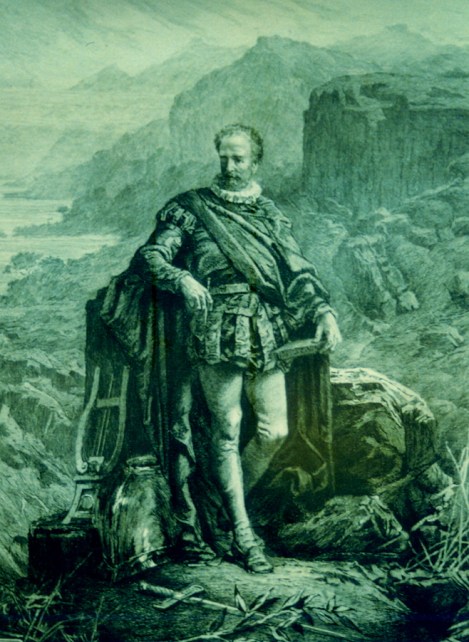
Luis de Camõens (1524-1580)

Luis de Camõens (1524-1580)

Once again I owe a debt of gratitude to Laudator Temporis Acti, certainly one of my favorite websites of late. It seems that no one pays much attention to Portuguese literature any more, or to Luis Vaz de Camõens, who, as author of the Lusiads, is considered perhaps her greatest poet. Below is his sonnet LVII entitled “Omnia Mutantur” (“Everything Changes”). First, here is the English translation by William Baer:

Time changes, and our desires change. What we
believe—even what we are—is ever-
changing. The world is change, which forever
takes on new qualities. And constantly,
we see the new and the novel overturning
the past, unexpectedly, while we retain
from evil, nothing but its terrible pain,
from good (if there’s been any), only the yearning.
Time covers the ground with her cloak of green
where, once, there was freezing snow—and rearranges
my sweetest songs to sad laments. Yet even more
astonishing is yet another unseen
change within all these endless changes:
that for me, nothing ever changes anymore.

And now, for all you Portuguese and Brazilians out there, here it is in the original Portuguese:

Mudam-se os tempos, mudam-se as vontades,
muda-se o ser, muda-se a confiança;
todo o mundo he composto de mudança,
tomando sempre novas qualidades.
Continuamente vemos novidades,
differentes em tudo da esperança;
do mal ficam as mágoas na lembrança,
e do bem (se algum houve) as saüdades.
O tempo cobre o chão de verde manto,
que já coberto foi de neve fria,
e em mi converte em choro o doce canto.
E, afora este mudar-se cada dia,
outra mudança faz de mor espanto:
que não se muda já como soía.

I cannot pretend to understand the Portuguese, but I dearly love to hear the language spoken. It is always music to my ears.

Sehnsucht

At Peyto Lake in Canada’s Banff National Park

At Peyto Lake in Canada’s Banff National Park

I had never heard the German term Sehnsucht before I tried to Google “yearning wild places” a few minutes ago. According to Wikipedia:

Sehnsucht … is a German noun translated as “longing”, “yearning”, or “craving”, or in a wider sense a type of “intensely missing”. However, Sehnsucht is difficult to translate adequately and describes a deep emotional state. Its meaning is somewhat similar to the Portuguese word, saudade, or the Romanian word dor. Sehnsucht is a compound word, originating from an ardent longing or yearning (das Sehnen) and addiction (die Sucht). However, these words do not adequately encapsulate the full meaning of their resulting compound, even when considered together.

Sehnsucht represents thoughts and feelings about all facets of life that are unfinished or imperfect, paired with a yearning for ideal alternative experiences. It has been referred to as “life’s longings”; or an individual’s search for happiness while coping with the reality of unattainable wishes. Such feelings are usually profound, and tend to be accompanied by both positive and negative feelings. This produces what has often been described as an ambiguous emotional occurrence.

It is sometimes felt as a longing for a far-off country, but not a particular earthly land which we can identify. Furthermore there is something in the experience which suggests this far-off country is very familiar and indicative of what we might otherwise call “home”. In this sense it is a type of nostalgia, in the original sense of that word. At other times it may seem as a longing for a someone or even a something. But the majority of people who experience it are not conscious of what or who the longed for object may be, and the longing is of such profundity and intensity that the subject may immediately be only aware of the emotion itself and not cognizant that there is a something longed for. The experience is one of such significance that ordinary reality may pale in comparison, as in Walt Whitman’s closing lines to “Song of the Universal”:

Is it a dream?
Nay but the lack of it the dream,
And failing it life’s lore and wealth a dream
And all the world a dream.

So what is my yearning? I can tell you one thing right from the start: It is for a place where there are no mosquitoes. Sun-drenched beaches are not anywhere in my dreams. Look at some of the places I have visited in the past years: The Hebrides and Orkney Islands of Scotland, Argentina’s Tierra del Fuego and Patagonia, Iceland, the Canadian Rockies, Quebec and the Maritime Provinces of Canada.

My Sehnsucht takes me to cold, wild places, such as Pehto Lake in Banff National Park (above).

I also like deserts, especially those in the American Southwest and Argentina. I would add Mexico if I were more familiar with the states of the North.

Where I part from the Wikipedia definition is any identification of the places for which I yearn with home. I was born in Cleveland, which I will forever associate with dirty red brick buildings and accumulations of snow that exhibit a chronicle of dog piss over time. Nor is Los Angeles my “home” in any real sense. I like it. It’s where I hang my hat. But it represents the place I would like to escape from—at least for the time being.

No, I do not think I could live in Tierra del Fuego or the Outer Hebrides, but I love to visit them. And I love to spend months planning for my visit. The planning can almost be as enjoyable as the actual trip. It seems I am always either planning one of these escapades or actually at my destination.

That tension between where I’m currently living and where I would like to visit is one of the main motivating factors of my life. I must say, it seems to work—at least for me.

Howdy Doody and Harvey Rice

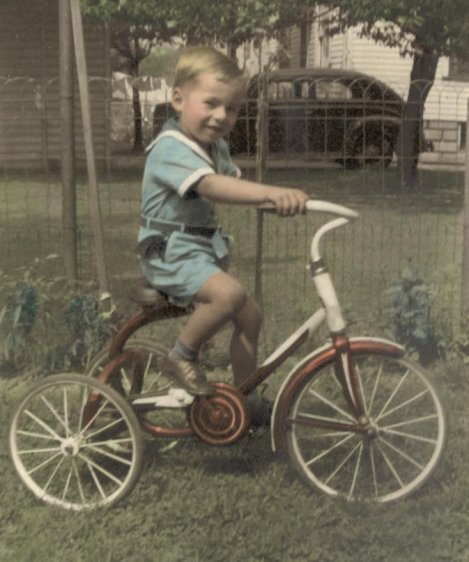
Me on a Tricycle Ca. 1950

Me on a Tricycle Circa 1950

That’s me on a tricycle, sometime around 1950. We were living at 2814 East 120th Street off Buckeye Road in Cleveland. The whole place was filthy with Hungarians. There were so many, in fact, that I did not know the English language existed until two things happened: First, we got a television set late in 1949, and I started watching the Howdy Doody show at 5 pm every day, just after Kate Smith closed her show by singing “When the Moon Comes Over the Mountain.” (It took me a while to understand what Howdy and Buffalo Bob Smith were saying.)

Secondly, I started kindergarten at Harvey Rice School on East 116th Street in January of 1950. My parents thought that, living as we did in a Hungarian neighborhood, the public school teachers would speak Hungarian. Nothing doing! Mrs. Idell sent me home with a note pinned to my shirt that asked, “What language is this child speaking?” As if she didn’t know!

That last factor decided my Mom that we had to leave our little Hungarian womb on the East Side and move to the suburbs. Gone forever would be the Reverend Csutoros and the First Hungarian Reformed Church; the Regent and Moreland movie theaters; Kardos’s Butcher Shop with its delicious Hungarian sausages; the College Inn, where my Dad would take me for French Fries; and the Boulevard Lanes where my Dad bowled and I kept score.

It was a cohesive little world, but my parents ate the apple from the Tree of Knowledge when they decided to raise me as a Hungarian. You know what? I’m grateful that they did. I made my adjustment to English (and I’m still making it), but my heart belongs to the Magyar Puszta.

.

Visiting the Angry Sisters

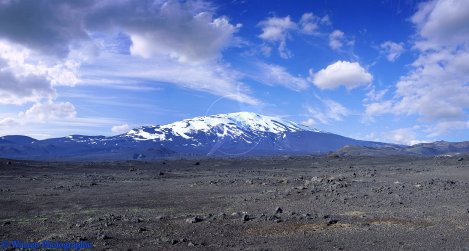
Mount Hekla

Mount Hekla in South Iceland

Whenever I have a few minutes during the craziness of tax season, I check out the Daily Life column on The Iceland Review’s website. Yesterday’s entry by Katharina Hauptmann (half of the Daily Life columnists are from outside Iceland) had the following to say:

In the past two days news broke about unusual seismic activity around the volcano Hekla.

Naturally, it became talk of the town.

Officially, a level of uncertainty has been issued and the related parties continue to monitor Hekla closely.

So can you by keeping your eyes on the volcano with this webcam.

Actually, everybody was waiting for Hekla’s neighbor Katla to blow, as an eruption is more than overdue.

Now it seems that Katla’s little sister Hekla is keeping the world on tenterhooks.

Here in Iceland, one usually refers to Hekla and Katla as the “angry sisters.”

I was once told that volcanoes had women’s names in Iceland because their nature was just like women: unpredictable and explosive.

During my upcoming visit to Iceland, I hope that neither Katla nor Hekla nor the dread Eyjafjallajökull erupt, because I will be spending four days in the South of Iceland in areas that would have to be evacuated (Hvolsvollur and Heimaey). And if it happens while I am in Höfn for two days, I will have to go all around the island to return to Reykjavik.

In European history, it is Hekla (shown above) that has the horrendous reputation. During the Middle Ages, it was widely regarded as the mouth of hell, and fishermen could see its eruptions from hundreds of miles away. By the way, there is a Hekla webcam you can visit. Just note that Iceland is on or near Greenwich Mean Time, and it is likely to be night there when you try.

You may recall the widespread cancellation the last time Eyjafjallajökull erupted twice in 2010. Newspapers around the world showed photographs of the devastation:

Eyjafjallajökull

Eyjafjallajökull

With volcanoes, one could get a day or two of warning before—literally—all hell breaks loose. But isn’t that all part of the fun?

Sons and Dóttirs

Icelandic Mystery Writer Yrsa Sigurdardóttir

Icelandic Mystery Writer Yrsa Sigurdardóttir

The following is loosely excerpted from a review I wrote on Goodreads.Com about Ashes to Dust by the Icelandic mystery writer Yrsa Sigurdardóttir:

Yrsa Sigurdardóttir’s work reminds me of an Icelandic “delicacy” called hákarl, which consists of shark meat which is fermented for several months, sometimes underground, until the ammoniac stench is strong enough to repel the most ravenous shorebirds. I do not mean to imply that Ashes to Dust is as appetizing as road kill: It is just that its author has a tendency to go for the gamier edge of crime. That was also the case with her first book, Last Rituals. I was surprised to read that Ms. Sigurdardóttir is an engineer, because I would have guessed that she was a pathologist.

Ashes to Dust is about three bodies — accompanied by a severed head — which were discovered more than thirty years after the eruption of the volcano Eldfell on the Westmann Islands, which destroyed some 400 homes on the main island of Heimaey. Attorney Thóra Gudmundsdóttir is trying to build a case for the innocence of the man accused of the murders, back when he was a teenager and the volcano erupted in January 1973. The story gets rather complicated (as in her other book that I read), but the author manages to keep all the threads in play until the very end.

Iceland is becoming quite a haven for mysteries: In addition to Yrsa and Arnaldur Indriðason—not to mention the American Ed Weinman (who has lived in Iceland for many years)—there seems to be a growing trend for the small island to become a major force in the production of mystery novels.

I thought I would segue into a not entirely unrelated topic, namely Icelandic names. You may have noticed that most of the names I’ve mentioned in this post end either in -dóttir or -son. That is partly because, until recently, it wasn’t considered quite kosher to have a last name that was anything but a patronymic.

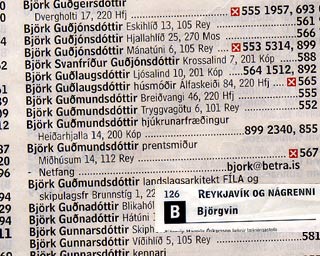
Let’s see how this works. If I were an Icelander, my name would be James Alexson, “James the Son of Alex,” and Martine would be Martine Wilsonsdóttir, “Martine the Daughter of Wilson.” Take a look at the image below from an Icelandic telephone directory:

Bjork to Your Heart’s Content!

Bjork to Your Heart’s Content!

Notice that the names in an Icelandic telephone directory are alphabetized by first name, in this case Björk, and patronymic. In case you didn’t already know, Björk Guðmundsdóttir is the Icelandic recording artist Björk. My guess is the recording artist is probably the one whose address is in Reykjavik 101, which is the Icelandic equivalent of Beverly Hills 90210.