I Book the World’s Youngest Volcano

The Town of Heimaey, Iceland, Flanked by Two Volcanoes

The Town of Heimaey, Iceland, Flanked by Two Volcanoes

I had been there on a day trip from Reykjavik twelve years ago. Because I was afraid of seasickness on the three-hour ferry from Þorlákshöfn, which was famous for rough seas, I flew from the small Reykjavik airport. Several years ago, the Eimskip Line opened a new ferry port at Landeyjahöfn, which is only a thirty-minute ferry ride from the Westmann Islands. This time, I’ll take the ferry, fortified with Dramamine.

Heimaey (literally “The Home Island”) is a beautiful town flanked by two volcanoes, Eldfell (on the left) and the extinct Helgafell (right). Until January 23, 1973, Eldfell didn’t exist. What was a suburban development suddenly turned overnight into a volcano, forcing the evacuation of the entire island. While lava destroyed some 400 homes, the ingenious Icelanders found a way of forcing the lava to form a berm by endlessly pumping cold seawater on its leading edge. The story is told by John McPhee in his book, The Control of Nature.

I had a difficult time booking a room in Heimaey on my original desired dates. Then, just for the heck of it, I decided to hang around a few extra days along the Suðurland, or South Coast, of Iceland (at Hvolsvöllur and Höfn) and try for a few days later. Bingo! I got into the best accommodation on the island. My guess is that there was a local event, like a soccer game or a festival, that drew a crowd on the original dates.

Why do I want to go to the Westmann Islands again? First of all, it is drop-dead beautiful, a major fishing port, and the place where I am most likely to be able to photograph puffins:

Puffins

Puffins

I am told the island’s southernmost peninsula has the world’s largest concentration of the picturesque seabirds at a place called Störhofði.

Puffins and I go way back. I tried to find them in Scotland in September 1998, but they hadn’t arrived there yet. Then I went to Heimaey late in August 2001, but they had all just left.

Martine would love to see them, but I’ll just have to take a load of pictures so that she could enjoy them vicariously.


Those Krazy Kims

Kim III, Alias Kim Jong Unnnnhhh

Kim III, Alias Kim Jong Unnnnhhh

The nuclear era has been around for almost three-quarters of a century now, and we finally have a head of state threatening to begin a thermonuclear war against the United States. I think we have to take this wing-nut seriously. Even if it’s just empty tough talk, it’s the kind of tough talk that calls for a unblinkered response.

Why should we bother to send food to North Korea when they have identified themselves as our enemy? We should be planning airstrikes against Pyongyang and the various outlying nuclear weapons facilities, if we know where they are. Then I think we have to hold back on the trigger, unless, unless, Kim steps over the line in an overt way. Once he does that, he and his poor damned country will have to be vaporized.

Obviously, we will have to coordinate closely with China on this. I suspect that Beijing wants Kim out as much as we do, and may even take the first step. Seeing as how Chinese Communism has evolved into a form of capitalism, Beijing does not want to see its business partners threatened.

Right now, I see the DPRK (“Democratic” Peoples’ Republic of Korea) fully as dysfunctional as Somalia, Syria, the tribal areas of Pakistan, or any other failed state. Apparently, you don’t have to be Muslim to be totally wacko.

I have heard that Kim’s tough talk is occasioned by hard-liners in his military who think he is too soft on the West. Maybe, but I wouldn’t like to take that chance.

The Polymath

An Old Scholar

An Old Scholar

Keith was a pertinacious and omnivorous student; he sought knowledge not for a set purpose but because nothing was without interest for him. He took all learning to his province. He read for the pleasure of knowing what he did not know before; his mind was unusually receptive because, he said, he respected the laws which governed his body. Facts were his prey. He threw himself into them with a kind of piratical ardour; took them by the throat, wallowed in them, worried them like a terrier, and finally assimilated them. They gave him food for what he liked best on earth: ‘disinterested thought’. They ‘formed a rich loam’. He had an encyclopædic turn of mind; his head, as somebody once remarked, was a lumber-room of useless information. He could tell you how many public baths existed in Geneva in pre-Reformation days, what was the colour of Mehemet Ali’s whiskers, why the manuscript of Virgil’s friend Gallus had not been handed down to posterity, and in what year, and what month, the decimal system was introduced into Finland. Such aimless incursions into knowledge were a puzzle to his friends, but not to himself. They helped him to build up a harmonious scheme of life—to round himself off.—Norman Douglas, South Wind

Serendipity: The Janissaries

At One Time, They Were Feared by the Enemies of the Ottoman Empire

At One Time, They Were the Most Feared Infantry in Europe

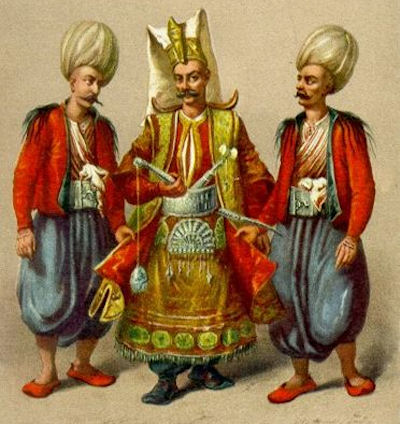
They look rather silly, don’t they? But in the 15th and 16th centuries, they were the elite infantry of the Ottoman Empire. The Janissaries conquered the Balkans, much of the Black Sea coast, and Hungary. Little known to most people is that they were almost exclusively Christians, who were either kidnapped or bought from their parents by recruiters under the empire’s devshirme system. But, like many things that were once a good idea, it didn’t look so good any more by the time the 1800s rolled around.

The following discussion comes from David Brewer’s excellent book The Greek War of Independence: The Struggle for Freedom from Ottoman Oppression and the Birth of the Modern Greek Nation:

The Sultan’s problem within his borders lay, as it had done before, with the corps of janissaries. They were now practically useless as a military force, and [the Sultan] Mahmoud had to fight his wars with mercenaries and with troops raised by local pashas. The janissary regiments in the provinces drew pay and rations in idleness, while those in the capital were an unruly menace, as a contemporary visitor described. “Lords of the day,” he wrote,

they ruled with uncontrolled insolence in Constantinople, their appearance portraying the excess of libertinism; their foul language; their gross behaviour; their enormous turbans; their open vests; their bulky sashes filled with arms; their weighty sticks; rendering them objects of fear and disgust. Like moving columns, they thrust everybody from their path without any regard of age or sex, frequently bestowing durable marks of anger or contempt.

In 1807 Mahmoud’s predecessor Selim III had tried to bring the janissaries under control by incorporating them into his so-called Army of the New Order. The janissaries reacted violently, the New Army was formally abolished and Selim lost his throne. In the following year, the first of Mahmoud’s reign, his grand vizier publicly advocated reforming the janissaries and curbing their abuses, but lost his life in the ensuing janissary revolt.

In the space of some four hundred years, the janissaries went from an elite military force to a kind of mafia, with members of the corps selling “protection” to merchants. They acted as the firemen of Constantinople, but it was also widely believed that they set the fires in the first place.

For a delightful novel about the decay of the janissary corps, I recommend Jason Goodwin’s The Janissary Tree, a 19th century mystery whose “detective” is a eunuch connected with the Sublime Porte. In 1826, the Sultan could take no more and began arresting and executing the remnants of the corps. In Ottoman history, the persecution is referred to as the “Auspicious Event.”

By the way, Jason Goodwin not only writes entertaining detective stories set in the Ottoman Empire, but he is also a historian whose Lords of the Horizons is perhaps the best introduction to the Empire.

How Our Era Will Be Remembered

Turmoil in the Middle East

Another Day of Turmoil in the Middle East

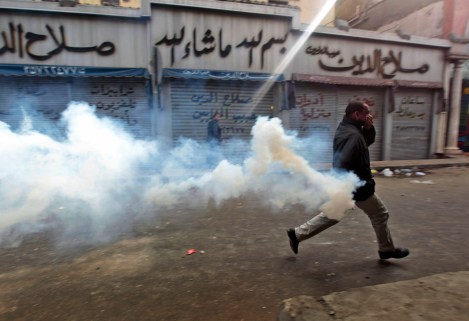
Clearly, Islam is undergoing a large-scale upheaval. Ever since the break-up of the Ottoman Empire after the First World War, most Muslims in the Middle East have been living in countries with ill-defined borders ruled by various strong men. There is a general feeling that all is not well with their part of the world.

Beginning in the peri0od between the two World Wars, American and European oil companies moved in on these strong men and made them an offer they couldn’t refuse: unlimited wealth and power, if only they would sign on the dotted line. They signed, all right, but after almost a century, that money has not filtered down to the Arab man on the street. (Most of it probably ended up in offshore banking accounts owned by the strong men and their families.)

What to do about it? Well, first of all, one could riot and cause mayhem. Even if they topple one strong men, like Hosni Mubarak of Egypt, there is always a Mohammed Morsi waiting in the wings to make himself and his family equally rich and powerful.

Or, another popular option is to blame the West for all their ills. “Ameriki” is the Great Satan and must be destroyed, along with its jackal partner Israel. If your country’s unemployment rate for young men is something like 75%, then blowing oneself up along with Islam’s enemies looks like a good career move. The Jihad Option is a popular one, especially the more the situation appears to be dire. The problem is, when all of Islam’s external enemies have been destroyed, then it will be necessary to move on the internal enemies, such as Shia, Alawite, or Sufi Muslims; Druzes; Baha’is; Copts and other Middle-Eastern Christians, and others. Other than filling graveyards, how does that solve their problems?

Islam has so very many enemies, and so few friends. If, by merely existing, Americans become enemies of Jihadists, what’s the point of trying to kiss up to them? The pity of it all is that, to quote Yeats:

The best lack all conviction, while the worst
Are full of passionate intensity.

And the streets are teeming with the worst….

The Second Step Is Taken

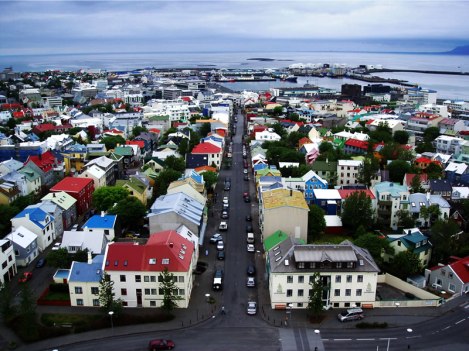
Downtown Reykjavik, Iceland

Downtown Reykjavik, Iceland

Now that I settled on a flight to/from Iceland, it’s time to get some room reservations. Iceland has a very short tourist season, running roughly from the middle of June to the end of August. Even before September, many tourist offices are closed down in preparation for the beginning of school. That’s right: Many tourist facilities are in school buildings scattered around the country. Many boarding schools become summer hotels, and then return to educational use come September.

When I arrive in Reykjavik, it will be just before the longest day of the year, during which there is no darkness to speak of. Unless the guesthouses where I stay have blackout curtains (and most of them don’t), I will have to wear eyeshades to allow me to sleep. And because of the runtur—the Icelandic equivalent of a spring weekend at a Mexican resort—and the boisterousness of hundreds of European teenagers showing they can drink like a man, I will also come equipped with earplugs. That will not be much of a problem outside the capital, however.

Greater Reykjavik is a small city by U.S. standards, about 120,000 people in a country whose total population is about 322,000. It is the world’s northernmost capital of a sovereign state. That sentence is worded thusly to eliminate Nuuk, which is the capital of the Danish colony of Greenland.

I had hoped to secure a room at the Baldursbra Guesthouse on Laufásvegur, where I stayed in 2001, but they were booked solid; so I took a chance on the Guesthouse Odinn, which is slightly nearer the center of things by Laugavegur (the main shopping street) and therefore probably more noisy. No matter. Being by myself, I am more able to put up with a variety of situations. I just hope it’s not a big party place, with young males screaming and projectile vomiting all over the place.

The First Step Is Taken

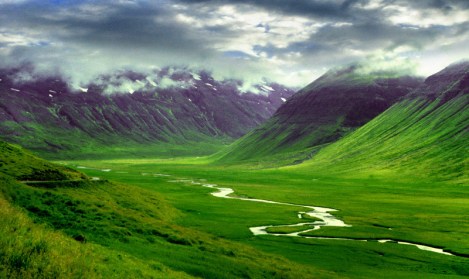
Icelandic Scenery

Icelandic Scenery

Today I finally booked my flight to Iceland. Note that I said my rather than our. Unfortunately, Martine will not be able to come with me. Ever since the beginning of the year, she has been suffering from what I think is fibromyalgia, characterized by neuromuscular pains in the neck, shoulder, and back and a difficulty with sleeping. She is currently working with a physical therapist to alleviate her symptoms. But, as things stand now, she is unable not only to carry her luggage, but to wear a purse on her shoulder. It will be a beautiful but lonely trip.

My plans are to leave in the middle of June and return early in July. I hope to see, in addition to the capital Reykjavik, the island of Heimaey, the Njals Saga country around Hvolsvöllur, the Egil’s Saga country around Borgarnes and Reykholt, the Snaefellsness Peninsula around Stykkishólmur, and the Westfjords from Isafjörður to the bird cliffs of Látrabjarg. Perhaps, if there is time, I could also visit Akureyri and the falls at Goðafoss.

My Kindle is already loaded with Icelandic Sagas, and before I leave for Reykjavik, I expect to read another half a dozen.

I could have taken the cheapest flight, but I hate being rushed from one gate to the other at a large airport, so I arranged to have four-hour stopovers in Toronto on the way out and Boston and the way back.

Iceland is beautiful, but I will miss Martine.

Syria’s Hezbollah Connection

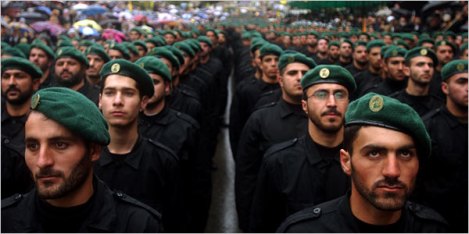
Hezbollah Fighters

Hezbollah Fighters

You may recall that, when Israel last invaded Lebanon in 2006, they got a bit of a surprise: the fighters of Hezbollah, “the Party of Allah,” fought them to a standstill. Long used to winning all their armed conflicts with the Islamic world, Israel found itself flummoxed at every turn by a well prepared military force based in undetectable underground bunkers all along the border.

Hezbollah is a Shia paramilitary group, founded and bankrolled by Iran, operating in several states in the Arab world that are mostly Sunni. To ensure their survival amid changing conditions, the Hezbollah made a devil’s bargain with Bashar al-Assad in Syria to help them against the anti-régime rebels. If Syria loses its conflict, Hezbollah fears it will lose its influence to a new Syria in which the political power will rest with the Sunni.

As a step to maintaining its power in Lebanon, Hezbollah has done something it never wanted to do: It became a political party. When you’re predominately an insurgent group, it’s difficult to take care of issues like healthcare, education, and sanitation. The Hezbollah legislators are a quietly sullen group doing what they feel they have to do to survive.

What could happen is that Hezbollah might find that politics are to its liking. And then they will become just another terrorist group (like Kenya’s Mau-Mau and South Africa’s African National Congress) that became legit.

White Heroes and Dark Heroes

Egil Skallagrimsson (d. A.D. 990)

Egil Skallagrimsson (d. A.D. 990)

As my need to escape the horrors of tax season grows apace, I am increasingly burying myself in the world of medieval Icelandic sagas. A few days ago, one of my favorite writers for The Iceland Review, Jóhannes Benediktsson, wrote the following in the “Daily Life” column:

I was taught in junior college, that there were two types of heroes in the Icelandic Sagas: White heroes and dark heroes. Mickey Mouse is an example of a white hero. Donald Duck is very dark.

In Njáls Saga, we have a good example of a white hero: Gunnar of Hlíðarendi.

Gunnar is described as being close to perfect. He’s exceptionally athletic and breathtakingly good looking. He’s an honorable man and very popular. Seemingly to me, he has only one flaw: He’s a bit shallow—a common trait found in people that go through life without experiencing any real adversity.

Skarphéðinn Njálsson is a dark hero from Njáls Saga. Like Gunnar, he’s very strong. But his appearance is not as light. His mood is heavy and he often grins when he hears about warfare that may be brewing.

Another good example of a dark hero is Egill Skallagrímsson, from The Saga of Egill. He’s described as being very ugly, but stronger than most men. He’s greedy and can be unfair. Some of his most heroic moments happened when he was the sole witness.  I think that is no coincidence.

These guys are not flawless. They are very complicated and have some serious issues. I have no idea what they’ll do next, and that makes me very excited.

Last night I just finished reading what Jóhannes calls The Saga of Egill, and which British and American publishers call Egil’s Saga. Over a space of about 250 pages, we see him carrying on a brutal war of vengeance against everyone he feels done him wrong, including two Norwegian kings, Harald Fine-Hair and Eirik Blood-Axe.

At the same time he was a redoubtable warrior, Egil Skallagrimsson was also a poet of some distinction, and he went back and forth between composing poems and planting axes in the heads and bodies of his enemies.

Jesse L. Byock, perhaps one of the world’s greatest scholars of Icelandic history during the saga era, wrote an article for The Scientific American in January 1995 about his personal search for Egil’s bones. It appears that Egil may have suffered from an ailment known as Paget’s disease, which may be partly responsible for his fearsome appearance. If you’re interested in the sagas, you should read Byock’s article. And, while you’re at it, you may want to hunt up a copy of his book Viking Age Iceland.

My Lack of Civic Spirit

The L.A. Marathon Is Good Mainly for Screwing Up L.SA. Traffic

The L.A. Marathon Is Good Mainly for Screwing Up L.A. Traffic

Every year around this time, the Los Angeles Marathon is run; and, every year, it’s run on a Sunday morning and afternoon during the most brutal part of tax season. Those of us who have to go to work on this day are frequently re-routed in a way that makes us feel tired before we even get to work.

Here is the problem in a nutshell: I live south of the usual L.A. Marathon route, and I work north of the route. That means I have to take the freeway to work … But wait, CalTrans is still working on the exit I have to take. So I would have to go miles out of my way to get to and from work.

The other option is Wilshire Boulevard. Fortunately, the boys and girls in their floppy shorts go under the road through the Veterans’ Administration campus on Bonsall. That works fine in the morning, but in the afternoon, for the return trip, all the left turn lanes are a mile long. So I had to take Veteran Drive to Montana to Sepulveda and take a right on Wilshire. That was a five-mile detour.

If it were me to re-route the Marathon, I would have them run straight up the San Gabriel Mountains. That’ll show how much heart they have!