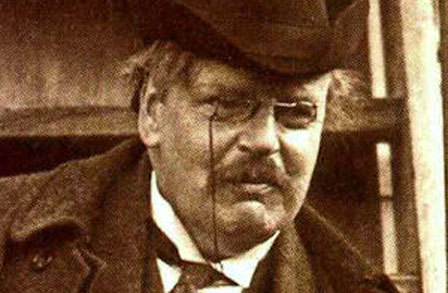
We have remarked that one reason offered for being a progressive is that things naturally tend to grow better. But the only real reason for being a progressive is that things naturally tend to grow worse. The corruption in things is not only the best argument for being progressive; it is also the only argument against being conservative. The conservative theory would really be quite sweeping and unanswerable if it were not for this one fact. But all conservatism is based upon the idea that if you leave things alone you leave them as they are. But you do not. If you leave a thing alone you leave it to a torrent of change. If you leave a white post alone it will soon be a black post. If you particularly want it to be white you must be always painting it again; that is, you must be always having a revolution. Briefly, if you want the old white post you must have a new white post. But this which is true even of inanimate things is in a quite special and terrible sense true of all human things. An almost unnatural vigilance is really required of the citizen because of the horrible rapidity with which human institutions grow old. It is the custom in passing romance and journalism to talk of men suffering under old tyrannies. But, as a fact, men have almost always suffered under new tyrannies; under tyrannies that had been public liberties hardly twenty years before. Thus England went mad with joy over the patriotic monarchy of Elizabeth; and then (almost immediately afterwards) went mad with rage in the trap of the tyranny of Charles the First. So, again, in France the monarchy became intolerable, not just after it had been tolerated, but just after it had been adored. The son of Louis the well-beloved was Louis the guillotined. So in the same way in England in the nineteenth century the Radical manufacturer was entirely trusted as a mere tribune of the people, until suddenly we heard the cry of the Socialist that he was a tyrant eating the people like bread. So again, we have almost up to the last instant trusted the newspapers as organs of public opinion. Just recently some of us have seen (not slowly, but with a start) that they are obviously nothing of the kind. They are, by the nature of the case, the hobbies of a few rich men. We have not any need to rebel against antiquity; we have to rebel against novelty. It is the new rulers, the capitalist or the editor, who really hold up the modern world. There is no fear that a modern king will attempt to override the constitution; it is more likely that he will ignore the constitution and work behind its back; he will take no advantage of his kingly power; it is more likely that he will take advantage of his kingly powerlessness, of the fact that he is free from criticism and publicity. For the king is the most private person of our time. It will not be necessary for any one to fight again against the proposal of a censorship of the press. We do not need a censorship of the press. We have a censorship by the press.—G. K. Chesterton, Orthodoxy
Home » 2014 (Page 29)
Yearly Archives: 2014
Tarnmoor’s Iron-Clad Rule #1: Ecology
This is the start of a new series on what I perceive to be iron-clad rules based on my perceptions of human psychology, science, and other factors. I will start with ecology.
Most of us would like to do what we can to save the environment. I certainly do. But I am only one person, and there are several billion refractory individuals who refuse to be influenced by me. People who mine coal, cut down redwoods, and manufacture Soylent Green in bulk will wish to continue to do so. They need the job and don’t give a flying petoot what some tree-hugging pansy-assed Liberal wants. No, they don’t care about Whooping Cranes, the California Condor, or any number of endangered amphibians or insects. To hell with ’em: Let ’em all get extincticated.
Even I am conflicted: I love to travel, but most of the places I want to visit involve an airline flight, often for long distances. A pogo stick or skateboard will just not get me to Argentina.
So here is Tarnmoor’s Iron-Clad Rule #1: People who have a vested interest in things continuing as they are will not move a muscle to help the environment. And that includes both Progressives and Conservatives in great numbers.
Whatever the rule may state, I will continue to do what I can, in my own small way, to help slow down what appears to be the coming extinction of the human race by its own accumulated garbage. (Though I won’t stop traveling while I can.)
Eventually, things will reach such a pass that there won’t be a choice. I think that the major cities of China are fast reaching that point with their abysmal air quality. The potential collapse of the ground over drained-out aquifers in the United States may be coming soon. And that’s not to mention such catastrophic game-changers as the asteroid that caused the Cretaceous Extinction.
He Died in Paris After All
Since I’ve been reading so much about Peru, I felt bad that I had not read any Peruvian poetry. According to what I’ve read, the national poet of that land was César Vallejo (1892-1938). I took a fancy to the following poem, which I present in both English and Spanish:
Black Stone on Top of a White Stone
I shall die in Paris, in a rainstorm,
On a day I already remember.
I shall die in Paris—it does not bother me—
Doubtless on a Thursday, like today, in autumn.
It shall be a Thursday, because today, Thursday
As I put down these lines, I have set my shoulders
To the evil. Never like today have I turned,
And headed my whole journey to the ways where I am alone.
César Vallejo is dead. They struck him,
All of them, though he did nothing to them,
They hit him hard with a stick and hard also
With the end of a rope. Witnesses are: the Thursdays,
The shoulder bones, the loneliness, the rain, and the roads…
Here is the original Spanish:
Piedra Negra Sobre Piedra Blanca
Me moriré en París con aguacero,
un día del cual tengo ya el recuerdo.
Me moriré en París—y no me corro—
tal vez un jueves, como es hoy, de otoño.
Jueves será, porque hoy, jueves, que proso
estos versos, los húmeros me he puesto
a la mala y, jamás como hoy, me he vuelto,
con todo mi camino, a verme solo.
César Vallejo ha muerto, le pegaban
todos sin que él les haga nada;
le daban duro con un palo y duro
también con una soga; son testigos
los días jueves y los huesos húmeros,
la soledad, la lluvia, los caminos…
It’s a rather somber poem about a man who dies alone in exile, after having been beaten with a stick and the end of a rope. And who are his witnesses? Thursdays, shoulder bones, loneliness, rain, and the streets. I would like to know more about the poet’s life, but I’ll just have to content myself for now with his lonely death on the streets of Paris.
Conversation in the Cathedral
Even though I have so little time to myself this time of year, I still tend to pick at least one gigantic and challenging book to read each month. Last month, it was Tony Judt’s Postwar: A History of Europe Since 1945. Next month, it will be my third re-reading of Marcel Proust’s Swann’s Way. This month, it was Mario Vargas Llosa’s Conversation in the Cathedral, probably the greatest novel to come from Peru.
Conversation in the Cathedral cuts through a broad swath of Peruvian society during the dictatorship of Manuel A. Odria (1948-1956), from the corrupt Zavala family, which is tied in to Odria, and Don Cayo Bermudez, the dictator’s enforcer, to the chauffeurs, Odriista strongarms, mistresses, and whores who are all in on the take. The major characters are Santiago Zavala, nicknamed Zavalita, and Ambrosio Pardo. The first is the eldest scion of the Zavalas; the second, a black former chauffeur for Zavalita’s father and also for the infamous Cayo Bermudez, Odria’s security chief. Ostensibly, the “conversation” of the title is between Zavalita and Ambrosio, who have just met at the dog pound where the latter now works. It takes place at bar called the Cathedral.
For the first third of the novel, numerous conversations between several of the characters are interleaved—conversations taking place at different times and in different places. Then Vargas Llosa continues in a more conventional vein picking up various threads of the story. Every once in a while, however, threads of the main conversation between Zavalita and Ambrosio reappear.
Estranged from his wealthy family after a flirtation with communism as a student, Zavalita breaks free and becomes a reporter for The Crónica, a Lima daily newspaper, where he gets involved with murders, stories about lottery winners, and other lowlife minutiae, to the disgust of his family. He gets married to a nurse who his mother claims is little better than a maid.
In the end we see numerous stories of blighted ambitions and hopes arising from the heavy hand of President Odria and his enforcers—all taking place over a period of approximately a decade.
If Vargas Llosa never wrote another word in his life, I think that Conversation in the Cathedral was sufficient in its scope and excellence to qualify him for the Nobel Prize in Literature, which he eventually won in 2010, over forty years after he wrote this novel.
Tarnmoor’s ABCs: Cleveland
Cleveland has not aged well. When I was a grade school student, it was one of the ten largest cities in the United States, famed for its steel, machine-tool building, and automotive support industries. Now it is a fraction of the size, with a large bombed-out crater of a central business district and suburbs stretching across several counties in Northeast Ohio. When I graduated from high school, there was a regular diaspora to … anywhere but Cleveland.
The “Mistake on the Lake.” The “Worst Location in the Nation.” Perhaps the ultimate insult was when Amtrak pondered whether it was worth even stopping at the large underground station in the Terminal Tower, illustrated above. There was a time when the Terminal Tower was the largest building in the country outside of New York City.
Just being from Cleveland makes one feel humble. Wasn’t the movie that Maynard G. Krebs of The Affairs of Dobie Gillis always going to see The Monster That Devoured Cleveland? Well, Cleveland got devoured all right: The monster that devoured it was rampant unemployment.
I can only talk about the Cleveland that was because, after 1962, I spent most of my time elsewhere, either in Hanover, New Hampshire, attending Dartmouth College, or here in Los Angeles, where I seem to have set down roots.
The last time I saw my native city was 1998, when I attended my mother’s funeral. She had died in Kings Beach, California, on the shores of Lake Tahoe; but at her request, my brother and I had the body flown to Cleveland, where it was buried next to my father. After the funeral, my brother and I spent some time driving around our old haunts.
What surprised me more than anything else were the trees! When I lived on East 176th Street in the 1950s, the neighborhood was still relatively new and bare; and the trees were all tiny. By 1998, they were gigantic and imposing. It was actually rather nice. I should probably go back there again, perhaps stopping in on a visit to New York or Boston. Most of the people I grew up with are either elsewhere or under the ground, especially the older generation. So it goes.
Signor Piranesi’s Prisons
When I first came to Los Angeles, UCLA had a special program of renting prints and etchings to members of the university community at a low price. I fell in love with a print by Giambattista Piranesi (1720-1778), a Venetian artist known for his series of prints on prisons, or Carceri. I seem to remember having, for about six months, the above print, one of a series of sixteen he did that were to bridge the classical period with the romanticism and surrealism that were to follow.
In his Confessions of an English Opium Eater (1820), Thomas De Quincey wrote:
Many years ago, when I was looking over Piranesi’s Antiquities of Rome, Mr. Coleridge, who was standing by, described to me a set of plates by that artist … which record the scenery of his own visions during the delirium of a fever: some of them (I describe only from memory of Mr. Coleridge’s account) representing vast Gothic halls, on the floor of which stood all sorts of engines and machinery, wheels, cables, pulleys, levers, catapults, etc., etc., expressive of enormous power put forth, and resistance overcome. Creeping along the sides of the walls, you perceived a staircase; and upon it, groping his way upwards, was Piranesi himself: follow the stairs a little further, and you perceive it come to a sudden abrupt termination, without any balustrade, and allowing no step onwards to him.
I still love looking at Piranesi’s imaginative prisons, and I think of myself trapped in one of them—at least until April 15 or thereabouts. Tomorrow is the first of eight Saturdays I will have to work. Oh, well, here are only a little more than fifty days left of this dreadful time. I will probably survive, diminished only slightly.
When Did We Become So Trashy?
There is a new spate of ads on the Internet aimed at idiots. They are usually aimed to appeal to more ignorant Internet users and are frequently sponsored by DoubleClick and related enterprises that would love to load your computer with malware. Once they have you, you’ll see plenty of ads featuring big-breasted middle-aged women, old codgers joyful at reducing their mortgage debt, and finding ways to get your beanpole to extend to ridiculous lengths.
What I find interesting is, that if you click on one of these, you will be directed immediately toward other bonehead ads that make ridiculous promises. You will probably even forget what you were looking for in the first place. Just follow the pendulous boobs and you will be directed to Pleasure island where, in no time at all, you will turn into a donkey.
Oh, No, Another Bill Nye Debate?!
Today, my blog is written by Juan Cole. I thought it was really funny, so here it is in its entirety:
David Gregory’s Meet the Press today hosted a debate between Bill Nye the Science Guy and Texas Rep. Louie Gohmert (R-TX) on whether gravity is just a theory.
“Sure,” Gohmert said, “things fall down all the time. But that doesn’t mean gravity is a law. Look at the Leaning Tower of Pisa. It’s still there after hundreds of years. Things don’t always fall down.”
Nye pointed out that Isaac Newton discovered the law of gravity in the 17th century and it is settled science.
Gohmert challenged Nye’s certainty. “The cultists who tout science always speak as though we know for sure that scientific discoveries are true. Gravity has only been theorized for a couple hundred years. It’s too early to tell. How much money do they want us to waste on suspension bridges and other expensive technology aimed at keeping things from falling down, on the basis of a theory?”
Nye tore off his bow-tie and began chewing on it in frustration.
“Wasn’t it an apple that hit Newton on the head?” Gohmert asked. “Well, I’ve read the Bible and I know that an apple was used to tempt Eve. Maybe the Serpent was just tempting Newton with a secular humanist theory.”
Nye said, “What?”
“Besides,” Gohmert went on, “we all saw that movie ‘Gravity.’ Obviously there’s no gravity in outer space. So if the theory doesn’t work everywhere, there must be something wrong with it.”
“The law of gravity says,” Nye replied, “that ‘any two bodies in the universe attract each other with a force that is directly proportional to the product of their masses and inversely proportional to the square of the distance between them.’ Gravity works in deep outer space, it is just that bodies there are distant from the earth. And in ‘Gravity’ they were just falling around the earth, in the grip of its gravity.”
Moderator David Gregory smirked. “That’s a lot of verbiage there, Bill. If you can’t explain something clearly, maybe it’s because there’s something wrong with the theory.”
Gohmert angrily interrupted Gregory. “Besides, we all know that Muslims believe in gravity. That should make you suspicious of it, right there.”
Nye turned to Gregory. “How can you call yourself a journalist? This is a carnival with a bearded lady exhibit!”
Gregory shrugged. “Next you’ll be saying Glenn Greenwald is a journalist. I am not an activist. I don’t know whether gravity is universal. I let both sides tell their story.”
“That’s not a ‘side’! He’s just mouthing nonsense! It doesn’t even make any sense.”
Gohmert pounded the table. “This whole gravity thing is just a way for scientists to get taxpayers’ hard-won money away from them. NASA wouldn’t get all that funding for rocket fuel if people realized that ‘gravity’ is just a theory.”
Gregory turned to the camera and smiled. “There you have it, folks. Next week on ‘Meet the Press:’ A quarter of Americans think the sun goes around the earth. Could they be right? To explain, we’ll be joined by a homeless man who says he is possessed by the spirit of the ancient astronomer Ptolemy.”
The Squid Test
If lots of different categories of foods fail to pass your “Yuck!” test, it’s fairly certain that squid is on your “avoid at all costs” list. It’s a pity, because most people have never had any really fresh squid. They’re used to those rubbery breaded rings served with a generic tomato dipping sauce at some restaurants with pretensions to high class.
Today, I went to a new Italian restaurant in Westwood called the Donna Sophia Trattoria Napoletana and decided to give them the squid test. Their daily special was tagliatelle cooked in squid ink with calamari. I had never tried anything cooked in squid ink before, but I was feeling decidedly peckish, so I went for it. It was delicious. The calamari pieces were actually tender, and the tagliatelle was made from scratch. Sometimes it pays to take a chance.
Usually, the only places where I’ve had really tender calamari was in certain of the more ethnic Thai restaurants. It was great to see an Italian restaurant where they knew something about squid above and beyond keeping it in the freezer for several decades.
If Donna Sophia had failed to pass my squid test, I would reluctantly have concluded that the place was not very good. Fortunately, it passed with flying colors. It’s so unusual to see a new restaurant in Westwood that is not exclusively Burgers-and-Fries or rice-bowls.
Pacheco and the Dogs
It is a well-known fact that poets don’t grow on trees. Belatedly, I am recognizing the death of José Emilio Pacheco, the Mexican poet who just recently died after a fall at the age of seventy-four. I am not familiar enough with Pacheco’s poetry—to be honest, I am not nearly familiar enough with poetry in general. I should read more, even though there is nothing that is more demanding—or rewarding. Take this simple example, called “A Dog’s Life”:
A Dog’s Life
We despise dogs for letting themselves
be trained, for learning to obey.
We fill the noun dog with rancor
to insult each other.
And it’s a miserable death
to die like a dog.
Yet dogs watch and listen
to what we can’t see or hear.
Lacking language
(or so we believe),
they have a talent we certainly lack.
And no doubt they think and know.
And so
they probably despise us
for our need to find masters,
for our pledge of allegiance to the strongest.
Thanks to Fred Runk, here is the Spanish text of the poem:
Despreciamos al perro dejarse
domesticar y ser obediente.
Llenamos de rencor sustanivo perro
para insultarmnos.
Y una muerte indigna
es morir como un perro.
Sin embargo los perros miran y eschucan
lo que no vemos ni escucharmos.
A falta de lenguaje
(o eso creemos)
poseen un don que ciertamente nos falta .
Y sin duda piensan y saben.
Asi pues,
resulta muy probable que nos desprecien
por nuestra necesidad de buscar amos,
poe nuestro voto de obediencia al mas fuerte.


You must be logged in to post a comment.