The Art of Dust

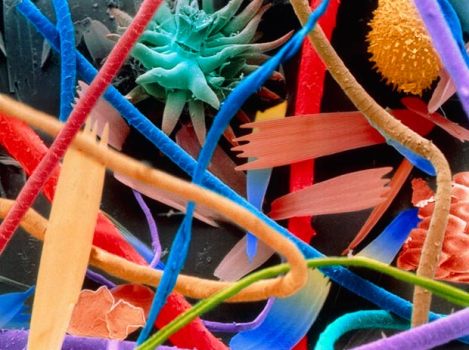
Dust Magnified by an Electron Mkicroscope

Common Household Dust Magnified by an Electron Microscope

One would not think that regular household dust, when magnified by an electronic microscope, could look so artistic. In fact, if I saw a painting like this hanging in an art museum, I would think that here was a painter who had considerable promise.

But then I think of this stuff being sucked into my lungs and down my throat and wonder how I can survive. After all, things are being manufactured with ever more exotic materials; and the detritus from these materials is being sucked into our bodies. Maybe I should look for an electron microscope photograph of our lungs or our bloodstream.

This photo comes from The Guardian’s website, which directs you to other examples of microphotography. Happy hunting!


Laser Light

Extreme Brightness

Extreme Brightness

The month of January is Southern California’s rainiest month. Usually. But not this year. So far, we have been treated to an endless round of Santa Ana winds and low humidity (around 10%). Right now, it’s about 85° Fahrenheit (that’s about 30° Celsius). If the temperature didn’t drop sharply at night, we would all be sweltering.

I just got back from lunch. The heat in this arid weather isn’t quite so uncomfortable as the laserlike light of the sun. It makes me wish I wore my baseball hat or some other brimmed headgear to protect my eyes. Although I wear photo optic glasses, they don’t provide sufficient protection from the sun’s fierceness. Years ago, I used to have super-dark prescription sunglasses. I’m beginning to think I should see my optometrist for another pair of those.

Either Way Is Okay

Shinto Shrine

Shinto Shrine

It is a series of low buildings among trees. Space in a shrine is horizontal and not, as in a cathedral, vertical. In a church, space is confined. It must struggle upward, having no place else to go. In a shrine, space is spread. There are no high walls, no tight enclosures. The space is a grove and this grove seems so endless that it might be the world itself.

The sky seems low, near. There are long expanses of lawn or grove among the buildings. One is not enclosed, nor is one directed. One is liberated, and almost always alone.

Shrine prayer, as I have said, is not communal prayer. It is solitary prayer. It is not a state—it is a function. It lasts only a minute or so and it is spontaneous. One does not enter, as in churches, or descend, as in mosques. The way to the shrine is through a grove, along a walk, through nature itself, nature intensified. Through these trees, over this moss, one wanders to shrines.

This casual, unremarked acceptance of nature speaks to something very deep within us. It speaks directly to our own nature, more and more buried in this artificial and inhuman century. Shinto speaks to us, to something in us which is deep, and permanent.

Certainly we feel—which is to say, recognize—more here than in smiling Buddhism with its hopeful despair, more than in fierce man-made Islam with its heavenly palaces on earth, more than in the strange and worldly tabernacles of the Hebrews or in the confident, vaunting, expectant Christian churches.

This religion, Shinto, is the only one that neither teaches nor attempts to convert. It simply exists, and if the pious come, that is good, and if they do not, then that too is good, for this is a natural religion and nature is profoundly indifferent.—Donald Richie, The Inland Sea

“A Lonely Impulse of Delight”

British Biplane in World War One

British Biplane in World War One

William Butler Yeats is one of my favorite Twentieth Century poets, and one of my favorites among his poems is “An Irish Airman Foresees His Death.” Although deeply shrouded in skepticism, the poem speaks to all people who find themselves somewhere between a rock and a hard place:

An Irish Airman Foresees His Death

I know that I shall meet my fate
Somewhere among the clouds above;
Those that I fight I do not hate,
Those that I guard I do not love;
My country is Kiltartan Cross,
My countrymen Kiltartan’s poor,
No likely end could bring them loss
Or leave them happier than before.
No law, nor duty bade me fight,
Nor public men, nor cheering crowds,
A lonely impulse of delight
Drove to this tumult in the clouds;
I balanced all, brought all to mind,
The years to come seemed waste of breath,
A waste of breath the years behind
In balance with this life, this death.

Kiltartan is a barony in Ireland’s County Galway, home to Augusta, Lady Gregory. Also, it was the occasional residence of the poet himself.

I am particularly drawn to the final quatrain, in which the airman makes an existential decision to fly for the RAF despite his lack of loyalty to the British cause and uncertainty that his people would be worse off if the Kaiser won. He appears to have been a young wastrel who hazards his life in an uncertain cause, joying only in the delight of flying into battle.

Tarnmoor’s ABCs: Books

Some of My Books About Iceland

Some of My Books About Iceland

I was very impressed by Czeslaw Milosz’s book Milosz’s ABC’s. There, in the form of a brief and alphabetically-ordered personal encyclopedia, was the story of the life of a Nobel Prize winning poet, of the people, places, and things that meant the most to him. Because his origins were so far away (Lithuania and Poland) and so long ago (1920s and 1930s), there were relatively few entries that resonated personally with me. Except it was sad to see so many fascinating people who, unknown today, died during the war under unknown circumstances.

This blog entry is my own humble attempt to imitate a writer whom I have read on and off for thirty years without having sated my curiosity. Consequently, over the next few months, you will see a number of postings under the rubric “Tarnmoor’s ABCs” that will attempt to do for my life what Milosz accomplished for his. I don’t guarantee that I will use up all 26 letters of the alphabet, but I’ll do my best. My previous posting on this theme was last month.

Well, B is for Books, the love of my life. It all started before I could read … before I could even speak English. I remember my mother reading me stories (translating them into Hungarian). And when she didn’t have a story to read, she made up one. These were just as good as the published stories. I remember walking with her from our apartment on East 120th Street to the public library next to Harvey Rice School. A few doors down, between Buckeye Road and Van Aken, there was a very good doughnut shop where we would sometimes stop.

In 1951, after my brother Dan was born, we moved to the then treeless suburbs of the Harvard-Lee area. I guess my parents didn’t want to have two boys who couldn’t speak English. I was signed up to attend second grade (even though I completed only the first half of first grade at Harvey Rice—Shhh! Please don’t tell anyone) at Saint Henry School on Harvard Road.

Once I got a handle on the English language, by about the fourth or fifth grade, I started accumulating books. On one hand, my parents were delighted at my strides in understanding English. On the minus side, whenever they got some insurance document written in legalese, I had to interpret it for them. (Ever since, I have hated that fine print crap.)

Also, the books started getting to my parents. “Jimmy, why do you need so many books?” “Uh, because I just do.” “Well, pick up after yourself please.”

Years later, the books started getting to Martine. “Jimmy, why do you need so many books?” “Uh, because I just do.” “Well, pick up after yourself please.”

Actually, I have improved some. I now own two Kindles with fifteen hundred books on them. How many physical books do I own? Oh, somewhere around six or seven thousand.

Currently, I read something like ten books a month, usually literature and history, but some travel, science, economics, and philosophy on occasion. If you are curious about my bookish habits, I suggest you check out my page on Goodreads.Com. You’ll see reviews of every book I read. Click here. You can see links to reviews off to the right side of the four or five books I have read most recently.

I have always assumed that God would let me live as long as I have books to read. And I keep buying more books. It’s like finding the genie in the bottle and wishing for an infinite number of wishes.

Okay, so I’m a bit delusional.

 

Bruce Lee Welcomes You to Chinatown

Statue of Bruce Lee in L.A.’s Chinatown

Statue of Bruce Lee in L.A.’s Chinatown

I’m not sure why it has to be protected by a fence, but there is a statue commemorating Bruce Lee near Chungking Square in L.A.’s Chinatown. When Martine and I celebrated Christmas in Chinatown last month, we noticed Asian family groups taking pictures with the statue. Small wonder: After Bruce’s martial arts films were released in this country, he became a role model for Asian boys who had hitherto been regarded as dorky and innocuous. Even my black friends flocked to see his movies and expressed shock when he died at the age of thirty-two. Needless to say, foul play was suspected.

I myself never went in for what I call “Martian Arts,” but I believe it’s a useful discipline, especially for young men. Once you start on the road to developing yourself into a master of the sport, you learn a lot of good things—including patience. A feisty eight-year-old won’t quickly be able to disarm an opponent the size of, say, Chewbacca; but, as the Chinese say, the journey of a thousand miles begins with a single step.


By Rail to the Past

Selected Gems amnd Minerals

Selected Gems and Minerals

I should have written this post last Sunday, when Martine and I took Los Angeles’s relatively new Expo Light Rail Line to the Natural History Museum, just south of the University of Southern California. We go there, on the average, once every year or two. It was good that we went last week because the Traveling the Silk Road exhibit was still running (it goes until April 13). It was well worth spending an hour or two to see.

It was fun taking the Expo Line because parking at the museum has always been a bit of a drag. Even though we had to catch the line at its temporary terminus in Culver City, we look forward to its extension westward to the beach in Santa Monica. There will be a station just one mile south of where we live, and it will take us all the way downtown and a number of interesting stopping points in between. It will run roughly along the line of Exposition Boulevard, where once the old Pacific Red Car ran in the days when Southern California was better served by public transportation. (If you’ve ever seen the 1988 cartoon/live action feature Who Framed Roger Rabbit?, you know what happened to the Red Car line.)

Triceratops on the Loose!

Triceratops on the Loose!

Of the museum’s permanent exhibits are the dinosaur hall (see above) and the gems and minerals (see illustration at top). There are other exhibits of note, but it would take two days to see them all. Also noteworthy are the exhibits of stuffed North American and African mammals, and a California history exhibit, which deserves to be seen by more visitors. After tax season, I wouldn’t mind checking out the collections again.

My favorite Natural History Museum program of all time was back in 2002, when they had an exhibit and a program of lectures about the Vikings. This was just after my 2001 trip to Iceland, and I was still buzzed—plus I got a chance to meet Jesse L. Byock, Professor of Old Norse and Medieval Scandinavian at UCLA, and Gisli Sigurðsson of the Árni  Magnússon Institute in Rekjavík (whose exhibit on “Vikings and the New World” I had seen at the Culture House in Rekjavík just months before). That was the high point of my relationship with the Natural History Museum: I even became a member for a year or two. Since then, I have been waiting and watching for another special event so in line with my interests.

This Bud’s for You

Camellia Buds at Descanso Gardens

Camellia Buds at Descanso Gardens

Today, in the dead of winter, Martine and I visited Descanso Gardens in La Cañada-Flintridge. There wasn’t much to see, except perhaps a foretaste of things to come. Usually by this time the camellias are in full bloom, but this has been the driest rainy season on record thus far, with less than an inch of rain over the last six months. The number of camellia blossoms was way below normal, but there were a few nice blossoms, and quite a few buds (such as the above) waiting for better conditions.

Sometimes I wonder what the global climate change has in store for Southern California. Will we become like the Atacama Desert of Chile and Peru, where the annual rainfall is measured in millimeters? And this while the Eastern, Southern, and Midwestern parts of the country are suffering from record precipitation!

The Rose Garden was surrounded by a fence to protect the bushes from hungry mule deer that find their way into the gardens and devour up to twenty pounds of plants a day. There didn’t seem to be many, if any, roses; so any damage the deer might do would be mostly to future plants.

Even in a dry season, Descanso was beautiful. It contains the largest camellia forest in North America, shaded by some of the most spectacular oaks on the West Coast. We watched the koi form patterns, as if they were ink strokes in God’s own pictographic language. What He was communicating, I don’t know, but it looked nice.

Koi at Descanso

Koi at Descanso

Shock and Awe

So Easy To Get In ... So Hard To Get Out

So Easy To Get In … So Hard To Get Out

If we weren’t born yesterday, we know by now that it is so much easier to start a war than to end one. Our military talks about going into a war with an “exit strategy,” but what makes us think that we know enough about the situation in the country we are invading to devise an exit strategy that is based on any kind of reality, Take Iraq, for example. We stepped into that tar baby (or was it something equally sticky, but more pungent?) with a display of what George W. Bush called “shock and awe.” It made for good newsreel photography, but don’t you think that once people figured out was happening, they burrowed deep into their warrens and, except for a few unlucky souls, managed to survive.

For a while, things looked pretty good. But then something happened that the Pentagon never imagined: The invasion forced the irreconcilable elements of Iraqi society to splinter apart so quickly that, before we knew what was happening, we found ourselves in a civil war. After the first victories, we bottled ourselves up in the Green Zone. Whenever our boys ventured out, they risked being blown to smithereens by Improvised Explosive Devices (IEDs). Wars tend to accelerate the rapid transformation of societies. Take a look at what happened with all the displaced persons who found themselves stateless at the end of the Second World War.

We are not the only ones to find ourselves in this situation. Take Hitler’s Operation Barbarossa—the invasion of Russia—in 1941. Hitler and his General Staff thought that after some quick one-sided victories, Stalin would sue for peace. After all, the Soviet leader had no idea what was coming. When a Nazi deserter crossed into Russia to warn of an impending mass invasion the day before Barbarossa, Stalin casually had him executed as a spy attempting to sow disinformation. The Germans won their rapid victories and, for two years, came close to taking it all. They had an exit strategy, however, that bore no relation to reality. They thought Stalin would quickly sue for peace. Hitler would then take over Belarus and the Ukraine, send the Slavic riff-raff to death camps, and re-settle the area with prosperous German farmers. So ingrained was this image in the Germans’ minds that they made three slight errors:

  1. They did not plan to repair or replace the tanks, trucks, artillery, and other war machinery that would bog down on muddy Russian roads.
  2. They did not equip their troops with winter clothing.
  3. They did not have enough gasoline and oil to power their working war machinery.

When the Russians began their counter-offensive, they found the roads littered with frozen Wehrmacht corpses. Only 10-20% of the vaunted Nazi tanks were still working. And Paulus’s Sixth Army could not take Stalingrad because they didn’t have the fuel to get a sufficient number of their war machines into battle.

And as for the transformations wrought in Russian society, they were extensive. The war unified the Russians behind Stalin: They called it the Great Patriotic War. They moved their manufacturing capabilities out of range of the German bombers. Unlike Hitler, Stalin actually listened to his generals … in the long run, anyhow. On the negative side, Stalin assumed that every Russian who was ever behind German lines was suspected of collaboration: Hundreds of thousands were sent to the Gulag.

Japan’s exit strategy was to form a Greater East Asian Co-Prosperity Sphere consisting of China, Korea, Indonesia, Burma, the Philippines, and whatever other country they were able to overcome. No one told the Imperial Japanese Army, however, to be nice to the conquered peoples of East Asia. The net result was that no one voluntarily wanted in to Japan’s scheme.

Even Germany’s Schlieffen Plan (see Barbara Tuchman’s book The Guns of August) in the First World War was defective. It was no longer 1870, when Bismarck and von Moltke crushed France in a cakewalk. They forgot to consider that this might turn out to be a long war which they were not sufficiently endowed with the natural wealth to endure.

And so it goes. I am grateful that we did not take the opportunity to invade Syria. I can just see it now: After both sides whine for American help, no sooner would we show up than both sides would say, “Let’s get ’em” and proceed to blow us into kingdom come.

Metaphor

Polish Poet Adam Zagajewski

Polish Poet Adam Zagajewski

Increasingly often and striking powerful chords, Eastern Europe calls to me. While I was looking for something else on my shelves, I pulled out Adam Zagajewski’s Unseen Hands and started scanning it. Here is a poem of his called “Metaphor”:

Metaphor

Every metaphor is a failure, said
the very old poet in the hotel bar,
turning to his rapt pupils.
The very old poet was in fine form
and said, with a wineglass in his hand:
It’s the fundamental problem of incarnation,
the things we love, the unseen things,
take flesh, of course, in what can
be seen and said, though never
absolutely, one to one,
so it follows that there’s always a little too much
or a little too little, the seams remain on the surface,
fingers jut, buttons, umbrellas, fingernails,
uncollected letters in azure airmail envelopes,
the sense of shortfall or excess remains,
someone is ominously silent, someone else
summons help, the ice cracks, the ambulance
arrives, too late, alas, but just wait,
thanks to this, thanks to this incongruity,
thanks to this inexplicable rupture,
we may keep chasing the chimera of metaphor,
all our lives we walk in darkness,
in a dim forest, we track the trail of simile,
imperfect, just like my
speech, just now reaching
its conclusion, although there is
no doubt much more to add,
but I fear that I’m already
growing weary and seem
to hear sleep calling.

I can just imagine the very old poet beginning to nod off, somewhat dismayed by the imperfection of language. Just as, I might add, I am beginning to nod off as my bedtime hour approaches. I like the use of the word “incarnation” to describe metaphor, an “unseen thing taking flesh.”