Feeling the Onset of Christmas

Angel at the Grier Musser Museum

Elf at the Grier Musser Museum

On Sunday, Martine and I went to view the extensive Christmas collections at the Grier Musser Museum near downtown Los Angeles. Ray and Susan Tejada have displays dating back to the 19th Century—and as recent as this year, including hundreds of fascinating Victorian and turn of the century Christmas cards.

There aren’t too many things that we do that are Christmassy. For one thing, we never have a Christmas tree. (You can blame me for having somewhere between 6,000 and 8,000 books.)  When we visit my brother next week, we may view a holiday light display at the Living Desert Museum in Palm Desert.

We always used to visit the Department of Water and Power’s Holiday Light Festival, but budgetary constraints closed that down in 2009. We also regularly attended the Christmas Concert put on by the Torrance Civil Chorale, but Concert Master David Burks retired after the Spring concert; and we incorrectly assumed that the organization would undergo extensive rebuilding.


Dining with the Bomberos

One of the Best Places to Eat in Chile is the Main Fire Station in Valparaiso

One of the Best Places to Eat in Chile is the Main Fire Station in Valparaiso

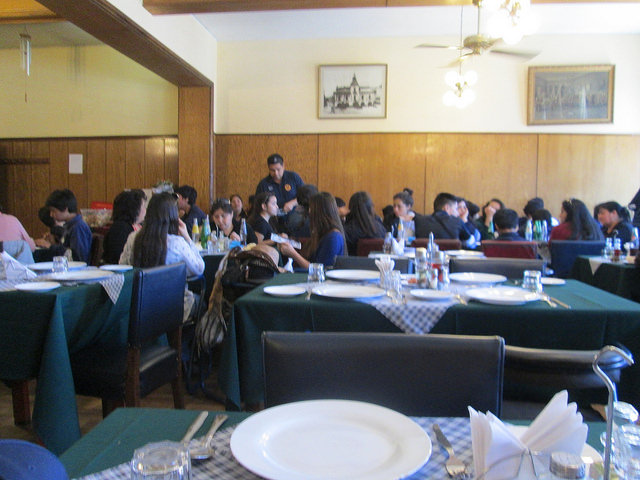
One of the best places to have good wholesome food in Chile is at the local firehouse. I put this truism to the test in Valparaiso, where I had a delicious meal consisting of chicken consommé, salad, fried fish, rice, and a fruit dessert at the main fire station in Valparaiso—for only 3,000 pesos (that’s less than five dollars).

I believe my waiter was one of the firemen (he’s shown standing in the background in the above photo). The food was straightforward; there were no other tourists in attendance; and the place was immaculately clean.

The word bombero sounds vaguely menacing in English, probably because it looks like “bomber.” Rest assured that I do not make a practice of dining with terrorists. Chilean firemen is a different story altogether.

Dreams of Soon Tofu

Cold Weather? Time for Soup!

Cold Weather? Time for Soup!

Today, Martine and I went to lunch at Galbi King. With the onset of cold weather in L.A., I felt like having some hot soup. And what can be hotter than extra spicy soon tofu? What is soon tofu? Here’s what one food writer on Chowhound.Com wrote:

Soon means “soft” in Korean, in this usage. So “soon tofu” is soft tofu. It’s quivery soft, like custard, but flavored with a savory broth filled with any number of good things from beef, to seafood, to pork. It’s just like the tofu in tofu fa, if you’ve ever had that.

At BCD and most other soft tofu joints in L.A. and OC [Orange County], the soft tofu comes bubbling in a stone crock to your table.

When the hot stone crock comes to your table, you break a raw egg in it—and prepare for a culinary paradise. I also spoon in some steamed rice to cool the fire. Mine was served with pork and was as spicy as the restaurant was willing to risk. As it happens, I am a certified chili-head, so I had no difficulty with the fiery broth. (Unless you too are one, don’t try this at home, Kids!)

Please note that not all Korean restaurants can make good soon tofu. I went to one Korean-owned place in the Patronato district of Santiago, Chile, and had a bowl that was sadly deficient in flavor. Even in Los Angeles, there are good Korean restaurants, and bad Korean restaurants.


The Lakes Crossing

From Bariloche Over the Andes to Chile

From Bariloche Over the Andes to Chile

There are a number of border crossings between Argentina and Chile. One of the most picturesque is the so-called “Lakes Crossing,” known in Spanish as the CruceAndino. It takes almost eleven hours and consists of three boat rides and four bus rides. They are as follows:

  • BUS from San Carlos de Bariloche to Puerto Pañuelos on Lago Nahuel Huapi
  • CATAMARAN from Puerto Pañuelos to Puerto Blest
  • BUS from Puerto Blest to Puerto Alegre on Lago Frias
  • BOAT from Puerto Alegre to Puerto Frias, where you will officially exit from Argentina
  • BUS from Puerto Frias to Puerto Peulla on Lago Todos Santos, where you will officially enter Chile, and where you can stretch the trip to two days by staying in a hotel (I didn’t)
  • CATAMARAN from Puerto Peulla to Petrohué
  • BUS from Petrohué to Puerto Varas right past the Calbuco Volcano, which erupted three times this spring
Puerto Peulla on Chile’s Lago Todos Santos

Puerto Peulla on Chile’s Lago Todos Santos

I had thought that crossing the Andes here would involve altitude sickness, but it didn’t. I do not believe this route got much higher than 3,000-4,000 feet. Although while on Lago Frias, it seemed we were way up high, we weren’t. All in all, it was very comfortable and well organized, considering all the handoffs between buses and boats.

The only thing that was odd was that I never received a Chilean tourist card at Peulla, where I entered the country. When I left Chile from Santiago’s Benitez Airport, I had to go to another window so that the PDI (investigative police) generated one for me based on my passport stamps. In any case, it was worth the slight inconvenience.


Cruising the Paraná

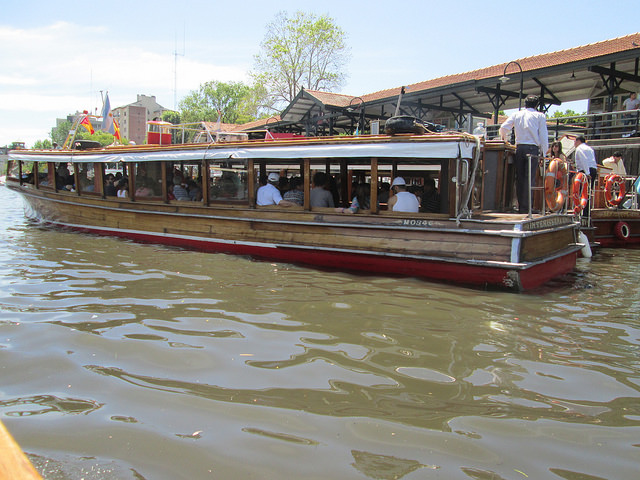
Cruising the Delta of the Paraná in a Launch

Cruising the Delta of the Paraná in a Launch

One of the fun getaways from Buenos Aires is the massive delta of the Paraná River, second only to the Amazon in South America. Rising at the confluence of the Paranaiba and Grande Rivers in Brazil, the Paraná flows south some 4,880 km until it becomes the Rio de la Plata near the Argentine capital. Headquarters for delta cruises is Tigre, about an hour out of Buenos Aires.

Last month, I boarded a launch in Tigre and took a one-hour cruise of several branches of the 60 km wide delta. There is an entire community that lives along the delta that is reachable only by boat. There are grocery boats, barber and beauty salon boats, and others that ply these waters servicing the population which likes the poky life at the edge of one of the world’s great waterways.

Drainage Basin of the Paraná

Drainage Basin of the Paraná

As you can see, the river drains portions of five South American countries: Brazil, Paraguay, Uruguay, Bolivia, and Argentina.The river is broad enough for container ships to go several hundred miles upstream past Rosario and Santa Fe.

One could get to Tigre by train, bus, or even boat. Don’t make the mistake of going by train on a weekend however, as it is standing room all the way from Retiro train station.


The Magical Forest

A Forest of Chilean Myrtles at Los Arrayanes National Park

A Forest of Chilean Myrtles at Los Arrayanes National Park

One of the sights I most wanted to see on my recent trip to Argentina and Chile was Los Arrayanes National Park on the Quetrihué Peninsula. We arrived there on a fantastic old boat (more about which in a future post) from Puerto Panuelos near San Carlos Bariloche.

There is a prevalent myth that Disney was inspired by the look of the Luma apiculata (Chilean Myrtle) trees for his cartoon feature Bambi (1942); but, alas, Disney did not visit Argentina until three years later. Still, it is possible that he knew of and was inspired by the forest before his visit.

These trees with their orange-colored bark grow only in the Patagonian Lakes District of Argentina and Chile between 33° and 45° South Latitude. They range from 33 to 49 feet (10 to 15 meters) tall.

Typically it is possible to take a tour to Los Arrayanes which also includes Isla Victoria on Lago Nahuel Huapi, where one can see Sequoias and Ponderosa Pines imported from California over a century ago.


Raging Waters

Waterfalls So Extensive They Create Their Own Climate

Waterfalls So Extensive They Create Their Own Climate

Probably the most spectacular destination on my recent trip to South America was Iguazu Falls. For a panoramic view of the falls, one would have to visit the Brazilian side and pay $160 as a “reciprocity fee,” without guaranteeing that I would get a visa in time. So I opted for the Argentinian side, where I could cozy up to a number of the cataracts, either from the top or bottom.

Iguazu is in the State of Misiones, which juts like a narrow finger into the jungles of Southern Brazil. And, just a few miles to the west is the border with Paraguay at Ciudad del Este.

In the past, I had avoided visiting the falls because I was afraid of contracting a mosquito-borne disease such as malaria, dengue, or chikungunya. Imagine my shock when I saw no mosquitoes near the falls: Apparently the waterfalls, which can range up to 9,500 feet wide depending on water volume, create their own climate of swirling mists.

Most of the water squeezes through at a place called the Garganta del Diablo, or “The Devil’s Throat.” Standing near where the water rushes down is an awe-inspiring (and very wet) experience. But it is eminently worth it!

I spent two days visiting the Iguazu National Park. Looking back, I would have to consider it the single most impressive place I visited this year in Argentina and Chile.