The Phantom Republic

It Lasted for Less Than 24 Hours

It Lasted for Less Than 24 Hours

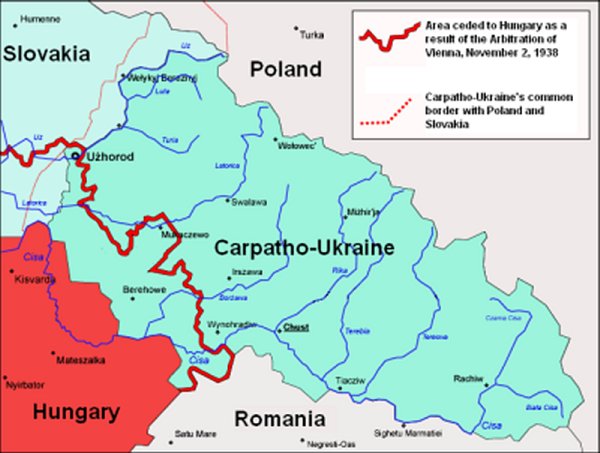
The darker green area on the above map marked Carpatho-Ukraine declared its independence from Czechoslovakia on March 15, 1939. Within less than 24 hours, it has been absorbed by Hungary with Nazi Germany’s blessing.I guess, from Germany’s point of view, it didn’t matter because it was inhabited by a bunch of Slavs, who were deemed to be of inferior racial stock. And Hungary by this time was an ally of Germany: My people were not only Aryans, they were Hung-Aryans. (In actuality, Hungary’s ruler, Admiral Horthy was intimidated into joining the Axis powers when he saw what happened to leaders of adjoining countries—such as the assassinated Engelbert Döllfuss of Austria—who were not part of Hitler’s program.)

When I was a young stamp collector, I was surprised to find that Hungary was not in the Overrun Countries commemorative series of 1943-1944. It was only later I found out that Hungary was part of the Axis.

The Overrun Countries: I Guess Hungary Was Part of the Bad Guys

The Overrun Countries: I Guess Hungary Was Part of the Bad Guys

Hungary paid dearly for being part of the Axis. Although we “got” the short-lived Republic of Carpatho-Ukraine, we lost thousands at Stalingrad when the Nazi 6th Army was surrounded by the Russians.

And, after World War Two, the Carpatho-Ukraine territories were made part of the Ukrainian Soviet Socialist Republic. And, as they say, that was that!

The Most Scenic Highway in America

Bryce National Park

Bryce National Park

Of all the road trips I have ever taken in the Western United States, the most spectacular is Utah Route 12, which runs from a point along U.S. 89 between Hatch and Panguitch to the town of Torrey. Along the way, you will find Red Canyon, Bryce Canyon National Park, Kodachrome Basin State Park, Grand Staircase-Escalante National Monument, a scenic stretch known as “The Hogback,” Anasazi State Park, and Capitol Reef National Park. Nowhere else in the U.S. will you find 122 miles of concentrated scenic beauty equivalent to what you will find here. And, what is more, you are within hailing distance of the Grand Canyon, Zion National Park, Canyonlands National Park, Arches National Park, the Glen Canyon National Recreational Area, and Hovenweep National Monument.

Below is a map of the route:

Map of Utah Scenic Byway 12

Map of Utah Scenic Byway 12

For the full detail, you can consult a 23-page Adobe Acrobat PDF file by clicking here. In it, you will find that I left out at least half of your destination options.

Martine and I took this highway about six years ago. We considered it probably one of our best trips within the U.S., and certainly the best in the Southwest. Along the way, we visited several other National Parks and Monuments and tourist sites, including a spectacular museum of taxidermy (of all things) just outside of Bryce. We even stopped to see the “original” London Bridge in Lake Havasu City, Arizona.


Tarnmoor’s ABCs: Patagonia and Penguins

Killing Two Birds with One Stone

Killing Two Birds With One Stone, So To Speak

I was so very impressed by Czeslaw Milosz’s book Milosz’s ABC’s. There, in the form of a brief and alphabetically-ordered personal encyclopedia, was the story of the life of a Nobel Prize winning poet, of the people, places, and things that meant the most to him. Because his origins were so far away (Lithuania and Poland) and so long ago (1920s and 1930s), there were relatively few entries that resonated personally with me. Except it was sad to see so many fascinating people who, unknown today, died during the war under unknown circumstances.

My own ABCs consist of places I have loved (Iceland), things I feared (Earthquakes), writers I have admired (Chesterton, Balzac, Proust, and Borges); things associated with my past life (Cleveland and Dartmouth College), people who have influenced me (John F. Kennedy), foods I love (Olives), and things I love to do (Automobiles and Books). This blog entry is my own humble attempt to imitate a writer whom I have read on and off for thirty years without having sated my curiosity. Consequently, over the months to come, you will see a number of postings under the heading “Tarnmoor’s ABCs” that will attempt to do for my life what Milosz accomplished for his. To see my other entries under this category, hit the tag below marked “ABCs”. I don’t guarantee that I will use up all 26 letters of the alphabet, but I’ll do my best. Today the letter is “P” for both Patagonia and Penguins, which kind of go together in my mind.

Above is a photo I snapped on Isla Martillo, which lies on the Beagle Channel in Argentina’s Tierra Del Fuego. I had always wanted to go to Patagonia, ever since I read Paul Theroux’s The Old Patagonian Express and, even more, Bruce Chatwin’s In Patagonia. It was one of those places at the end of the earth. About six hundred miles south of Isla Martillo lies the Antarctic Peninsula. Even farther north lies Buenos Aires and the heavily populated temperate territories of Argentina.

Martine and I have always loved penguins. There was something helpless and cute about them, even though their fishy smell made them somewhat less than huggable. I think I was only able to get Martine to come with me to Patagonia if I could take her to places where she could walk among penguins in the wild. Although past “expeditionary” vacations in search of puffins and moose turned up a blank, I was able to deliver on the penguins—in spades. Isla Martillo was a small penguin rookery that was fascinating, and Punta Tombo in the State of Chubut was even more spectacular. We were there right around the time, to the day, that the Magellanic penguins were hatching. Our trip there was one of the happiest experiences of my life.

Do I want to go back to Patagonia? Absolutely. I’ve been there twice: The first time, on my own, I broke my shoulder by slipping on the ice in Ushuaia … but the second time was a charm.

Life always seems brighter when you could go to far places that you love.


Aun Aprendo

Not for Me the Stupor Bowl!

Not for Me the Stupor Bowl!

Instead of watching professional wife- and girlfriend-abusers concuss each other today, I did something that was a thousand times more satisfying: I attended a memorial service for my late friend Lee Sanders at the Besant Hill School of Happy Valley in Ojai, of which he was an active alumnus. Gathered there were members of his family, old friends (of whom I am one), and his former associates in the IATSE Projectionists Union Local 33 and the Culver City Democratic Club.

Lee lived several lives about which I knew relatively little, especially his activities in music and science. The side of him I saw was a brilliant and gentle soul who was politically active as well as an internationally known collector of film memorabilia and prints for projection. As I said in my short speech to the audience, he never had a bad word to say about anyone. He was something of a bodhisattva. (I, on the other hand, daily consign my perceived enemies to the deepest pit of hell, especially when I’m behind the wheel.)

What I found interesting—and new to me—was that to his family, Lee was better known as Guy Sanders. I knew he frequently showed up at his old school to help out; and it showed, because there was a great outpouring of love for him at the school. I was awestruck.

The Besant Hill School of Happy Valley was co-founded by several individuals, two of whom were great influences on my own life: J. Krishnamurti and Aldous Huxley. In fact, the last book Lee was reading was Volume V of The Collected Essays of Aldous Huxley, which I had given him.

Now that my own school—St. Peter Chanel in Bedford, Ohio—blinked out of existence last year, I would like, if possible, to do something for Besant Hill.

By the way, aun aprendo is the school’s Latin motto. It means, “I’m still learning.” That¹s a good motto, and I might adopt it for my own.


Where to Pan for Gold

New York Review of Books Titles I Have Read This Month

New York Review Books Titles I Have Read This Month

At different times in my life, I have fallen in love with different publishers: Penguin, Oxford, Dover, Modern Library, New Directions. Now I am mightily enamored with the publications of New York Review Books. The four titles illustrated above are books by authors I had never read before, but which I read this month as part of my Januarius project. Of the three best books I have read this month, two—Andrey Platonov’s Soul and Antal Szerb’s Journey by Moonlight—were New York Review Books. The third, Juan José Saer’s The Witness, was recommended to me by an article in The New York Review of Books, which publishes New York Review Books.

I am always amazed by the editorial acumen of the publishers of New York Review Books: They seek out the best in Twentieth Century literature, whether it be from Russia, Hungary, Finland, Germany, Asia, Africa, or wherever. So many of the best discoveries I have made in the last few years have come from there that I follow their emails and website closely to populate my TBR (To Be Read) list.

Just this month, they came out with Silvina Ocampo’s Thus Were Their Faces: Selected Stories. Silvina and her sister Victoria Ocampo were closely associated with Jorge Luis Borges, who is one of only two or three authors whom I idolize,  collect, and ingest in bulk.

“The Lark Sings for Itself and God”

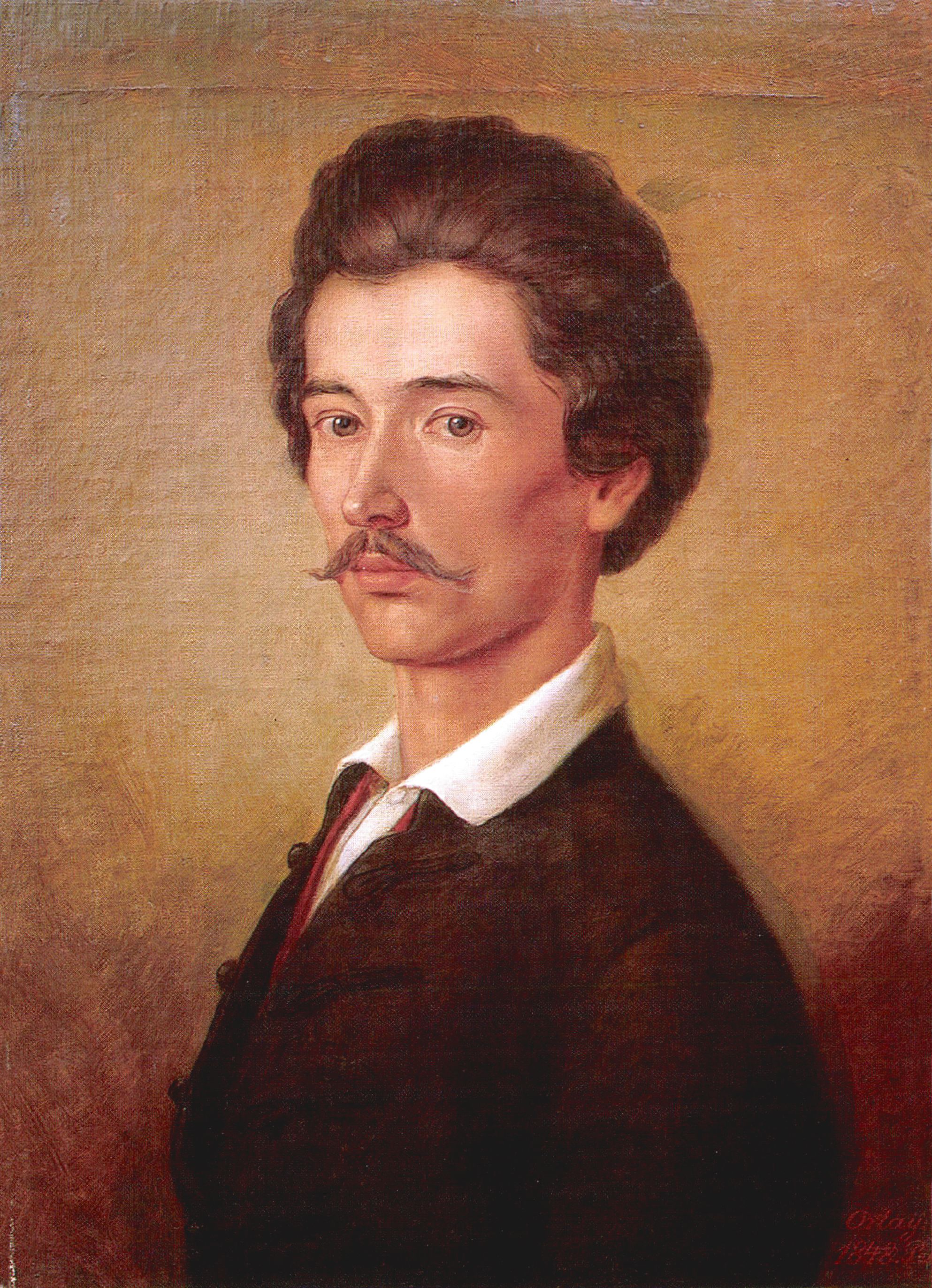
Hungary’s National Poet, Sándor Petofi (1823-1849)

Hungary’s National Poet, Sándor Petőfi (1823-1849)

Now that I am able to spell Hungarian words correctly, I will try to write more blogs about my exploration of my heritage. Today, we have a poem by Sándor Petőfi who died at the Battle of Segesvár during the 1848 Revolution against Austrian rule, where he was shot by Russian troops allied with the Austrians.

Why Are You Still Singing Gentle Bards? (Mit Daltoltok Még ti, Jámbor Költők)

Why are you still singing gentle bards,
in times like these what good is the song?
The world can hardly hear your words,
the noise of war drones on and on.

Lay down your lute, wholesome boys,
your beautiful music falls too flat.
Even the lark’s melodious voice
disappears amid thunderous claps.

Or maybe not. Birds don’t really care
if down here they are even heard?
In the vast blueness of their air,
the lark sings for itself and god.

When sorrow or joy touches our hearts
songs fly from us so naturally,
and sail on the waves of a steady wind
like the tattered leaves of a rosewood tree.

So let us sing lads, like we used to,
but even louder, so our lutes will vie
with the clamor of a disturbed earth,
and add a note or two to the clearing sky.

Half the world in rubble … a bleak vision
and though it troubles our hearts and heads
let our souls descend on these harsh ruins,
and our songs like ivy gently spread.

At home, I have Petőfi’s complete poetic works in a volume I purchased in Budapest, when I was there in 1977. The above poem was translated by Arlo Voorhees and is one of several that appears at Pilvax Online Magazine. I may also in future add some translations of my own.

The Canadian Op

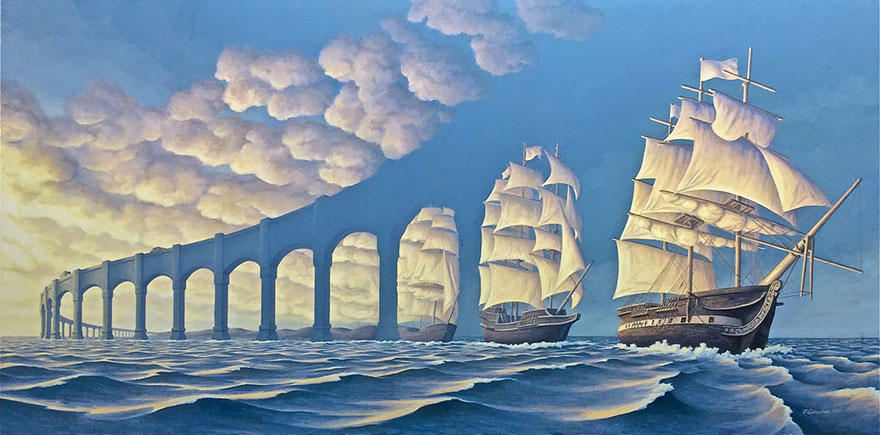
Optical Illusion Art by Canadian Painter Rob Gonsalves

Optical Illusion Art by Canadian Painter Rob Gonsalves

I saw a fascinating selection of Rob Gonsalves mind-stretching optical illusions on BoredPanda.Com. I would say more about them if it weren’t for the fact they speak so well for themselves. Here are two more:

PICmagic-realism-paintings-rob-gonsalves-9__880
PICmagic-realism-paintings-rob-gonsalves-100

I AM That Demon


A Representation of the Mandaean Demon Dinanukht

A Representation of the Mandaean Demon Dinanukht

It is strange how reading a few lines on some abstruse subject can set your mind going. I was reading Christian Caryl’s review of Gerard Russell’s book Heirs to Forgotten Kingdoms: Journeys into the Disappearing Religions of the Middle East in the December 4, 2014 issue of The New York Review of Books. There I came upon this quote from the book regarding the Mandaeans from the marshes of Southern Iraq:

There is Krun, the flesh mountain, who sounds a bit like Jabba the Hutt; as [E. S.] Drower wrote, “The whole visible world rests on this king of darkness, and his shape is that of a huge house.” There is Abraham, who appears as a failed Mandaean guided by an evil spirit to leave and found his own community. There is the dragon Ur, whose belly is made of fire and sits above an ocean of flammable oil. There is Ptahil, “who takes souls to be weighed and sends his spirits to fetch souls from their bodies.” My favorite was the demon Dinanukht, who is half man and half book and “sits by the waters between the worlds, reading himself.” [Italics mine]

Omigosh, that sounds like me.


Our Ratty Old Constitution

How Can These Bewigged Lawyers and Farmers Understand What We Have Become?

How Can These Bewigged Lawyers and Farmers Understand What We Have Become?

Oh, I have nothing against the Constitution per se. Except it was just peachy for a rural slave-owning society. It always amuses me that certain people who don’t profess to read anything but their Bibles have suddenly started sporting tricorne hats and taking on the appearance of the men in knee-breeches in the above patriotic painting.

The delegates to the Constitutional Convention of 1787 could not have imagined what was to follow: Manifest Destiny. The Civil War. Immigration. Two World Wars bracketed on either side of a global Depression. The atomic bomb. The Cold War. Global warming. A completely deadlocked congress.

Our Founding Fathers did not trust the people, so they opted for a form of representational government in which there were “buffers” between the rabble (that’s us) and power. The States forming the Union were all important—particularly in the U.S. Senate, where Wyoming’s 0.5 million people has as much political power as California’s 38 million. Now I like Wyoming a lot, but for all us Californians to have to kowtow to a mere handful of them cowboys is a bit of a stretch to me.

The whole system of checks and balances was a brilliant invention, but when a majority of ultra-conservative Supreme Court justices appointed by past Republican presidents can make their own law in the face of the will of the people, the result is chaos. Now corporations are being treated as people, and money rules supreme in elections (cf. Citizens United).

There are a number of ways that things could have gone, but they didn’t. The political stasis of the last decade will be how this era will be remembered. Look at the faces in the news: You can start drawing mustaches on them, because they will be the villains of the future.

In the meantime, all we can do is try to keep the ship afloat while the Three Stooges pound holes in the keel so that the water coming in can flow out easier.


Looking East

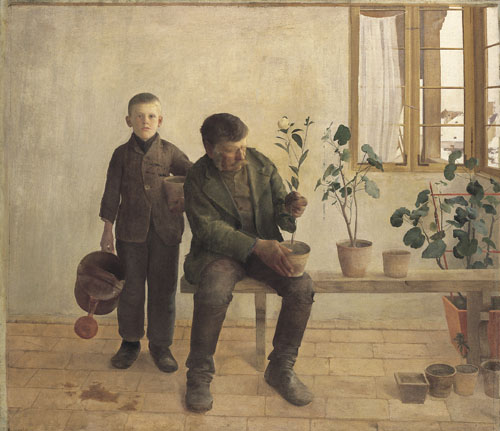
Károly Ferenczy’s “The Gardeners”

Károly Ferenczy’s “The Gardeners”

I know next to nothing about academic Hungarian art, but I would like to know more. Today I searched the website of the Hungarian National Gallery looking for paintings that caught my eye. The one above looks like a typical folk subject, a gardener and his son. The gardener works at potting what looks like a yellow rose while his son holds an empty pot and a watering can while blankly staring into the distance.

From my childhood, I know a bit about popular art, which consists of all sorts of peasant scenes, with picturesque cottages, rustic wells, and galloping Magyar cowboys (we called them csikosok). We had one such reproduction in our living room which actually scared me. If one stared at the shadows of branches and leaves against the wall of the cottage, it looked like a sinister face with a hand raised threateningly.

Here is another work that caught my eye:

Jenö Gyárfás’s “Youth and Age”

Jenö Gyárfás’s “Youth and Age”

From time to time I will return to this subject, hopefully becoming a little more learned in the process.