From Out of Nowhere: Bam! Nibiru!

It’s All Over This Saturday

For feeble-minded Christians, especially those who believe in all the cockamamie conspiracies that are “revealed” by self-proclaimed prophets, Earth can possibly be destroyed this coming Saturday by a roving hidden planet that no one has seen yet. That planet has variously been called Nibiru and Planet X (among other things). That’s the prediction of David Meade, a self-published author whose subject matter is astrology and the Bible. How can such a planet, supposedly larger than the Earth, be at one and the same time invisible and moving very, very fast?

This whole Nibiru/Planet X catastrophe has been predicted several times before. Even Meade originally set the date in October, but revised his prediction because of the recent eclipse. I would have thought he would base his prediction on that well-known Beast of the Apocalypse, Donald J. Trumpf—but no.

Sometimes I think these Christian conspiracy theorists have altogether too much time on their hands.

My suggestion is that, on Sunday, September 24, the survivors of the Nibiru disaster gather together to mock David Meade and his kind. You can do so by contacting him at DavidMeade7777@gmail.com—if, that is, he doesn’t close that e-mail account beforehand.


Fun with Calvin and Hobbes

I Miss Calvin and Hobbes

Let’s face it: I never really grew up. I sill love the comics. My day is not complete until I have read the comics in the Los Angeles Times, which I have delivered at home daily and Sundays. I still miss many of the cartoon strips that no longer appear, going all the way back to Walt Kelly’s Pogo. I also loved Gary Larson’s The Far Side, Johnny Hart’s B.C. and The Wizard of Id, and Patrick McDonnell’s Mutts. Fortunately, some great comic strips come back: I am thinking of Berkeley Breathed’s Bloom County, which now appears with new cartoons on Facebook.

Bill Watterson’s Calvin and Hobbes lasted from 1985 to 1995, but you can see all of them at Gocomics.Com. I am slowly re-reading the entire work of this great cartoonist and philosopher.


When the Sunday paper arrives, I still read the comics starting from the bottom of the last page and ending up with the top of the first page. Some habits never die.

Juggalos 1 Trumpf 0

There Were Two Rallies in Washington DC This Weekend: Guess Which Was Larger

This weekend was the so-called Mother of All Rallies (MOAR) of Trumpf supporters. Hundreds of mental defectives wearing red, white, and blue and waving American flags made as much noise as they could.

Also in Washington on the same weekend was a much larger, less violent demonstration, consisting of Juggalos and Juggalettes, the mostly young supporters of a band called Insane Clown Posse (ICP), were protesting the 2011 decision by the FBI that the movement was a gang. It’s not. The followers of ICP consider themselves a family. Although the songs they follow appear to be violent, they do not generally translate into violent actions by the Juggalos. (How very unlike the Trumpf Brownshirts!)

The whole seemingly violent Dark Carnival atmosphere of ICP is in fact a form of therapy which actually helps their followers cope with broken families, joblessness, bad relationships, and other misfortunes.

Perhaps our Presidente will take a cue from them. He would look great in black and white clown markings, and they would be wholly appropriate on him.


At the Santa Barbara Zoo and Mission

Meerkat on Guard at the Santa Barbara Zoo

Today I rented a car to take Martine and me to Santa Barbara. My 1994 Nissan Pathfinder has a brake warning light and ABS warning light, requiring me to take it into the shop on Monday. (Even without the warning lights, I would have rented a car. It would be far cheaper than towing the Nissan great distances.)

It doesn’t take long to “do” the SB Zoo, which at 30 acres merits about two hours, more if you want to sit down and take in the atmosphere. It is only a few hundred yards from Cabrillo Beach, which makes it all the better. And today was a relatively cool day.

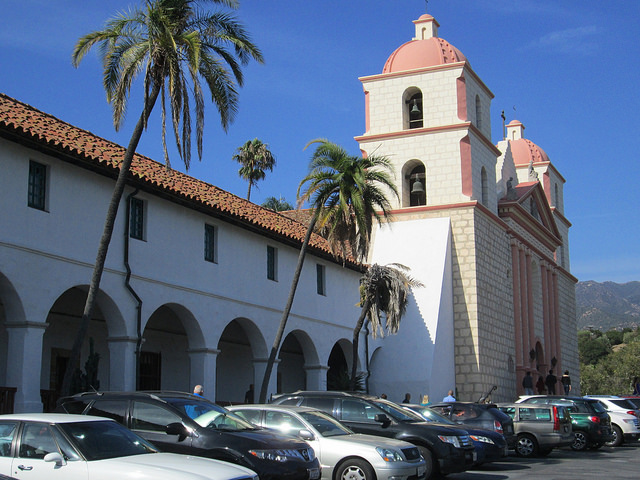
After the zoo, we had some extra time, so we revisited the Santa Barbara Mission—founded in 1789 by Padre Fermín Lasuén, who took over the entire chain of twenty-one missions for Padre Junípero Serra after the latter’s death. I know that the Spanish missions were involved in the suppression of the local Indian tribes, yet remain as so many islands of peace dotting the California landscape.

The Santa Barbara Franciscan Mission

As we were touring the mission’s museum, one of the old Franciscan padres introduced himself to us. He looked frail, probably in his eighties, but was friendly. We toured the old church and the adjoining small cemetery as well. According to a sign in the cemetery, there are some 800 Chumash Indians buried there, not to mention the Spanish conquistadors and subsequent American settlers and their families.

On the way home, we decided to skip the coastal route (there was serious construction on Route 1 in Santa Monica) and the even more crowded U.S. 101 in favor of Route 126 through Santa Paula and Fillmore. It added perhaps ten miles to our trip, but it was more restful driving through all that farm country. Plus, we stopped at Cornejo’s fruit stand near Fillmore to buy some white peaches and plums.

Gemina

Gemina, the Giraffe With the Crooked Neck

Tomorrow, I will take Martine to one of our favorite places, the Santa Barbara Zoo. Martine will probably leave me at some point in the next two or three weeks, so I want to spend some of that time revisiting places we love.

Although Los Angeles has a bigger zoo, it is so crowded and so constricted by constant construction that visitors have a hard time negotiating the paths without getting run over by harassed parents pushing strollers. As their website says, the SB Zoo has 500 animals and only 30 acres. That’s just about our speed, and tomorrow promises to be a nice day.

The most remarkable animal we have seen at the Zoo is the late Gemina, the giraffe with the crooked neck. The following long quote is a release from the zoo that I thought I’d like to pass on to you:

If you visited the Zoo between 1990 and 2008, you probably saw an unusual giraffe. Her name was Gemina and she had a crook in her neck.

Born at the San Diego Wild Animal Park (now San Diego Safari Park) in 1986, Gemina was a Baringo (or Rothschild’s) giraffe, and joined the Santa Barbara Zoo’s giraffe herd when she was just about a year old.

Her neck seemed normal until a bump appeared when she was around three years old. Slowly, over time, it sharpened into a distinctive “V”, which interrupted the graceful curve of her neck.

Though she was examined by veterinarians, a cause for the crook could not be determined. The good news? In spite of her appearance, she didn’t exhibit any signs of being in pain.

In fact, the crook didn’t hamper Gemina’s life at the Zoo. She received normal treatment by zookeepers, ate normally, gave birth to a calf, and was an accepted member of the Zoo’s giraffe herd. She was beloved by our guests, locals and visitors alike.

Long before I came to work here as the Zoo’s publicist, management had decided not to sensationalize Gemina. We could have emblazoned her image on t-shirts and made banners with her silhouette, but that’s not our style. She was a member of the giraffe herd, and not to be exploited. We responded to media requests, but didn’t push out the story.

But Gemina became an icon in spite of our low-key approach. In its second season (2004), “The Bachelor” filmed a sunset dinner at the giraffe exhibit, and the couple met Gemina. In the 2005 television show “Miracle Workers,” she was the source of inspiration for a young boy with severe scoliosis. In 2007, she was voted Number One of the “Seven Wonders of Santa Barbara” in a local radio station poll.
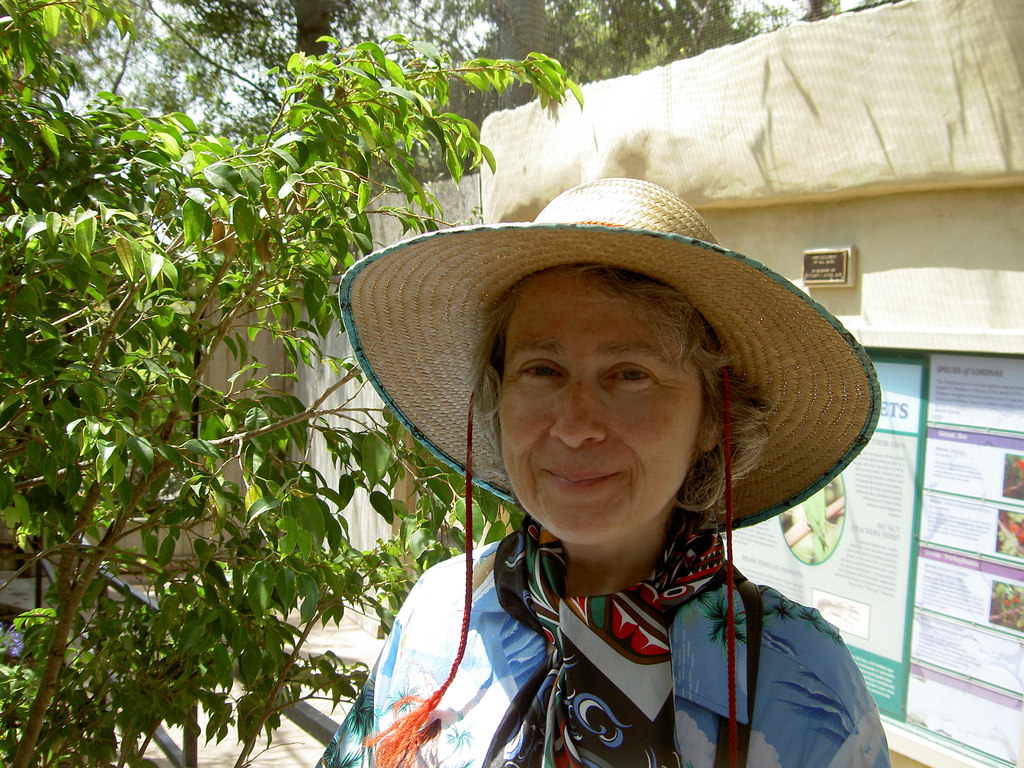
Martine at the Santa Barbara Zoo in 2007 … in Happier Times

By then, she was 20 years old, which is elderly for a giraffe in captivity. We threw a party for her 21st birthday, knowing that her time was nearing an end. Many of us had tears in our eyes when Zoo Campers, wearing self-made giraffe hats, sang “Happy Birthday.”

She lived another five months, before she stopped eating and her health declined. Gemina was humanely euthanized on January 9, 2008. It was a sad day at the Zoo.

But her memory lives on. Gemina is still the most asked-about animal at the Zoo, even eight years later. A children’s book, “Gemina the Crooked-Neck Giraffe,” written and illustrated by Karen B. Winnick, was released in 2013, and is still for sale in the Zoo Gift Store (all proceeds benefit the Zoo).

Now, her fans can again visit Gemina. Her distinctive top six vertebrae, skull, and jawbone have been preserved and rearticulated, and are now on view in a display case as part of the Zoo’s “Animals…Inside Out” art exhibit in the Discovery Pavilion’s Volentine Gallery.

It’s free, with admission, to view Gemina and the exhibit of cool animal x-rays. Gemina’s skeleton is on view 10 a.m. to 3 p.m. weekdays, and 9:30 a.m. to 4:30 p.m. on weekends.

Thanks goes to Skulls Unlimited for her skeletal work, and to TruPart, a Ventura company, for building the display case free of charge.

Gemina reminds us all that being different is just fine. She’s a reminder to me not to blithely feed the media’s appetite for the odd and outrageous. That we can tell a quieter story, about being accepted in a herd of your peers and loved by a generation of visitors. That one giraffe can still stand tall, even with a crooked neck.


Wandering Mindfully in DTLA

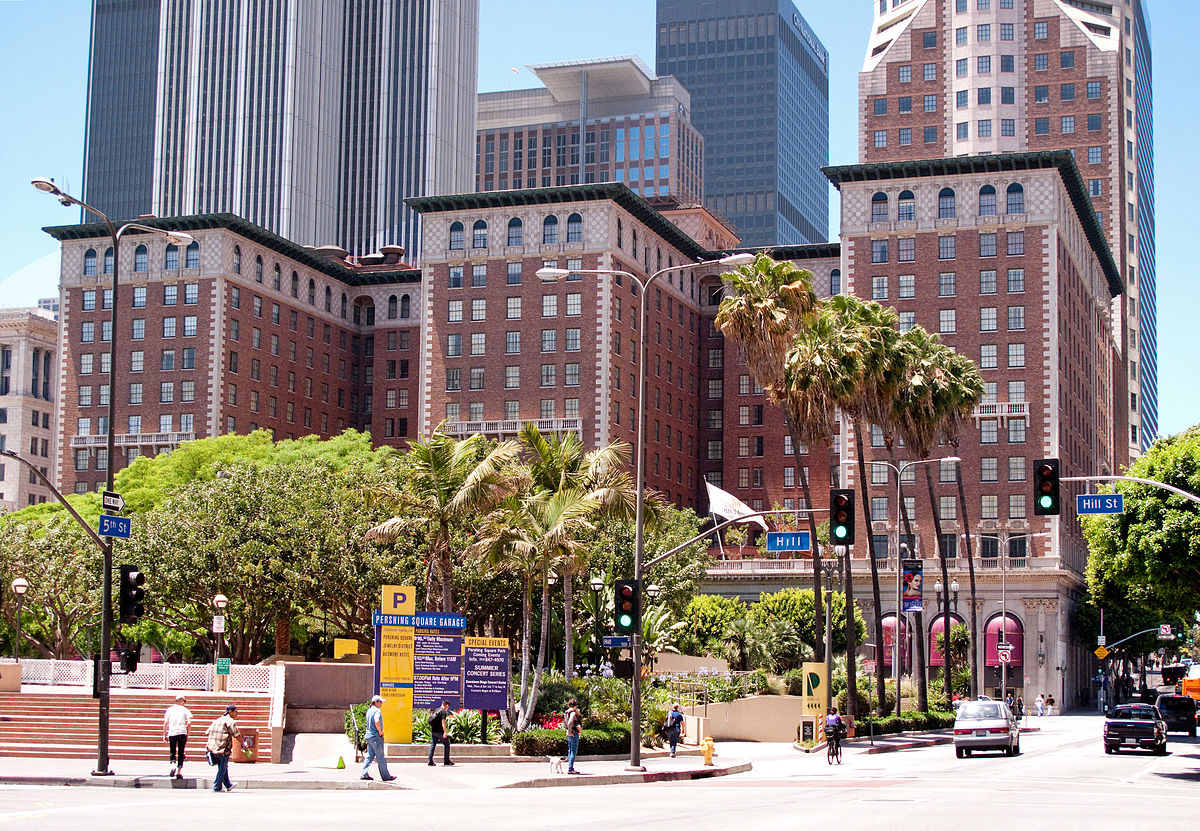
The Millenium Biltmore Hotel on Pershing Square in Los Angeles

I am facing a change in my life relating to my relationship with Martine. It appears that, before long, we will not be together. The odd thing is that we still love each other: The reason for Martine’s desire to leave has more to do with how she feels about herself. There is a French expression bien dans sa peau: Feeling comfortable within one’s own skin. Ever since she got a pinched nerve in her back early in 2013, she has not felt well. Plus, she seems to just want to leave Los Angeles, which I cannot do at this time without quitting my job and running through my savings..

My first reaction was anger and sadness. The sadness is still there, but to make her feel even more depressed would be doing her an injustice. All I can do is hope she will discover that life with me is indeed preferable—even if it is in Los Angeles. My door will remain open for her.

How am I coping with this event? I will concentrate on my mindful meditation practice. I wandered around downtown LA (a.k.a. DTLA) after my meditation session at the Central Library. I ate lunch at the Bugis Street Brasserie at the Millenium Biltmore Hotel on Pershing Square. The red awnings at the lower right of the above photo is where the restaurant is located.

Then I stopped in at the Last Bookstore at 5th and Spring, looking for more Teju Cole books. Apparently they sold out. Then I took the Dash D bus to Union Station and waited for the Santa Monica Big Blue Bus #R10 to take me back home.

Home will be a different experience, but I am resolute about not poisoning the well.


The White Savior Industrial Complex

Poverty in South Africa

I am not one to like Twitter, especially as misused by the Trumpf as a way to short-circuit rational discourse. Sometimes, it is good to have one’s ideas overturned, in this case by a talented writer/photographer named Teju Cole. Although born in the U.S., Cole was raised in Nigeria and returned to this country to attend college. The following is a series of Tweets written under the name @tejucole that were published by The Atlantic in 2012. The subject? The White Savior Industrial Complex. Here are the tweets, min order:

1- From Sachs to Kristof to Invisible Children to TED, the fastest growth industry in the US is the White Savior Industrial Complex.
2- The white savior supports brutal policies in the morning, founds charities in the afternoon, and receives awards in the evening.
3- The banality of evil transmutes into the banality of sentimentality. The world is nothing but a problem to be solved by enthusiasm.
4- This world exists simply to satisfy the needs—including, importantly, the sentimental needs—of white people and Oprah.
5- The White Savior Industrial Complex is not about justice. It is about having a big emotional experience that validates privilege.
6- Feverish worry over that awful African warlord. But close to 1.5 million Iraqis died from an American war of choice. Worry about that.
7- I deeply respect American sentimentality, the way one respects a wounded hippo. You must keep an eye on it, for you know it is deadly.

Teju Cole

These seven Tweets showed that the medium has the capability of carrying on discourse rather than just shutting it down. But then, not everyone is as witty and perspicacious as Teju Cole. I will write more about him as I investigate his books and photography.

Florida … Going, Going, Gone!

The Only Part of Florida I Really Like Are the Keys

Whatever you may think of Florida, and whatever you may think of global warming, Florida is sinking into the sea. Back when I was an infant, I used to live in Lake Worth, Florida, just south of West Palm Beach. My Dad didn’t like it much at all: With his delicate st0mach, he didn’t like to pick up the bodies of dead alligators, load them into a truck, and unload them at their final destination.

For a while in the 1980s and 1990s, my parents owned a condominium in Hollywood, at a place called Carriage Hills. I visited them from time to time, but had difficulties with the heat and humidity. Not that I saw much of the state, but I did go several times down to the Keys, which I loved. The first time was right after Hurricane Andrew struck. I was so amazed at miles of houses and apartments sans roofs that I kept accidentally exiting at all the offramps.

The highest point in the state is only 345 feet, and that’s near the Georgia border. Miami’s elevation is between six and seven feet. As glacial and polar ice continues to melt, Florida will assume a different shape in the years to come:

What Florida Will Look Like in the Not Too Distant Future

The left is Florida as it looks today. At the right, you can see what a five- and ten-meter rise in water level will do to the peninsula. You can kiss Miami goodbye.

Two Presidents Reconsidered

Entrance to the Ronald Reagan Presidential Library and Museum

I have come to enjoy visiting Presidential Libraries. The two in Southern California—those of Ronald Reagan and Richard Nixon—have been visited by me several times. When Presidents Nixon and Reagan occupied the White House, I was dead set against them. I voted for neither of them and, in fact, threatened to leave the country if Reagan were elected.

Today, Martine and I spent a few hours at the Ronald Reagan Presidential Library and Museum in the Simi Valley. It’s funny how time tends to remove sharp edges. Now I look back and see a gifted speaker who sincerely believed in what he was saying and who was able to convince listeners of his sincerity. Even though his presidency fell apart somewhat toward the end with the whole Iran-Contra negotiation; even though the whole Savings & Loan fiasco was the result of a horrible miscalculation; even though his mind couldn’t wrap itself around that truck bomb in Beirut that killed 241 U.S. military; even though he trusted that sanctimonious snake-in-the-grass Colonel Oliver North—he did not turn out to be an irredeemably awful president like the Current Occupant.

Probably what I liked most about Reagan were the sentiments expressed in his epitaph: “I know in my heart that man is good. That what is right will always eventually triumph. And there’s purpose and worth to each and every life.” I could forgive a man who believed that, and I do not think that Ronald Wilson Reagan was given to lying.

Earlier this year, Martine and I paid another visit to the Richard Nixon Presidential Library and Museum in Yorba Linda. As President, Nixon may well have been paranoid, but he was also brilliant. The videos of his speeches were articulate and, overall, impressive. Granted that he was not at his best after the Watergate break-in forced him to go into defensive mode, he succeeded in ending the Viet Nam War and opening Communist China. Both were considerable accomplishments, and could not be altogether diminished by the whole Watergate fiasco.

Also, there was a real humility about the man. His presidential library also includes the house in which he was born which was built by his father from a kit. It was as humble a house as any log cabin. And directly outside it is where Richard and Pat Nixon are buried.


The Long Slow Death of America

Chris Hedges Is My Political Guru

I have met Chris Hedges several times at the Los Angeles Times Book Festival—before it moved to USC. On a regular basis, I read his contributions to Truthdig.Com and his books. Currently, he has a great article on Truthdig entitled “Diseases of Despair,” which paints a grim picture of the decline of mainline white culture:

The opioid crisis, the frequent mass shootings, the rising rates of suicide, especially among middle-aged white males, the morbid obesity, the obsession with gambling, the investment of our emotional and intellectual life in tawdry spectacles and the allure of magical thinking, from the absurd promises of the Christian right to the belief that reality is never an impediment to our desires, are the pathologies of a diseased culture. They have risen from a decayed world where opportunity, which confers status, self-esteem and dignity, has dried up for most Americans. They are expressions of acute desperation and morbidity.

A loss of income causes more than financial distress. It severs, as the sociologist Émile Durkheim pointed out, the vital social bonds that give us meaning. A decline in status and power, an inability to advance, a lack of education and health care and a loss of hope are crippling forms of humiliation. This humiliation fuels loneliness, frustration, anger and feelings of worthlessness. In short, when you are marginalized and rejected by society, life often has little meaning.

Hedges goes on from there to lambaste the whole shabby weltanschaaung of 21st century America. It’s not a pretty picture. Among his best books are:

  • War Is a Force That Gives Us Meaning (2002)
  • Losing Moses on the Freeway: The 10 Commandments in America (2005)
  • American Fascists: The Christian Right and the War on America (2007)
  • I Don’t Believe in Atheists (2008)
  • Empire of Illusion: The End of Literacy and the Triumph of Spectacle (2009)

As you can guess from some of the titles, Chris Hedges is the son of a Presbyterian minister who, himself, attended Harvard Divinity School. As a war correspondent, he won the Pulitzer Prize for journalism.

If you want to know what is wrong with this country, you can either wear a red hat that promises to make American great again, or you can use your brain and get a better idea of what is going on behind all the political spectacle.