Sun Shining Through Leaves

Nothing Puts Me in a More Meditative State of Mind

This scene at Descanso Garden’s Mulberry Pond represents to me nature at its most lovely. I enjoy sitting there in the late afternoon and watching the lengthening sun shine through the leaves of the tree and the reeds growing from the pond. That luminous shade of green more than anything else makes me feel at peace. I usually let Martine walk around the park while I thinking about my inhaling and exhaling, all the while small children try to throw sticks and stones into the water. No matter: It’s all good.

One doesn’t always find this lush configuration of plants and sunlight in Southern California. More frequent are dusty botanicals that merely look dark. Not that Descanso has a team of caretakers dusting and polishing the plants—but that bench under the mulberry tree is one of the secret places in my heart. And it’s one of the reasons I keep returning to the park in La Cañada-Flintridge.

How the North Won the Civil War?

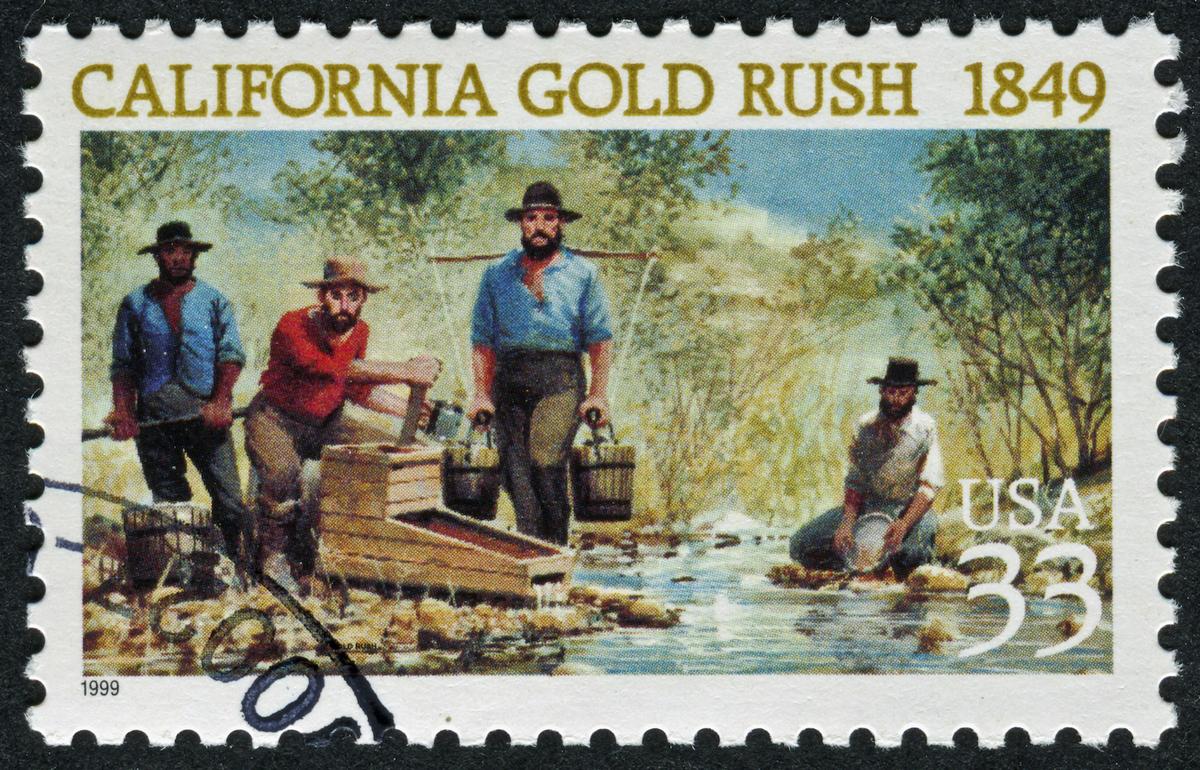
California Gold Paved the Way to Victory

This evening, I was reading John McPhee’s Assembling California when, suddenly, I came upon this quote by John Bidwell who wrote the following in his memoirs, first published in 1900:

It is a question whether the United States could have stood the shock of the great rebellion of 1861 had the California gold discovery not been made. Bankers and business men of New York in 1864 did not hesitate to admit that but for the gold of California, which monthly poured its five or six millions into that financial center, the bottom would have dropped out of everything. These timely arrivals so strengthened the nerves of trade and stimulated business as to enable the government to sell its bonds at a time when its credit was its life-blood and the main reliance by which to feed, clothe, and maintain its armies. Once our bonds went down to thirty-eight cents on the dollar. California gold averted a total collapse and enabled a preserved Union to come forth from the great conflict.

Bidwell should know: He was, in addition to being a California settler as far back as 1841, but was a member of congress and a candidate for Governor of the State of Califonia.

McPhee states that “by 1865, at the end of the American Civil War, seven hundred and eighty-five million dollars had come out of the ground in California, making a difference—possibly the difference—in the Civil War.”

Indian Country

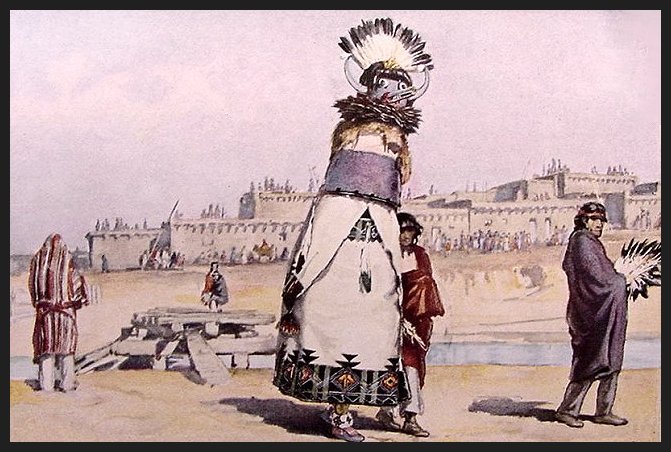
Figure from the Zuñi Shalako Ceremonial

I will always think of the American Southwest as Indian Country. The high points of my visits to Arizona, New Mexico, Utah, and Colorado were encounters with the various Indian tribes that inhabit that region. I was always conscious of stepping outside my culture into something radically different and in many ways spiritually superior. Yet I stand very much on the outside looking in.

Among the peoples I have visited are the following:

  • Navajo, the most populous tribe in the Southwest, whose reservation encompasses parts of Arizona, New Mexico, and Utah. Their capital, Window Rock, AZ, is just over the border from New Mexico. Martine and I enjoy listening to their radio station, KTNN, AM 660. Clyde Kluckhohn and Dorothea Leighton’s The Navaho is an authoritative work about the culture.
  • Hopi, surrounded on all sides by the Navajo Reservation in Arizona, consists of three mesas, which include one of the oldest continuously inhabited villages in North America at Old Oraibi. Don C. Talayesva’s Sun Chief: The Autobiography of a Hopi Indian is a great resource. Some day, I would like to spend more time on the Hopi reservation.
  • Zuñi, who call themselves the Ashiwi, are the largest of the New Mexico pueblos. Unfortunately, the only time I visited with them, they were down on tourists because someone had profaned one of their ceremonials. Frank Hamilton Cushing wrote several useful studies of the tribe over a hundred years ago which are still in print.
  • Acoma is the other pueblo with claims to be the oldest continuously settled village in North America. Their mesa-top “Sky City” is one of the most incredible places to visit within Indian Country.
  • Taos, north of Santa Fe, is a stunning multi-story pueblo that reminds me of the ancient Anasazi ceremonial centers at Chaco Canyon and other nearby locations.

When I go to New Mexico in a couple of months, the high points, once again, will be these native peoples. Wyatt Earp, Billy the Kid, Bat Masterson—all have some interest to me, but not early so much. Stay tuned to this website for further developments.


WTF: Tofu Spa Massage

What Strange Animal Is This?

It was late yesterday afternoon. I had parted with my friend Bill at the Antelope Valley California Poppy Reserve and, while he took the mountain route back to Altadena, I took the I-5 and I-405 back home to West LA. But first, I decided to drop in at what used to be my favorite Mexican restaurant in L.A., Dos Arbolitos at Nordhoff and Woodley. It was still pretty good, with that smoky chipotle chile salsa casera, and the chile verde pork was excellent.

What got to me, however, was its neighbor, the Tofu Spa Massage (illustrated above). Now what is it they do? Do they rub soft tofu into all your nooks and crannies prior to a vigorous massage? Do they first wrap your private parts in organic kale and stuff purple broccolini up your fundament? I would have stepped inside and asked them; but, seriously, Folks, I was just about to eat. So I could be forgiven, no?

This mysterious business has inspired a new series entitled “WTF,” concentrating on some of the weirder things I see, especially in Southern California.

Eschscholzia californica

A

Field of California Poppies

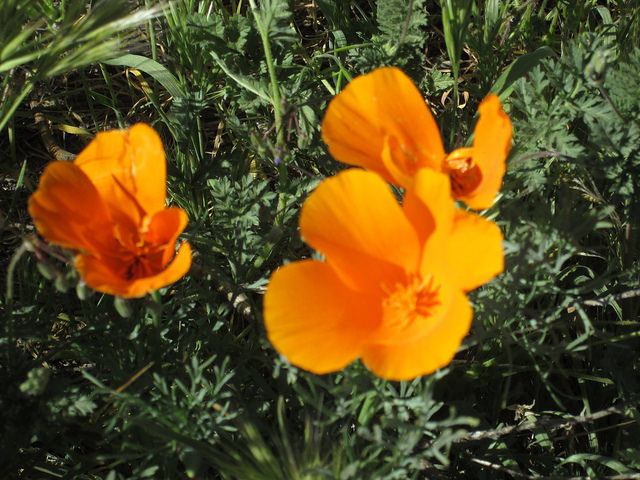
After a wet winter, such as this has been, there is a brief explosion of bright orange for a few weeks in the Spring. Don’t worry: It’s not Donald J. Trumpf. It is the California Poppy (Eschscholzia californica) in all its glory. Today, my friend Bill Korn and I went to the Antelope Valley California Poppy Reserve in the high desert valley running east and west between I-5 and California 14. We took separate routes and arrived there within fifteen minutes of each other.

The California Poppy is the official state flower of California: It is considered an offense to pick any of them. They are truly lovely, though, and the Poppy Preserve was crawling with thousands of people who came out to wander in fields of flowers. There were one-hour lines outside the bathrooms and the portable toilets.

We took several trails and saw the pointillist dots of bright orange extending in several directions.

Poppy Fields with San Gabriel Mountains in Background

I’m happy that I was able to work only half a day doing taxes before making my getaway. It was a good day!

Trying to Convince Callicles

Plato Was Perhaps the Greatest Philosopher Who Ever Lived

In the early 20th century, something happened to philosophy: It became ever more remote from the human experience—a matter for trained professionals. Whenever I get chilled by the likes of Wittgenstein, Ayer, Heidegger, or Derrida, I like to go back to the Ancient Greeks, and most especially Plato. His dialogues are probably the height of philosophy. Given their general appeal, it is no wonder that so many of them survived some 2,500 years of war and rapine.

Today, I finished reading Gorgias, which starts on the subject of rhetoric, and which, thanks to the persistence of Socrates, turns into a dialogue on how goodness and morality are more important than hedonism and success. Ultimately, Socrates says, it is better to be the victim of another’s wrongdoing than to perpetrate any wrongdoings oneself. That is because “it takes true goodness to make a man or woman happy, and an immoral, wicked person is unhappy.” [471a]

Something interesting happens in this dialogue. One of the participants, Callicles, refuses to accept the drift of Socrates’s argument. Even when he finds himself agreeing to individual points, he keeps on backtracking in favor of hedonism over morality. He interrupts the conversation between Socrates and Polus to say:

Socrates, may I ask you a question? Are we to take it that you’re serious in all this, or are you just having us on? You see, if you’re serious, and if what you’re saying is really is the truth, surely human life would be turned upside down, wouldn’t it? Everything we do is the opposite of what you imply we should be doing. [481c]

This is a big change from the usual philosophical dialogue, when the recipient of Socrates’s wisdom is reduced to saying “Yes, that is so” or “That’s absolutely inevitable!” Callicles, on the other hand, frequently backtracks and says things like, “Tell me, Socrates, doesn’t it embarrass you to pick on people’s mere words and to count it a godsend if someone uses the wong expression by mistake?” or “You’re not being altogether sincere, Socrates.”

Without losing track of his argument, Socrates keeps trying to get through to his interlocutor, despite his contrariness.

This Socrates was certainly a dangerous man. I could see why his enemies arranged to have him tried, convicted, and executed.

If you’re interested in reading Plato, I suggest the translations by Robin Waterfield.

Madame Vleughels

Edmé Bouchardon’s Bust of Madame Vleughels

The Getty Museum in Los Angeles has been putting on an exhibit entitled Bouchardon: Royal Artist of the Enlightenment, which ends in a few days. I was enthralled by both his drawings and his sculptures, of which the above bust of Mme Vleughels is one of my favorites. Edmé Bouchardon (1698-1762) is not well known to most people, but thanks to the Getty, I have made another discovery.

His work that shows the same technical virtuosity of some of the great rococo painters, as in the ornately draped blouse worn by the young woman, yet retains an austere classicism in her facial features and shoulders. Below is one of his drawings:

Head of a Woman Wearing a Scarf

Here again we have a combination of simplicity and technical virtuosity, which seems to be a hallmark of Bouchardon’s style.

Visiting an art museum can be a thrilling experience. But you have to open your eyes and be willing to make comparisons.

A Jobs Plan for Trumpf’s America

Specially Targeted to Trumpf Supporters

Our president wants jobs for Americans. It suddenly hit me that he could kill two birds with one stone: Send his most vociferous supporters deep into coal mines. (And none of that sissy strip mining stuff, either!) That coal dust does things to those who are most vociferous: It gives them black lung disease. That might also be a good solution for those members of his staff that the president is forced to remove for disloyalty or, worse yet, getting caught.

Perhaps we could direct our economy into those jobs which were more typical of centuries past. It’s a way of looking forward by looking back, and paying homage to our economic heritage. Say, what about harvesting cotton and sugar cane?

Serendipity: The Allegory of the Lamp Post

Lamp Post at Hotel Jardines de Nivaria in Tenerife

I am currently reading Simone Weil’s essay “On the Abolition of All Political Parties”—a subject to which I will return in a few days. In the introduction by Simon Leys, I found this splendid long quote from G. K. Chesterton’s Heretics:

Suppose that a great commotion arises in the street about something, let us say a lamp-post, which many influential persons desire to pull down. A grey-clad monk, who is the spirit of the Middle Ages, is approached upon the matter, and begins to say, in the arid manner of the Schoolmen, “Let us first of all consider, my brethren, the value of Light. If Light be in itself good—” At this point he is somewhat excusably knocked down. All the people make a rush for the lamp-post, the lamp-post is down in ten minutes, and they go about congratulating each other on their unmediaeval practicality. But as things go on they do not work out so easily. Some people have pulled the lamp-post down because they wanted the electric light; some because they wanted old iron; some because they wanted darkness, because their deeds were evil. Some thought it not enough of a lamp-post, some too much; some acted because they wanted to smash municipal machinery; some because they wanted to smash something. And there is war in the night, no man knowing whom he strikes. So, gradually and inevitably, to-day, to-morrow, or the next day, there comes back the conviction that the monk was right after all, and that all depends on what is the philosophy of Light. Only what we might have discussed under the gas-lamp, we now must discuss in the dark.

In the Rough

We’re All in the Rough Together With the Trumpfster

Say, is that a hippo wallowing in the rough? Oh, wait a minute, no, it’s our Tweeter-in-Chief! Apparently, our super-smart prexy is not a very good golfer, unless the tall grass qualifies as the green on a Trumpf-owned golf course.

Politics may be an ugly profession, but it takes some talent to avoid the sand traps and water hazards in which the orotund gentleman pictured above finds himself. Perhaps one doesn’t have to be so smart as he is: Just listening would be a good start. Do you suppose it’s the small hands that have made him unable to wield the club of state?