Vikings

Vikings: They Did a Lot More Than Loot and Pillage

They were the bad boys of early Medieval Europe. From the pulpits of all of Europe and even farther came the prayer “A furore Normannorum libera nos, Domine”—“From the fury of the Norsemen, O Lord deliver us.” Sailing out of Scandinavia, they occupied large parts of Britain, Ireland, France (surely you’ve heard of Normandy), Ukraine, Russia, and Italy. They formed an elite regiment in Constantinople, where they were called the Varangian Guard.

They just happened to be the first Europeans to set foot in the Americas some half a millennium before Columbus sailed the ocean blue. They had a settlement at L’Anse aux Meadows in Newfoundland, which they abandoned only after constant warfare with the Skrælings (Indians).

We call them Vikings, but for them the word was a verb, not a noun. Most of the dread Norsemen raiders were farmers who would “go viking” when their short growing season was over. They were, in effect, part time terrorists.

Also, they just happened to create a great literature in the sagas, particularly those created in Iceland in the 13th century. They included such works as:

  • Njúls Saga,, the greatest of them all, about revenge that gets out of hand
  • Egils Saga, about the bard Egil Skallagrímsson
  • Laxdæla Saga, with its female heroine Guðrun
  • Eyrbiggja Saga, with its berserkers (yes, they actually existed)
  • Grettirs Saga, about a famous outlaw warrior

These were probably the best works of literature to come out of Europe in the period in which they were written. They are all available in excellent translations from Penguin Books.

Incidentally, as a French woman of Norman heritage, my Martine is herself a Viking.

Too Many Freedoms

Maybe Wee Need to Stop Desiring “Freedoms” That Were Never Guaranteed to Us

Look what happened to our Second Amendment. Somehow, the original text—“A well regulated Militia, being necessary to the security of a free State, the right of the people to keep and bear Arms, shall not be infringed.”—became in the minds of our dimmest and most criminally inclined citizens an invitation to accumulate military grade weapons for non-militia use.

As school children, we all heard that we didn’t have the right to shout “Fire!” in a crowded theater. Now I think almost half the population would disagree with this.

The outbreak of the coronavirus epidemic has created a whole slew of crypto-freedoms, such as the freedom to refuse Covid-19 vaccination or to wear a mask to protect oneself and others from the virus.

I have just finished reading a collection of Franz Kafka’s shorter works that were published during his lifetime. In one of the stories, entitled “A Report to an Academy,” we find this very germane discussion in a speech given by a talking ape:

I deliberately do not use the word “freedom.” I do not mean the spacious feeling of freedom on all sides. As an ape, perhaps, I knew that, and I have met men who yearn for it. But for my part I desired such freedom neither then nor now. In passing, may I say that all too often men are betrayed by the word freedom. And as freedom is counted among the most sublime feelings, so the corresponding disillusionment can be also sublime.

Take a look at the above picture of the January 6 insurrection by Trump’s followers at the Capitol in Washington. This insurrection was conducted by people who have decided to take a lie (that Trump won the 2020 election) and make it into a cause for revolt. Repeating a lie at the top of one’s voice, even when accompanied by violence, is not a right guaranteed by the Constitution.

Such freedoms I can do without!

A Different Tiger

A Somewhat Less Cosmic Tiger Than the One Created by Borges

Jorge Luis Borges wrote a number of spectacular poems based on tigers he had viewed at the Buenos Aires Zoo. Leave it to his friend, poet Silvina Ocampo, to provide an altogether different picture. Appropriately, the title is:

 
A Tiger Speaks


I who move like water
sinuously
like water I know
shameful secrets.
I heard that there are dog cemeteries,
with earnest inscriptions
commemorating human friendship,
and that there are horses so stupid
they kneel before their masters,
oxen who are slaves to farmworkers,
cats who are ornaments for ladies,
like a hat or a fan,
bears who dance to the sound of a tambourine
from a man or a dwarf woman,
monkeys who flatter their owners,
elephants whom the public degrades,
abject seals who gargle
to entertain the children,
cows who let themselves be dragged along, mistreated,
who give their milk to anybody,
trained sheep
who donate their wool
to make clothing or mattresses,
snakes who caress
the head and neck of madmen.

We never managed to agree
about man’s true nature,
some fools think
perhaps in gratitude
for those who deified us
in other times
that man is a god,
but I and certain of my friends and enemies
think that he is edible.
The edible man
is always shy and trembling,
without claws and hair or with very little hair;
the man-god distributes food
with his hands, so I’ve been told,
he has a whip in his tongue and in his eyes.
In olden days, when he took up his position in the arena,
or in the desert, he wore a halo
or carried a magic wand,
he had a long mane
like a lion’s, which tangles in the teeth.
All this disturbs me:
sometimes I dream
of a rug whose coat
resembles mine, and I cry
stretched out on my own skin.
It’s strange. Inconceivable.
But there are stranger things:
Don't birds exist
who pass the time singing,
ridiculous doves, and an infinite series of fish
and beetles I’m unaware of
but which bother me?
Isn't there a poet who thinks about me constantly,
who believes that in my skin are signs revealing
man’s destiny drawn by God
in a poem?

Serendipity: On the Tram

An Old-Style Tram in Prague

The following is one of Franz Kafka’s brief stories in his volume entitled Meditation, shown below in its entirety. You will find it in Kafka’s The Metamorphosis and Other Stories (New York: Schocken Books, 1948). What an amazing description of a young woman of his day!

I stand on the end platform of the tram and am completely unsure of my footing in this world, in this town, in my family. Not even casually could I indicate any claims that I might rightly advance in any direction I have not even any defense to offer for standing on this platform, holding on to this strap, letting myself be carried along by this tram, nor for the people who give way to the tram or walk quietly along or stand gazing into shop windows. Nobody asks me to put up a defense, indeed, but that is irrelevant.

The tram approaches a stopping place and a girl takes up her position near the step, ready to alight. She is as distinct to me as if I had run my hands over her. She is dressed in black, the pleats of her skirt hang almost still, her blouse is tight and has a collar of white fine-meshed lace, her left hand is braced flat against the side of the tram, the umbrella in her right hand rests on the second top step. Her face is brown, her nose, slightly pinched at the sides, has a broad round tip. She has a lot of brown hair and stray little tendrils on the right temple. Her small ear is close-set, but since I am near her I can see the whole ridge of the whorl of her right ear and the shadow at the root of it.

At that point I asked myself: How is it that she is not amazed at herself, that she keeps her lips closed and makes no such remark?

Back to the Movies

Nicolas Cage and His Truffle-Hunting Pig

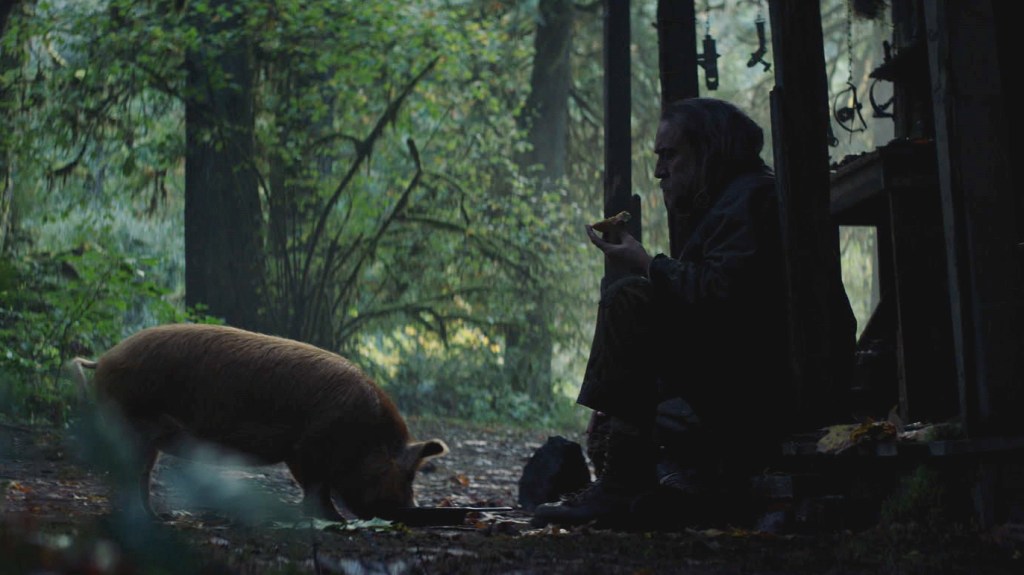
Today, for the first time in over a year, I went to the movies. My brother Dan had recommended I see Michael Sarnovski’s film Pig (2021) starring Nicolas Cage. So I took the bus to Pico and Westwood to see the film at the Landmark Theatres there—seeing as how I hate to spend a lot of money on parking.

The film was a winner. Cage is made to look like a grizzled old homeless person, which is all part of Sarnovski’s attempt to make us underestimate the character. When Cage’s truffle-hunting pig is stolen, he heads to the city (Portland, Oregon) to find it and bring it back. There we learn that he is the formerly famous chef Robin Feld who was once a legend in the city’s restaurant world.

This is a film for people who are into food, as my brother certainly is. The film reminds me of Marie NDiaye’s novel The Cheffe, which has a similar foodie emphasis. And because of Robin Feld’s prodigious memory of every meal he ever prepared, I will add that you should check out Jorge Luis Borges’s story “Funes the Memorious.”

Great movies and stories always lead you to interesting places. And I think Pig fits into this category.

The He-Man Woman-Haters Club

Why Is That Guy on the Left Not Sporting a Beard and Turban?

Well, Kabul has gone Kaboom once again. The predictable happened: The U.S. started a war, lost interest in it, and Ali Baba and the Forty Thieves waited for their opportunity to pounce, which they did. As in Viet Nam, the U.S. must evacuate thousands of Afghans who made the mistake of thinking we were in it for the long haul.

Note: The United States is never in it for the long haul. We are short-termers in just about everything we do.

The biggest losers, of course, will be the women of Afghanistan, who must resign themselves to a lifetime of drudgery, hidden behind ugly face-and-body-covering burkas. Naturally, women will no longer be able to go to school or work with men in jobs. Your hospital nurse will probably have a beard and turban as well as some kind of automatic weapon.

The Taliban remind me of the Cult of Hashashins in medieval Lebanon and the murderous Thuggees of India, who have given us two words in our English language: assassins and thugs.

Will the Taliban be as plug-ugly as they were in the lead-up to the 9/11 terrorist attacks? Or have they learned to be something other than cartoon villains resembling a 1930s Popeye cartoon based on the Ali Baba story? Only time will tell.

Two Englishmen in 1930s Mexico

Mexican Family ca 1930

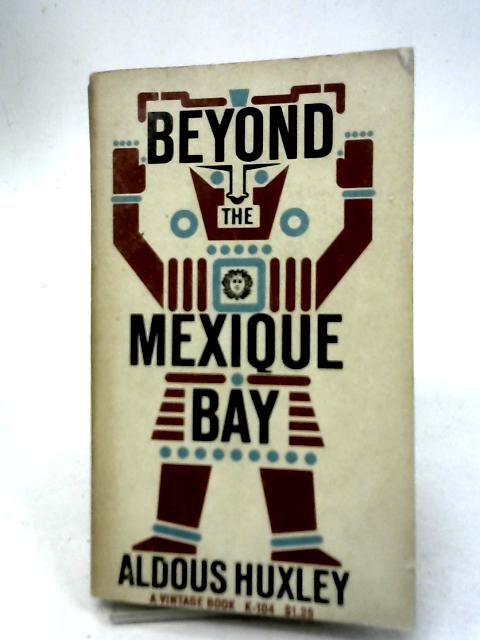
Two writers who influenced my travels in Mexico are Aldous Huxley, who wrote Beyond the Mexique Bay in 1934, and Graham Greene, who wrote The Lawless Roads in 1939. Both writers were there during a rough time. The Mexican Revolution was theoretically over in 1920, but there were not only widespread disturbances, but there were not, as there are today, a safe system of intercity roads. Plus Huxley spent most of his book on his travels in Guatemala and Honduras.

Greene’s book was my guide to a trip my brother and I took to Mexico in 1979. We flew to Mexico City and transferred to a flight to Villahermosa, which at the time impressed me as the armpit of the republic. Greene then then made his way to the Maya ruins at Palenque. From there to San Cristóbal de las Casas was lengthy journey over the Sierra Madre on muleback. For Dan and me, it was an all-day journey by second class bus during which we passed a bus from the same company (Lacandonia) that had run off the road and encountered an army inspection just outside of Ocosingo. From there we visited Oaxaca and rode an all-night bus back to the Mexico City airport.

Old Penguin Cover for The Lawless Roads

Greene had considerably worse experiences during his trip over forty years earlier. In the middle of his journey, he broke his glasses:

Just short of our destination a sudden blast of wind caught my helmet and the noise of cracking cardboard as I saved it scared the mule. It took fright and in the short furious gallop which followed I lost my only glasses. I mention this because strained eyes may have been one cause for my growing depression, the almost pathological hatred I began to feel for Mexico. Indeed, when I try to think back to those days, they lie under the entrancing light of chance encounters, small endurances, unfamiliarity, and I cannot remember why at the time they seemed so grim and hopeless.

Why the author went to Mexico with a single pair of glasses is a mystery to me. Fortunately, I never felt any pathological hatred for Mexico, based on the many subsequent journeys I took there.

The Edition of Huxley’s Book That I Own

I have also been to most of the places that Aldous Huxley described in Beyond the Mexique Bay during my trip to Guatemala and Honduras in 2019. Unlike Greene who saw only the Maya ruins at Palenque, Huxley traveled to Copán in Honduras and Quirigua in Guatemala.

Like Greene, Huxley also had a problem with the people of Central America. At one point, he lets it all hang out: “Frankly, try how I may, I cannot very much like primitive people. They make me feel uncomfortable. ‘La bêtise n’est pas mon fort.’” The French expression could be translated thus: Stupidity isn’t my strong point.

These two civilized and (perhaps) sticky Englishmen did manage to write interesting books which engaged my interest through multiple readings over a period of more than four decades.

Now why would you want to read books written almost a century ago when there are more current books on the subject? My answer is a simple one: The best recent books were written with a knowledge of what went before. And when it comes to Mexico, one could easily go back to the books of John Lloyd Stephens written in the 1840s. (In fact, I will do just that in a follow-up post.)

Antigua Guatemala

The View from the Roof Garden of My Hotel

My 2019 vacation in Guatemala started out on a promising note. Instead of staying in Guatemala City, I immediately took a van to Antigua Guatemala, a beautiful city a scant thirty minutes from the capital that is surrounded by active volcanoes and the ruins of churches which collapsed during the disastrous 18th century, which required the city to move several times in its history:

  • The San Miguel Earthquake of 1717
  • The San Casimiro Earthquake of 1751
  • The Santa Marta Earthquake of 1773

When I was in Antigua in January 2019, I spent most of my time visiting ruined churches.

Ruined Church with Collapsed Roof

In the end, I got as much fun from visiting the ruins of Spanish Catholicism as I did the Maya cities like Copán in Honduras, and Quiriguá and Tikál in Guatemala’s Petén jungle.

Although Guatemala is not known for its cuisine, the food I had was uniformly good, particularly the beans. I wouldn’t mind going again, if that is in the cards for me.

Hallelujah!

A Small Victory—With Large Consequences

Today I accompanied Martine to the Access Pharmacy in Westwood where she received the Johnson & Johnson Covid-19 vaccine (AKA Janssen Covid-19 Vaccine).

Martine is a person of monumental stubbornness, so I was surprised that she decided to get the vaccine. In all honesty, it wasn’t my impeccable persuasiveness that did the trick: Her tête de Normande (referring to her Norman French stubbornness) was swayed by the Los Angeles City Council, which was going to make it hard for her to go to restaurants, movies, museums, etc. without either a vaccination card or a weekly Covid test.

Whatever the reason, I am delighted that she has disobeyed the KABC shock jocks and consented to possibly save her life.

My Fingers Are Crossed

No That’s Not Me: I Don’t Wear Ties

After months of bullyragging Martine about not getting her Covid-19 vaccination, Martine has finally made an appointment to receive the Johnson & Johnson vaccine tomorrow. There have been harsh words spoken by me (“That’s because you get all your info from Nazi radio!” “KABC Talk Radio is not Nazi radio!”). But the LA City Council’s unanimous vote on requiring vaccination proof for restaurants and other indoor locales finally did the trick.

I see this as a victory over the shock jocks of KABC, which I persist in referring to as Nazi radio.May all of them come down with Covid-19 complicated with a few other embarrassing ailments!

Since she made the appointment, Martine has been Googling all the negative info she could find about the shots, so I hope she doesn’t back down at the last minute.