I thought that today I would like to present one of Emily Dickinson’s simpler poems. Emily (1830-1886) is one who was well acquainted with defeat, yet who was victorious in the greatness of her literary output.
Success Is Counted Sweetest
Success is counted sweetest By those who ne’er succeed. To comprehend a nectar Requires sorest need.
Not one of all the purple Host Who took the Flag today Can tell the definition So clear of victory
As he defeated – dying – On whose forbidden ear The distant strains of triumph Burst agonized and clear!
The year was around 1950. I was a five-year-old boy living at 2814 East 120th Street in Cleveland, right in the middle of the Hungarian neighborhood. All the houses on the street were two-family homes in which the upper story was rented. It was around then that I met the love of my life, Joycey, who was my age.
We did all the usual things: played doctor and looked at each other with moonstruck eyes. What I loved most about Joycey was, to be precise, the back of her knees. The picture above is of a grown-up woman, because I could not find the same picture for a little girl. I would probably have been arrested if I tried.
Although her name sounds vaguely Anglo, Joycey spoke Hungarian just like me. I don’t remember exactly how our “relationship” ended, though it was probably in 1951 when two major events happened:
My brother Dan was born and
We moved out of the Hungarian neighborhood because the teachers were complaining that I couldn’t speak English
I don’t think I ever knew Joycey’s last name. It was like we were two ships passing in the night. But it was nice while it lasted.
The Mural “Isle of California” (1972) When It Was Newly Painted
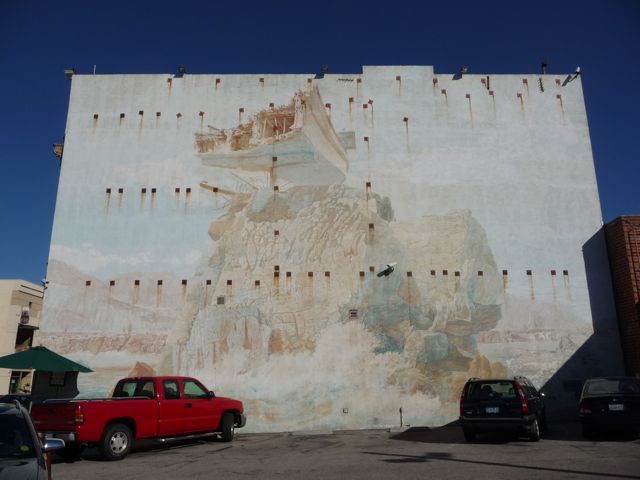
Near the West Los Angeles Post Office is the Village Recording Studio at 1616 Butler Avenue. On its back wall is a mural entitled “Isle of California” showing what remains when most of California has fallen into the ocean. It was painted in 1972 by the L.A. Fine Arts Squad consisting of Victor Henderson, Terry Schoonhoven, and Jim Frazin.
Of course, Southern California will not just fall into the ocean after “the Big One.” What is west of the San Andreas Fault will be displaced northwards, separating itself horizontally from the area east of the fault.
I saw today a fascinating quote from J. B. Priestley in Carey McWilliams’s Southern California Country: An Island on the Land:
There is something disturbing about this corner of America, a sinister suggestion of transience. There is a quality, hostile to men in the very earth and air here. As if we were not meant to make our homes in this oddly enervating sunshine…. California will be a silent desert again. It is all as impermanent and brittle as a roll of film.
Oddly, that’s what I felt shortly after I moved here. The feeling was reinforced by the Sylmar Earthquake of 1971 and the Northridge Earthquake of 1994.
The Same Mural Today: Badly Faded With Earthquake Reinforcing Bolts
Well, Southern California is still here. And I’m still here. The place still feels a bit unreal to me, but I have fallen in love with it. So if the whole place should happen to fall in the ocean after all, I’m a goner.
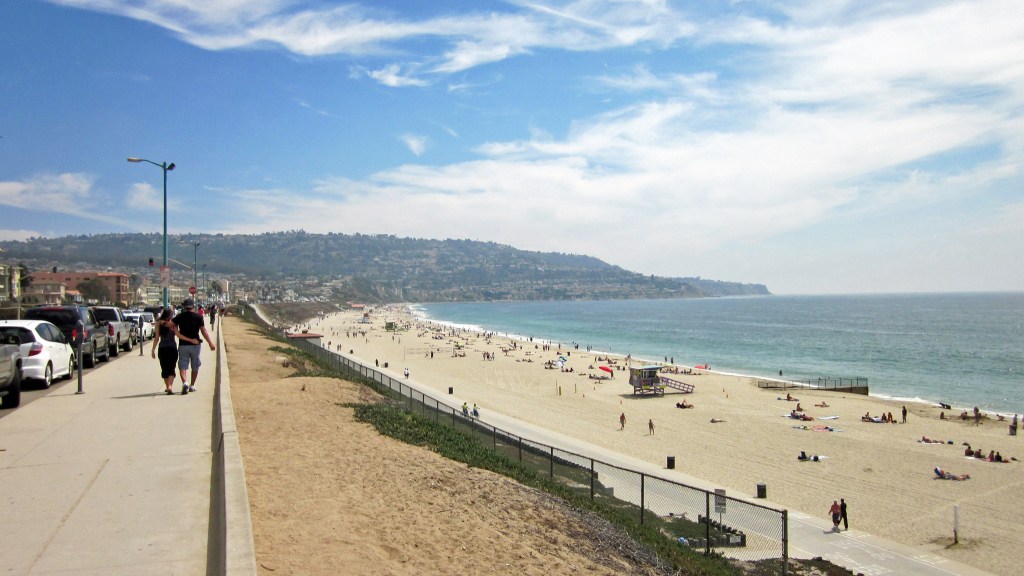
The Pacific Coast from the airport south to Point Fermin on the Palos Verdes Peninsula is a kind of Beach Neverland in which there are a number of high-price communities such as El Segundo, Manhattan Beach, Hermosa Beach, Redondo Beach, a small sliver of Torrance, and the wealthy enclaves around the hills of Palos Verdes. Collectively, the area is known as the South Bay.
Today, Martine and I drove down to Captain Kidd’s Fish Market & Restaurant in Redondo Beach. It’s a bit of a splurge for us, but we enjoy the fresh fish and the view of the southwest-facing ocean on a sunny day. I had some Canadian salmon char-broiled, and Martine had some sautéed Alaskan cod.
Usually we walk south along the boardwalk after we eat, but today we just returned home. Martine’s feet have been hurting, and she wanted to rest them.
When I first moved to Southern California at the end of 1966, the first area that my friend Peter showed me were the beach communities of the South Bay. To the kid from Cleveland, which I was, it all smacked of hedonism; and I looked on it with disapproval. In later years, I was one of the hedonists on the beach in Santa Monica.
There is something gemlike in these communities. They have always had a kind of glow in my imagination. In fact, I wouldn’t mind living there, if I could afford it.
As we tread upon the ground, we tend not to think of what lies beneath our feet. I thought about this after I wrote yesterday’s blog post entitled “Mission Creep.” The small size of the cemeteries at the Santa Barbara and Santa Ynez missions in Southern California troubled me because of the large number of bodies said to be buried there. The Catholic Church did not sanction cremation at that time, so literally thousands of bodies, mostly of Indians, were interred over a 65-year period in these small burial grounds.
I live within walking distance of Kuruvungna Springs, a place where the Tongva or Gabrielino Indians congregated f0or ceremonies or just a fresh drink of spring water. It is entirely possible that as I walk along Santa Monica Boulevard and the streets feeding into it I am walking on the bones of Indians who died in the area—at least those which weren’t carted away by dirt haulers as the area was built up with multi-story commercial and residential buildings.
And then I thought of a great English writer who thought the same way. The quote is from an essay by Sir Thomas Browne (1605-1682) called “Hydriotaphia, urn-burial, or, A discours of the sepulchral urns lately found in Norfolk ….” The 17th century English is hard to read, but I promise that it is rewarding.
In the deep discovery of the Subterranean world, a shallow part would satisfie some enquirers; who, if two or three yards were open about the surface, would not care to rake the bowels of Potosi, and regions towards the Centre. Nature hath furnished one part of the Earth, and man another. The treasures of time lie high, in Urnes, Coynes, and Monuments, scarce below the roots of some vegetables. Time hath endlesse rarities, and shows of all varieties; which reveals old things in heaven, makes new discoveries in earth, and even earth it self a discovery. That great Antiquity America lay buried for a thousand years; and a large part of the earth is still in the Urne unto us.
Though if Adam were made out of an extract of the Earth, all parts might challenge a restitution, yet few have returned their bones farre lower then they might receive them; not affecting the graves of Giants, under hilly and heavy coverings, but content with lesse then their owne depth, have wished their bones might lie soft, and the earth be light upon them; Even such as hope to rise again, would not be content with centrall interrment, or so desperately to place their reliques as to lie beyond discovery, and in no way to be seen again; which happy contrivance hath made communication with our forefathers, and left unto our view some parts, which they never beheld themselves.
Sir Thomas Browne
The reference to Potosi is to the fabulous silver mines at the Cerro Rico (Rich Hill) of Potosi in Bolivia. The mines are at an altitude of approximately 13,300 feet (4,050 meters).
Wherever we may go, we are walking a very few feet above the remnants of the past. We tend to forget this as we follow the latest trends and knock ourselves into a digital frenzy that only hastens us to our own grave.
California has given birth to many beautiful myths. Unfortunately, they frequently have little bearing on the actual history of the Golden State. For instance, the twenty-one Franciscan missions founded by Father Junipero Serra—who has been canonized a saint by Pope Francis in 2015—are among the most peaceful places I have ever visited. Yet they were little more than rural concentration camps in which thousands of Californian Indians found their way to early graves.
If you look at a map of the mission location, you will find that they are all strung out like so many pearls along the Camino Réal closely following the coastline. Indians who dwelt close to the coast were rounded up and assigned as peons to the various missions, where they were worked to death. During the heyday of the missions from 1769 to 1834, some 53,600 adult Indians were baptized, and 37,000 were buried.
The Graveyard of the Santa Barbara Mission
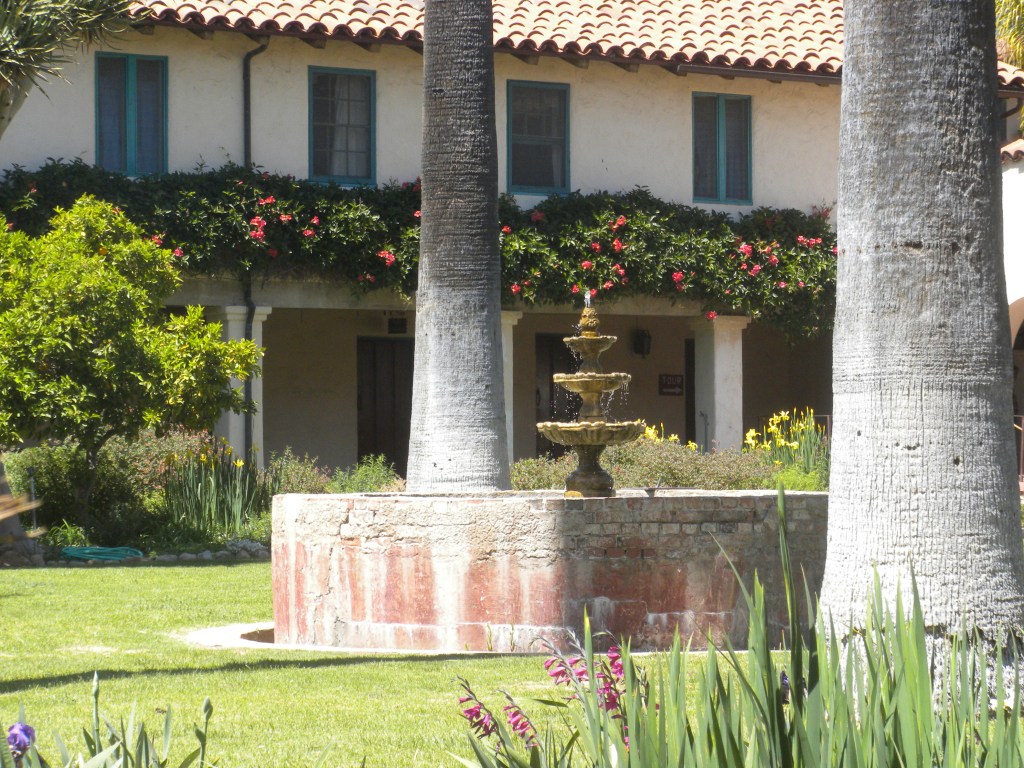
Visiting the Santa Barbara and Santa Ynez missions, I was stunned to find that the postage-stamp-sized cemeteries adjoining the missions held 3,936 and 1,227 bodies respectively. Why is this? The Indians attached to the missions (they were not allowed to leave) were essentially overworked and underfed. When they lived in the missions, the Indians lived in permanent adobe structures that were infested with fleas. Young Indian maidens were treated as nuns and confined to barracks in which the rooms were 50 feet long by 21 feet wide with bunks ranged around the walls. A single high window provided the only ventilation, while the center of the room was an improvised sewer or latrine.
According to Carey McWilliams in Southern California Country: An Island on the Land:
To understand what conversion meant to the Indian, it should be remembered that the process of Missionization necessitated a sudden transition from the settled, customary existence of the Indian in a small rancheria or village to the almost urban conditions that prevailed in the larger Mission establishments. The change … must have come as a deep mental shock to the Indian.
As much as I respect much of Catholic teaching from my long education in religious elementary and high schools, I cannot condone many practices of the past, such as the Inquisition and the treatment of native peoples in the missions.
Nathaniel Hawthorne’s Original House of the Seven Gables in Salem, Massachusetts
We tend to think that the most recent works of biography, history, or literary criticism are the best, on the general principle that the present corrects the errors of the past. Yet I do not think that is true. I like to read scholarly books written before our time. More often than not, I find they are better.
I am currently reading Van Wyck Brooks’s New England: Indian Summer, itself the sequel of The Flowering of New England. The books were published in 1940 and 1936 respectively. They are incredibly rich on a paragraph to paragraph level. There are numerous footnotes, which themselves are frequently more interesting than the text. As I read Brooks, I take notes for books to read in the future.
These titles are part of a series of five books called the “Makers and Finders” series. They consist of:
The Flowering of New England, 1815-1865, pub 1936
New England: Indian Summer, 1865-1915, pub 1940
The World of Washington Irving, pub 1944
The Times of Melville and Whitman, pub 1947
The Confident Years, 1885-1915, pub 1952
So far I have cracked only the first two titles, but I intend to read all five. Fortunately, they are readily available in used book stores, as they were exceedingly popular in the period they were written.
On the Cover of Time Magazine
It doesn’t much matter to me that Brooks’s writing is currently regarded as unfashionable. After all, I am wildly unfashionable. He did write a biography of Mark Twain that I didn’t like, but this “Makers and Finders” series is pure gold, compared to much of the dross being published today. These are books for people who like to read, and I am certainly one of them.
Manhattan: Esplanade Apartments and Lake Shore Drive Apartments
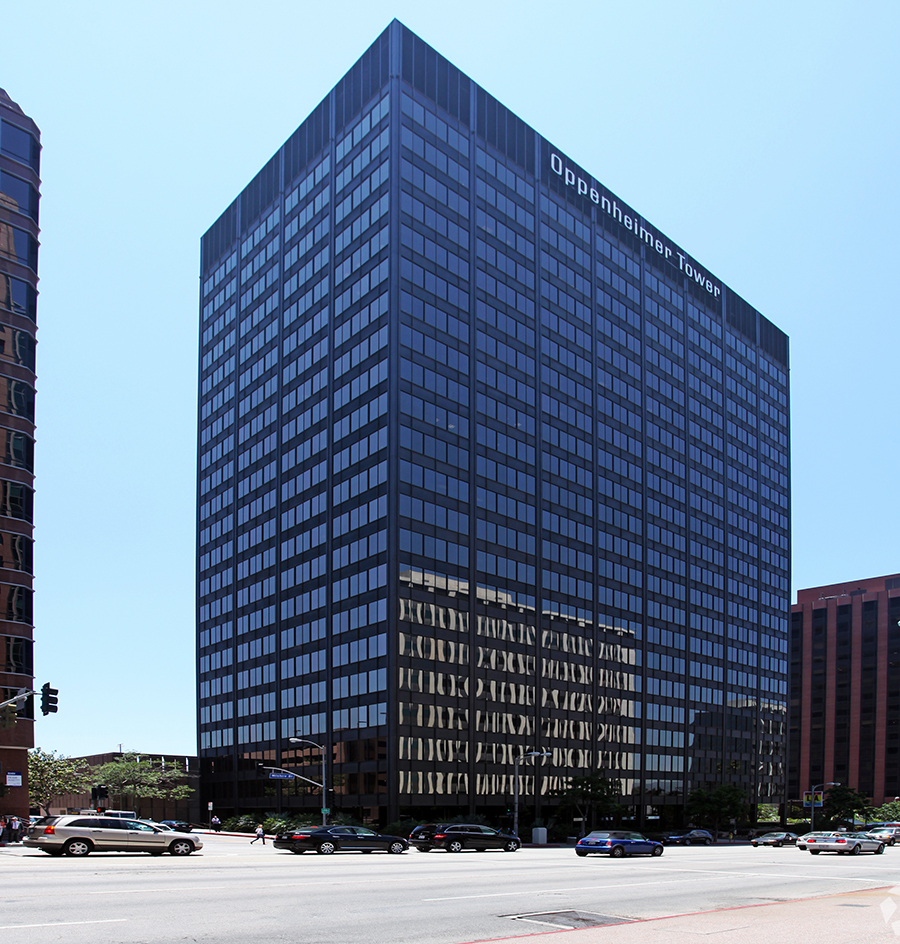
American urban architecture is, for the most part, a series of rectangular Kleenex boxes fronted by rows of large glass windows, requiring scandalous amounts of electricity for air conditioning. When Mies van der Rohe and other postwar architects pioneered their glass towers, they little thought that they were creating unhealthy environments for companies and their workers, and even more so for the dwellers of apartments and condominiums built in that style.
For a quarter of a century, I worked in two such glass towers in the Westwood neighborhood of Los Angeles, just south of the University of California Los Angeles (UCLA). They were right across Westwood Boulevard from each other, and both had what I feel is a baneful effect on my health.
It was only when I retired that I discovered I was not always coming down with colds and headaches. The way that air is circulated in these towers reminds me of giant free-standing Petri dishes.
With global warming, it is becoming more expensive than ever to cool these buildings, at a time when the air outside is requiring even more juice for the HVAC (heating, ventilation, and air conditioning) system. In Los Angeles during the frequent heat waves, I remember dreading going down to the parking lot to get my car. It was almost like crawling through a sewer.
All these architectural fads are based on what seems cheap and feasible at the time they are introduced.
I Spent 16 Years Here
I remember once taking a course in commercial real estate at UCLA. One of the things I learned is that building owners could request—and get—higher rent for suites which have corner offices. Just the sort of thing for a CEO with a swelled head! And that’s one of the reasons for all the Kleenex boxes.
So many of our problems as a nation are due to the institutionalization of greed in our culture. Even in our Declaration of Independence, we are declared to have the right to “Life, Liberty and the pursuit of Happiness.” Originally, the text read “Property” instead of “the pursuit of Happiness.”
So here we are, with the 21st century well under way, admiring billionaires like Elon Musk and Jeff Bezos, as well as self-declared billionaires (but not really) like Donald J. Trump. As a people, we still believe the rich are job creators, even when they get rich by sending American jobs overseas, in which case they could be regarded as job destroyers. In the meantime, we are becoming poorer as a nation, even while believing the opposite.
When José Clemente Orozco painted his famous murals at Dartmouth College’s Baker Library, he was commenting on the betrayal of ideals in the wake of the Mexican Revolution, which came hard on the heels of the Porfiriato, the stifling military dictatorship of Don Porfirio Díaz, which ran from 1876 to 1910. He also painted elsewhere on campus, the so-called “Hovey Murals,” which were so controversial that they were painted over for offending wealthy alumni donors.
Small wonder that they weren’t offended by the above panel from the Baker Library murals.
The wealthy are correct to regard the United States as the land of opportunity. This opportunity, however, comes at a cost. We are too ready to enthrone greed as an American virtue while treating the American poor as somehow losers in the game of life.
I love this poem by Polish poet Czeslaw Milosz (1911-2004). Sometimes I think that those who have lived much of their lives under Communism understand best our need for angels.
On Angels
All was taken away from you: white dresses,
wings, even existence.
Yet I believe you,
messengers.

There, where the world is turned inside out,
a heavy fabric embroidered with stars and beasts,
you stroll, inspecting the trustworthy seams.

Short is your stay here:
now and then at a matinal hour, if the sky is clear,
in a melody repeated by a bird,
or in the smell of apples at close of day
when the light makes the orchards magic.

They say somebody has invented you
but to me this does not sound convincing
for the humans invented themselves as well.

The voice — no doubt it is a valid proof,
as it can belong only to radiant creatures,
weightless and winged (after all, why not?),
girdled with the lightning.

I have heard that voice many a time when asleep
and, what is strange, I understood more or less
an order or an appeal in an unearthly tongue:

Day draw near
another one
do what you can.
I love the message conveyed by the angel: “do what you can.”











 Tarnmoor
You must be logged in to post a comment.