Looks Like the Map of North America from Yucatán to Panama
Every once in a while, I check out NASA’s Astronomy Picture of the Day which frequently has images which make me think. The above picture is technically called the Cygnus Wall of Star Formation. According to the website:
The North America nebula on the sky can do what the North America continent on Earth cannot — form stars. Specifically, in analogy to the Earth-confined continent, the bright part that appears as Central America and Mexico is actually a hot bed of gas, dust, and newly formed stars known as the Cygnus Wall. The featured image shows the star forming wall lit and eroded by bright young stars, and partly hidden by the dark dust they have created. The part of the North America nebula (NGC 7000) shown spans about 15 light years and lies about 1,500 light years away toward the constellation of the Swan (Cygnus).
I have just finished reading all of Charles Willeford’s Hoke Moseley novels about a Miami police sergeant investigating homicides. Unfortunately, there are only four novels in the series:
Miami Blues (1984)
New Hope for the Dead (1985)
Sideswipe (1987)
The Way We Die Now (1988)
Hoke Moseley is a decidedly soft-edged detective. He soaks his false teeth in a glass, has no ambitions regarding promotion, is helping to take care of his two teenage daughters as well as his pregnant Cuban police partner (he was not the father), and is actually an all-around nice guy. He drinks beer, plays Monopoly, and is, in many ways, quite average. Very refreshing for a change!
If you like the Florida crazies in the novels of John D. MacDonald, Elmore Leonard, and Carl Hiaasen, you will love Willeford’s Hokester. It’s too bad that he wrote his best novels at the end of his career (he died in 1988) instead of earlier. That way, he could have written more of the Moseley saga.
I urge you to start with Miami Blues and continue with the other three titles. In fact, I couldn’t think of a better series for summer reading.
Today I took a walk along the Venice Boardwalk. I could swear that I actually heard a couple of people speaking English. There was French, German, and something that sounded vaguely Slavic. And that was in addition to the frequently heard Spanish.
My destination was Small World Books, near the corner of Pacific and Windward (under the Venice sign above). If you’ve ever seen Orson Welles’s film Touch of Evil (1958), you will remember the colonnades meant to be a sleazy Mexican border town. Except now it’s all tattoo parlors, T-shirts, surfboard and bicycle rentals, food take-out places., and Hippie paraphernalia.
When I first visited the Boardwalk, I was put off by all the Hippie associations and suggestions of violence. After all, the Manson Family was in residence there in the 1960s. (But them, so was Jim Morrison of The Doors.) That’s still part of the Venice scene, but I’ve come to terms with it. If anyone tries to sell me a rap music CD recorded by a local garage band, I’ll just answer pleasantly in Hungarian and continue on my way.
Venice was the creature of a developer named Abbot Kinney who founded the community in 1905, complete with canals, gondoliers, and bath houses. And there was also an amusement park jutting out on a large pier (Pacific Ocean Park), Some of the canals still exist and are another pleasant walk,
At Small World Books, I bought books by Roberto Bolaño and Salman Rushdie.
I encountered the following paragraph in Jean-François Duval’s Bukowski and the Beats: A Commentary on the Bet Generation:
It was Jack’[Kerouac’s] matinee idol looks that irritated Hank [Bukowski]. “He was even better looking than Marlon Brando,” Joyce Johnson, one of his girlfriends, said of him. As a good-looking rodeo rider and actor, Jack was too handsome to be “real,” authentic in the Bukowskian perspective (which was ever tinged with humor). Jack was lacking in ugliness that, according to Bukowski, allows a truer contact with the reality of the world more than beauty; ugliness is a safe conduct for hell and, as such, is infinitely closer to the truth. In fact, beauty is not even real to Buk’s eyes, beauty doesn’t make sense at all. As he said to [his friend] Sean Penn, “There is no such thing as beauty … it’s kind of a mirage of generalizations.” In Buk’s opinion, Kerouac seemed like a cheap Roy Rogers whose work gets lost in a swirl of glitter and illusions where the word “wonderful” crops up every three sentences. Jack went wrong in trying to go with “heart’s songs” and the illusions attached: hope of salvation on the road, faith in an idealized America, poetically fantasized, escape into an uncertain mysticism, oscillating between Buddhism and Catholicism. This was not Buk’s cup of tea at all.
Whoever ordered the tombstone for poet and counterpuncher Charles Bukowski knew what he (or she) was about. There is a two-word epitaph: “Don’t Try.” Below it is a silhouette drawing of a boxer with his gloves raised.
The poet’s grave is at Green Hills Memorial Park in San Pedro which I have passed scores of times 0on visits to my friend Peter who lives a couple miles further south. Maybe next town, I’ll stop by and pay my last respects.
On Bukowski.Net, there is an explanation by Bukowski’s wife Linda which sheds some light on he meant:
See those big volumes of books? [Points to bookshelf] They’re called Who’s Who In America. It’s everybody, artists, scientists, whatever. So he was in there and they asked him to do a little thing about the books he’s written and duh, duh, duh. At the very end they say, ‘Is there anything you want to say?’, you know, ‘What is your philosophy of life?’, and some people would write a huge long thing. A dissertation, and some people would just go on and on. And Hank just put, “Don’t try.”
I am reminded of Portuguese writer Fernando Pessoa in The Book of Disquiet, who sees life as a roadside inn where we all have to stay until the coach from the abyss pulls up:
Night will fall on us all and the coach will pull up. I enjoy the breeze I’m given and the soul I was given to enjoy it with, and I no longer question or seek. If what I write in the book of travellers can, when read by others at some future date, also entertain them on their journey, then fine. If they don’t read it, or are not entertained, that’s fine too.
In the days to come, I plan several more posts about Bukowski and what he means to me.
My two best friends each live 25 miles away: Bill K, in Altadena; and Peter J, in San Pedro. This afternoon I drove to San Pedro and discussed a film idea with Peter, whom I think is the ideal person to do a film about the whole hippie scene in Southern California in the late 1960s.
On the way back, I was listening to KUSC-FM. They were playing Mozart’s Requiem Mass in D, K. 626. Although I feel most partial to the 19th century romantic composers, Mozart strikes me as almost Godlike in the perfection of his music. The Requiem was composed in the last year of the composer’s life (1791) and eerily foresees his own upcoming death in abject poverty. There is a solemn magnificence to the Mass.
I felt quite strange driving in the L.A. traffic on the 405 at dusk, seeing the cars in front of, beside, and behind me almost as if they were notes in the symphony.
Frequently, I am powerfully moved by classical music. Pop music? Not at all. As I ascended the stairs to my apartment, my neighbor was playing some Mexican pop music that went BOOM BOOM BOOM with assorted moans and cries. No, there is no doubt where my preference lies.
To put it simply, Thomas De Quincey was an opium addict. There were times when he wrote like an angel. Other times, reading him could be heavy slogging. Oft times you will find both in the same book, or even in the same essay. I have just finished reading his long essay “On Murder, Considered as One of the Fine Arts.” His description of the crimes of serial murderer John Williams is detailed and ghastly. Yet earlier in the essay is the following light touch:
For, if once a man indulges himself in murder, very soon he comes to think little of robbing, and from robbing he comes next to drinking and Sabbath-breaking, and from that to incivility and procrastination. Once begun on this downward path, you never know where you are to stop. Many a man has dated his ruin from some murder or other that perhaps he thought little of at the time.
Whenever the summer heat of Los Angeles becomes too unbearable, I pick up the book I am reading and head to my magic peninsula, Burton Chace Park, which is surrounded on three sides by the boats in Marina Del Rey.
There is a Hungarian expression from my youth that aptly describes this week’s weather: dög meleg, or, in English, damned hot. Although the temperature has been in the low 80s Fahrenheit, the humidity has generally been over 50%, and there has been no cooling breeze.
Even when the area even a few hundred feet inland is like a blast furnace, there, for some reason, always a cooling sea breeze blowing at Chace Park. Unfortunately, the secret is out, especially on the weekends. Even if it can get crowded, it’s always nice to have a respite from the dög meleg.
The title of this post comes from Samuel Taylor Coleridge’s “The Rime of the Ancient Mariner”:
The fair breeze blew, the white foam flew,
The furrow followed free:
We were the first that ever burst
Into that silent sea.
Of all the places I have visited on my travels, I think the most spectacular was Argentinian Patagonia from El Chaltén south to Tierra del Fuego. Twice I have traveled that route, once in 2006 (when I had my trip cut short by a broken shoulder) and once in 2011 with Martine. Although both my finances and remaining years are dwindling, I would like to take another stab at it.
I would like to fly into Ushuaia and take buses north all the way to Buenos Aires. To my right would be the South Atlantic and to my left the windy plains of Patagonia with glimpses of the Andes in the distance.
Argentina is not a destination beloved by North American travelers. The country is full of mostly Spanish-speaking Italians with pockets of Welsh and Croatians. Its main export used to be wool centered in large estancias held by British landowners, but it has become more diversified over time, especially with oil being discovered there.
Near El Calafate there are numerous glaciers originating on the eastern slope of the Andes. Martine and I visited the Perito Moreno, Upsala, and Spegazzini glaciers. As the world warms up, many of these glaciers will not be around for the next generation. But it was nice seeing them while we could.
As a student at Dartmouth College in the mid 1960s, I spent four years in the second farthest dormitory from the center of campus. Why? It was one of three new dormitories, and many of the older dormitories didn’t appeal to me for various reasons. Initially, my dorm was called Middle Wigwam; then it changed its name to McLane Hall. God knows what it’s called now, as the college erected numerous other buildings in the immediate vicinity and called another building McLane Hall. I certainly hope that the McLanes are happy with that.
There were several problems about being so far from the center, which mostly became apparent in the fierce New Hampshire winter. First of all, the central heating plant was more than a mile away. When the temperature dipped down to -30° degrees Fahrenheit (-34° Celsius), it wasn’t particularly easy to heat the building. Fortunately, I had an electric blanket for those days when the mercury sank way below comfort level. We never needed a refrigerator most of the year: windows were festooned with gallon jugs of apple cider.
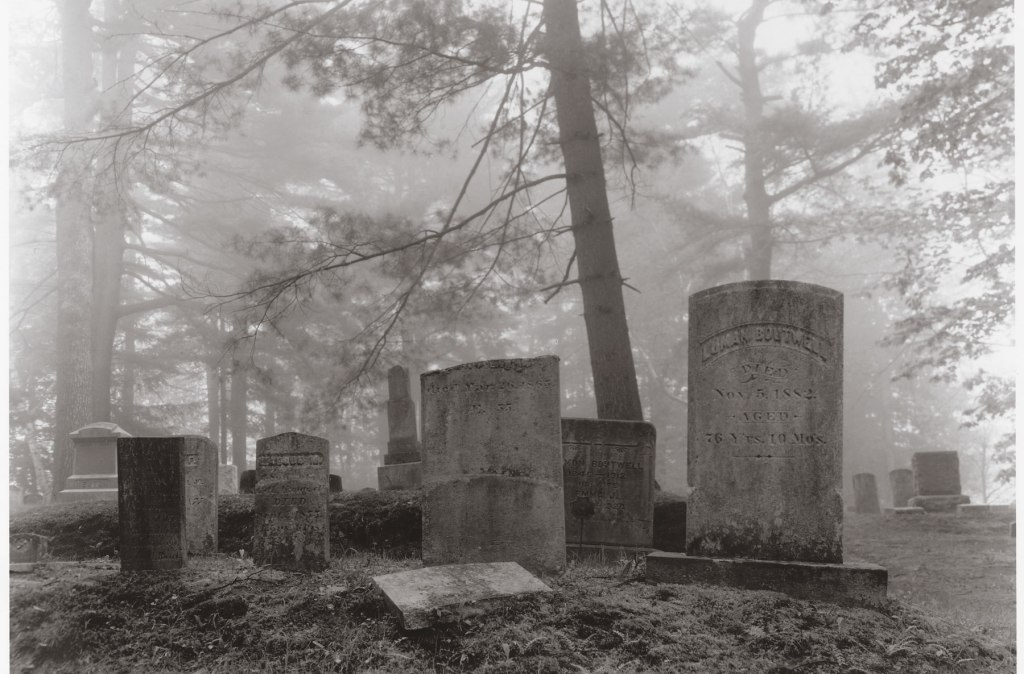
Secondly, in going to and from classes and meals, I had to take a long walk on a frequently icy (and in Spring slushy) Tuck Mall past the Hanover town cemetery, which at night was a scary experience. Many of the graves dated back to the 18th century and looked ominous from dusk on.
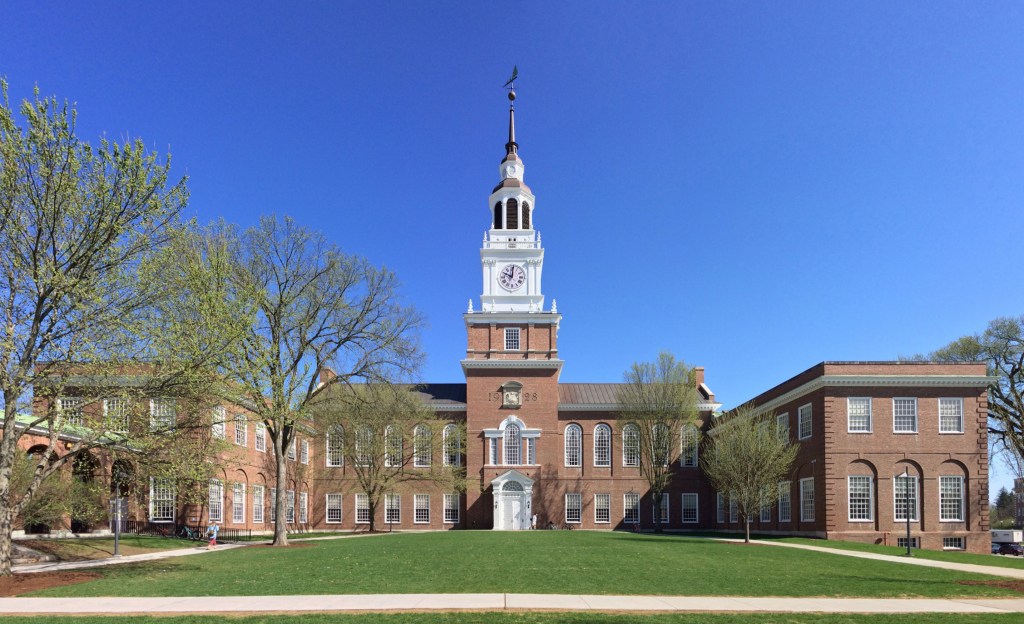
Baker Library (As It Was Called Then) at Dartmouth
In my college years, I was frequently sick with severe frontal headaches that made going to class or the dining hall a misery. It was only after I graduated that I found the cause: a benign tumor was growing in my pituitary gland and pressing on the optic nerve. I was basically a pretty unhealthy young man who was taking long walks every day during the school year. Of course, once I got to my classes or the dining hall, I hung out in the Baker Library (now the Baker-Berry Library) or the Hopkins Center or—that’s where my habit began—the Dartmouth Bookstore.
I was fortunate to have survived my college years. All the times I showed up to the student infirmary, I was told I had migraines or hay fever or some such—pure bosh! But then, in those early years, all they had to go on were X-Rays; and the pituitary, being directly in the center of the head, did not show up well on the X-Rays of the period. MRIs and CAT Scans were all in the future.
Even so, I enjoyed most of my time at Dartmouth. It was a beautiful place, with majestic elm trees all over the place. No more! And the college’s aggressive building program has destroyed much of the campus’s charm.







 Tarnmoor
You must be logged in to post a comment.