
Keep Him Occupied

Trump Appearing in New York for Another Deposition

Yesterday, I was surprised that Bill Maher on “Real Time with Bill Maher” came out against the 34 felonies with which the Trumpster is charged relating to the Stormy Daniels case. Apparently, he thinks that Americans don’t care about sex-related charges against our presidents, thinking of how Bill Clinton’s popularity soared despite the whole Monica Lewinsky affair.

I say that it is best to keep MAGA Man busy with lawsuits and criminal charges—enough to keep him busy for the rest of his days. This is on the same principle that it is best to keep a toddler busy so that he doesn’t get into more mischief. And here the stakes are considerably higher than mere mischief.

Wear the man out defending himself, looking out for ever more lawyers to stiff. When he is kept busy in this way, there will be fewer incendiary rallies en route to becoming president again. It’s like tying a 100-pound weight to his legs.

If you read this blog, you know I dislike the man. That doesn’t stop me from seeing the humor of the situation.

All these court cases are like the death of a thousand cuts. One can make a case for him being a martyr the first time, but what about the 70th time? or the 7 times 70th time? It may just do the trick.

The Kingdom of Lundy

Block of Four 16-Puffin Stamps from Lundy Island

A small island of the north coast of Devonshire was once owned by a man who called himself a king, issued his own postage stamps, and even—until he was fined for doing so—his own coinage. Martin Coles Harman, who owned the island until his death in 1954, denominated the stamps (and coins) in monetary units of his own devising, which he called Puffins, after the bird which used to congregate on the island. One puffin equaled one British penny.

The stamps were in use to provide postage to Biddeford, Devon, as the Royal Mail had cancelled services to Lundy in 1927. The reason given? There were just two few people resident on the island to justify postal services. So Harman undertook to deliver the mail to Biddeford upon payment of a prescribed number of Puffins. The Lundy stamp appeared on the back of the envelope, so that it would not confuse the Royal Mail employees. On the front of the envelope appeared the appropriate British stamp.

Today, Lundy Island is controlled by the Landmark Trust and still issues its own stamps. And they are still denominated in Puffins. Only now they are good not only for the cross-channel hop to Biddeford, but to whatever destination the sender wishes, with the Royal Mail getting its cut. This is made possible because some 25,000 tourists a year visit the island and send letters and postcards therefrom using the new stamps.

When I used to collect stamps, I had a few Lundy stamps in my possession. At the time, the stamps from the island were considered to be “cinderellas,” that is to say, “anything resembling a postage stamp, but not issued for postal purposes by a government postal administration.” There is a wide variety of cinderella stamps, such as those printed for promotional use by businesses, churches, political or non-profit groups.

Totem Poles

Totems at Quw’utsun’ Cultural and Conference Center in Duncan, BC (2004)

The First Nations tribes of the Pacific Northwest have created a unique art form in the totem pole. They are truly multipurpose. According to Wikipedia:

The carvings may symbolize or commemorate ancestors, cultural beliefs that recount familiar legends, clan lineages, or notable events. The poles may also serve as functional architectural features, welcome signs for village visitors, mortuary vessels for the remains of deceased ancestors, or as a means to publicly ridicule someone. They may embody a historical narrative of significance to the people carving and installing the pole. Given the complexity and symbolic meanings of these various carvings, their placement and importance lies in the observer’s knowledge and connection to the meanings of the figures and the culture in which they are embedded.

The above totem poles were from the Quw’utsun’ Cultural and Conference Center in Duncan on Vancouver Island.

Interestingly, totem poles till being carved. In Port Alberni on Vancouver Island, I took this picture of a First Nations member carving a new totem pole.

Carving a New Totem Pole

I hope to take a trip to Southeast Alaska and visit the totem poles in Ketchikan, Prince of Wales Island, and other locations. Instead of taking a cruise, I prefer to fly to Ketchikan and travel using the oceangoing ferries of the Alaska Marine Highway. That way, Martine and I can concentrate on seeing the sights—and not schmoozing with cruise ship passengers.

Smart Phones and Brussels

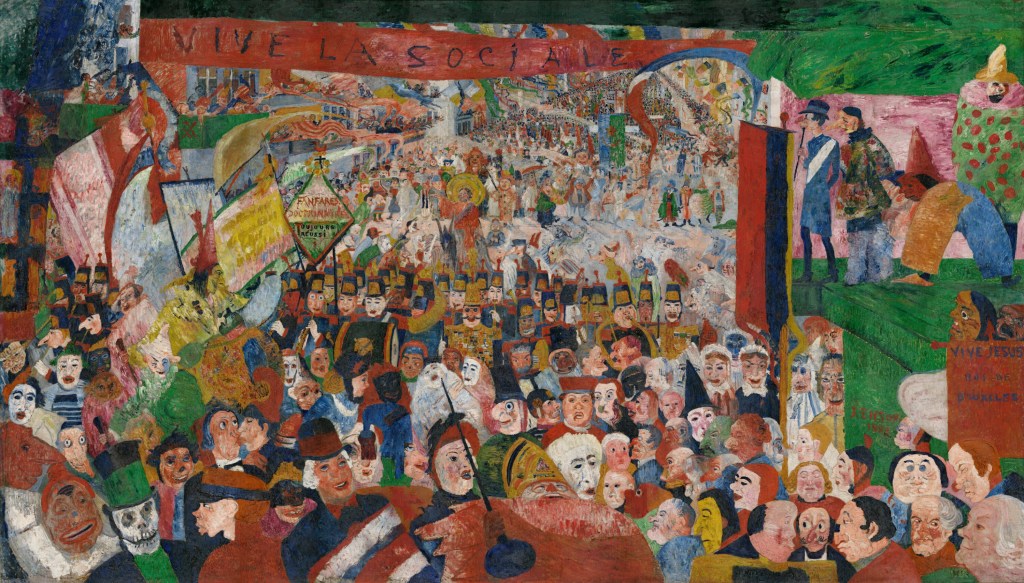
James Ensor’s Christ’s Entry into Brussels 1889

On Friday, I took a bus (to avoid the $20 parking fee) to the Getty Center to view the latest exhibitions and to reacquaint myself with the permanent collection. Unfortunately, the museum was mobbed. Time and time again, I was prevented from seeing a painting because some oversized bozo was stationed in front finger f—ing his smart phone, totally oblivious to the crowds and the magnificent artworks around him.

They reminded me of one of my favorite paintings in the Getty’s permanent collection, James Ensor’s Christ’s Entry into Brussels 1889. Look closely at the crowd entering with Christ who appears (with golden halo) in the center of the painting and slightly to the left. Now imagine each member of the crowd with a smart phone and not giving a tinker’s damn about anything but his or her Facebook or Instagram or whatever.

The Getty’s notes on the painting confirm my opinion:

James Ensor took on religion, politics, and art in this scene of Christ entering contemporary Brussels in a Mardi Gras parade. In response to the French pointillist style, Ensor used palette knives, spatulas, and both ends of his brush to put down patches of colors with expressive freedom. He made several preparatory drawings for the painting, including one in the J. Paul Getty Museum’s collection.

Ensor’s society is a mob, threatening to trample the viewer–a crude, ugly, chaotic, dehumanized sea of masks, frauds, clowns, and caricatures. Public, historical, and allegorical figures, along with the artist’s family and friends, make up the crowd. The haloed Christ at the center of the turbulence is in part a self-portrait: mostly ignored, a precarious, isolated visionary amidst the herdlike masses of modern society. Ensor’s Christ functions as a political spokesman for the poor and oppressed–a humble leader of the true religion, in opposition to the atheist social reformer Emile Littré, shown in bishop’s garb holding a drum major’s baton and leading on the eager, mindless crowd.

After rejection by Les XX, the artists’ association that Ensor had helped to found, the painting was not exhibited publicly until 1929. Ensor displayed Christ’s Entry prominently in his home and studio throughout his life. With its aggressive, painterly style and merging of the public with the deeply personal, Christ’s Entry was a forerunner of twentieth-century Expressionism.

I managed to enjoy my visit despite the crowds. I guess it was Spring Break for too many people, so I should have known better.

Hiking to Inspiration Point

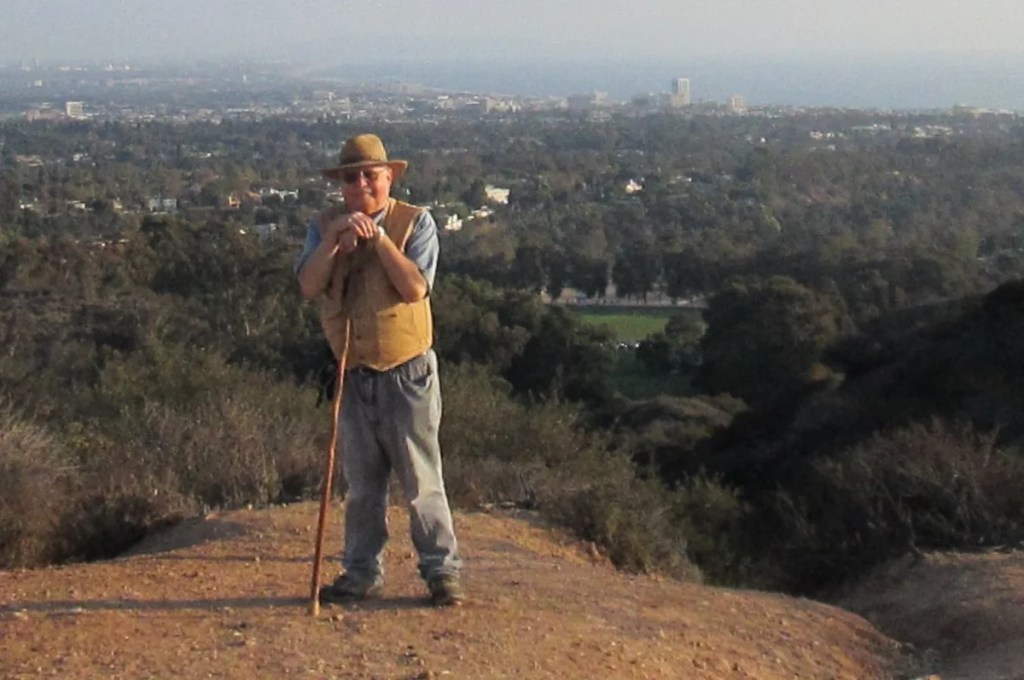
Atop Inspiration Point Ten Years Ago

Today I took a hike … sort of. Now that we are not being flooded out very week, I needed some exercise—only to find that I was way out of shape. I drove to the Will Rogers State Historical Park in Pacific Palisades. Now this is a trail I had hiked many times before, but today I couldn’t quite make it to the top. And that despite the fact that the trip there and back was only 9/10 of a mile (1.5 km) with a total gain of 119 feet (36 meters)!

I am resolved to try again soon. It is amazing how a long spell of bad weather can expose how out of shape one is.

No matter. I still enjoyed the experience. The hills were covered with purple and gold wildflowers, and at several points there were still rivulets seeping from the hills right through the center of the trail. At three points along the trail, there are benches . I took advantage of them once on the way up and once on the way down. It was a lovely day, with coastal fog starting to come in at the lower elevations.

In another ten or twelve weeks, it’ll be too hot to hike this trail, so I had better do it again soon perhaps two or three times. When it gets really hot in L.A., it’s better to stick to level ground—and that early in the morning. Once 11 am rolls along, it becomes a sweaty ordeal.

When I finished the walk, I sat down on one of the three rocking chairs on the porch of Will Rogers’s old house and watched parents play with their children on the wide lawn in front.

The Tooth, the Whole Tooth, and Nothing But the Tooth

Uh oh! A couple days ago, I felt a sharp pain in one of my upper molars. Plus, when I drank anything cold, I felt the same pain. My last dental siege involved a new crown for one of my bicuspids, which couldn’t stay on. That was followed by two root canals of the bicuspid and an adjacent tooth, which had to be scrapped by having the tooth pulled. Total cost: about $4,500.

That sort of sequence is not exactly balm to someone like me on a fixed income. After that adventure, I did something I had never really done before. I purchased an electric toothbrush and did a thorough brushing of the gums and all tooth surfaces (fore, aft, and sides) for two full minutes—timed—before going to bed.

Today, I saw my dentist and had the sore tooth x-rayed. Apparently, the problem was caused by the molar next to the extracted bicuspid sticking out a little too far. So my dentist carefully measured my bite and trimmed the tooth so it wouldn’t receive too much pressure from my normal chewing of food.

The good news: It seems to be holding up for now.

Protective Detachment

Brush Fire About Five Miles from My Front Door

There I was, siting and reading the essays in Joan Didion’s After Henry, when I suddenly found a perfect phrase to summarize the sang-froid Californians feel about earthquakes and wildfires:

The notion that land will be worth more tomorrow than it is worth today has been a real part of the California experience, and remains deeply embedded in the California mentality, but this seemed extreme, and it occurred to me that the buying and selling of houses was perhaps one more area in which the local capacity for protective detachment had come into play, that people capable of compartmentalizing the Big One [that is, earthquake] might be less inclined than others to worry about getting their money out of [a real estate investment].

People in other parts of the country have told me scores of times that California is going to “fall into the ocean,” as if we were all living on a thin shelf of unsteady earth stretched out over the Pacific Ocean. In actuality, our part of the state will, instead of falling into the ocean, slowly head north to Alaska—over a period of millions of years. No matter, I won’t be around to have to buy heavy parkas.

When growing up in Cleveland, I had a deathly fear of tornadoes. They frequently featured in my nightmares. Finally, on June 8, 1953, a large tornado tore through the West Side. As an eight-year-old, we visited a family friend whose two-story house was half a block from utter devastation. At the time, we lived on the East Side and suffered no damage; but that didn’t help my dreams any.

Freeway Damage from the Northridge Quake of 1994

Because I live on a large heavily populated plain just south of the Santa Monica Mountains, I have no reason to fear wildfires. But earthquakes are a different matter. The Sylmar Quake of 1971 scared the Bejeezus out of me, and the Northridge Quake of 1994 didn’t help matters. Perhaps I don’t feel Didion’s protective detachment because I wasn’t born in California as she was.

When He Was Cool

A Young Donald Trump With First Wife Ivana

Now that his karma is finally catching up with him, my thoughts have turned to the young Donald Trump, when he was actually considered to be cool. I am thinking of Trump at Studio 54 being kowtowed as a celebrity. Here was a real estate mogul married to an exotic Czech model named Ivana. He still had a reasonable amount of hair and even looked sort of handsome. This was in the period before he became a reality TV star on The Apprentice in 2004. And definitely before he took aim at the presidency.

The moment Trump came down that gold-plated escalator of the Trump Tower on June 16, 2015, everything turned into a brown and murky covfefe. After ex-wife Ivana died last year, she was interred at the Trump National Golf Club in Bedminster, NJ as part of an elaborate tax dodge. In fact, the golf course had to be consecrated so that the Catholic Ivana could be buried there. As a certain ex-president would say in its nightly tweets, SAD!

As time goes by, there will be a lot more to be SAD about. The current indictment is only the beginning of the ex-president’s troubles. Whatever you may think about him, you wouldn’t like to be in his shoes.

Where the Streets Have No Name

David Hockney’s “Pearblossom Highway, 11-18 April 1986, #2”

This the way I remember it: the way it was decades ago. Yesterday, Martine and I took a road trip to Littlerock, California. Why? We were looking for smoked Hungarian sausage (füstölt kolbász) which was no longer available from our usual source, as the Alpine Village Market in Torrance was no more. I had a distant memory of the Valley Hungarian Sausage & Meat Company in Littlerock, where I had purchased some good kolbász years ago, when my mother was still alive. Then I heard from my brother Dan of a place called Tibor’s that sold kolbász somewhere in the Antelope Valley.

So I took a chance and drove along California 14 (the Antelope Valley Freeway) with its vanishing lanes past the Vasquez Rocks where Captain Kirk battled the reptilian Gorn on Cestus III, past the Red Rover Mine Road and Acton, until we got yo California 138, the Pearblossom Highway, which runs from the 14 all the way to the I-15 at Victorville.

“Where did all those people come from?” I wondered as I saw all the suburban developments that have sprung up in what is now called Canyon Country. I continued asking the same question as I saw how the Pearblossom Highway was no longer “Where the Streets Have No Name,” as Bono and the U2 sang.

Well, the Streets Now Have Names

On the way to Tibor’s, we stopped at Charlie Brown Farms—also in Littlerock—to have lunch and browse around. We quickly realized several characteristics common to the people who now lived in the area:

  1. Everyone was at least thirty pounds overweight, even the kiddies
  2. If they had any discretionary income, it was spent at the local tattoo parlor
  3. To a man, woman, and child, they looked liked bad ass wannabes

We located Tibor’s easily: It was the same as the old Valley Hungarian Sausage & Meat Company. Unfortunately, it was not well stocked. When asked for füstölt kolbász, they said they didn’t have any in stock. That’s kind of like finding no tortillas in a Mexican food store or pasta in an Italian deli. We bought some other kolbász, which turned out to be good. But it was an awfully long drive for slim pickings.

Still, it got Martine out of the house, and she enjoyed the drive to an area she had never seen before. And the California poppies along the road were like golden explosions of faerie light.