
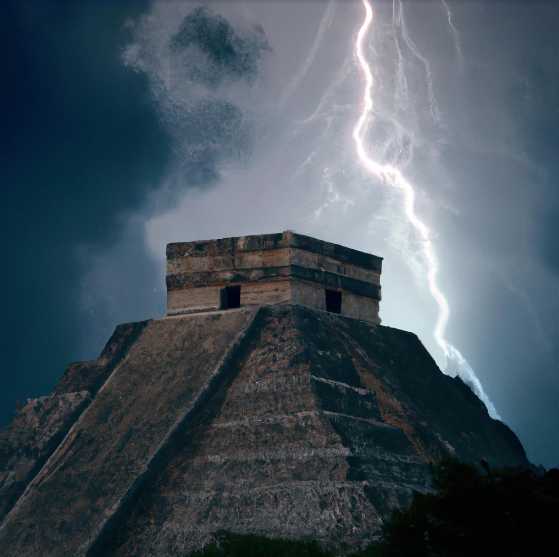
El Castillo at Chichén Itza Being Struck by Lightning
Except for this first paragraph and the photo caption above, this post was created by ChatGTP. I wanted to see what the program could do with a topic I proposed (“Discuss the many dialects of the Maya language”) accompanied by a picture of a Maya pyramid being struck by lightning. Let’s take the picture first: ChatGTP seems to think that the Castillo at Chichén Itza is the only Maya pyramid. Personally, I would have chosen the Temple of the Dwarf at Uxmal. In the AI discussion of Maya dialects below, ChatGPT starts with the patently false statement that Maya is also known as Yucatec Maya. Not so, Yucatec Maya is the most populous dialect of Maya, but the statement confuses a part with the whole. The rest is not objectionable, except that ChatGPT does not attempt to quantify the number of speakers of each dialect.
The Maya language, often referred to as Yucatec Maya, is a language spoken by the indigenous Maya people in Mexico, Belize, Guatemala, and Honduras. While Yucatec Maya is the most widely spoken and recognized dialect, there are actually many dialects within the Maya language family. These dialects exhibit variations in vocabulary, pronunciation, grammar, and even some differences in syntax.
Here are some notable dialects of the Maya language:
- Yucatec Maya: This is the most prominent dialect and is primarily spoken in the Yucatán Peninsula of Mexico, including the states of Yucatán, Campeche, and Quintana Roo. Yucatec Maya has the largest number of speakers among the Maya languages.
- K’iche’ Maya: K’iche’ is one of the largest Maya language groups, spoken mainly in Guatemala. It has several regional variations, and the dialect spoken in the city of Quetzaltenango (Xela) is considered the standard. K’iche’ Maya gained recognition for being the language of the Popol Vuh, a sacred book of the Maya.
- Tzotzil Maya: Tzotzil is spoken in the Chiapas region of Mexico, primarily in the highlands. It is one of the most widely spoken indigenous languages in Mexico, and it has a significant number of speakers.
- Tzeltal Maya: Another major Maya language of the Chiapas region in Mexico is Tzeltal. It is closely related to Tzotzil and shares some similarities. Tzeltal is spoken by a sizable population and has various dialectal variations.
- Mam Maya: Mam is spoken in Guatemala and parts of Mexico. It is known for having a considerable number of speakers and is recognized as one of the major Maya languages.
- Q’anjob’al Maya: Q’anjob’al is spoken in Guatemala, mainly in the western highlands. It has a significant number of speakers and is recognized as an official language in Guatemala.
- Ch’ol Maya: Ch’ol is spoken in the state of Chiapas in Mexico. It has a substantial number of speakers and is considered a separate branch of the Maya language family.
- Itzá Maya: Itzá is spoken by the Itza people in the Petén region of Guatemala. Itzá is considered a distinct dialect within the Yucatec Maya branch.
These are just a few examples of the diverse Maya language family, and there are many more dialects and variations within each branch. Each dialect has its own unique characteristics, influenced by regional differences and historical factors. The preservation and revitalization of these dialects are crucial for maintaining the rich cultural heritage and identity of the Maya people.
 Tarnmoor
You must be logged in to post a comment.