
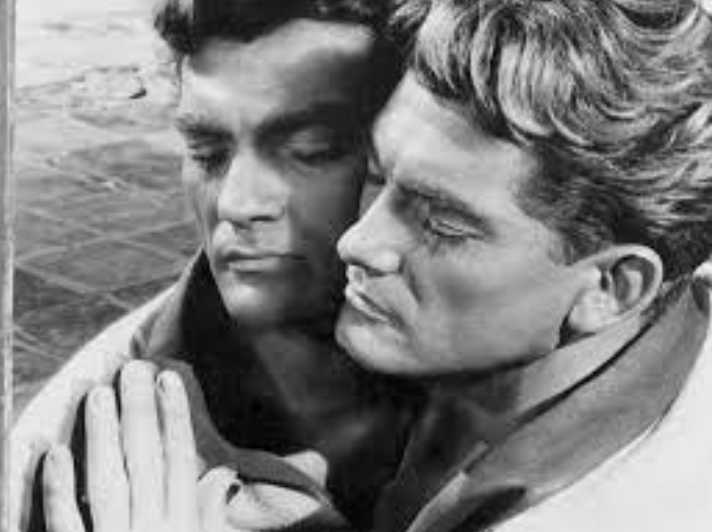
Jean Marais as Orpheus in Jean Cocteau’s Orphée
This is a film I have loved for upwards of sixty years, ever since I first saw it screened by the Dartmouth Film Society. It is the only film I have ever seen that makes a stab at showing us what happens after death—without looking totally silly.
The story is based on the Greek myth of Orpheus the poet and his wife Eurydice, variously mentioned by such authors as Plato, Plutarch, Apollonius of Rhodes, and others. Eurydice dies, and Orpheus, while still alive, goes to the Underworld to get her back. The gods agree, but with the condition that he must never look upon her face again. If he did, her spirit would be instantly wafted back to the Underworld.
Jean Cocteau places the tale in postwar France and adds some interesting touches. Death is personified as “The Princess.” Played by the lovely and elegant Maria Casares, who falls madly in love with Orpheus. Among hr assistants are François Périer as Heurtebise and Édouard Dermit as Cégeste. One enters the underworld by walking through a mirror wearing special rubber gloves, which convert the mirrors to a waterlike substance. The ruins of Saint Cyr Military Academy serve as the Underworld, where Orpheus and Heurtebise go to negotiate with a tribunal in a grimy meeting room.

The Last Shot: The Princess and Heurtebise Go to Meet Their Fate
I have seen Orfée at least a dozen times, and each time was as magical and striking as the first viewing. Along with the same director’s La Belle et la Bête (1946), it is one of the glories of the French cinema, indeed of world cinema.
 Tarnmoor
You must be logged in to post a comment.