“That Terrible Dusty Brilliance”

I have been reading a fascinating book of stories by Gavin Lambert about Hollywood as it was in the 1960s. The book is called The Slide Area, after the crumbling cliffs overlooking the ocean from Santa Monica north to Pacific Palisades. It is some of the best writing about Los Angeles as it was then. Lambert, by the way, was also the author of Inside Daisy Clover, which was made into a Robert Mulligan film starring Natalie Wood. Oh, and Lambert also wrote a biography of Natalie.

Following is an excerpt from near the beginning of The Slide Area:

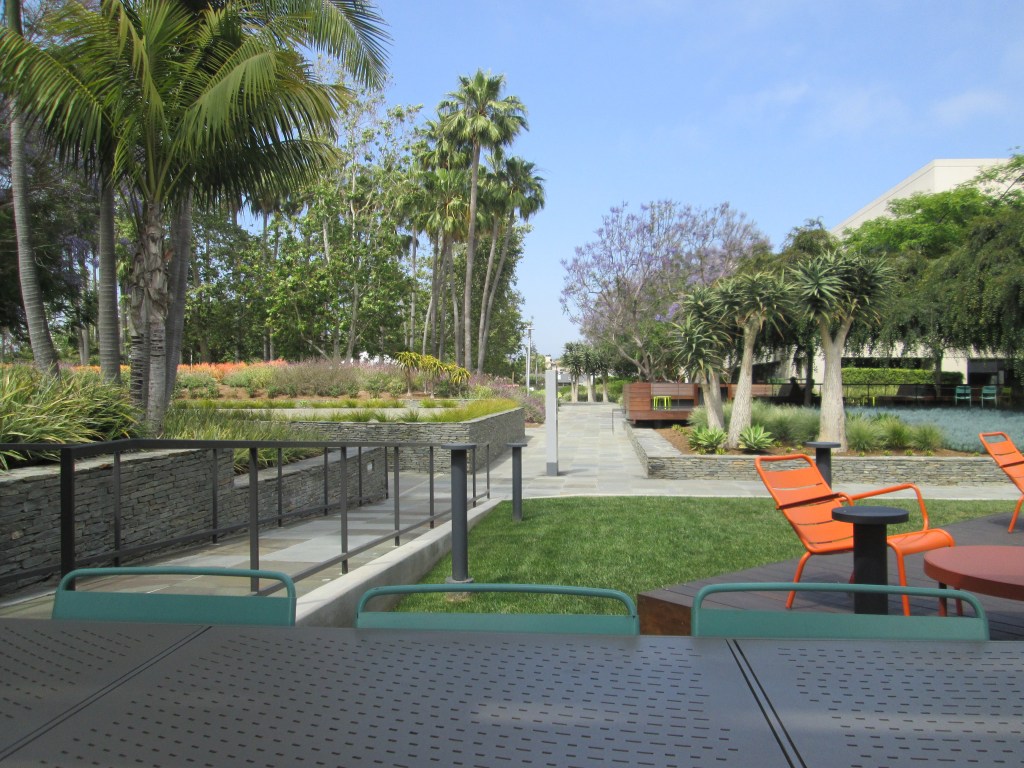
It is only a few miles’ drive to the ocean, but before reaching it I shall be nowhere. Hard to describe the impression of unreality, because it is intangible; almost supernatural; something in the air. (The air … Last night on the weather telecast the commentator, mentioning electric storms near Palm Springs and heavy smog in Los Angeles, described the behaviour of the air as ‘neurotic’. Of course. Like everything else the air must be imported and displaced, like the water driven along huge aqueducts from distant reservoirs, like the palm trees tilting above mortuary signs and laundromats along Sunset Boulevard.) Nothing belongs. Nothing belongs except the desert soil and the gruff eroded-looking mountains to the north. Because the earth is desert, its surface always has that terrible dusty brilliance. Sometimes it looks like the Riviera with a film of neglect over villas and gardens, a veil of fine invisible sand drawn across tropical colours. It is hard to be reminded of any single thing for long. The houses are real because they exist and people use them for eating and sleeping and making love, but they have no style of their own and look as if they had been imported from half a dozen different countries. They are imitation ‘French Provincial’ or ‘new’ Regency or Tudor or Spanish hacienda or Cape Cod, and except for a few crazy mansions seem to have sprung up overnight….

Los Angeles is not a city, but a series of suburban approaches to a city that never materializes.

In Praise of Tacos

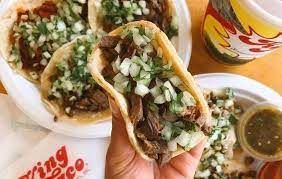
Tacos al Pastor from King Tacos

Tacos come in two basic varieties. There are the hard shell tacos which disintegrate the moment you put your hands on them; and there are the soft shell tacos, usually made with corn tortillas, which you can pinch without having a mess in your lap. I suppose there are soft shell flour tortillas in places like Northwest Mexico, but they are infrequently found across el border.

Today I drove Martine to Lakewood for an appointment with her ophthalmologist. On the way, I noticed there was a King Tacos on Lakewood Boulevard just south of Alondra, and a light suddenly went on in my memory. About twenty or thirty years ago, I attended an L.A. Galaxy professional soccer game at the Rose Bowl. While there, I bought several tacos from the concessionaire, who was King Tacos. I remember really liking them, but I had not been to any of the low rent parts of town where branches of King Tacos tend to congregate … until today.

I had three tacos el pastor with a Diet Pepsi, which I enjoyed mightily. There is something about Mexican antojitos (“little whimsies”) which help make Mexican cuisine one of the great world cuisines—and that’s before even figuring in some regional variants as Oaxácan and Yucatec cuisines.

I shall make it a point to return to King Tacos again. Still great after so many years!

Glorious Fourth

As I write these words, the air is thick with explosions as juvenile delinquents of all ages set off fireworks, terrorizing their pets and injuring themselves in an orgy of carelessness. This is what the anniversary of our independence has come to mean: explosions and barbecues.

Forgive me i I choose not to join in the festivities. At one time, I did; but the combination of too much charred meat and too many overcrowded fireworks displays has, in time, soured me.

Instead I took a walk to the Colorado Center’s park, at a central point called The Landing, where there is shade, a roof, and metal seating. On weekends and holidays, I am more likely to see janitors and security guards going from building to building than locals. There was a bench with two girls, a couple of serious kickboxers practicing, and two or three people walking their dogs.

I had planned to begin reading Georges Simenon’s The Shadow Puppet, an early (1932) Inspector Maigret novel; but I found had already finished the book same under another title, namely Maigret Mystified. No matter, I merely reveled in the peace and quiet with relatively few fireworks explosions in the background.

Then I walked the mile and a half back to my apartment and continued my reading of an interesting history of Spain by John A. Crow entitled Spain: The Root and the Flower.

Work Friends

Don Kiyomi Yamagishi (1960-2017)

I worked for a quarter of a century for two accounting firms, the second of which was an outgrowth of an earlier firm. During that time, the best friends I had at work were two accountants. Don Kiyomi Yamagishi was a Nisei and in every way more of an American than I ever was. Danilo Cabais Peña was a Filipino. Both passed away in the late 2010s. (Somewhere, I have a picture of Dan Peña; but it will take me some time to find it. When I do, I’ll post it.)

Both of my accountant friends were genuinely good human beings. Surprisingly, that’s not always true in that particular profession, where the temptation to cheat carries both penalties and rewards.

I was greatly saddened that I lost both of my friends—both within the space of a single year. I attended both of their funerals and had to soldier on at work for another year without their wise counsel.

No life is without heartbreak.

Taking Stock

An All-But-Abandoned Park in Santa Monica

This was for me a day of taking stock and meditating. It all started with a fortune cookie I received at lunch from Siam Chan: “You can only live once, but if you do it right, once is enough.”

When I got home, I decided to take a walk to a little park at 26th Street and Broadway in Santa Monica. I grabbed my copy of Dhammapada: The Sayings of the Buddha and set out. It’s a nice little park which is all but abandoned on weekends. (On weekdays, the surrounding office buildings are crowded with folk.)

Arriving there, I grabbed a chair and started to read. As usual, Buddha hit the nail on the head:

And yet it is not good conduct
That helps you on the way,
Nor ritual, nor book learning,
Nor withdrawal into the self,
Nor deep meditation.
None of these confers mastery or joy.

O seeker!
Rely on nothing
Until you want nothing.

Again and again, it is he stifling of desire that is the key:

Death overtakes the man
Who gathers flowers
When with distracted mind and
     thirsty senses
He searches vainly for happiness
In the pleasures of the world.
Death fetches him away
As a flood carries off a sleeping village.


Frito Pies

This Is the Way It Looked When I First Ate One

The first time I ate a Frito Pie, it looked like the above photo, and it was purchased from where it was invented, a lunch counter in Santa Fe, New Mexico.

The second time was today. I cooked it myself from this recipe. As I made it to please Martine, the finickiest of all eaters, there was no way I could add raw onions as a garnish. And I used a mild La Victoria Red Enchilada sauce, even though my preferences is for spicy hot dishes. I second the recommendation of using Ranch House canned beans, as they go very well with this recipe. Oh, and I recommend extra sharp cheddar cheese. By the way, don’t use any other chips other than original recipe Fritos: That’s why it’s called Frito Pie.

Tomorrow, I will serve the leftovers with cut up fresh avocado. It’s not in the recipe, but I think it would go well with it.

A Visit to Asteroid City

A Strange Film Set Near the California-Nevada Border in the 1950s

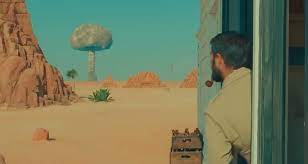
Yesterday afternoon, I went to see a matinee performance of Wes Anderson’s Asteroid City (2023). I had seen his earlier The French Dispatch (2021), which did the same for France as Asteroid City did for the 1950s American desert.

Is it a great film? Not exactly, but I think it is definitely worth seeing. Wes Anderson has, rattling around somewhere in his head, a great film; and I believe it will eventually be made.

Picture a group of Junior Stargazers and their parents descending on a nowhere town in the Mohave Desert. With a cast that includes Tom Hanks, Scarlett Johansson, Jason Schwartzman, Tom Hanks, Tilda Swinton, Margaret Robie, Steve Carell, and some very talented juvenile actors, the film ranged from riveting to “What the …?”

During the Junior Stargazers awards ceremony, a space alien kidnaps a meteor that was on display and later returns it with various inventory markings. The military proceeds to put Asteroid City on lockdown, with no one able to leave or arrive—until the alien makes his second appearance.

One of Two Nuclear Tests That Occur During the Course of the Film

The most striking thing about the film is its visual style. It all looks like desert postcards of the period. except for a connecting story of a writer and a group of play actors which is not only shot in black and white, but in Academa 4:3 ratio, whereas most of the film is in color and wide screen. In fact, the weakest part of the film is this connecting story.

I remember when I first saw The French Dispatch on TV at my brother’s house. At first, I didn’t know what to make of it. Some of it I loved, some I thought deplorable.

No matter, just hold your nose during the bad parts and enjoy the scenes set in Asteroid City.

Bad Asses for Hire

Something About Hiring a Lawyer I Don’t Understand

People in Southern California must be very accident-prone. I don’t know what other parts of the country are like, but you can’t pass a bus or a row of billboards without seeing an ad for an attorney who promises “to fight for you” with a 95% or higher ratio of won cases.

Excuse me, but don’t lawyers get to keep a hefty chunk of what they earn by fighting for you? I see a lot of people who were injured in auto accidents praising their hired bad-ass lawyers to the skies, but I wonder how much of that money actually finds its way into the pockets of poor slobs who have been victimized on the highways of SoCal.

I know you want to hurt the party that injured you, but what do you really get out of it?

It’s a lot like the lottery. If you win a jillion dollars, unless you opt for a payout over so many decades, you only get what is called the present value of a jillion dollars, which might be 0.5 jillion. And then there is the Internal Revenue Service (IRS) and your state and local income tax authorities, which might lower your winnings to 0.3 jillion dollars.

But, after all, this is America. Everyone wants to hire a bad-ass to handle your case, but that bad-ass, being a bad-ass, is probably more intent on enriching his own coffers.

“This Fabulous Shadow Only the Sea Keeps”

American Poet Hart Crane (1899-1932)

I’ve always liked the poetry of Hart Crane. To begin with, he was from Cleveland, like me. In 1932, he killed himself by jumping overboard from a steamship sailing the Gulf of Mexico—after he had made an unsuccessful sexual overture to a crew member. This poem is a tribute to Herman Melville, author of Moby Dick, Billy Budd, and other tales of the sea.

At Melville’s Tomb

Often beneath the wave, wide from this ledge
The dice of drowned men’s bones he saw bequeath
An embassy. Their numbers as he watched,
Beat on the dusty shore and were obscured.

And wrecks passed without sound of bells,
The calyx of death’s bounty giving back
A scattered chapter, livid hieroglyph,
The portent wound in corridors of shells.

Then in the circuit calm of one vast coil,
Its lashings charmed and malice reconciled,
Frosted eyes there were that lifted altars;
And silent answers crept across the stars.

Compass, quadrant and sextant contrive
No farther tides ... High in the azure steeps
Monody shall not wake the mariner.
This fabulous shadow only the sea keeps.

He Did It All Right!

He Has Good Reason to Worry

Back in February 27, 2022, I submitted a blog post entitled Putin Screws the Pooch. In it, I wrote:

I cannot help but think that Vladimir Putin has made a serious misstep in his assumptions regarding Ukraine’s willingness to abide by his thuggish behavior. The Russians made the same assumptions that Donald Rumsfeld and Vice President Dick Cheney made when we invaded Iraq in 2003: We were not in fact welcomed with flowers and candy, and, moreover, we are still there.

Now Putin is in a worse position politically than Nikita Khrushchev was in after the Cuban Missile Crisis of October 1962. Not only has Putin failed in his attempt to walk all over Ukraine, but he had to put down a quasi-coup by Yevgeny Prigozhin and his Wagner Group mercenaries.

When one is a totalitarian dictator, one cannot afford to look weak. And Vladimir Putin at this time looks a lot weaker than Khrushchev did in 1964 when Brezhnev and Kosygin replaced him as top dog of the Soviet Union.

And how can you be top dog when you’ve screwed the pooch like Putin has?