Glimmers

The Archangel Raphael in the Style of the Cuzco School of Painting

Currently, I am reading Olga Tokarczuk’s House of Day, House of Night, an early (1988) novel by the 2018 winner of the Nobel Prize in Literature. I came across the following passage and thought I would like to share it with you:

Quite out of the blue a bizarre and compelling idea came into my head today: that we have ended up as human beings through forgetfulness, through lack of attention, and that in reality we are creatures participating in a vast, cosmic battle that has probably been going on since time immemorial, and which, for all we know, may never end. All we see of it are glimmers, in blood-red moons, in fires and gales, in frozen leaves that fall in October, in the jittery flight of a butterfly, in the irregular pulse of time that can lengthen a night into infinity or come to a violent stop each day at noon. I am actually an angel or demon sent into the turmoil of one life on a sort of mission, which is either carrying itself out without my help, or else I have totally forgotten about it. This forgetfulness is part of the war—it’s the other side’s weapon, and they have attacked me with it so that I’m wounded, invalided out of the game for a while. As a result, I don’t know how powerful or weak I am—I don’t know anything about myself because I can’t remember anything, and that’s why I don’t try to look for either weakness or power in myself. It’s an extraordinary feeling—to imagine that somewhere deep inside, you are someone completely different from the person you always thought you were. But it didn’t make me feel anxious, just relieved, finally free of a kind of weariness that used to permeate my life.

Riding the Error3 Bus

I had a strange dream last night. I was waiting for the bus to Siegmaringen. The name was clearly imprinted in my mind even though I don’t think I knew anything about the South German city. But then, that’s dream logic for you. That is to say, no logic.

A bus came by and stopped in front of me. The destination noted on the display above the front window of the bus said only “Error3.” I asked the driver whether it was headed for Siegmaringen. He nodded yes and I boarded. End of dream.

In many ways, that’s me all over. I wasn’t deterred by the “Error3” destination and forged ahead. Did I get there? Both the ride and my putative arrival in Siegmaringen were not part of the dream. So if you see me riding the Error3 bus, please don’t forget to wave.

In the Hospital Again

UCLA Santa Monica Medical Center

Ye gods, not again! On Sunday during the hour of the wolf (around 4 AM), my digestive system spewed waste with great force. While still in bed, I projectile vomited with such velocity that nothing within an eight foot radius was left unmarred by my effluvia. This was followed up what the doctors at UCLA Santa Monica Medical Center referred to in my discharge papers as “acute weakness.” It was more than weakness: I was too lethargic to get out of bed.

Unaffected was my brain function. Martine wanted to call an ambulance to take me to the hospital. I demurred. Then she called my brother in Palm Desert and got him into the act. At that point, I finally agreed. Martine cleaned me up as best she could. In no time at all, the Los Angeles Fire Department was there hoisting me up and strapping me in a device that took me down the apartment steps to the waiting ambulance that stood there with its lights flashing.

I asked to go to the UCLA Ronald Reagan Medical Center. Apparently, their emergency room was filled to capacity with the usual weekend accidents. Fortunately, there was an opening at the UCLA-owned Santa Monica Medical Center. If I were to go to a non-UCLA-affiliated emergency room, I would be poked, prodded, and tested for days for the simple reason that few if any hospitals could afford to keep an endocrinologist on hand at all hours. Probably not even Bellevue in New York or the Mayo Clinic in Rochester, Minnesota!

So, what happened? I am no longer possessed of a working pituitary gland in the center of my head (due to a benign tumor I had roughly between 1956 and 1966). No pituitary gland means no signal to my glands to produce hormones. So, no hormones at all—zilch. That means no thyroid, no testosterone, and—most important—no adrenaline.

Sometime in the early morning hours of Sunday, my body made a request for adrenaline due to something I ate. When it did not respond to that request, my body basically shut down. Fortunately, I was conscious the times I wasn’t snoozing.

And so what did they do at the hospital to make me better? Not a damned thing. Before the paramedics came, I asked Martine for a glass of water and five 10mg tabs of Hydrocortisone, which I was able to ingest. I was still weak for several hours, but that’s what made me feel able to get up and walk.

What the hospital staff did do was X-Ray me, start an IV, and take my vital signs. Fortunately, the hospital had access to previous hospital admissions which gave my medical history. When they finished poking and prodding me, they discharged me. Scram, Buddy, we need your space for other patients. So they called Martine, who was having back pains from having to clean the mess I made; and she grabbed my car keys and picked me up.

In the end, I wonder whether I should have gone to the hospital at all. I decided to mainly because Martine and my brother were bummed out by my condition. I’ll have to talk to my doctor about this when I see her.

Where Lions Roam

Self Portrait of William Blake

William Blake was not only a visionary artist, but also a visionary poet, whose works range from simple lyrical pieces to long, complicated prophetic books redolent of the Old Testament. For these latter, he invented his own mythology, with beings named Enitharmon, Los, Urizen, Albion, and such like.

The excerpt below is taken from my favorite Blake poem, “The Marriage of Heaven and Hell.” In it the character of Rintrah appears as a personification of the just wrath of a prophet.

THE ARGUMENT

Rintrah roars & shakes his fires in the burden’d air;
Hungry clouds swag on the deep.

Once meek, and in a perilous path,
The just man kept his course along
The vale of death.
Roses are planted where thorns grow,
And on the barren heath
Sing the honey bees.

Then the perilous path was planted,
And a river and a spring
On every cliff and tomb,
And on the bleached bones
Red clay brought forth;

Till the villain left the paths of ease,
To walk in perilous paths, and drive
The just man into barren climes.

Now the sneaking serpent walks
In mild humility,
And the just man rages in the wilds
Where lions roam.

Rintrah roars & shakes his fires in the burden’d air;
Hungry clouds swag on the deep.

Here is a link to an interesting video called The Otherworldly Art of William Blake: YouTube Video.

Which Path?

Aaron Rogers: Quarterback, Trumper, Anti-Vaxxer, and All-Around Dickhead

I had a choice of two ways to go for today’s blog. Instead I took a third way. The first way was to continue writing about poet and printmaker William Blake, one of my all-time favorites. Then I was thinking about Aaron Rogers implying of ESPN that late night TV host Jimmy Kimmel was a pederast in Jeffrey Epstein’s circle of sexual deviants.

The third way turned out to analyze why I am triggered by the bad behavior of Trump and his followers. To the very core of my being, I despise what Trump and the Trumpites are doing to this country. But my political opinions are of no great interest to anyone. So many Americans, so many raw wounds that won’t heal, that keep on being re-infected!

It strikes me that my blogs about things that interest me make for better reading than blogs about my political opinions, especially when they involve the culture wars of the 21st century.

So tomorrow I return to writing about William Blake, a great artist and poet. Tomorrow, I’ll post some of his poetry. If you’d rather read about Aaron Rogers, trust me: It’s just too depressing for words. Even when I write them.

Old Testament Visionary

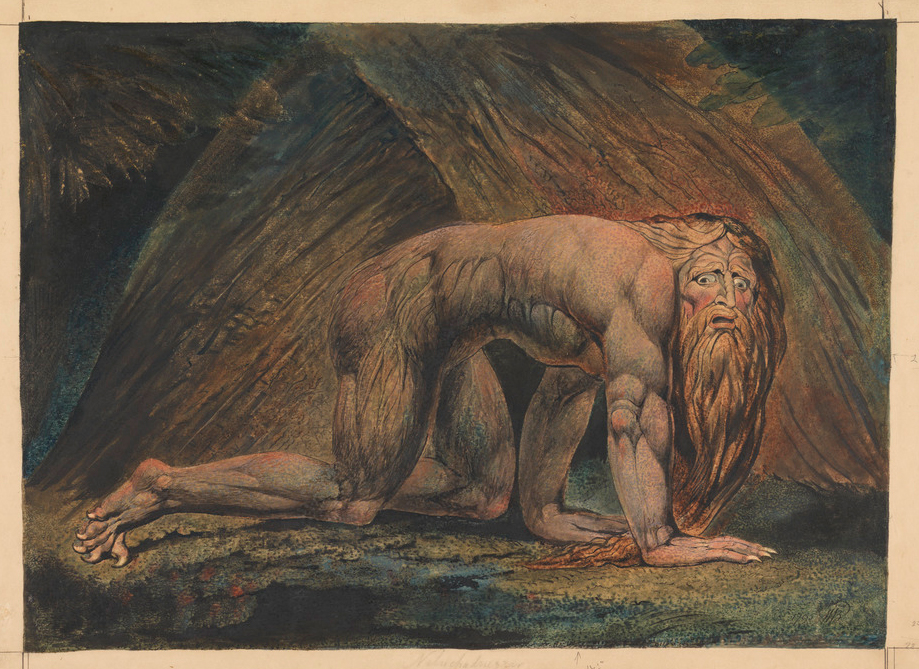
William Blake’s “Nebuchadnezzar” (1795)

As I said in yesterday’s post, William Blake (1757-1827) was that rarity who was not only a great poet but a great visual artist. What I found interesting was his predilection for Old Testament subjects, especially the books of the Old Testament prophets.

Take Nebuchadnezzar II, the subject of the above illustration. According to the Book of Daniel, the Babylonian king has a dream that is interpreted by Daniel to mean that he would be deposed and die of insanity after living like an animal for seven years. The text from the King James version of Daniel 4:31 is “And they shall drive thee from men, and thy dwelling shall be with the beasts of the field: they shall make thee to eat grass as oxen, and seven times shall pass over thee, until thou know that the most High ruleth in the kingdom of men, and giveth it to whomsoever he will.”

Satan Exults Over the Recumbent Eve After the Forbidden Fruit Incident

Here from Genesis is an image of Satan as a serpent coiled around the naked body of Eve as one of God’s angels (Michael?) points the way to the exit from Eden with his spear. It is interesting how the story from Genesis had resulted for centuries in women being held to blame for original sin and the expulsion from Eden. It’s just like the Jews unjustly being thought of as Christ-killers when it was actually the doing of Caiaphas, the Jewish high priest of the Temple and his cronies.

Blake never really took to painting, but as a print maker, he had few equals.

Tuesday at the Getty Center

On the 781 Metro Bus to the Getty Center

In my retirement years, I sometimes drive where I’m going; sometimes I just take public transportation. The two Getty museums in Los Angeles are a good example of the advantage of traveling by bus. There is no admission fee, but parking at each museum costs twenty dollars. Compare that with an outlay of seventy cents for a round trip between Sepulveda & Exposition and the Getty Center. A big plus is that the 781 Metro bus runs every few minutes, so that waiting is not a big factor.

The reason for my visit is an exhibit entitled “William Blake: Visionary,” which closes on January 14. Organized with the cooperation of London’s Tate Museum, it includes a large number of Blake’s prints. I even dished out the money for the exhibit book. It costs a fortune, but I know I would have kicked myself had I passed up the opportunity.

In the next few days, I will write several posts about my visit to the Getty, particularly relating to William Blake, who is probably the only human being who is at one and the same time a great poet and a great visual artist.

The Getty’s Cactus Garden with Westwood and the 405 Freeway in the Background

I like to visit the Getty whenever they have a special exhibit that interests me. This time, I saw only the Blake exhibit and also a large selection of great photographs by Arthur Tress. (The Getty Center always has interesting photographic exhibits.)

Later this month, I will also trek to the Getty Villa in Pacific Palisades to see an exhibit on the Egyptian Book of the Dead. Unlike the Getty Center, the Getty Villa concentrates on ancient Greek and Roman art in a building whose design is a re-created Roman country home within view of the beach.

“A Butterfly Secret”

Bats Head in Dorset

I have just finished reading the essays in Earth Memories by Llewelyn Powys (1884-1939), one of three literary giants in a family that included John Cowper Powys (1872-1063) and T. F. Powys (1875-1953). The essays in the book are mostly nature studies with an occasional jaunt into the philosophical implications of his everyday reality. The following is from his essay “A Butterfly Secret”:

And, indeed, as one walks over these downs at nighttime, under the fathomless pricked dome of infinity, one receives but one answer, The matter is as plain as a child’s sum in a dame’s school. Life is its own justification. There is no other aim to it, no other meaning, no other purpose, and if we think otherwise, we are foolish. Let the truth be spoken. Each one of us, each intellectual soul among us, advances steadily and surely toward the grave. Abdel Krim and his Rifis, General Feng and his soldiers, are all marching down the same road—a road that leads to oblivion and that for a thousand years has been trodden by a procession of all nations. Every religion is as brittle as an empty snail shell in dry weather, as quick to disappear as cuckoo-spit in a summer hedge that conceals at its center no green fly. The secret to be remembered is that nothing matters, nothing but the momentary consciousness of each individual as he opens his eyes upon a spectacle that knows nought of ethics.

Let us, as best we may, reconcile our minds to the fact that all our self-imposed tasks, our political engineering, our brave talk have actually, under the shadow of Eternity, no consequence. Our idealism is treacherous. It is a moonshine path over a deep sea. We are cursed souls each one of us and resemble nothing so much as jackdaws flying about he radiant cliffs of God pretending to be seagulls.

And yet there is no cause to despair. Merely to have come to consciousness at all constitutes an inestimable privilege. The past is nothing, the future is nothing, the eternal now alone is of moment. This is understood well enough by every living creature but man.

Náthás

My Nasal Congestion Was Nowhere So Pretty As Hers

Sometimes, from deep inside my early memories, a Hungarian word comes flying to the surface, bringing with it a whole jumble of interconnected moments from my past.

Today’s word is náthás, which was a word frequently applied to me as a child. It is pronounced like naht-hahsh, equally accented on both syllables. According to my trusty Országh Magyar-Angol Kéziszotár (translates as Handy Hungarian-English Dictionary), the word means “having a cold.” Actually, in my experience, it really means “having the symptoms of a cold, whether from an actual cold or allergy.”

In my case, it was respiratory allergies, going back to an early age. I remember all the vain attempts to unblock my nose, starting with the deceitful over-the-counter nose drops called Neo-Synephrine. It actually succeeded in unplugging the blockage for up to half a minute, immediately followed by an even more resistant blockage.

Then there was the old Hungarian remedy of filling a large pan with boiling water and mixing it with table salt. I would hold a towel over my head and bend low over the steaming salty water, breathing deeply. That didn’t work any better than the Neo-Synephrine. So much for old remedies.

Nowadays there are more effective medications and procedures. One good nasal unplugger is a sinus rinse in which salt is dissolved in distilled water and shot up each nostril using a squeeze bottle—the principle being that what goes up one nostril comes out the other, bringing with it the muck stored in the sinus cavity.

Nevertheless, I am still very much náthás, due to snorting, sneezing, and nose-blowing. That never seems to go away. I like to think of myself as a superhero in the Marvel Comic Universe, my super power being the ability to shoot great gobs of mucus at evildoers.

Death By Comfy Chair

La-Z-Boy Maverick-582 Rocker Recliner

I have never understood why people buy those overstuffed recliners. Is it because they are tired of living and just want to sink into something soft while their body functions shut down? Never forget the old Monty Python episode in which the Spanish Inquisition uses comfy chairs as a form of (not unwelcome) torture.

All the seating in my apartment tends to be on the firm side. In fact, I refer to them as my uncomfy chairs. To that I attribute the back that, at my advanced age, my back doesn’t hurt; and I am more agile than most of my age cohort.

This brings to mind one of my favorite poems by Dylan Thomas entitled “Do Not Go Gentle Into That Good Night.”

Do Not Go Gentle Into That Good Night

Do not go gentle into that good night,
Old age should burn and rave at close of day;
Rage, rage against the dying of the light.

Though wise men at their end know dark is right,
Because their words had forked no lightning they
Do not go gentle into that good night.

Good men, the last wave by, crying how bright
Their frail deeds might have danced in a green bay,
Rage, rage against the dying of the light.

Wild men who caught and sang the sun in flight,
And learn, too late, they grieved it on its way,
Do not go gentle into that good night.

Grave men, near death, who see with blinding sight
Blind eyes could blaze like meteors and be gay,
Rage, rage against the dying of the light.

And you, my father, there on the sad height,
Curse, bless, me now with your fierce tears, I pray.
Do not go gentle into that good night.
Rage, rage against the dying of the light.

And so I continue to burn and rave at close of day from my uncomfy chair.