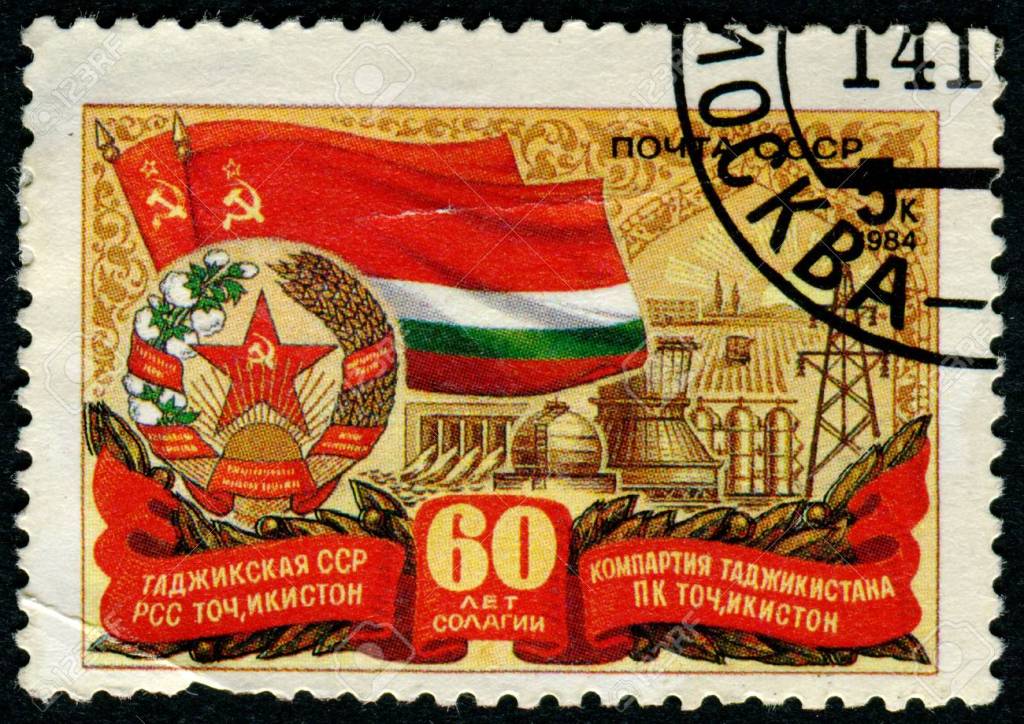
RUSSIA – CIRCA 1984: shows Tadzhik Soviet Socialist Republic flags and arms, circa 1984
I am currently reading a book of stories by the Russian writer Maxim Osipov entitled Rock, Paper, Scissors and Other Stories. In the title story is an incredible Tadzhik woman who kills an official of a small rural town in Russia who tries to rape her. Her name is Ruhshona Ibragimovma. Although working in a menial position at a restaurant, she is a highly educated woman, which, in the position she finds herself, becomes increasingly unimportant to her.
[D]eath’s omnipresence is no accident, no unhappy mistake. Everyone fears death, just as they fear misfortune, yet death is inescapable, which means it is real. And that we did not invent it. At this very moment Ruhshona begins to see death as the most important thing that can exist within a person. She views those who don’t carry death within themselves—who don’t live by it—as empty, like wrapping paper, like candy wrappers. Hollow, soulless people. She can pick them out at a glance.
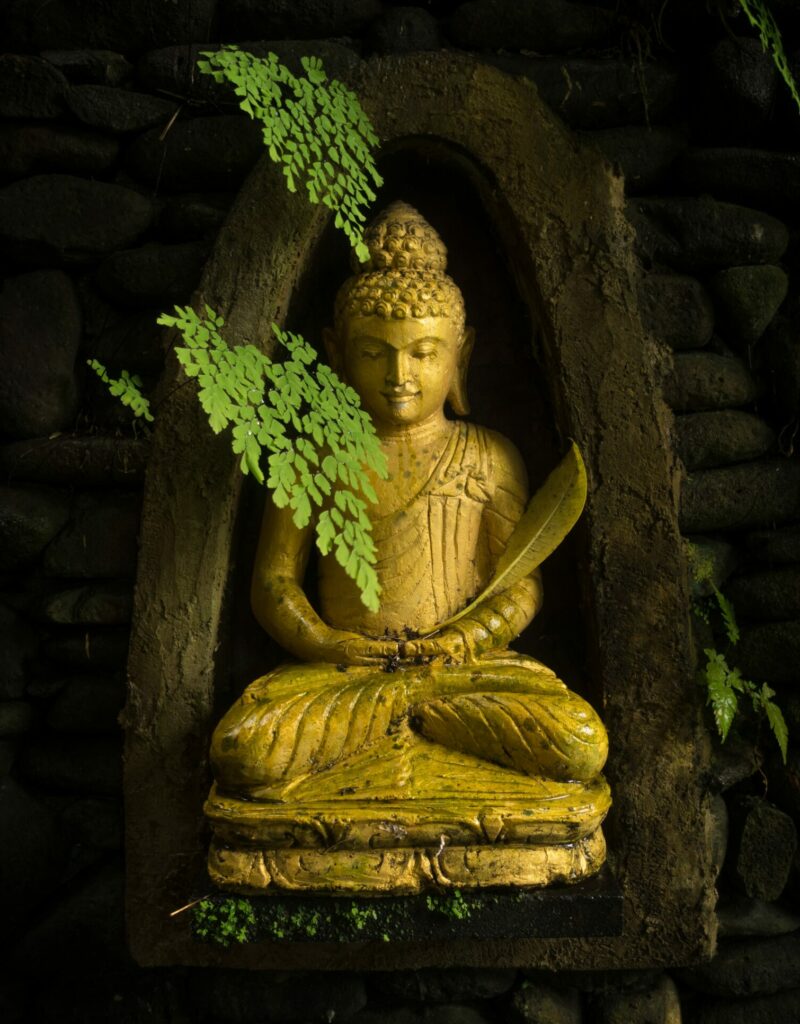
Jack Kerouac spent many years studying the Dharma of Buddhism. It shows up in many of his earlier works, particularly in his The Scripture of the Golden Eternity, from which the following excerpts are taken:
11.
If we were not all the golden eternity we wouldn’t be here. Because we are here we cant help being pure. To tell man to be pure on account of the punishing angel that punishes the bad and the rewarding angel that rewards the good would be like telling the water “Be Wet”—Never the less, all things depend on supreme reality, which is already established as the record of Karma-earned fate.
16.
The point is we’re waiting, not how comfortable we are while waiting. Paleolithic man waited by caves for the realization of why he was there, and hunted; modern men wait in beautiful homes and try to forget death and birth. We’re waiting for the realization that this is the golden eternity.
22.
Stare deep into the world before you as if it were the void: innumerable holy ghosts, buddhies, and savior gods there hide, smiling. All the atoms emitting light inside wavehood, there is no personal separation of any of it. A hummingbird can come into a house and a hawk will not: so rest and be assured. While looking for the light, you may suddenly be devoured by the darkness and find the true light.
I am not sure that Kerouac’s Buddhism is the genuine article, but in a way it doesn’t matter. His questing had its value and brushes against the truth at a wide number of places.
If you’ll remember, I was hospitalized in November for two days and a night at UCLA’s Ronald Reagan Medical Center for losing consciousness in the bathroom in the middle of the night—either from a lack of adrenaline (my pituitary was removed years ago) or low blood pressure. If not, you can read about it in my post entitled “I Dodge a Bullet.”
Although I had been hospitalized for roughly similar reasons three times before, this time I also had an ugly hematoma on my left forehead and a broken eleventh rib.
Apparently, this qualified me for a higher level of care than previously. Also, I am now 78 years old; and the good doctors probably thought I was a shut-in. So I had eight weeks of visits from a nurse, occupational therapist, physical therapist, and even a social worker. The last official visit was today from the physical therapist, a stunningly beautiful young woman from Ecuador.
Back when I was in high school, my mother worked at a Cleveland hospital for the terminally ill. During the summers, I volunteered in the hospital’s physical therapy department—not working with patients, but mainly inventorying and storing the materials used by the therapists. Most of the department’s patients were paraplegics and hemiplegics.
Three times before, I had benefited from physical therapists who had worked with me when I had a hip replacement in 2002 and two separate broken shoulders, one from a fall in Argentina and another (on the other shoulder) closer to home. As a result, I have always respected the profession.
The home visits from the therapist sent by UCLA were likewise helpful to me. The balls of my feet have for several years been tingling from diabetic neuropathy. The exercises the therapist had me do were relatively simple, but have mitigated the neuropathy to some extent. That’s good, because I remember one of my former physicians had the same problem and had to retire when they had to amputate his feet, which exhibited a severe case of neuropathy.
So I have now been discharged from the home visits, which have been extremely helpful in transitioning me to what is to come.
He is the patron saint of Naples. At the church named for him, the dried blood of Saint Januarius (or Gennaro) is supposed to liquefy three times a year:
September 19, the saint’s feast day
December 16
The first Saturday in May
When the miracle fails to occur, it portends “imminent disaster including war, famine or disease,” according to one website. Apparently, the miracle occurred again in September, but I have not been able to find whether the December 16 miracle occurred on schedule.
Januarius was a third century bishop of Benevento, Italy, who was martyred during the persecutions of the Emperor Diocletian.
For a number of years, I have pre-empted the name of Januarius to refer to my practice of using the first month of the year to read only authors I have never read before. My reasoning for this is to constantly broaden my horizons. For example, this year I plan to read several Cuban novels.
One result of my Januarius project is also that I read more women authors, which I had not done so much heretofore.
I will report back to you probably in early February if I have made any finds worth noting. (I probably will.)



 Tarnmoor
You must be logged in to post a comment.