

Live Content

No, It Doesn’t Have To Be This Picturesque

The title of this post is deliberately misleading. I could mean the adjective “live” with a long “i” followed by the noun “CONtent,” with the accent on the first syllable; but what I really mean is the verb “live” with a short “i” followed by the adjective “conTENT,” with the accent on the second syllable. English is a very confusing language, but then life is confusing, too.

If you look at the images related to contentment in Google, you get a lot of nice scenery with people assuming various yoga-like pastures. If I were to sit like the woman in the above picture, I would be in considerable pain within two minutes. At my advanced age, I just don’t have the flexibility.

Besides, I’m not talking about contentment as seen by the chief gurus of our culture. I am thinking more of what G. K. Chesterton had in mind when he wrote his essay entitled “The Spice of Life”:

But it is much more important to remember that I have been intensely and imaginatively happy in the queerest because the quietest places. I have been filled with life from within a cold waiting room in a deserted railway junction. I have been completely alive sitting on an iron seat under an ugly lamppost at a third-rate watering place. In short, I have experienced the mere excitement of existence in places that would commonly be called as dull as ditch-water.

That I think, is the right idea. I rather like the idea of being content in a doctor’s office or at a bus stop or in a supermarket line. It actually doesn’t matter where, and it doesn’t have to be pretty. And it’s cheap: You don’t even need to buy a special wardrobe to practice it.

“Alas, Alas for England”

In this election year, I came across a short poem by G. K. Chesterton (1874-1936) that expressed exactly what I feel about politicians.

Elegy in a Country Churchyard

The men that worked for England
They have their graves at home:
And birds and bees of England
About the cross can roam.

But they that fought for England,
Following a falling star,
Alas, alas for England
They have their graves afar.

And they that rule in England,

In stately conclave met,

Alas, alas for England

They have no graves as yet.

Report: Januarius 2024

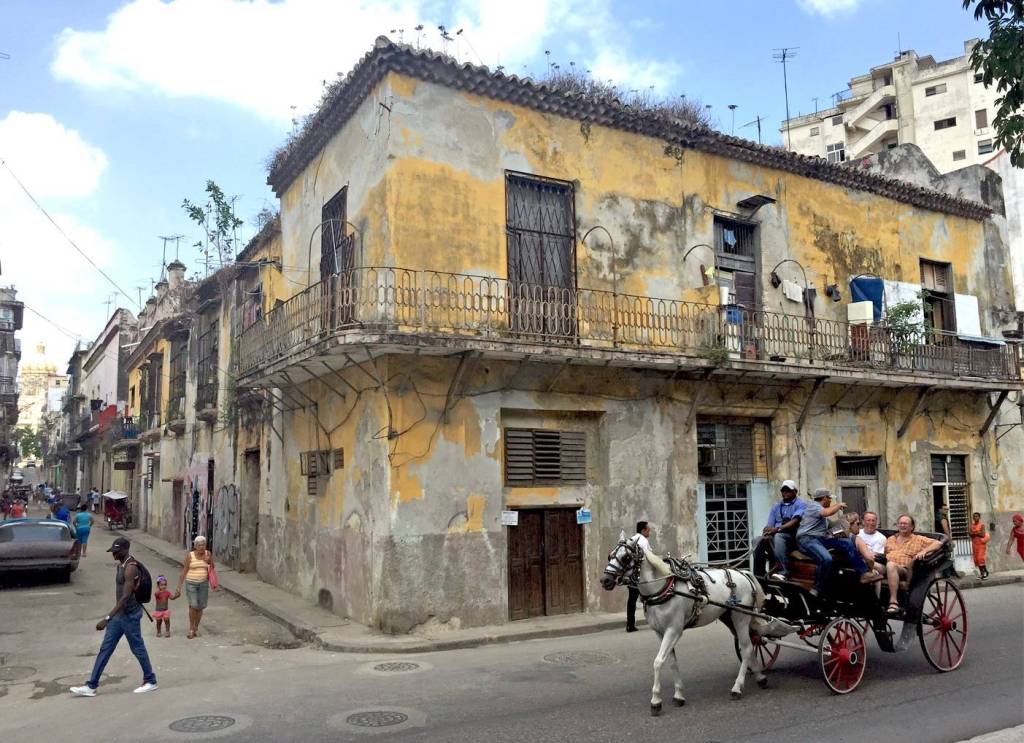
Havana Street Scene

As I mentioned at the beginning of January, I typically read books in this first month of the year written by authors I have not read before. Well, last month’s total was eleven books:

  • Maxim Osipov: Rock, Paper, Scissors and Other Stories (Russia)
  • Dorothy Parker: “Men I’m Not Married To” (USA) – short story
  • Llewelyn Powys: Earth Memories (Britain)
  • George MacDonald: The Princess and Curdie (Scotland)
  • Alejo Carpentier: Explosion in a Cathedral (Cuba)
  • Olga Tokarczuk: House of Day, House of Night (Poland)
  • Joseph Joubert: Notebooks of Joseph Joubert (France)
  • Pedro Juan Gutiérrez: Dirty Havana Trilogy (Cuba)
  • Fleur Jaeggy: Sweet Days of Discipline (Switzerland)
  • Luis Vaz de Camoens: The Lusiads (Portugal)
  • Leonardo Padura: Havana Red (Cuba)

Three of the books were by Cuban authors, and I enjoyed all three of them. Only three were originally published in English. Three of the authors were women, most particularly Olga Tokarczuk, whose House of Day, House of Night was by far the best book I read last month. Second best was Carpentier’s Explosion in a Cathedral, followed by Powys’s Earth Memories.

Were there any clunkers? I am pleased to say “No, not a one!”