
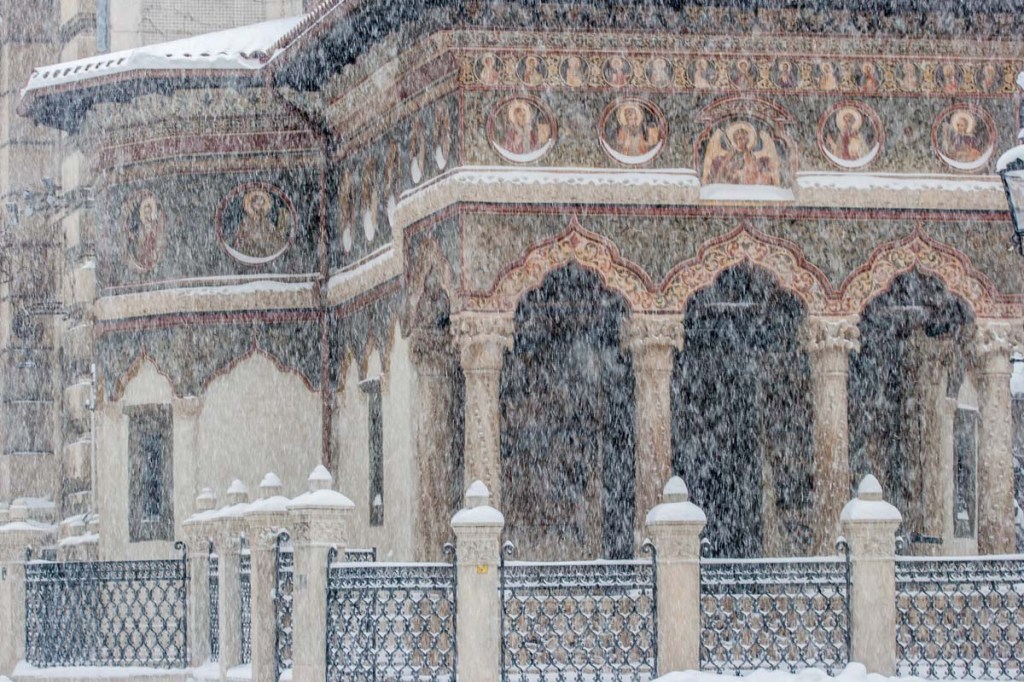
Bucharest in Winter
I am reading a great Romanian novel by Mircea Cărtărescu entitled Solenoid. In it, I found the following description of Bucharest, the country’s capital:
More probably, like all of Bucharest, the saddest city on the face of the earth, the factory had been designed as a ruin from the start, as a saturnine witness to time devouring its children, as an illustration of of the unforgiving second law of thermodynamics, as a silent, submissive, masochistic bowing of the head in the face of the destruction of all things and the pointlessness of all activity, from the effort of carbon to form crystals to the effort of our minds to understand the tragedy in which we live. Like Brasilia, but more deeply and more truly, Bucharest was born on a drawing board from a philosophical impulse to imagine a city that would most poignantly illustrate human destiny: a city of ruin, decline, illness, debris, and rust. That is, the most appropriate construction for the faces and appearances of its inhabitants. The old factory’s production lines, driven by long-immobile motors had produced—and perhaps, in a quiet isolation beyond humanity, continued to produce—the fear and grief, the unhappiness and agony, the melancholy and suffering of our life on Earth, in sufficient quantities for the surrounding neighborhood.
 Tarnmoor
You must be logged in to post a comment.