
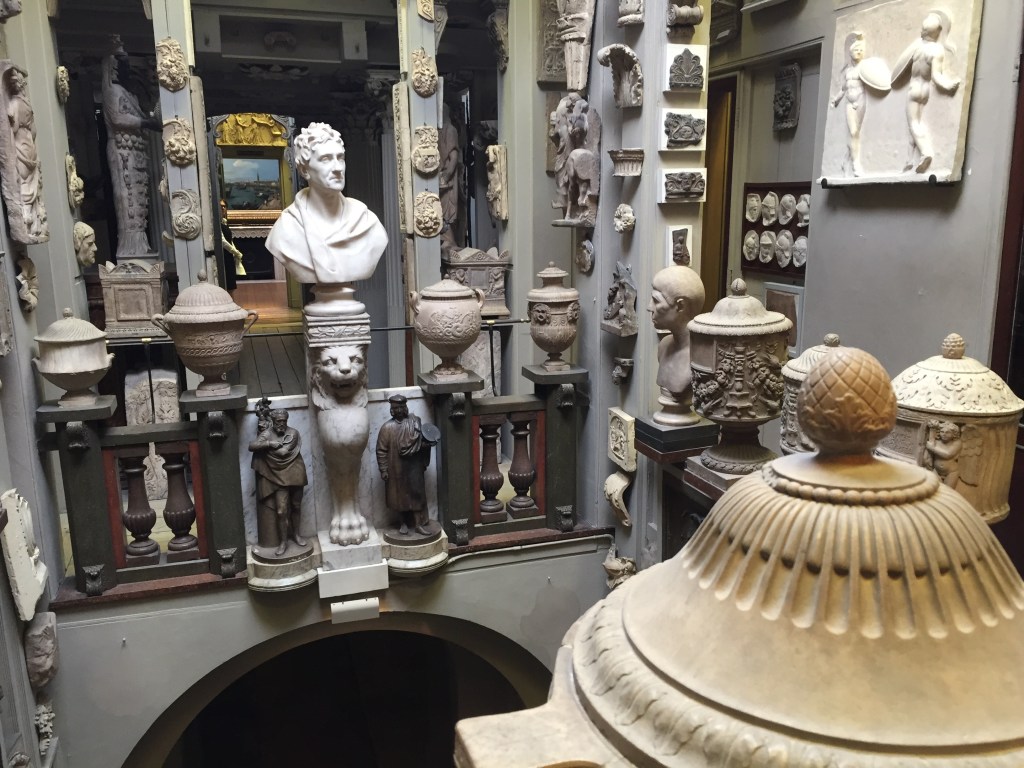
Is This the Attic of Western Civilization?
If I were asked to pick my favorite museum, I would have a hard time deciding; but I might very well end up by picking Sir John Soane’s Museum by Lincoln’s Inn Fields in London. Each time I have visited London, I have spent time marveling at the collections represented, whether of Egyptian, Greek, or Roman antiquities or 18th century paintings.
The original Sir John Soane (1753-1837) was the architect who designed the Bank of England, Not the present one, but the old one that was demolished in the 1920s. While I cannot comment on Soane’s skills as an architect, I am nothing short of amazed by Soane the art collector.
Walk through the museum, and it’s as if you were carefully edging your way through an overcrowded attic—except that Soane was no mere hoarder. He is, as it were, at the very pinnacle of a cultivated English artist circa 1800.

Paintings and Sketches Line the Walls from Floor to Ceiling
And I mean English with a vengeance. You would not find anything like this in France. The story of how the museum came to be is archetypally English (quoted from Wikipedia):
The museum was established during Soane’s own lifetime by a private Act of Parliament … in 1833, which took effect on Soane’s death in 1837. The act required that No. 13 [Lincoln’s Inn Fields] be maintained “as nearly as possible” as it was left at the time of Soane’s death, and that has largely been done. The act was necessary because Sir John had a living direct male heir, his son George, with whom he had had a “lifelong feud” due to George’s debts, refusal to engage in a trade, and his marriage, of which Sir John disapproved. He also wrote an “anonymous, defamatory piece for the Sunday papers about Sir John, calling him a cheat, a charlatan and a copyist.”
Oh, you can view the changing of the guards at Buckingham Palace, ride in giant Ferris Wheel in Greenwich, visit the British Museum, but nowhere else could you see the odd genius of a single human being—one who left us a Pisgah view of the 18th century.
Check out the museum’s website if you have a few minutes.
 Tarnmoor
You must be logged in to post a comment.