
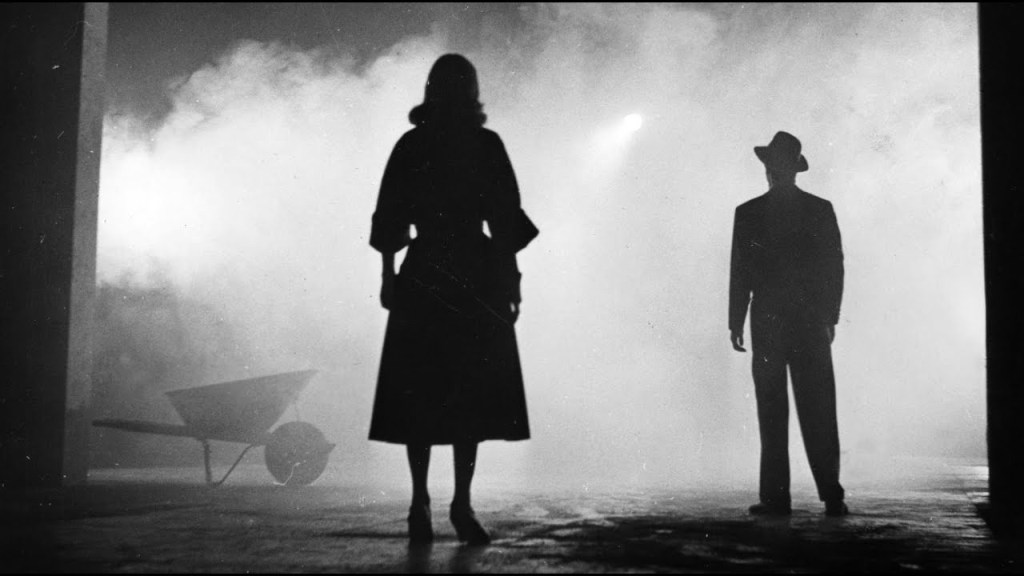
Still from Joseph H. Lewis’s The Big Combo (1955)
One of the great visual artists of the American film was John Alton (1901-1996), a cinematographer famous for the visual style of some of the best noir films. Born Johann Jacob Altmann in Sopron, Hungary, Alton was instrumental in creating a look across the films of different directors at different studios that became a quintessential characteristic of an entire American genre.
As he wrote in his book Painting with Light:
The director of photography visualizes the picture purely from a photographic point of view, as determined by lights and the moods of individual sequences and scenes. In other words, how to use angles, set-ups, lights, and camera as means to tell the story.

John Payne in Robert Florey’s The Crooked Way (1949)
In an otherwise unremarkable film I saw last night on Turner Classic Movies (TCM), Alton’s work lifted the film up to an entirely different level. United Artists’ The Crooked Way was a tale of a war hero amnesiac who, on investigating his pre-war life, finds he was a criminal. Alton’s images of Los Angeles, including a bail bond shop, a night club, and a war surplus warehouse made the film a feast for the eyes.

Still from Anthony Mann’s T-Men (1947)
Even in a movie shot for a poverty row studio like Eagle-Lion Pictures, Alton was superb. Of course, it helped that the director was Anthony Mann, whose noir credentials are impeccable.
To see a list of the noir films Alton photographed, check out this website and scroll halfway down for a list of eighteen of his noir masterpieces.
And just to demonstrate his versatility, Alton was also superb in working with color, such as in Allan Dwan’s Slightly Scarlet (1958) and Stanley Donen’s musicasl with Gene Kelly, An American in Paris (1951)
 Tarnmoor
You must be logged in to post a comment.