Of course, it was nowhere near so bad as I imagined it would be. I tend to get a bit crotchety about holidays. They tend so often to make for bad feelings because there are all those things one has to do to make for the perfect holiday. If it turns out to be less than perfect, one is floored by feelings of inadequacy.
The French have a word for it: devoirs. Check out the Alpine French School website for a discussion of the different meanings of the term, particularly the second meaning. The devoirs for Thanksgiving include:
A turkey dinner with mashed potatoes, green bean casserole, cranberry sauce, pumpkin pie, etc etc etc
Getting together with as many of your family that you can sit around your dining room table
Discussions about politics with that uncle with whom you do not wish to converse
If you think that’s a lot, let’s take a look at thge many devoirs pertaining to Christmas:
Expensive and thoughtful gifts for everyone
A tree in the living room with ornaments, tinsel, and lights
Multi-colored lights festooning the front of your house
Maintaining harmful myths about Santa and elves to your underage children
Sending Christmas cards to family, friends, acquaintances, and just about everyone else
Just remember one thing: You don’t have to buy into all the “oughts” connected with the holidays. Your more conventional friends will probably think you a bit of a Grinch. Note, however, that it is better to be thought a Grinch than to be depressed and broke.
I took Martine out to Cafe 50s so she could have her Thanksgiving turkey, while I, of course, ordered something other than bird. She also had her favorite Hawaiian Tropic milk shake, so she is quite pleased with our quasi-celebration of the holiday.
The Famous 1975 Cartoon by Ron Cobb About Thanksgiving
Even back in 1975 when I saw the famous R. Cobb cartoon depicting a family saying grace over a Thanksgiving turkey while the ground beneath them is littered with the bones of massacred Indians. Of course, even back then I didn’t like Thanksgiving. I had too many memories of dry bird carcasses drenched in fat to make them palatable.
Curiously, we never had Thanksgiving turkey at home. Turkey just wasn’t a Hungarian meat; and my father, like me, didn’t want my Mom to ever cook any. So we always went out for Thanksgiving.
The whole nonsense about the Pilgrims making nice with the Indians before wiping them out in King Philip’s War and other conflicts. The holiday is based on a myth designed to make us feel good about violently supplanting the indigenous peoples of the New World. If you want to get a more balanced picture of what happened, I suggest you read Eduardo Galeano’s trilogy entitled Memory of Fire. I read all three volumes in the 1980s, which served only to solidify my dislike of the holiday.
On this and many other issues, I find myself in the minority. So enjoy your dry bird. And think of all the football games you can watch this weekend!
By the way, Martine loves turkey; so I’ll be taking her out for a turkey dinner tomorrow. Needless to say, I will order something else.
To begin with, I am a big fan of Frank Herbert’s novel Dune and the three feature films based on it: David Lynch’s Dune (1984) and Denis Villeneuve’s Dune: Part One (2021) and Dune: Part Two (2024).
Recently HBO has been screening Dune: Part Two almost daily, so I have seen the film a number of times. Although Timothée Chalamet is the acknowledged star of the film, I have been increasingly drawn to Zendaya’s portrayal of Chani Kynes, the Fremen Sayyadina and concubine of Paul Muad’Dib Atreides. In fact, I think the film revolves more around her reaction to Muad’Dib and his assumption of the role of Kwisatz Haderach than to Muad’Dib’s military exploits.
Chani clearly loves Paul, but she doesn’t buy into the myth that is being built up around him. And when Paul decides to take Princess Irulan, daughter of Emperor Shaddam IV, as his bride. She wanders off alone into the desert while her love moves on to an imperial role.
During all of Dune: Part Two, she is seen as smouldering with blazing eyes during all the stages of Paul’s transformations. Chalamet does a good job acting the role of Paul, but Zendaya is almost crazy good, like one of the great silent actresses with her full range of expressions.
This is in marked contrast to Sean Young’s portrayal of Chani in the 1984 Dune, which was one of the major weaknesses of the David Lynch version as released.
What Ever Happened to Men’s Coat and Tie Fashions?
Up until the 1960s, the wearing of coat and tie, and usually a white shirt, was de rigeur for American men. When I started working on my first full-time job around 1968, I noticed for the first time that men were no longer 100% certain to wear a coat and tie to the office. What happened?
From the point of view of Los Angeles, I noticed the weather slowly started heating up, such that the traditional wool men’s uniform tended to be on the uncomfy side during warm weather.
When I started working in an accounting office in 1992, we were all required to wear a coat and tie every day. It was only a few years later that it was no longer required, even when clients were due to visit our offices. By the 2000s, I rarely had to wear a tie, except perhaps when I had to visit a client’s premises.
I watch a lot of noir films of the 1940s and 1950s, which makes me particularly aware of changes in the way men dress today as compared to then.
This evening I watched two Humphrey Bogart films that showed the star in a flashy dark suit in both The Maltese Falcon (1941) and The Big Sleep (1946). Whether playing Sam Spade or Philip Marlowe, Bogie looked ready for the big time even as he was supposed to be a cheap detective in a not-too-swank office. In the latter film, he even carried a pocket flask full of rye.
Was it climate change that doomed the wool suit? Or was it the swinging 1960s and 1970s that made casual a viable option? Probably it was a combination of the two.
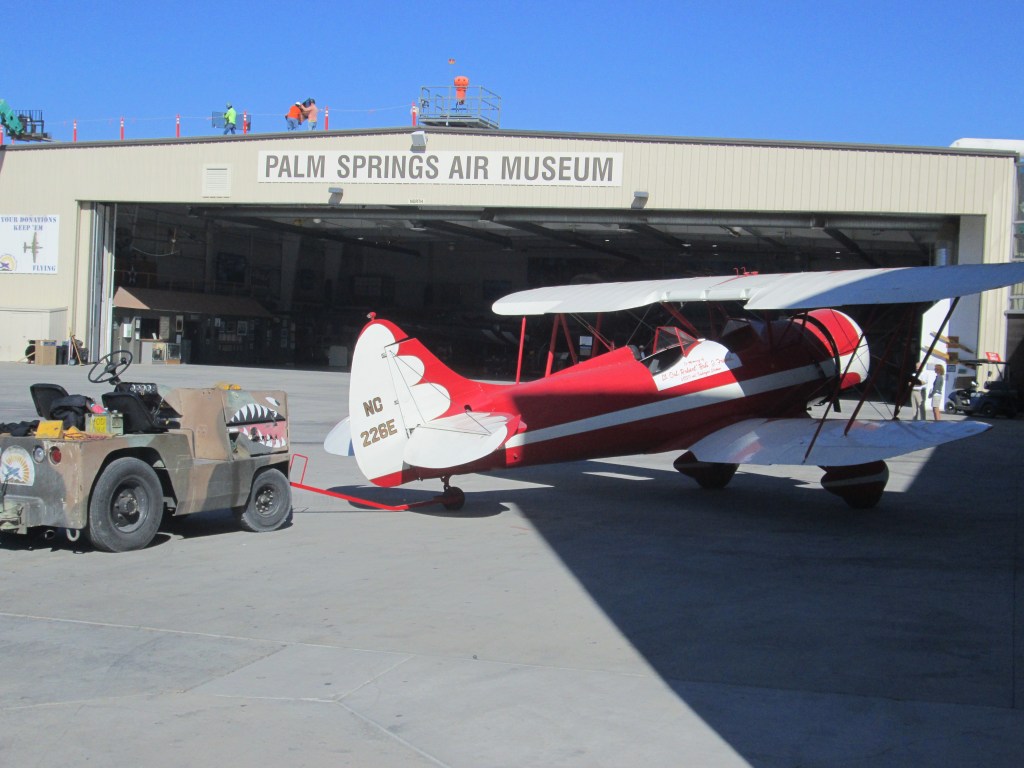
One of Several Hangars at the Palm Springs Air Museum
The Coachella Valley is a prime location for an aircraft museum if for no other reason than many former military and civilian pilots retired there. As a result, the museum is unusually well staffed and equipped with planes and flying paraphernalia.
Last Monday, I visited the museum for the third time. I was happy to see that they had a new temporary hangar for a Lockheed SR-71 Blackbird, which holds three records for speed at Mach-3 and above. Developed by Lockheed’s famous Skunk Works in Burbank, California, the SR-71 proved so useful that it was brought out of retirement twice.
SR-71 at the Palm Springs Air Museum
Of all the tourist sights in the Valley, I think the best two for children are the Living Desert in Palm Desert and the Palm Springs Air Museum. Never have I seen children so attentive as they viewed the exhibits. And, speaking as an adult, I found myself pretty attentive too.
Afterwards, my brother and i ate a great Mexican lunch at the San Miguel Taqueria on Ramon near Thousand Palms.
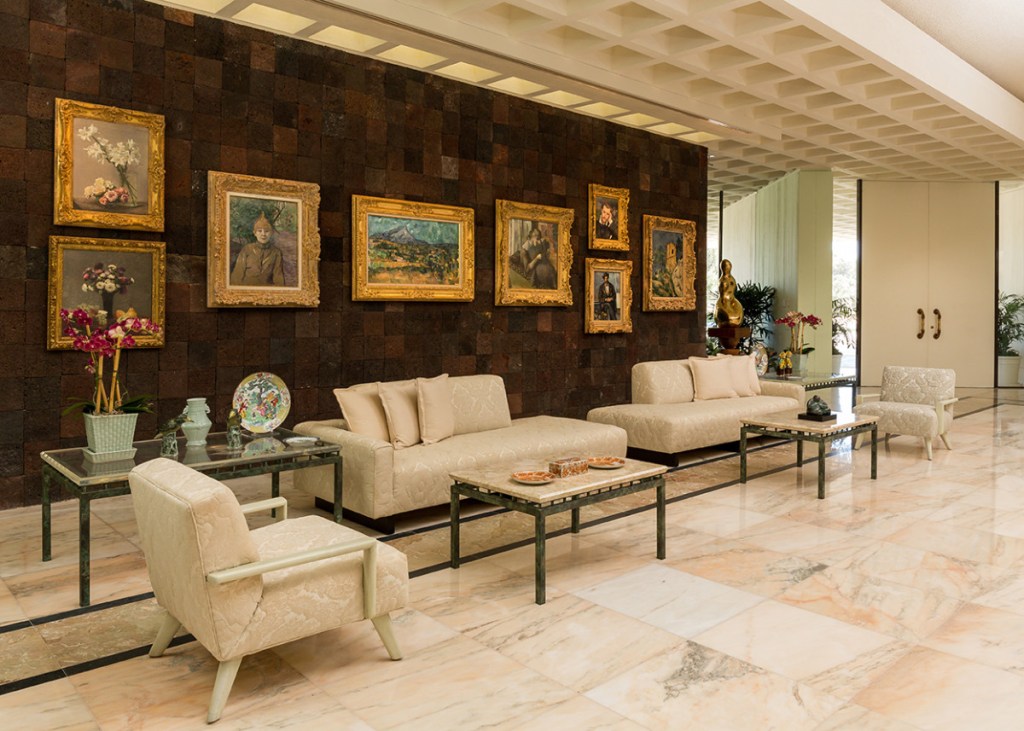
The Sunnylands Estate where Walter and Leonore Annenberg lived and entertained political and entertainment figures from around the world is one of the most interesting sights in the Coachella Valley. When I took the house tour last Sunday, I saw a beautiful example of 1960s modern architecture in the form of a single-story house that seemed to go on forever.
One strange note is that the walls were covered with reproductions of famous paintings. The originals belonged to the Annenbergs, but they were gifted in 1991 to the Metropolitan Museum of Art in New York.
During the lifetime of the Annenbergs, Sunnylands was frequently the site of meetings with world leaders, including both President Bushes, Barack Obama, Ronald Reagan, Queen Elizabeth II, Richard Nixon, Dwight D. Eisenhower, and Xi Jinping of China. In 1976, Frank and Barbara Sinatra were married there.
The Rose Garden at Sunnylands
Not only the house but the grounds at Sunnylands are worth seeing. Access is free to all, and there are tens of thousands of trees and cacti, a rose garden, and numerous other landscape features. Check out the video of the grounds at the Sunnylands website.
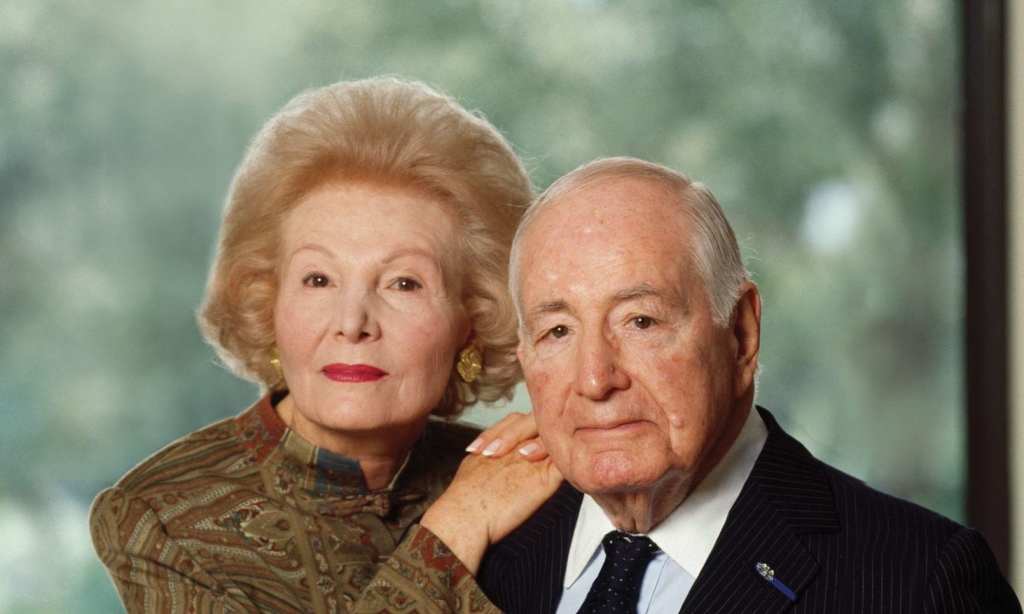
Some billionaires when they die leave behind treasures that could be enjoyed by future generations. Some actually manage to make the world a slightly better place. Such was publishing magnate Walter Annenberg (1908-2002). From 1969 to 1974, he also served as U.S. ambassador to the United Kingdom. His palatial 800+ acre estate at Sunnylands in Rancho Mirage served as the western version of Camp David, where world leaders met and discussed global issues.
Most billionaires, I’m sad to say, are merely a waste of skin. I am not interested in naming names, because you know who I mean.
Last Sunday, I took the tour of the Sunnylands estate and was impressed by the beauty of the house and grounds.
View from the Lower Terrace of the Sunnylands House
Now the Coachella Valley is a fairly populated place. You would never guess that from Sunnylands. There are wonderful views of Mount San Jacinto and the other mountains around Palm Springs—but the estate is so situated that one can’t tell that there are any houses or business districts in any direction. Where one would expect to find them, one is confronted by trees that give the estate a sense of splendid isolation, even though it is readily accessible from busy Bob Hope Drive.
I had visited the grounds of the estate twice before and strolled the lovely cactus gardens. The house tour, on the other hand, but be reserved and costs a pretty penny. But it is definitely worth it.
Unfortunately, it is not permitted to photograph the interiors, but I will try to find some previously published photos that I can show you in a later post.
I will not be posting to this website for a few days as I will be in the desert visiting my brother Dan. On Sunday morning, I will be doing a tour of the Annenberg Retreat at Sunnylands, “The Camp David of the West,” where many world leaders convened. Then, on Monday, because Dan will probably be at work, I will be on my own. I haven’t decided where I will go, but it will invariably be a photogenic place which will result in future blogs.
Here’s a post from ten years ago this month. I’ve always meant to read up on the Etruscans, as I admire what I know of their view of life—even though I’m not known for smiling.
The whole world of the smiling girl in he above photo is long gone, but her smile still speaks to us. It tells us that, even in Ancient Rome, there was something to laugh about. When I took the picture on Friday, I did not note the provenance of the figurine, but I wonder if it was Etruscan. This ancient people is the only one that has allowed itself to be depicted as wreathed in smiles—very contrary to the picture we have of the dour Romans.
Below is a hollow funerary urn from the Banditaccia Necropolis showing a married couple, whose ashes are presumably commingled therein:
I guess my little figurine is not Etruscan.Their images always show them as having sharp features and almond eyes. The girl above is definitely Roman.
Not to change the subject, but it reminds me somewhat of the following poem by Robert Browning:
My Last Duchess
That’s my last Duchess painted on the wall, Looking as if she were alive. I call That piece a wonder, now: Frà Pandolf’s hands Worked busily a day, and there she stands. Will ‘t please you sit and look at her? I said ‘Frà Pandolf’ by design, for never read Strangers like you that pictured countenance, The depth and passion of its earnest glance, But to myself they turned (since none puts by The curtain I have drawn for you, but I) And seemed as they would ask me, if they durst, How such a glance came there; so, not the first Are you to turn and ask thus. Sir, ‘t was not Her husband’s presence only, called that spot Of joy into the Duchess’ cheek: perhaps Frà Pandolf chanced to say, ‘Her mantle laps Over my lady’s wrist too much,’ or ‘Paint Must never hope to reproduce the faint Half-flush that dies along her throat:’ such stuff Was courtesy, she thought, and cause enough For calling up that spot of joy. She had A heart—how shall I say?—too soon made glad, Too easily impressed; she liked whate’er She looked on, and her looks went everywhere. Sir, ‘t was all one! My favour at her breast, The dropping of the daylight in the West, The bough of cherries some officious fool Broke in the orchard for her, the white mule She rode with round the terrace—all and each Would draw from her alike the approving speech, Or blush, at least. She thanked men,—good! but thanked Somehow—I know not how—as if she ranked My gift of a nine-hundred-years-old name With anybody’s gift. Who’d stoop to blame This sort of trifling? Even had you skill In speech—(which I have not)—to make your will Quite clear to such an one, and say, ‘Just this Or that in you disgusts me; here you miss, Or there exceed the mark’—and if she let Herself be lessened so, nor plainly set Her wits to yours, forsooth, and made excuse, —E’en then would be some stooping; and I choose Never to stoop. Oh, sir, she smiled, no doubt, Whene’er I passed her; but who passed without Much the same smile? This grew; I gave commands; Then all smiles stopped together. There she stands As if alive. Will ‘t please you rise? We’ll meet The company below then. I repeat, The Count your master’s known munificence Is ample warrant that no just pretence Of mine for dowry will be disallowed; Though his fair daughter’s self, as I avowed At starting, is my object. Nay, we’ll go Together down, sir. Notice Neptune, though, Taming a sea-horse, thought a rarity, Which Claus of Innsbruck cast in bronze for me!
That line about “all smiles stopped together” is grimly humorous.
I spent four years at Dartmouth College in New Hampshire while suffering from a brain tumor that caused severe frontal headaches that lasted until midnight. It was then that I started my homework, not going to sleep until three or four in the morning. It was truly horrible when I had classes scheduled for 8:00 AM.
Worst of all were the morning swimming classes that I had to attend the first two years. At the time, the college had a requirement that all students be able to swim fifty yards in one minute. I was, of course, handicapped by my pituitary tumor; but I eventually passed the test. If MRIs and CAT Scans existed back in the mid-1960s, I would have been excused. But they didn’t. The doctors all thought that I was just being a pussy. It was not until I graduated in 1966 that I collapsed at home in Cleveland, just prior to leaving for graduate school at UCLA.
Still, I loved going to Dartmouth. It was everything I wanted. It was far from home at a time when my parents were undergoing a rough patch in their marriage. It was a college that challenged students to excel intellectually. And, situated in the upper Connecticut River Valley, it was a place of beauty. Most of the majestic elm trees are long gone, having succumbed to Dutch Elm Disease; but while I was there, the campus was strikingly beautiful.
When I went with Martine to re-visit the campus in 2005, I was appalled by the campus building program that was putting multi-story buildings in all the green spaces where I tossed a frisbee with my classmates. But then, I guess that that is a problem common to many campuses. It wasn’t the buildings that educated me: it was the caliber of the faculty and the students.







 Tarnmoor
You must be logged in to post a comment.