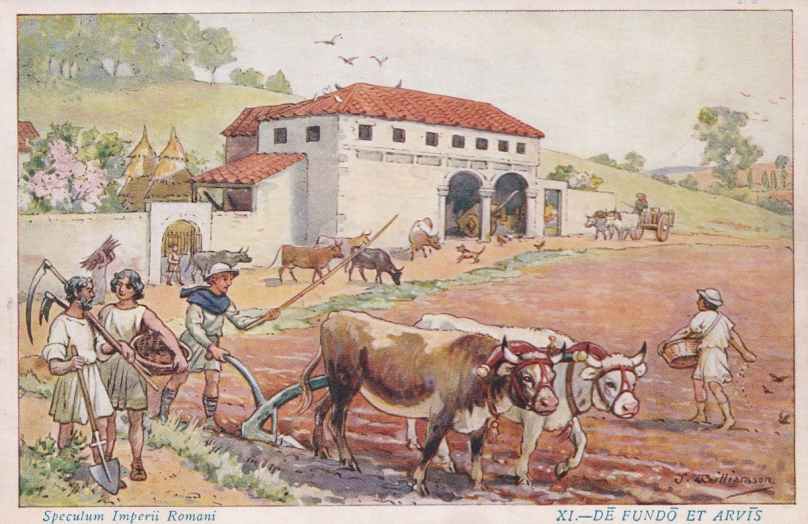
Old School Card Showing Cattle Farming in the Roman Forum
Roughly translated, the title of today’s post is “What has this to do with the cattle of Iphyclus?” or, more loosely, “Let us return tom the subject at hand.”
I am currently reading Sir Walter Scott’s Kenilworth (1821). Scott is famous for starting his novels slowly. I have just read fifty pages of densely packed plotting as Edmund Tressilian gets lost fleeing Cumnor and his horse throws a shoe. He meets up with an old scholar named Erasmus Holiday who converses mostly in Latin and who is delighted to meet anyone with even an imperfect knowledge of the old Romish tongue.
What Tressilian wants, quite simply, is the directions to the nearest blacksmith so he can continue on his way, but Erasmus is not willing to let go of him that easily. Finally, after numerous quotes from Latin classics, he deputes Hobgoblin (aka Flibbertigibbet), the son of his washerwoman, to show him the way to Wayland Smith, the local farrier.
And here we are detained still more by the rumors of said farrier being a tool of the devil as a result of his former association with a local mountebank.
Eventually Tressilian gets to his destination accompanied by Smith, who is now his servant.
There was a time when I would have been upset at the slow development of the story in Kenilworth, but now I am delighted. This is definitely a slow read, requiring frequent consultation with the notes and (yes) a detailed glossary.
In my old age, I now appreciate Scott’s divergence from the subject at hand. He is so damnably erudite and enjoys sharing it with us. Will Tressilian ever rescue the lovely Amy Robsart from the clutches of the evil Richard Varney? Eventually, I’ll find out; but, in the meantime, whether or not the cattle of Iphyclus enter the fray, I will enjoy every minute of this long and painstaking read.


 Tarnmoor
You must be logged in to post a comment.