
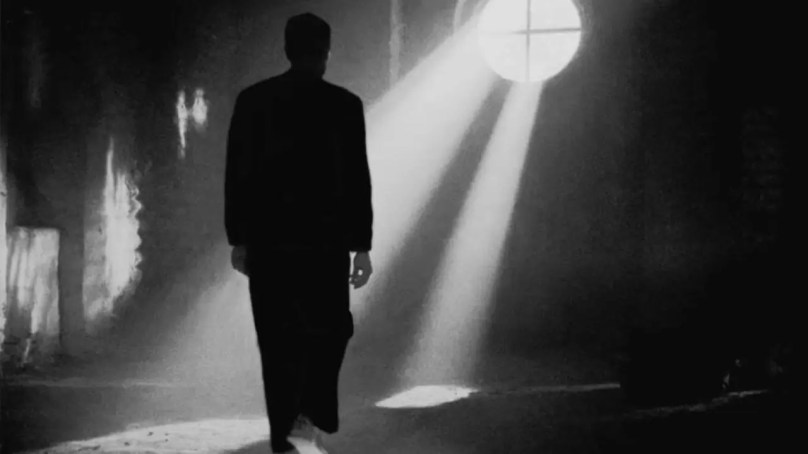
Still from John Ford’s The Fugitive (1947)
Yesterday as I was watching John Ford’s The Fugitive on Turner Classic Movies (TCM), I was reminded of what Peter Bogdanovich said about black & white vs. color: “Orson Welles says every performance looks better in black and white. It’s the fact that you don’t see blue eyes and blond hair. You focus on the performance, not the look of the people. And it enables you to capture the period better.” And that is why he shot The Last Picture Show (1971) in black and white.
When I was growing up, I preferred color, even though the color at that time was mostly three-strip Technicolor, which, though beautiful in its own right, is not particularly realistic. Then, in 1962, I saw a black & white film that changed me: Carl Dreyer’s powerful study of witchcraft in Denmark, Day of Wrath (1943). I started attending the Dartmouth Film Society’s screenings, and I saw numerous motion pictures that made me appreciate both color and black & white.
In the world of black & white, there are some great cinematographers. They include Gabriel Figueroa (he shot The Fugitive); John Alton, the great noir master; Joseph Von Sternberg and his regulars Lee Garmes and Bert Glennon; Sidney Hickox (the 1946 The Big Sleep); and Gregg Toland. Interestingly, the great B/W photographers could also make great color films—but not always vice versa.
Today, I have no preference between B/W and color. Most of the films I watch on TCM are in black and white, probably because I do not retain my childhood preference for color. Also, I will willingly watch silent films of the 1920s and films of the 1930s, 1940s, and up to the present day. Curiously, if I am prejudiced, it is mostly against recent films, which are overwhelmingly in color.
For balance, I will also write a blog about my favorite color films within the next few days.
 Tarnmoor
You must be logged in to post a comment.