The furthest I have ever traveled from home is to the southern tip of Argentina: to Ushuaia in the State of Tierra del Fuego. The absolute furthest was to the end of Route 3, at Bahia Lapataia in the Parque Nacional Tierra del Fuego, within sight of the Chilean border. I was there in both 2006 and 2011.
I am currently reading a collection of short short stories by the Swiss author Fleur Jaeggy. Following is the complete text of the shortest story in her collection I Am the Brother of XX.
Observing others is always interesting. On a train, in airports, at conferences, while waiting in line, when sitting across from someone at a table; on any occasion, in fact, that people flow into. Even someone who doesn’t travel or is very much alone will at some point go out on the street for half an hour. And observe a cat terribly concentrated and alert, stalking his prey. Or clawing it. Maybe it’s a butterfly, or a leaf, or a piece of paper, an insect. On reaching the target, suddenly a cat becomes distracted. Animal behaviorists call this movement Übersprung. It happens just before the deadly blow. We see the cat shift and move the prey as if it were a feather. The last moves. The butterfly dances its agony. It vibrates imperceptibly, and this attracts further interest from the cat. And then he looks away. Walks away. Calmly, he changes route. Changes the mental route. It is like a dead moment. Stasis. It’s as if nothing interests him. It’s as though he has forgotten the fluttering wings that only moments earlier had inspired his total dedication. That which had possessed him before, as though it were an idea, a thought. Now he pulls away. Looks elsewhere. With his little paw he rubs his muzzle. With his little paw he scratches behind one ear, head bent. He has many tasks to fulfill. They have nothing in common with the preceding one. With action. The cat is looking elsewhere. He is elsewhere. It is a strategic move. It is part of a mechanism of precision. All of it is reminiscent of the puppets in Kleist’s story. The precision of the assault, the lightness and agility. The detachment, the distance. Maybe the butterfly and the leaf have the same moment of Übersprung. Like the cat. They distract themselves from agony, abstract themselves from their own death. From the idea of death. That’s what the cat does. He distances even himself from the agony. That he has inflicted. We don’t know why it is that the cat turns his gaze away. He knows why. Who knows, maybe this Übersprung is a delectacio morosa. A melancholic doing away with any connection to the victim. Übersprung: a word that involves us, too. It is a turning away, going on to something else, manifesting a gesture of detachment, like a goodbye. Wandering from the theme, escaping from a word—at once hunting for words and doing away with them: these are all a mind’s modes of writing. Some write according to delectacio morosa. Thomas De Quincey, for instance, once hinted at the “dark frenzy of horror.”
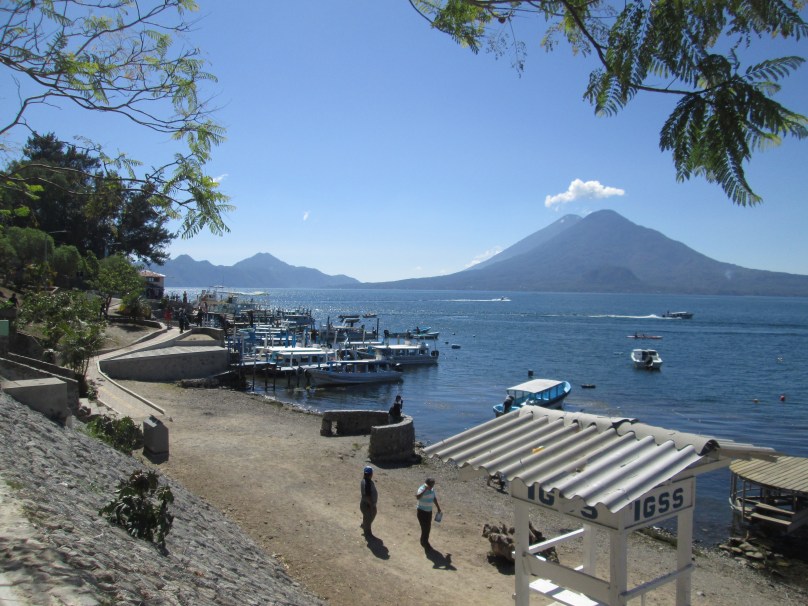
It was 2019 when I spent several weeks in Guatemala and Honduras. After five days in Antigua Guatemala, I took a bus to Panajachel, the main port on the Lago de Atitlán. I very much wanted to meet Maximón, a folk saint or deity based in Santiago de Atitlán, a city that had seen much strife during the persecution of the native Maya people.
According to the National Geographic Society’s website:
Maximón, also known as San Simón, represents light and dark. He is considered a trickster—both a womanizer and protector of virtuous couples. According to legend, the village fishermen traveled frequently for trade and enlisted Maximón to protect the virtue of the wives they left behind. It backfired. Instead, Maximón is said to have disguised himself as a loved one so he could have sex indiscriminately.
Today, Maximón’s effigy resides in a different family’s home every year—his wooden body is dressed in a typical male suit of the region and placed on a petate, or straw mat. Traditionally he was only brought out during Holy Week, but because of high demand from pilgrims, tourists, and brujos (shamans), he is on display year-round.
Those seeking miracles, good health, and love make offerings at his shrine in exchange for his favor—moonshine, hand-rolled cigarettes, and money are his vices of choice. His cofrades, or attendants, spend their days smoking and drinking by his side, and it is considered the highest honor to host him. He is brought out during Holy Week and paraded through the streets before being placed in a different home for the following year.
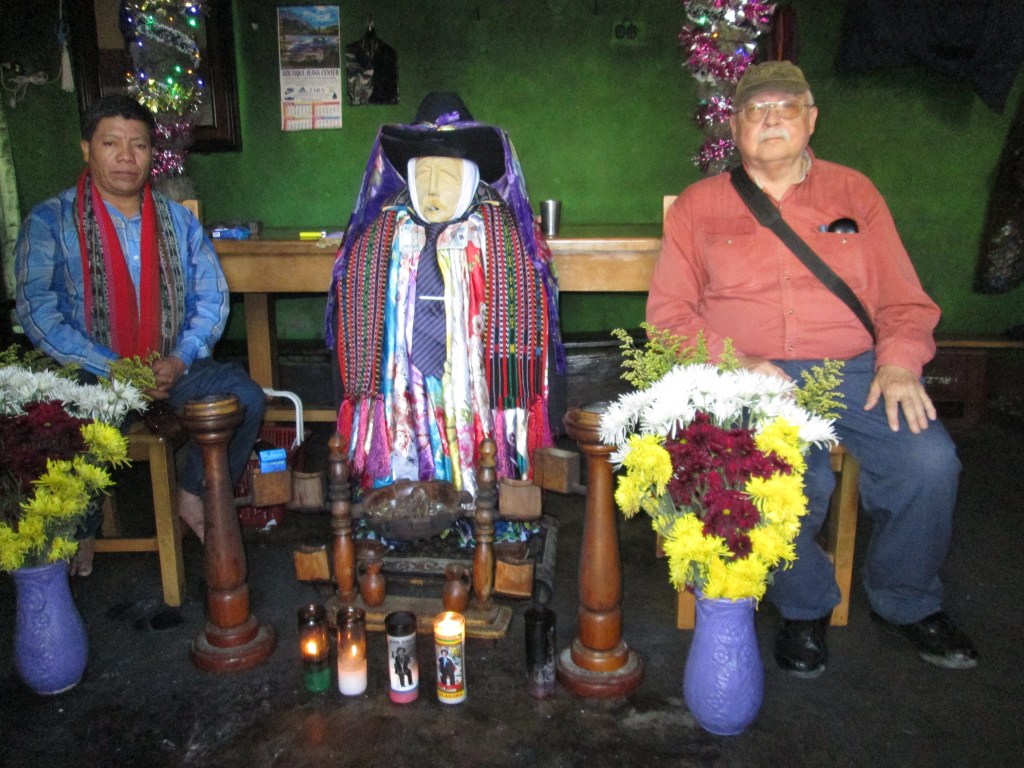
With Maximón (Center) in Santiago de Atitlán
I made my own offering to Maximón to protect me during my travels, as I had a number of hard-to-get-to Maya ruins still to visit, including Copán in Honduras and Quiriguá and Tikal in Guatemala. He rewarded me with one of my best trips in Latin America.


 Tarnmoor
You must be logged in to post a comment.