Young Lochinvar

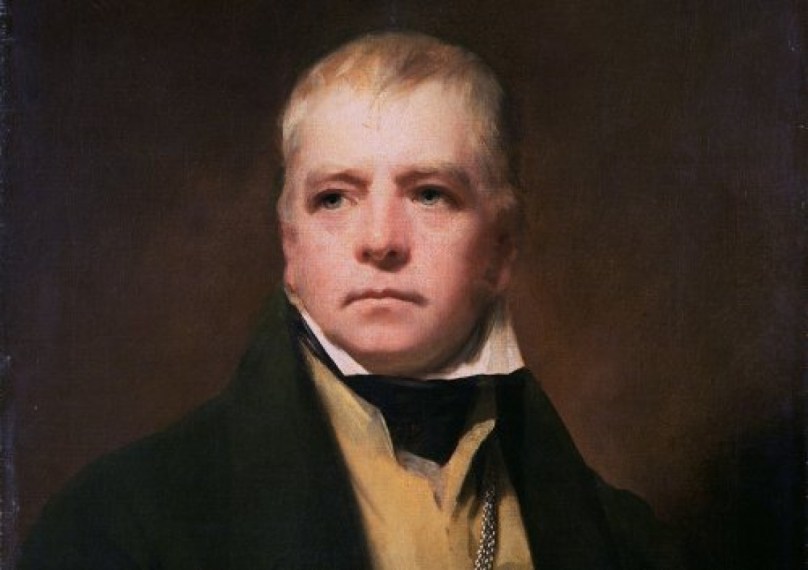
Sir Walter Scott (1771-1832)

Walter Scott himself was no Lochinvar. At the age of two, he had polio and was lame for the rest of his life. Somehow, his fertile brain made up for his physical weakness, and in his sixty-one years poured out an almost endless stream of poems, novels, poetry, plays, and non-fiction, including perhaps the greatest literary journals ever written. Here is one of his much anthologized poems. You may have read it in school, but look at it again from the point of view of the poet’s superhuman sense of energy and ease.

Lochinvar

O, young Lochinvar is come out of the west,
Through all the wide Border his steed was the best;
And save his good broadsword, he weapons had none,
He rode all unarm’d, and he rode all alone.
So faithful in love, and so dauntless in war,
There never was knight like the young Lochinvar.

He staid not for brake, and he stopp’d not for stone,
He swam the Eske river where ford there was none;
But ere he alighted at Netherby gate,
The bride had consented, the gallant came late:
For a laggard in love, and a dastard in war,
Was to wed the fair Ellen of brave Lochinvar.

So boldly he entered the Netherby Hall,
Among bride’s-men, and kinsmen, and brothers, and all:
Then spoke the bride’s father, his hand on his sword,
(For the poor craven bridegroom said never a word,)
“O come ye in peace here, or come ye in war,
Or to dance at our bridal, young Lord Lochinvar?”—

“I long woo’d your daughter, my suit you denied;—
Love swells like the Solway, but ebbs like its tide—
And now am I come, with this lost love of mine,
To lead but one measure, drink one cup of wine.
There are maidens in Scotland more lovely by far,
That would gladly be bride to the young Lochinvar.”

The bride kiss’d the goblet; the knight took it up,
He quaff’d off the wine, and he threw down the cup.
She look’d down to blush, and she look’d up to sigh,
With a smile on her lips, and a tear in her eye.
He took her soft hand, ere her mother could bar,—
“Now tread we a measure!” said young Lochinvar.

So stately his form, and so lovely her face,
That never a hall such a galliard did grace;
While her mother did fret, and her father did fume,
And the bridegroom stood dangling his bonnet and plume;
And the bride-maidens whisper’d, “’Twere better by far
To have match’d our fair cousin with young Lochinvar.”

One touch to her hand, and one word in her ear,
When they reach’d the hall-door, and the charger stood near;
So light to the croupe the fair lady he swung,
So light to the saddle before her he sprung!
“She is won! we are gone, over bank, bush, and scaur;
They’ll have fleet steeds that follow,” quoth young Lochinvar.

There was mounting ’mong Graemes of the Netherby clan;
Fosters, Fenwicks, and Musgraves, they rode and they ran:
There was racing and chasing, on Cannobie Lee,
But the lost bride of Netherby ne’er did they see.
So daring in love, and so dauntless in war,
Have ye e’er heard of gallant like young Lochinvar?

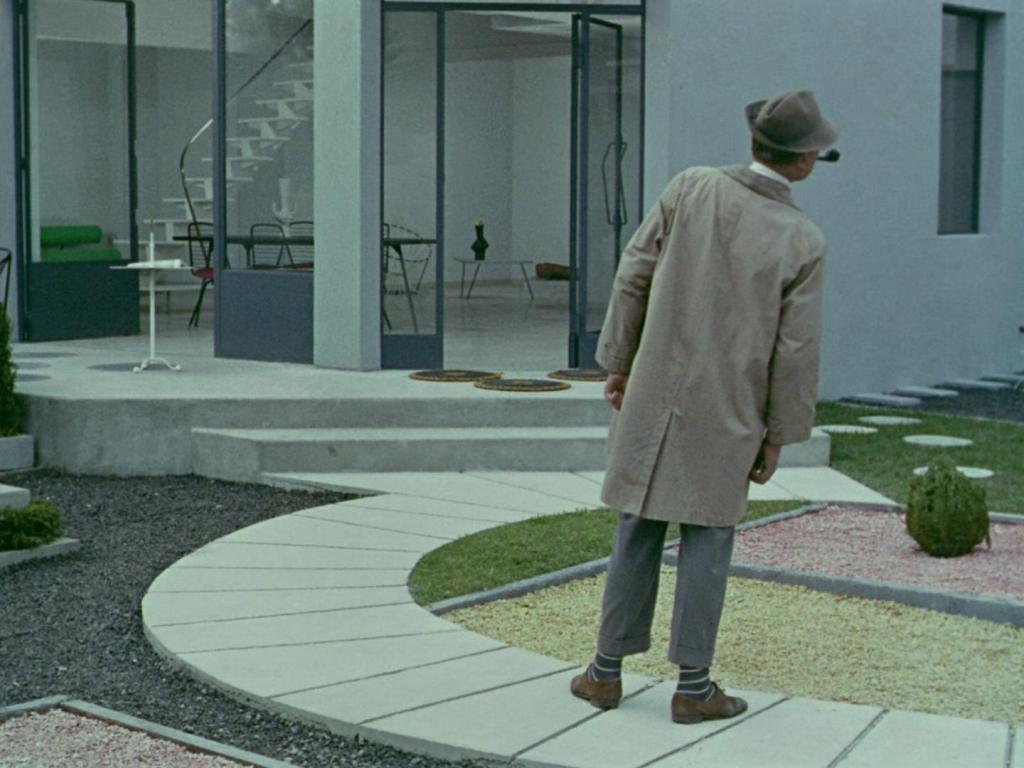
Perfection?

Poster for Jacques Tati’s Mon Oncle (1958)

It is in many ways the perfect comedy. And it was directed by the grandson of a Czarist Russian general (Dimitri Tatischeff) who married a French circus performer. I have seen Mon Oncle (“My Uncle”) at least twenty times and own a DVD of it and all of Jacques Tati’s other films.

Like Charlie Chaplin, Tati made comedies in which he both directed and starred. During his whole career, he only completed six full-length films over a period of thirty-five years. But in that number are some real gems:

  • Jour de Fête (1947)
  • Monsieur Hulot’s Holiday (Les vacances de M. Hulot, 1953)
  • Mon Oncle (1958)
  • Playtime (1967)
  • Traffic (1971)
  • Parade (1973) – made for Swedish television

M. Hulot Views His Sister’s Modern House

The Last Time I Was in Argentina

Buenos Aires: Traffic on Calle Florida

It has now been ten years since my last visit to Argentina. Cristina Kirchner was still President of the Republic. I had an itinerary that included a visit to the Foz de Iguazu by the border with Brazil, the Patagonian resort of San Carlos Bariloche, and a bus and boat trip over the Andes to Puerto Varas in Chile.

I revisited the spectacular cemetery at Recoleta where Eva Perón is buried and the port of Tigre by the delta of the Paraná River. On my way to the bus station in Retiro, a serious attempt was made to pick my pocket at a time when I was carrying $2,000 in Argentinean pesos. (I quickly sidestepped to the right and hailed a cab.)

Funerary Statue at Recoleta Cemetery

I got violently ill at a hotel by the Congreso after eating a dubious steak dinner the night before, but I managed nonetheless to catch my bus to Puerto Iguazu and got better after a 10-hour bus ride that passed hundreds of fields where yerba mate was growing.

In sum, it was a great trip. As long in the tooth as I am, I would jump at the chance to visit Argentina again. The long plane ride over the Andes could be brutal, but the country is endlessly fascinating. I especially love Patagonia and Tierra del Fuego.

At the Puerto Iguazu Bus Station

Most Americans have little or no idea of what South America is really like. Over the last twenty years, I have been to Argentina, Chile, Uruguay, Peru, and Ecuador and enjoyed just about every minute of my travels there.

Here’s Looking at You Kid

“Round Up the Usual Suspects”

It was appropriate on this Valentine’s Day to see Warner Brothers 1942 classic Casablanca for the umpteenth time. As TV host Ben Mankiewicz said when he introduced the film for tonight’s Turner Classic Movies (TCM) showing, it was the most perfect film produced by the Hollywood studio system.

As a love story, one is not sure until the end whether Rick (Humphrey Bogart) will give the letters of transit for Lisbon to Victor Laszlo (Paul Henreid) and his wife Ilsa Lund (Ingrid Bergman). And will Captain Renaud (Claude Rains) arrest Rick and turn him over to Major Strasser of the Third Reich (Conrad Veidt)?

I have seen Casablanca so many times in my life that it is almost like Holy Writ. Even when Ilsa Lund pleads, “Victor, please don’t go to the underground meeting tonight,” I forgive the clunky line because it is an integral part of a film that I love as is. I even like all the recurrences of “Here’s looking at you kid.”

Sometimes I think one of the things that makes the film great are all the actors from Mitteleuropa that were in the cast, including Peter Lorre, Conrad Veidt, Leonid Kinsky, S. Z. Sakall, Ludwig Stössel, Hans Heinrich von Twardowsky, Trude Berliner, Ilka Grünig, and Wolfgang Zilzer. And don’t forget Hungarian director Michael Curtiz and Austrian music director Max Steiner. It gives the whole “stuck refugee” theme a major boost, with the daily plane to Lisbon and freedom as its ultimate desideratum.

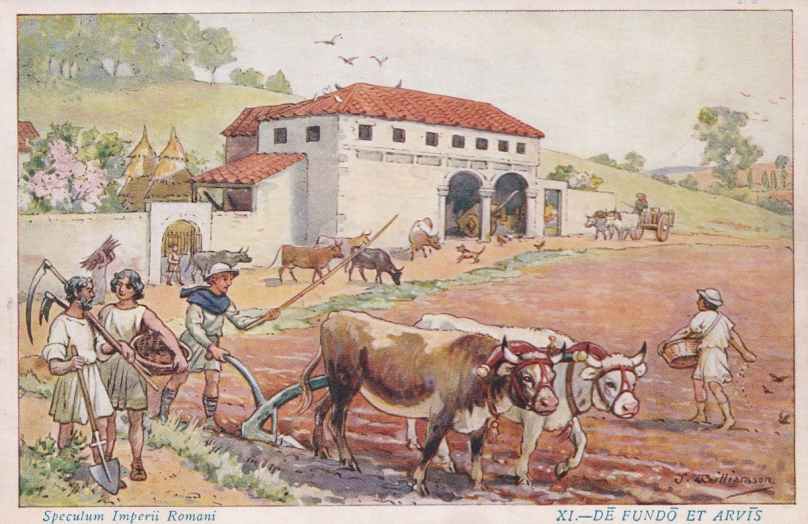
Quid hoc ad Iphycli boves?

Old School Card Showing Cattle Farming in the Roman Forum

Roughly translated, the title of today’s post is “What has this to do with the cattle of Iphyclus?” or, more loosely, “Let us return tom the subject at hand.”

I am currently reading Sir Walter Scott’s Kenilworth (1821). Scott is famous for starting his novels slowly. I have just read fifty pages of densely packed plotting as Edmund Tressilian gets lost fleeing Cumnor and his horse throws a shoe. He meets up with an old scholar named Erasmus Holiday who converses mostly in Latin and who is delighted to meet anyone with even an imperfect knowledge of the old Romish tongue.

What Tressilian wants, quite simply, is the directions to the nearest blacksmith so he can continue on his way, but Erasmus is not willing to let go of him that easily. Finally, after numerous quotes from Latin classics, he deputes Hobgoblin (aka Flibbertigibbet), the son of his washerwoman, to show him the way to Wayland Smith, the local farrier.

And here we are detained still more by the rumors of said farrier being a tool of the devil as a result of his former association with a local mountebank.

Eventually Tressilian gets to his destination accompanied by Smith, who is now his servant.

There was a time when I would have been upset at the slow development of the story in Kenilworth, but now I am delighted. This is definitely a slow read, requiring frequent consultation with the notes and (yes) a detailed glossary.

In my old age, I now appreciate Scott’s divergence from the subject at hand. He is so damnably erudite and enjoys sharing it with us. Will Tressilian ever rescue the lovely Amy Robsart from the clutches of the evil Richard Varney? Eventually, I’ll find out; but, in the meantime, whether or not the cattle of Iphyclus enter the fray, I will enjoy every minute of this long and painstaking read.

The Oldest Living Things?

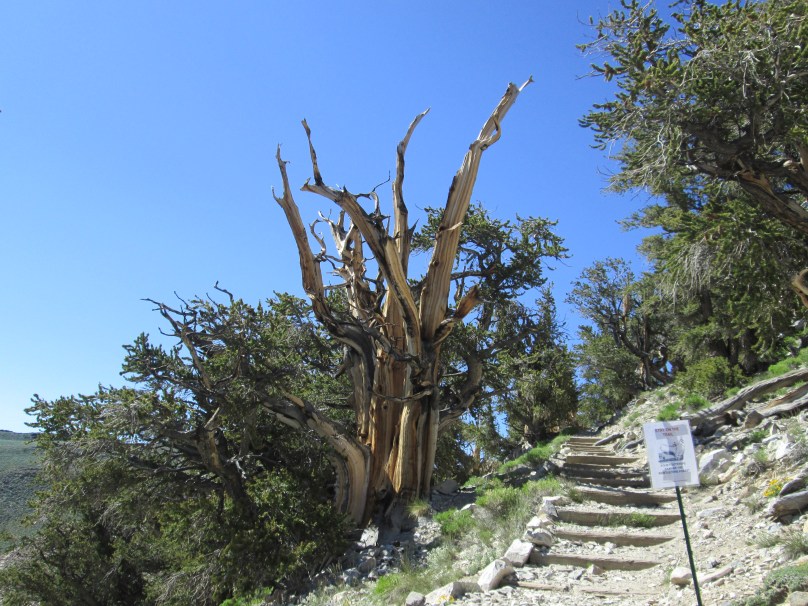
Pinus longaeva in California’s White Mountains

It has been said that the earliest living things on Earth are the Great Basin Bristlecone Pine trees in California’s Ancient Bristlecone Pine Forest within the Inyo National Forest. Martine and I visited the Schulman Grove (Altitude 10,100 feet or 3,078 meters) and its visitor center in 2019.

While there, we hiked along a trail (shown above) where there were numerous Great Basin Bristlecones (Pinus longaeva). Eventually, the altitude started to get to us; so we headed back down.

The most amazing thing we learned of at the visitor center is how scientists have been able, using the comparable annual rings of living and dead Bristlecones found in the same area, to calculate how long the species has been growing in the region. According to research conducted by C. W. Ferguson and D. A. Graybill of the Laboratory of Tree Ring Research at the University of Arizona, they were able to go back as far as 6700 B.C. This is a period of approximately 8,725 years when you add in the 2025 years of the Christian Era..

If you are a Young Earth Creationist who follows the teachings of James Ussher, Bishop of Armagh, who deduced in 1650 that the universe and everything in it was created at Noon on October 23, 4004 B.C., you are out of luck.

For more information, consult Ferguson and Graybill’s paper “Dendrochronology of Bristlecone Pine.”

Conspiracy of Silence

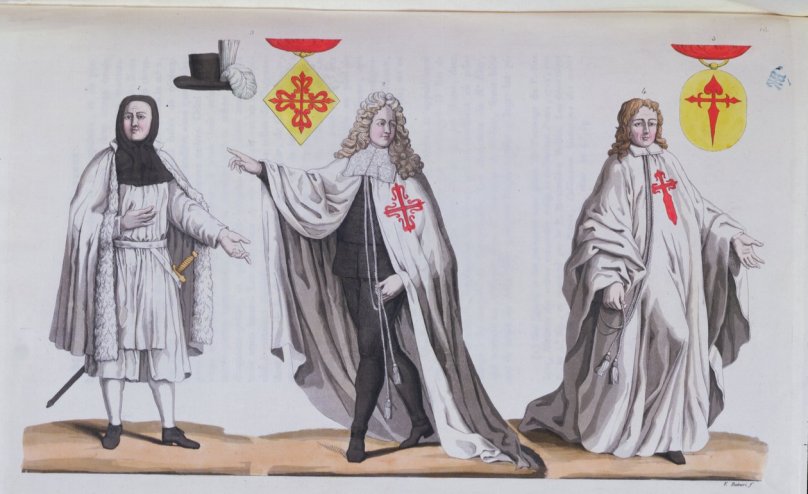
Costumes of the Knights of Calatrava

Around the time when Ferdinand and Isabella jointly ruled the Kingdoms of Aragon and Castile, there were three independent orders of knights: those of Santiago, Alcántara, and Calatrava. One of the commanders of the Knights of Calatrava, Fernán Gómez, is the feudal overlord of the village of Fuente Ovejuna (“The Well of Sheep”).

When Gómez goes on a rampage of torturing the peasants and raping the women of the village, the villagers resolve to assassinate him—first having promised not to reveal the names of the perpetrators, even under torture. When an investigative judge sent by the monarchy asks for the names of the murderers, all the villagers say, “Fuente Ovejuna did it!” Faced with a conspiracy of silence the villagers are let off the hook.

Around 1612, Spanish playwright Lope de Vega wrote a play called Fuente Ovejuna which memorializes the event.

There have been two interesting examples of similar events in which the unanimity of the populace prevented a judgment against the actual perpetrators.

In 1970, a group of Icelandic farmers took matters into their own hands when a governmental agency planned a dam that would affect a large swath of land along the Laxá River near Lake Mývatn in the north of the country. According to the Reykjavík Grapevine, this is what happened:

More than a hundred farmers officially claimed responsibility for the explosion, which annihilated a small dam in the river on August 25, 1970. The area’s inhabitants were determined to prevent the construction of a much bigger dam, which would have destroyed vast quantities of this natural area, as well as most of the surrounding farmlands.

The upshot was pretty much the same as in the Lope de Vega play:

“What makes the Laxá conflict peculiar is that those who resisted also succeeded,” Grímur says. “The planned dam was never built and the area was saved.” Four years later, parliament passed a law securing the protection of Laxá and Mývatn, contributing to the explosion’s status as “the most remarkable and powerful event in the history of environmentalism in Iceland,” as Sigurður Gizurarson, the bomber’s defence lawyer, put it.

Closer to home is the case of Ken McElroy, a small-town bully who regularly committed crimes against the inhabitants of Skidmore, Missouri, without serving time for his depredations. Until one day in 1981. The Wikipedia entry on McElroy tells the story:

On July 9, 1981, he appeared in a local bar, the D&G Tavern, armed with an M1 Garand rifle and bayonet, and later threatened to kill Bowenkamp [the local grocer].] The next day, McElroy was shot and killed in broad daylight as he sat with his wife Trena in his pickup truck on Skidmore’s main street. He was struck by bullets from at least two different firearms, in front of a crowd of people estimated as numbering between 30 and 46. Despite the many witnesses, nobody came forward to say who shot him. To date, no one has been charged in connection with McElroy’s death.

As I read Lope de Vega’s play, the other incidents came to mind. I found it interesting that they closely mirrored the Spanish events of some 500 years earlier.

Pursuit of the Transcendent

British Writer and Poet Walter de la Mare (1873-1956)

I am only now beginning to appreciate the work of Walter de la Mare. As the Poetry Foundation entry on him states, “His complete works form a sustained treatment of romantic themes: dreams, death, rare states of mind and emotion, fantasy worlds of childhood, and the pursuit of the transcendent.” Here is one of my favorite poems of his:

Music

When music sounds, gone is the earth I know,
And all her lovely things even lovelier grow;
Her flowers in vision flame, her forest trees,
Lift burdened branches, stilled with ecstasies.

When music sounds, out of the water rise
Naiads whose beauty dims my waking eyes,
Rapt in strange dream burns each enchanted face,
With solemn echoing stirs their dwelling-place.

When music sounds, all that I was I am
Ere to this haunt of brooding dust I came;
While from Time’s woods break into distant song
The swift-winged hours, as I hasten along.

Budapest. Keleti Pályudvar. 1977.

Keleti Pályudvar (Train Station) in Budapest

In the summer of 1977, I joined my parents in Budapest for a visit to locations in Hungary and Czechoslovakia (as it was called then). They flew to Budapest from Hungary, while I flew first to London and bought an Austrian Airlines ticket to Budapest by way of Vienna.

After a few days in Budapest, we decided to take a train to meet my relatives in Prešov in what is now Slovakia. We made our way to the Keleti Pályudvar from where trains went to Košice, where we would be met with our cousin Miroslav driving his trusty Škoda.

This was during the days of Communist rule, when things were a bit disorganized at times. As our train was pulling into the station, we jumped into a first class compartment for six and took our seats. In a few minutes, as the train was departing, another man jumped into our compartment. As it turn out, the man was Romany, a gypsy, or in Hungarian, a cigány.

Central and Eastern Europe are strongholds for many types of racism. So it is not surprising that my father’s first instinct was to grab the interloper by the collar and throw him off the slow-moving train, all the while calling him a büdös cigány (stinking Gypsy).

I sat there shocked not quite knowing how to react. Obviously things were different in this part of the world. This was confirmed for me when we went through a border inspection as we crossed into Czechoslovakia at Čaňa and my father bribed an inspector with a pack of Marlboro cigarettes.

That was an interesting trip. It involved my pretending to be a Hungarian railway worker so that we could use a MÁV (Hungarian State Railways) hostel in Szeged. (My cousin Ilona worked for MÁV in Budapest.) Apparently I was able to carry off the impersonation by grunting whenever spoken to.