
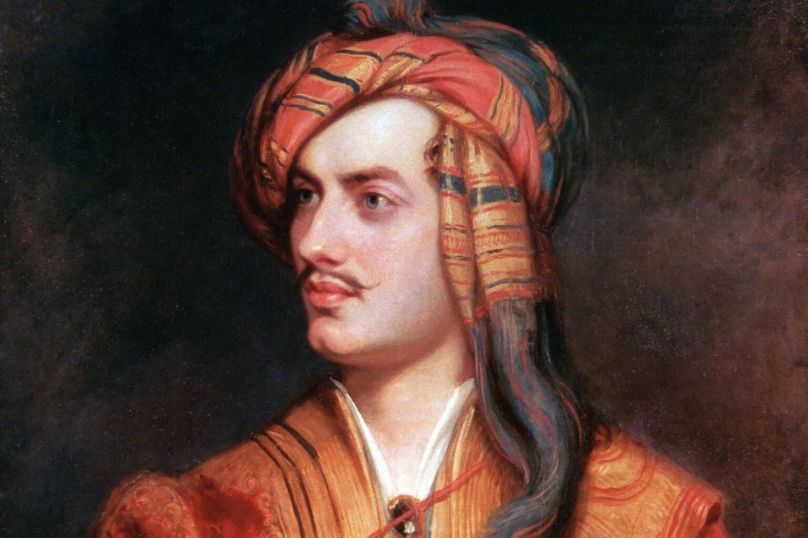
British Poet George Gordon, Lord Byron (1788-1824)
In that wonderful peak into the lives of two of England’s greatest poets we are indebted to Edward John Trelawny’s Records of Shelley, Byron, and the Author for eyewitness accounts. Although Trelawny was not altogether truthful at times, what would we give to have similar accounts of Shakespeare, Montaigne, and Erasmus, however imperfect?
I forgot that great actors when off the stage are dull dogs; and that even the mighty Prospero, without his book and magic mantle, was but an ordinary mortal. At this juncture Shelley joined us; he never laid aside his book and magic mantle; he waved his wand, and Byron, after a faint show of defiance, stood mute; his quick perception of the truth of Shelley’s comments on his poem transfixed him, and Shelley’s earnestness and just criticism held him captive.
I was, however, struck with Byron’s mental vivacity and wonderful memory; he defended himself with a variety of illustrations, precedents, and apt quotations from modern authorities, disputing Shelley’s propositions, not by denying their truth as a whole, but in parts, and the subtle questions he put would have puzzled a less acute reasoner than the one he had to contend with. During this discussion I scanned the Pilgrim [Byron] closely.
In external appearance Byron realised that ideal standard with which imagination adorns genius. He was in the prime of life, thirty-four; of middle height, five feet eight and a half inches; regular features, without a stain or furrow on his pallid skin, his shoulders broad, chest open, body and limbs finely proportioned. His small highly-finished head and curly hair had an airy and graceful appearance from the massiveness and length of his throat: you saw his genius in his eyes and lips. In short, Nature could do little more than she had done for him, both in outward form and in the inward spirit she had given to animate it. But all these rare gifts to his jaundiced imagination only served to make his one personal defeat (lameness) the more apparent, as a flaw is magnified in a diamond, when polished; and he brooded over that blemish as sensitive minds will brood until they magnify a wart into a wen.
His lameness certainly helped to make him sceptical, cynical, and savage. There was no peculiarity in his dress, it was adapted to the climate: a tartan jacket braided—he said it was the Gordon pattern, and that his mother was of that race. A blue velvet cap with a gold band, and very loose nankeen trousers, strapped down so as to cover his feet; his throat was not bare, as represented in drawings.
 Tarnmoor
You must be logged in to post a comment.