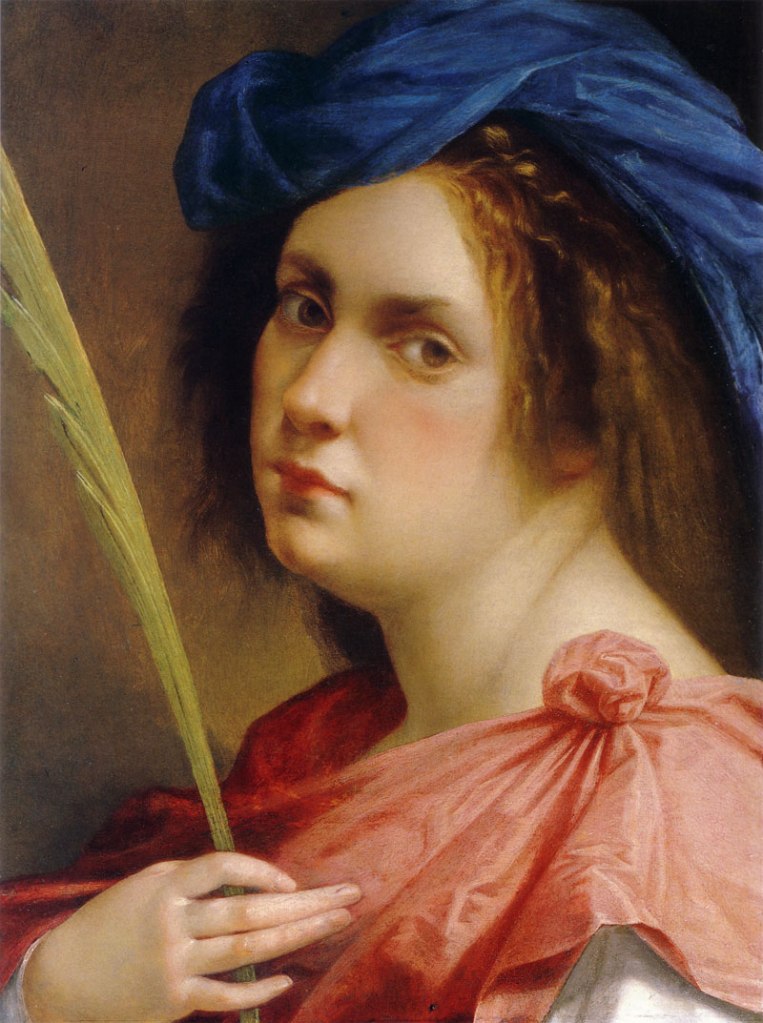
Artemisia Gentileschi’s “Self Portrait as a Female Martyr”
Of all the women artists before the 19th century, perhaps the greatest was Artemisia Gentileschi (1593-1654). Born in Rome, she was the daughter of a noted painter. According to the Getty Center’s website:
Artemesia Gentileschi is known as an ambitious and influential female painter of her time, when female artists were rare. She spread the Caravaggesque style throughout Italy and expanded the narrow possibilities for female artists. Artemesia was taught to paint by her father, Orazio Gentileschi, who painted directly on the canvas and used live models. Her paint-handling in her early works reflects her father’s influence, yet she also departed from him by choosing to paint tense, dramatic narratives with defiant female heroines. In 1612, Artemesia left Rome for Florence, after taking part in a trial against her art teacher, Agostino Tassi, who was convicted of raping her. Shortly after, she painted her interpretation of Caravaggio’s “Judith Beheading Holofernes,” taking a more arresting and gruesome approach to the subject than was common at the time. In the 1620s, Artemesia was living again in Rome, making brief trips to Genoa and Venice and continuing to paint narrative paintings as well as female nudes, a subject avoided by other female artists of the period. In 1630, Artemesia had moved to Naples where her style became less Caravaggesque and her themes turned to more conventional religious subjects. In 1638 Artemesia moved to London to care for ailing father. From then on, her work was less frequent and poorly documented. The last documentation of her was a painting commission dated January of 1654. She may have died in the plague that devastated Naples in 1656.
The self portrait of the painter as a martyr was a testimony to the difficulties she faced as a 17th century painter in what was typically an all-male profession. The painting was done around the year 1615. It was the Getty Center that introduced me to Gentileschi, whom I regard as one of the greatest artists of her time and place.
 Tarnmoor