According to the Baltimore Catechism in which we Catholic schoolkids were drilled in religion class, there are seven types of capital sin. They are:
Pride
Covetousness
Lust
Anger
Gluttony
Envy
Sloth
Conspicuously missing from the list is lying, which seems to me to be the prime sin of the 21st Century. According to the Washington Post, our former president told 30,573 lies during his four years in office. Now we have George Santos (R-NY), who seems unable or unwilling to tell the truth about anything. And it’s not just a Republican vice, though it seems most prevalent in the political world.
I can deal with violations of any of the above mentioned capital sins, but I find myself revulsed by someone who lies to me. None of the seven capital sins affects me as much as lying, which is an offense I feel is directed at me, to deliberately mislead me.
There is something in the voice of American Indian writers that is worth listening to. I have just finished reading Louise Erdrich’s Tracks, and now I have come across this delightful poem by Joy Harjo, a Muscogee Creek who was poet-laureate of the United States:
Desire’s Dog
I was desire’s dog. I ate when I was fed. I did what I was told. I knew how to sit, stand and roll over on command. When I was petted, I was made whole. Even when I dreamed, I dreamed a chain around my neck.
Desire is a bone with traces of fat. It’s the wag smell of a bitch in heat. It’s that pinched hit at the end of a beat. It’s a stick thrown into a rabbit chase.
I lay at the feet of desire for years.
Then I heard this song, calling me. It was a woman in a red dress, It was a man with a gun in his hand. It was a table filled with fruit and flowers. It was a fox of fire, a bird of stone.
I was looking for information on the Internet about Thomas Hardy when I came upon an interesting article on the Paris Review website. The opening paragraphs captured my attention:
Are you enjoying yourself at the moment? Please stop. It’s Thomas Hardy’s birthday, and he will wipe the smile right off your smug, contented, life-affirming face. You’re dealing with a man who knew how to deploy the word Niflheim, defined by the OED as “the region of eternal darkness, mist, and cold inhabited by those who died from old age or illness.” Hardy uses it to dispirited perfection in The Woodlanders, relating a kind of failure to connect: “But he continued motionless and silent in that gloomy Niflheim or fog-land which involved him, and she proceeded on her way.” Actually, The Woodlanders is full of an evocative, despondent murkiness. It extends even to the tiny twigs on the ground, which Hardy takes care to describe as they’re destroyed by a passing carriage: “they drove on out of the grove, their wheels silently crushing delicate-patterned mosses, hyacinths, primroses, lords-and-ladies, and other strange and common plants, and cracking up little sticks that lay across the track.”
Hardy wrote with a special zeal for death, and his sense of the morbid often lapsed into tone deafness. He witnessed two executions when he was a boy—maybe that had something to do with it. One of them was the hanging of Elizabeth Martha Brown, who was convicted of murdering her husband. By his own account, Hardy, then only sixteen, stood close enough to the gallows to hear her gown rustling; the hanging left an indelible mark on him such that seventy years later, in 1926, he could render it vividly in a letter to Lady Pinney, casting Brown’s final seconds in an unmistakably erotic light:
I am ashamed to say I saw her hanged, my only excuse being that I was but a youth and had to be in the town at that time for other reasons … I remember what a fine figure she showed against the sky as she hung in the misty rain, and how the tight black silk gown set off her shape as she wheeled half-round and back.
He added later:
The hanging itself did not move me at all. But I sat on after the others went away, not thinking, but looking at the figure … turning slowly round on the rope. And then it began to rain, and then I saw—they had put a cloth over the face—how as the cloth got wet, her features came through it. That was extraordinary. A boy had climbed up into a tree nearby, and when she dropped he came down in a faint like an apple dropping from a tree. It was curious the two dropping together.
No, it’s not a garden of plants, but rather a sculpture garden, right near one of the turnoffs from U.S. 395 to Panamint Springs and Death Valley. It’s off the side of the road on the left as one heads north on the highway. I’ve noticed it several times on my trips to and through the Owens Valley as I passed through the town of Olancha, just south of Lone Pine.
As soon as Martine’s broken wrist heals, I hope to spend a little time studying the metal sculptures of Jael Hoffmann and photographing them. Unlike most modern sculptures, which leave me cold, I find that Jael’s work sets off little explosions in my head. Really great art does that: It makes you a different person than the what you were a few minutes earlier.
There is an excellent video on YouTube in which the artist is interviewed and discusses several of her sculptures—including most especially the one illustrated above. It is called “Internal Scapes,” which is an accurate description of how they affect me.
An Interview with Jael Hoffmann
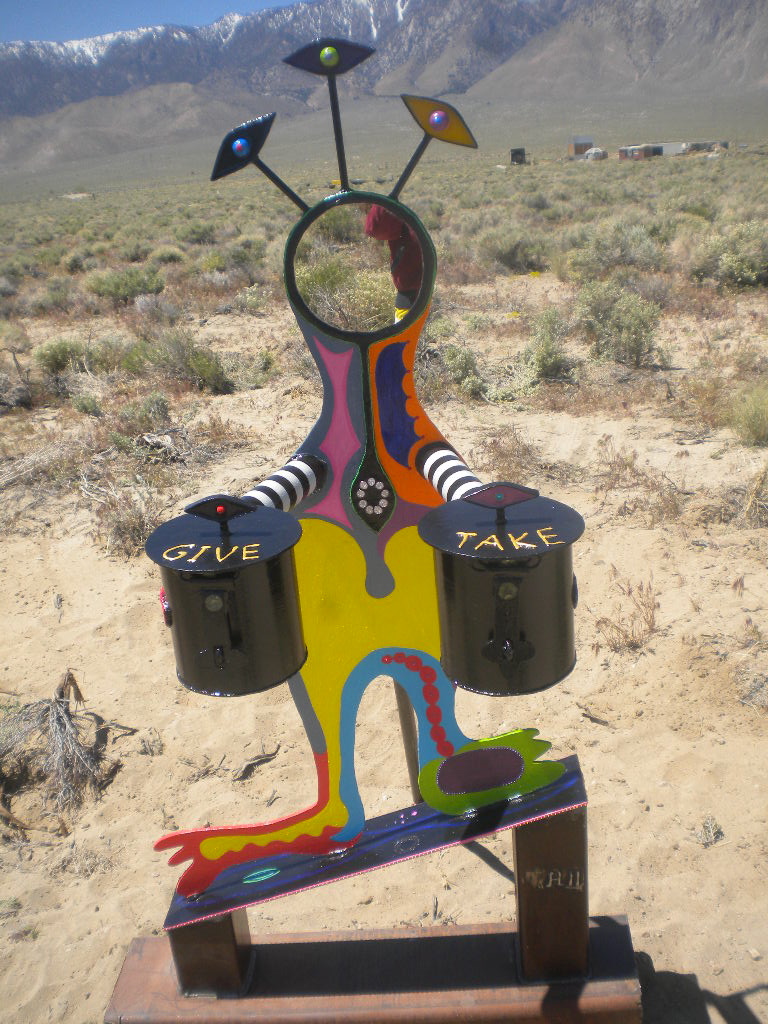
Below is one of her sculptures entitled “Give and Take”: It urges you to donate something in the can marked “Give” and take something from the can marked “Take.” As you examine both cans, your face is reflected in a mirror. Perhaps it will make you feel guilty if you take something without giving.
Jael Hoffmann’s “Give and Take”
Finally, there is another work I like which its creator calls “The Hitchhiker.” All three sculptures shown in this post are discussed in the YouTube video referred to earlier.
Jael Hoffmann’s “The Hitchhiker”
To see more of her work, I suggest you check out Jael’s website at www.jsculpt.com.
Although I still read more novels by far, I have found myself increasingly drawn to the medium of the short story. This evening, I decided to take a quick look at my reading long during the past twelve years. As the period progressed, I noticed myself reading more and more short story collections.
I was surprised to find that there were relatively few women writers whom I thought had mastered the genre. In fact, the only ones who impressed me were Virginia Woolf (no surprise there!), the Argentinian Silvina Ocampo, and—closer to home—Joyce Carol Oates and Shirley Jackson. Why this is I do not know. It could be that they are out there, but to date I am not familiar with their work.
Another surprise was that the United States was well represented, what with writers like Faulkner, Hemingway, Fitzgerald, Poe, Hawthorne, Melville, Stephen Crane, Henry James, J. D. Salinger, Barry Gifford, Philip K. Dick, and Ray Bradbury.
Latin America has some outstanding representatives. Topping the list are Argentina’s Jorge Luis Borges and Mexico’s Juan Rulfo. Not far behind are Roberto Bolaño and Francisco Coloane from Chile, Gabriel García Márquez from Colombia, Adolfo Bioy Casares and Silvina Ocampo (who were married to each other) from Argentina.
Britain gave us Somerset Maugham, George Mackay Brown, G. K. Chesterton, and Graham Greene. In France, there was Guy de Maupassant. From Central Europe there was Franz Kafka and Bohumil Hrabal (Czechoslovakia) and Bruno Schulz (Poland).
The greatest Russian short story writer was Anton Chekhov, but there was also Leo Tolstoy, Varlam Shalamov, and Andrei Platanov.
I have just finished Barry Gifford’s The Cuban Club: Stories, and I find several other story collections in my TBR (To Be Read) pile. I guess I’m hooked.
On Thursday of last week, I spent several hours at the Fowler Museum at UCLA viewing art that is outside the normal art marketplace. According to their website:
The Fowler Museum at UCLA explores global arts and cultures with an emphasis on Africa, Asia, the Pacific, and the Indigenous Americas—past and present. The Fowler enhances understanding and appreciation of the diverse peoples, cultures, and religions of the world through dynamic exhibitions, publications, and public programs, informed by interdisciplinary approaches and the perspectives of the cultures represented. Also featured is the work of international contemporary artists presented within the complex frameworks of politics, culture and social action. The Fowler provides exciting, informative and thought-provoking exhibitions and events for the UCLA community and the people of greater Los Angeles and beyond.
One gallery presented the work of Amir H. Fallah, a Persian-American, in an exhibit entitled “The Fallacy of Borders.” Then there were a number of Jain embroidered hangings from Indian shrines. There were a few Tanzanian paintings from the Tingatinga school left over from a larger exhibit that closed last month. Finally, there was the ongoing exhibit entitled “Intersections: World Arts, Local Lives” which included the following sculpture group from Mexico:
Calavera Sculpture from Mexico
Most of this art was not created for corporate conference rooms or major art museums. Much of it is folk art created to reflect a local culture. Some of it is commercial, but never for the art market of New York or London. All of it is outside European-American culture (except for some aboriginal American art).
When I visit the Fowler or other folk art museums, such as the Museo Mindalae in Quito, Ecuador, I see art that opens up other cultures to me. I am not just seeing another stale work of abstract expressionism created to make money in the New York market. I am seeing something that speaks for a people or for a religion. The result is utterly refreshing.
I hope in the weeks to come to reprise some of the folk art I have seen on my travels.
A week ago, I was reading a back issue of The Times Literary Supplement when I encountered an article that made me sit up straight. A Ukrainian author of some note—Oksana Zabushko—was blaming Russian literature and Russian culture for Putin’s invasion of her country.
While I regard Vladimir Putin personally responsible for the war, I do not go so far as to blame Russia as a country. Even when the man on the street in Petersburg or Moscow appears to back up Putin, I write that off as being careful what to tell a foreign journalist in view of the Draconian punishments in store for those not backing up Putin.
Why blame Dostoyevsky, Tolstoy, Gogol, Pushkin, and Chekhov for an invasion that they would in all likelihood opposed? Ukraine is certainly suffering from the invasion, which is targeting innocent civilians. At the same time, Russia is suffering, perhaps equally, from a war Putin did not expect would drag on for so long. He did not anticipate the disproportionately high Russian casualty rates, the incompetence of his generals, the sudden backbone shown by NATO, the global isolation of Russia from the world economy, and the disinclination of young Russian men to fight the war.
As much as I loathe Putin, I continue to read Russian literature and see Russian films. Although most of my fellow Americans avoid Russian literature like the plague, I think it is one of the great world literatures. Currently, I am reading a book of essays by Polina Barskova about the German siege of Leningrad during World War Two.
When Russia invaded Ukraine last February, I didn’t stop reading Russian literature. Instead, I made a point of adding more Ukrainian literature to my TBR (To Be Read) pile—including Oksana Zabushko herself, who is a pretty good author herself. Even when she makes an error in judgment.
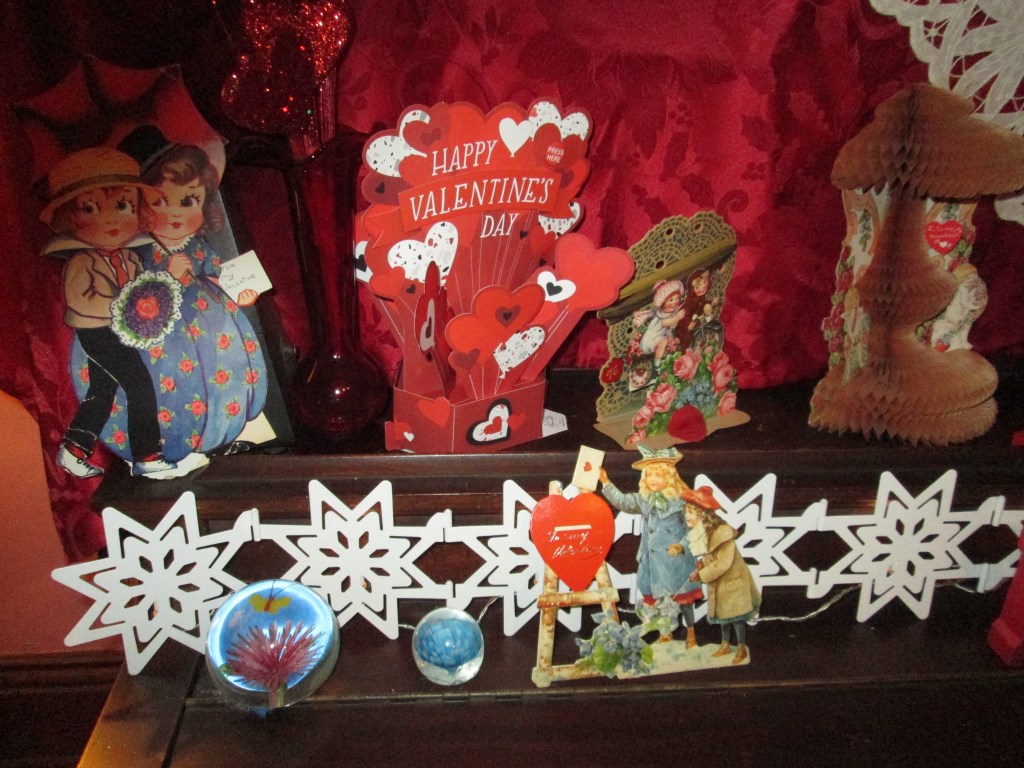
Valentine’s Day Memorabilia at the Grier-Musser Museum
On Sunday, Martine and I stopped in at the Grier-Musser Museum in the shadow of Downtown L.A. to see their Valentine’s Day memorabilia. Of late, Susan and Rey Tejada have been concentrating on paper in the form of old-fashioned images on postcards, greeting cards, and books—especially with pop-up illustrations.
There’s something about seeing this type of material in the Victorian mansion on Bonnie Brae Street that sends you back in time. Afterwards, we sat down with Rey and Susan over cookies and punch and talked for a couple of hours.
Although I got Martine a card for Valentine’s Day, we both decided to go out for lunch on the day after, when we were less likely to run into crowds. So tomorrow we will have a nice English lunch at Ye Olde King’s Head in Santa Monica. It is a great place to have fish and chips or bangers and mash or Cornish pasties. Fortunately, one is not likely to encounter such downmarket English cuisine items as spaghetti sandwiches or baked beans on toast.
Martine and I hope you enjoyed this little gem of a holiday. Why do I call it that? I would rather honor the love I feel than some bogus political or historical event, such as Columbus “discovering” America. After all, wasn’t he met at the beach by the local residents?
When I was a child at St. Henry’s Elementary School in Cleveland, Ohio, I studied in religion class how the holiday began. Apparently there was a Saint Valentine. Actually, there were three of them; the one after whom the holiday was named was called Saint Valentine of Rome. According to the Catholic Online web site: “St. Valentine is the Patron Saint of affianced couples, bee keepers, engaged couples, epilepsy, fainting, greetings, happy marriages, love, lovers, plague, travellers, and young people. He is represented in pictures with birds and roses and his feast day is celebrated on February 14.”
I find it interesting that Valentine is also the patron saint of epilepsy, fainting, and plague. This seems to go against all the lovey dovey stuff, but then that happens fairly frequently with the saints.
When I wish Martine a Happy Valentines Day tomorrow morning, I will of course refrain from bringing up all the negative stuff.
“What is success? It is a toy balloon among children armed with pins”
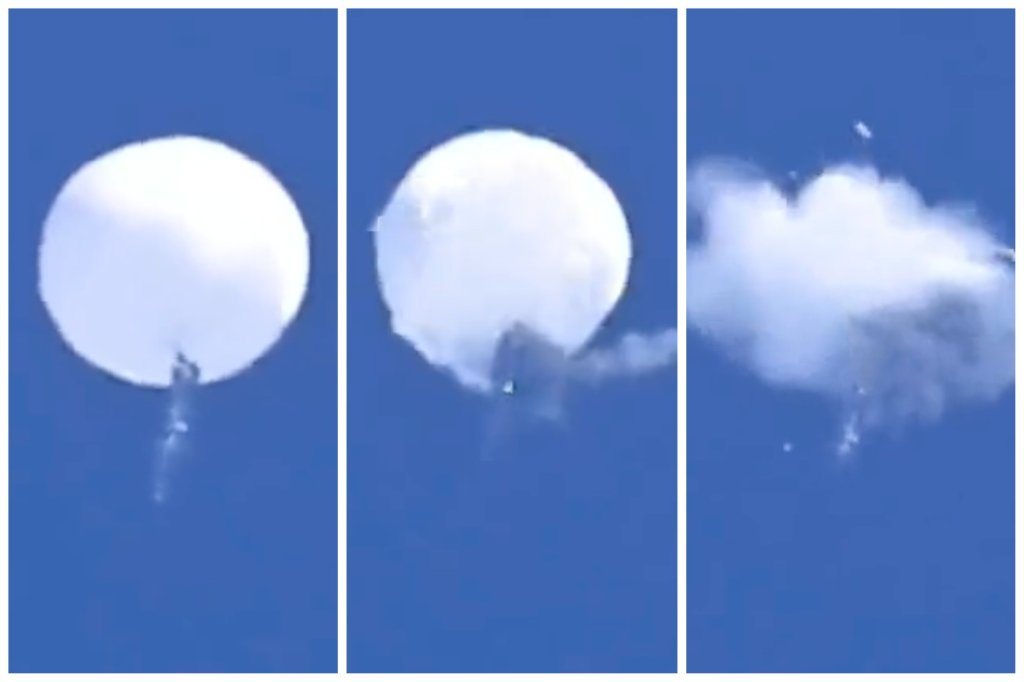
In the last few days, U.S. jet fighters have intercepted four balloons and popped them. Although the military has not officially admitted it, all four appear to be balloons equipped with electronics for spying. It is possible that we will never know, as what they manage to find is probably a military secret.
President Biden’s decision to bring these devices down is in sharp contrast to Trump, who let three or four such devices float over the U.S. during his régime without bringing it to anyone’s attention. Typically, he was full of anti-Chinese bluster—bluster, that did not translate into action.
We know that the Chinese have launched a number of spy satellites. Why, I wonder, did they feel it was necessary to supplement their findings with such a low-tech device as a balloon? Is it possible that their spy satellites did not produce satisfactory information? Were the Chinese balloons self-propelled? Or did they just drift any which where at the mercy of the winds? I doubt we’ll ever know.








You must be logged in to post a comment.