


If one doesn’t vote, then one is exceptionally happy irrespective of who gets elected.
Home » Articles posted by Tarnmoor (Page 34)
Author Archives: Tarnmoor
This Too Shall Pass

Poet Kim Addonizio
Another poet whose work I enjoyed at the Los Angeles Times Book Festival was Oakland poet Kim Addonizio. I remember attending one of her readings back when the L.A. Times Festival was held at UCLA. The following poem is from her collection entitled Exit Opera:
This Too Shall Pass
was no consolation to the woman
whose husband was strung out on opioids.
Gone to a better place: useless and suspect intel
for the couple at their daughter’s funeral
though there are better places to be
than a freezing church in February, standing
before a casket with a princess motif.
Some moments can’t be eased
and it’s no good offering clichés like stale
meat to a tiger with a taste for human suffering.
When I hear the word miracle I want to throw up
on a platter of deviled eggs. Everything happens
for a reason: more good tidings someone will try
to trepan your skull to insert. When fire
inhales your house, you don’t care what the haiku says
about seeing the rising moon. You want
an avalanche to bury you. You want to lie down
under a slab of snow, dumb as a jarred
sideshow embryo. What a circus.
The tents dismantled, the train moving on,
always moving, starting slow and gaining speed,
taking you where you never wanted to go.
The Night the Man with the Watermelon Died

The following is from Jack Kerouac’s Doctor Sax, about his youth in Lowell, Massachusetts. Here he describes a sobering scene in his typical jazzy style:
A man carrying a watermelon passed us, he wore a hat, a suit in a warm summer night; he was just on the boards of the bridge, refreshed, maybe from a long walk up slummy swilly Moody and its rantankling saloons with swinging doors, mopped his brow, or came up through Little Canada or Cheever or Aiken, rewarded by the bridge of eve and sighs of stone—the great massive charge of the ever stationary ever yearning cataracts and ghosts, this is his reward after a long dull hot dumb walk to the river thru houses—he strides on across the bridge—We stroll on behind him talking about the mysteries of life (inspired we were by moon and river), I remember I was so happy—something in the alchemy of the summernight, Ah Midsummer Night’s Dream, John a Dreams, the clink of clock on rock in river, roar—old gloor-merrimac figalitating down the mark all spread—I was happy too in the intensity of something we were talking about, something that was giving me joy.
Suddenly the man fell, we heard a great thump of his watermelon on wood planks and saw him fallen—Another man was there, also mysterious, but without watermelon, who bent to him quickly and solicitously as by assent and nod in the heavens and when I got there I saw the watermelon man staring at the waves below with shining eyes (‘Il’s meurt, he’s dying,’ my mother’s saying) and I see him breathing hard, feeble-bodied, the man holding him gravely watching him die, I’m completely terrified and yet I feel the profound pull and turn to see what he is staring at so deadly-earnest with his froth stiffness—I look down with him and there is the moon on shiny froth and rocks, there is the long eternity we have been seeking.
Fire

“What matters most is how well you walk through the fire.” — Charles Bukowski
Halloween



Jack-O-Lanterns
I would have to say Halloween. You don’t have to eat turkey, which I hate. There is an endless supply of good books and movies with a horror theme—few of which are as sappy as Xmas films. And there’s all that candy. Moreover, sometimes I think that Christmas exists to make you feel guilty for not being 100% perfect.
East Side, West Side
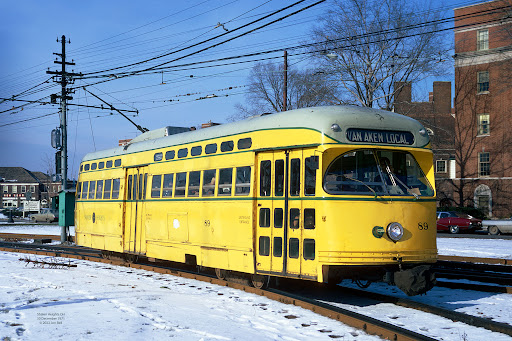
Cleveland’s Shaker Rapid—Way Back When
This was a particularly vivid dream that I had last night. I was visiting in Cleveland, and my mother was still alive. I was wandering the streets of downtown looking for the bus stop of the #71 CTS (Cleveland Transit System) line that went down Pearl Road to York Road, letting me out in Parma Heights where my mother lived.
The stop used to be near the corner of Prospect and Ontario, but in my dream the streets were different; and I didn’t see any bus stops. So I walked to Public Square and around Euclid and Superior Avenues, noting where Schroeder’s Bookstore used to be when I was young.
I gave up and decided to take the Shaker Rapid instead and headed for the concourse under the Terminal Tower.
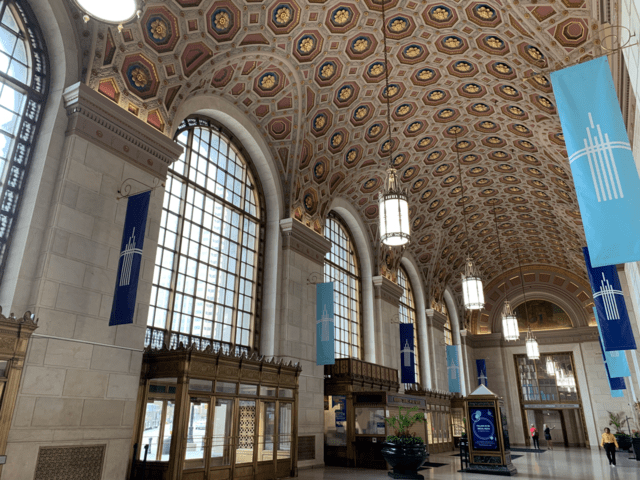
Entrance to the Terminal Tower Concourse
But wait! Mom lived in Parma Heights on the West Side of Cleveland, while the Shaker Rapid served the East Side, where we used to live in the Lee-Harvard area.
My dream ended inconclusively, as I got stuck in a busy store and then had to deal with a Shaker Rapid ticket seller who pointedly ignored me.
It wasn’t a nightmare: I almost never have nightmares. It was just a curious amalgam of my many trips from home to downtown and back again. It was at a point after my childhood after 1985, when my father died. My widowed mother lived alone in Cleveland until she decided to move to Hollywood, Florida, a number of years later.
“Clock In, Clock Out”

Poet Louise Mathias
This past weekend was the annual Los Angeles Times Book Festival, in fact its 30th anniversary. I attended both days, listened to a number of poetry readings, and picked up some interesting books (as if I needed more). I liked the poems of Louise Mathias that she read from her collection, the hauntingly named What If the Invader Is Beautiful. Here is one of her intriguing desert poems:
Bombay Beach
You know someone, somewhere.
A collection of knives, linoleum, unfortunately.
There’s a room now in the chest,
Comprised of a secretive clock—
clock in, clock out. The blonde
unfastens the strap,
sorry human noise
divorced
of song, unlatched now in the palms,
cocaine and ridicule,
but also, love, also.
Below is a picture I shot at Bombay Beach, on the polluted shore of the Salton Sea, when my brother and I visited last year.

Quartzite

Quartzite’s Main Street
On the way to Tucson and on the way back, Martine and I stopped in Quartzite, Arizona. On the way back, we actually spent the night. Why? Enroute to Tucson, we stopped at the Stagecoach Chinese Restaurant and had, respectively, chicken chow mein and kung pao beef. Martine urged me to stop there on the way back as well.
In fact we spent the night in the motor hotel connected to the Stagecoach Chinese Restaurant. (We had decided it was better to take two days to drive the 500 miles (805 kilometers) between Tucson and Los Angeles. And Quartzite was close to the middle of the trip.

The Stagecoach Restaurant and Motel
Quartzite was a strange little town whose residents appeared to be mostly snowbirds living out of their RVs during the winter. There were about 20 RV encampments scattered around the town.
There is a monument in town to one Hi Jolly, a Syrian-born camel driver who was involved with the U.S. army’s attempt in the 1850s to introduce camels into the cavalry posts of the Southwest. After the program fizzled out, Hi became a resident of Quartzite. Today there are numerous statues of camels distributed among many of the local businesses. (See top photo.)
Oh, and by the way, if you like beef jerky as much as I do, I highly recommend Daniel’s Really Good Fresh Jerky. I tried the popular Cowboy flavor and also the Habanero Mango flavor (H-O-T but good). And don’t forget the Chinese food at the Stagecoach.
White Dove of the Desert

The Mission Church of San Xavier del Bac
South of Tucson, visible from I-17, is the mission church of San Xavier del Bac. On Indian land belonging to the Tohono O’odham (Papago) tribe, the church was originally founded by the Jesuit Father Eusebio Kino in 1692 and is the oldest European structure in the State of Arizona, although it has been rebuilt several times. In fact, there is still scaffolding by the church’s entrance.
The mission has been called the White Dove of the Desert. The name fits, as the church’s interior and exterior are nothing short of beautiful.
To get a feeling for the church’s interior, click on this tour of the interior. Just pan the view by moving your mouse to the left or right.
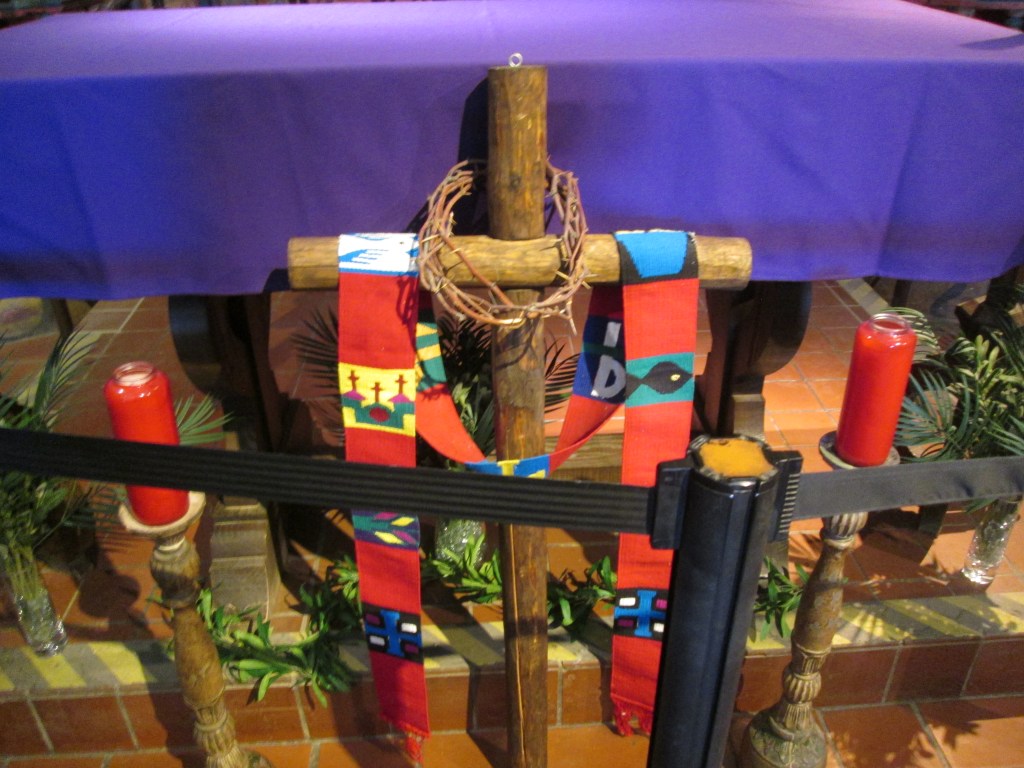
Crucifix with Crown of Thorns and Decorative Papago Cloth
Needless to say, it was another hot day; and I was content to take a pew and ogle the church’s interior. None of the Junipero Serra missions in California could hold a candle to San Xavier del Bac. It is easily worth two or three hours to view the church and its grounds. Afterwords, you can go get some good Indian fry bread at the little cafe just south of the church. (I always like my fry bread topped only with honey.)
Although we had a whole half day of sightseeing left after visiting San Xavier, we ran into some bad luck. We couldn’t visit the Arizona State Museum on the University of Arizona grounds because we could not find anyplace to park. Then, we attempted to visit the International Wildlife Museum on Gates Pass Road, but found it was unaccountably closed.
The Bajada Loop
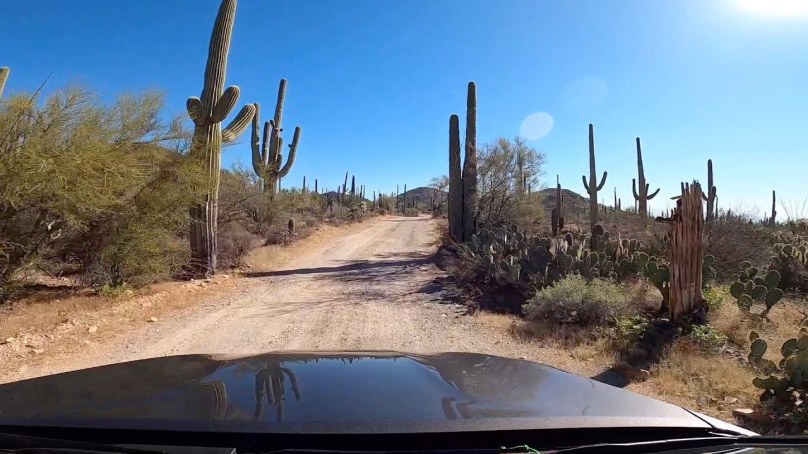
Touring by Car Through the Saguaro National Park West
After spending the early part of a super hot day at the Arizona-Sonora Desert Museum, we stopped at the nearby western portion of the Saguaro National Park. Taking a hike in the oven-like heat was out of the question, so we decided to survive the day with a modicum of comfort.
First, we spent some time at the National Park visitor center viewing the exhibits and a slide show about the Tucson Mountain District portion of the park. Then, with the air conditioner on, with drove the six-mile Bajada Loop. The road was unpaved, but well maintained. The view, especially for the southern part of the loop, was outstanding. The desert floor was crowded with fat, healthy saguaro cacti and other desert flora. Because I was driving, I didn’t take any pictures with my camera—especially as my windows were covered with dirt, smashed insects, and bird poop.
Unfortunately, we didn’t have enough time to see the eastern, or Rincon Mountain District, portion of the Saguaro National Park. No problem: I am not finished with Tucson and would gladly come back, but when the weather was more tolerable.
 Tarnmoor
You must be logged in to post a comment.