Beautiful Soup

When the weather turns cold and it starts to get dark early, I like to cook a nice big pot of soup. It makes me think of Lewis Carroll’s song from Alice’s Adventures in Wonderland:

BEAUTIFUL Soup, so rich and green,
Waiting in a hot tureen!
Who for such dainties would not stoop?
Soup of the evening, beautiful Soup!

Beau- ootiful Soo-oop!
Soo- oop of the e- e- evening,
Beautiful, beautiful Soup!

Beautiful Soup! Who cares for fish,
Game, or any other dish?
Who would not give all else for two
Pennyworth only of Beautiful Soup?
Pennyworth only of beautiful Soup?

Beau- ootiful Soo-oop!
Soo- oop of the e- e- evening,
Beautiful, beauti- FUL SOUP!

But then, Lewis Carroll is talking about turtle soup, and that’s not something I would care to cook, even if it is a Mock Turtle.

Martine used to love my soups, but recently she decided that soup makes her think of being ill. When she gets one of her spells of irritable bowel syndrome, she lives on Progresso’s Chicken with Wild Rice soup and Gatorade.

Needless to say, my home-made concoctions in no way resemble canned soup, even premium canned soup like Progresso.

My most recent creation was a Minestrone with chicken stock, Great Northern Beans (canned), carrots, potatoes, tomatoes, fennel, onions, garlic, and macaroni. Unfortunately, it had one small jalapeño chile pepper who was a good deal higher on the Scovill scale than by rights it should have been. It was almost as hot as a habanero chile.

The soup was still good: It’s just that I had to water it down some so as not to burn my gullet.
Vodka and Zakuski

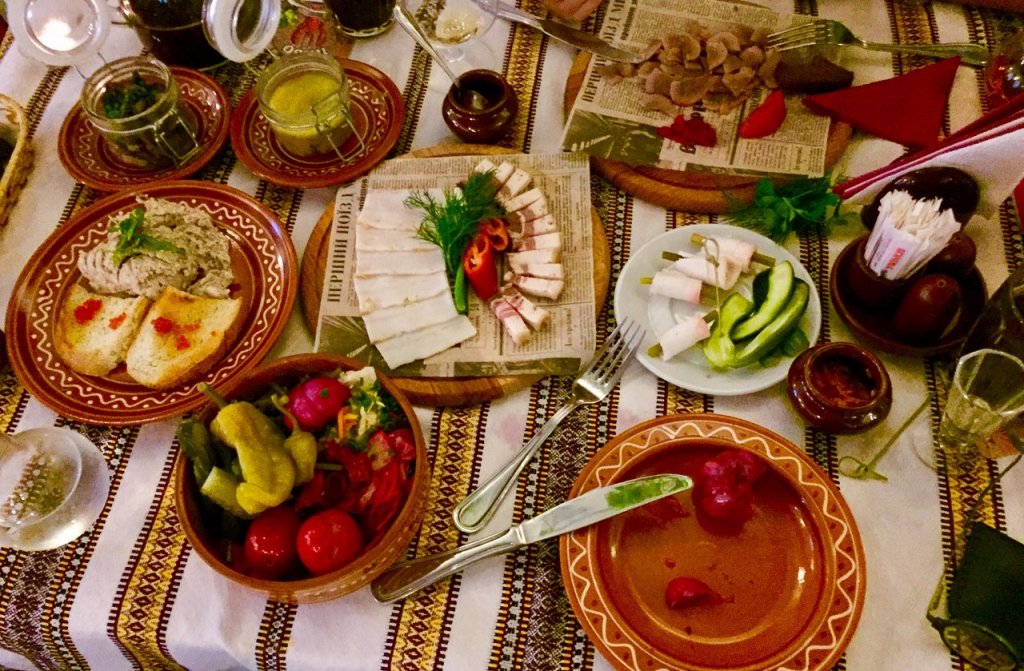
Zakuski: Hors d’Oeuvres to Go with Vodka

It’s a culinary tradition in Slavic countries such as Russia and Ukraine: When you drink vodka, you eat zakuski, which literally means “something to bite after.” It sounds like a delicious culinary tradition. Except for one thing: I’ve never had vodka.

After reading Ukrainian writer Andrey Kurkov’s Jimi Hendrix Live in Lviv (2012), I just might get myself a bottle. Throughout the novel, the characters are dealing with a strange anomaly. The inland city of Lviv has strange incidents of seagulls, starfish, a stench of seaweed, and salt water crabs appearing in various places throughout the city.

Several residents band together to try to identify the problem, which they do after the consumption of a whole lot of vodka and zakuski. Their Lviv is a magical city in which the hand of the late Jimi Hendrix is buried in a local cemetery, having been supplied by the KGB with the help of Lithuanian operatives. Why? Apparently to study the speed of the spreading of rumors in Soviet society.

This is the fifth work of fiction by Ukrainian author Andrey Kurkov that I have read. They are all of them sweet and gentle—especially as they come from a land that is now mired in a brutal invasion by Russian forces. I cannot help but think that Kurkov’s whimsy can be as deadly to Putin’s aims as any weapons in his arsenal. Anyhow, let’s hope so. I have a lot more of Kurkov that I want to read; and I hope he continues to live a long and productive life.

The Opinionator

We all have opinions—in fact, lots of opinions. Some of them are based on actually existing situations, and many are so wrong-headed as to be laughable. And yet, try to go up against someone else’s opinions, and you are likely to make an enemy for life. Attack an opinion, and you are in effect attacking the person who holds it.

I have been wrong about many things. So much so that I tend to regard my opinions as penciled on a scratch pad rather than cut into stone with all capital letters. At age 21, I was all gung-ho for the American participation in the Viet Nam War. I was also a devout Catholic who attended Mass every Sunday. I thought that seafood was terrible (understandable when one was raised on the shores of Lake Erie).

Nowadays, if you impugn any of my opinions, you are likely to be met with a shrug. I do not see an attack on what I believe in as an attack on me. All my friends think some of my opinions are out of line. They’re just different. That’s all.

I look back and find that many of the people I’ve loved in this life held (and still hold) beliefs that were opposed to mine. I guess not everyone I meet is a carbon copy of me. For that I am thankful!

“That First White Age”

Welsh Poet Henry Vaughan (1621-1695)

Bruce Chatwin introduced me to Welsh metaphysical poet Henry Vaughan. This poem goes by the rather clumsy name “Boethius, De Consolatione Philosophiae: Liber 2 Metrum 5.” For a 17th century poem, it is remarkably approachable today.

Happy that first white age when we
Lived by the earth’s mere charity!
No soft luxurious diet then
Had effeminated men:
No other meat, nor wine, had any
Than the coarse mast, or simple honey;
And by the parents’ care laid up,
Cheap berries did the children sup.
No pompous wear was in those days,
Of gummy silks or scarlet blaize.
Their beds were on some flow’ry brink,
And clear spring-water was their drink.
The shady pine in the sun’s heat
Was their cool and known retreat,
For then ’twas not cut down, but stood
The youth and glory of the wood.
The daring sailor with his slaves
Then had not cut the swelling waves,
Nor for desire of foreign store
Seen any but his native shore.
Nor stirring drum scarred that age,
Nor the shrill trumpet’s active rage,
No wounds by bitter hatred made,
With warm blood soiled the shining blade;
For how could hostile madness arm
An age of love to public harm,
When common justice none withstood,
Nor sought rewards for spilling blood?
Oh that at length our age would raise
Into the temper of those days!
But — worse than Etna’s fires! — debate
And avarice inflame our state.
Alas! who was it that first found
Gold, hid of purpose under ground,
That sought out pearls, and dived to find
Such precious perils for mankind!

Stooges Three

Curly, Moe, and Larry in “Three Little Beers” (1935)

For the last quarter of a century, my favorite part of the four-day Thanksgiving weekend was the Three Stooges festival put on by the Alex Film Society in Glendale. It was Martine who found out about it and got me into going with her on the Saturday afternoon after Turkey Day. In the intervening years, we have attended most of the screenings, except for those few times I was off to Mexico or South America at the time.

Of course, part of Martine’s interest in the festival are two of her favorite chicken restaurants in Glendale: Sevan Rotisserie Chicken and Elena’s Greek Armenian Kitchen. I am not a great lover of chicken, but I do love to see Martine happy.

When I was growing up, I started liking the Stooges; and I distinctively remember owning a 3-D Stooges comic book. But then, as my little brother Dan (who is six years younger than me) started liking the stooges, I decided they were too downmarket for me and disparaged them at every opportunity.

Now I appreciate the comics and marvel at their long career and the fact that they survived several deaths in the troupe. When Curly became ill in 1946, Moe and Curly’s brother Shemp took over without any diminution in the quality of the films. After Shemp died in 1955, he was followed by Joe Besser and Joe DeRita, who were not quite up to the mark.

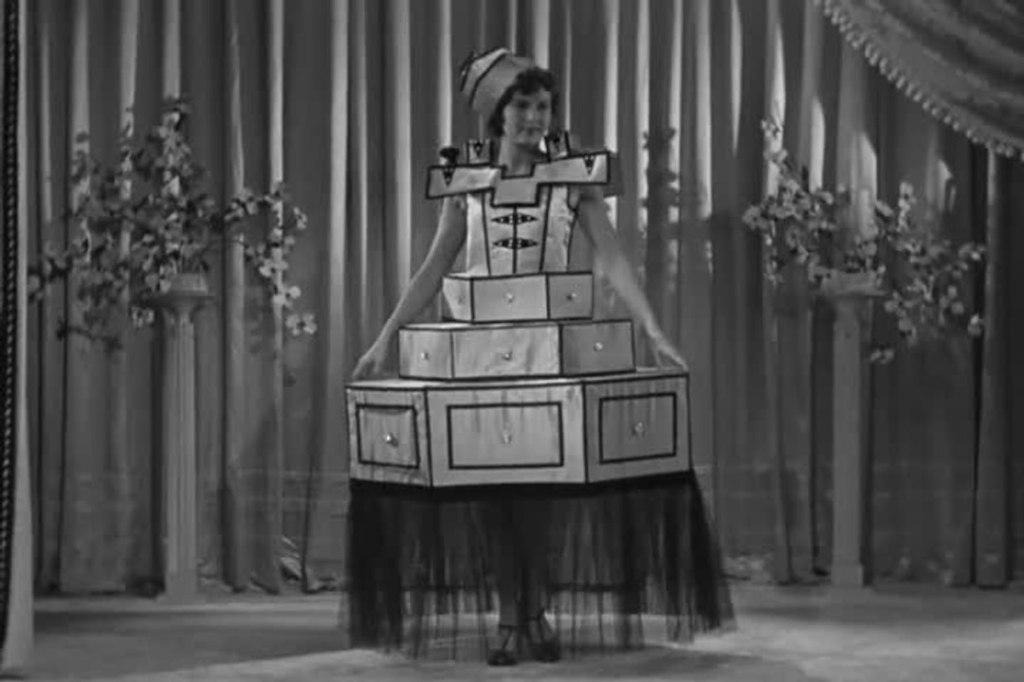
The best of the six Stooges shorts I saw yesterday was “Slippery Silks” (1936) in which the boys inherit a fancy women’s clothing boutique and put on the most cockeyed fashion show imaginable.

Fashion Model in “Slippery Silks”

The still above is explained by the fact that, before inheriting the dress shop, the stooges were carpenters who accidentally destroyed a priceless Chinese antique wooden box. I guess they still had their carpentry background in mind.

In any case, I laughed uproariously throughout the two hour screening.

Devoirs

Yay! I Survived Turkey Day!

Of course, it was nowhere near so bad as I imagined it would be. I tend to get a bit crotchety about holidays. They tend so often to make for bad feelings because there are all those things one has to do to make for the perfect holiday. If it turns out to be less than perfect, one is floored by feelings of inadequacy.

The French have a word for it: devoirs. Check out the Alpine French School website for a discussion of the different meanings of the term, particularly the second meaning. The devoirs for Thanksgiving include:

  • A turkey dinner with mashed potatoes, green bean casserole, cranberry sauce, pumpkin pie, etc etc etc
  • Getting together with as many of your family that you can sit around your dining room table
  • Discussions about politics with that uncle with whom you do not wish to converse

If you think that’s a lot, let’s take a look at thge many devoirs pertaining to Christmas:

  • Expensive and thoughtful gifts for everyone
  • A tree in the living room with ornaments, tinsel, and lights
  • Multi-colored lights festooning the front of your house
  • Maintaining harmful myths about Santa and elves to your underage children
  • Sending Christmas cards to family, friends, acquaintances, and just about everyone else

Just remember one thing: You don’t have to buy into all the “oughts” connected with the holidays. Your more conventional friends will probably think you a bit of a Grinch. Note, however, that it is better to be thought a Grinch than to be depressed and broke.

I took Martine out to Cafe 50s so she could have her Thanksgiving turkey, while I, of course, ordered something other than bird. She also had her favorite Hawaiian Tropic milk shake, so she is quite pleased with our quasi-celebration of the holiday.

The Man Who Killed Thanksgiving

The Famous 1975 Cartoon by Ron Cobb About Thanksgiving

Even back in 1975 when I saw the famous R. Cobb cartoon depicting a family saying grace over a Thanksgiving turkey while the ground beneath them is littered with the bones of massacred Indians. Of course, even back then I didn’t like Thanksgiving. I had too many memories of dry bird carcasses drenched in fat to make them palatable.

Curiously, we never had Thanksgiving turkey at home. Turkey just wasn’t a Hungarian meat; and my father, like me, didn’t want my Mom to ever cook any. So we always went out for Thanksgiving.

The whole nonsense about the Pilgrims making nice with the Indians before wiping them out in King Philip’s War and other conflicts. The holiday is based on a myth designed to make us feel good about violently supplanting the indigenous peoples of the New World. If you want to get a more balanced picture of what happened, I suggest you read Eduardo Galeano’s trilogy entitled Memory of Fire. I read all three volumes in the 1980s, which served only to solidify my dislike of the holiday.

On this and many other issues, I find myself in the minority. So enjoy your dry bird. And think of all the football games you can watch this weekend!

By the way, Martine loves turkey; so I’ll be taking her out for a turkey dinner tomorrow. Needless to say, I will order something else.

Smouldering in the Dunes

Zendaya as Chani in Dune 2

To begin with, I am a big fan of Frank Herbert’s novel Dune and the three feature films based on it: David Lynch’s Dune (1984) and Denis Villeneuve’s Dune: Part One (2021) and Dune: Part Two (2024).

Recently HBO has been screening Dune: Part Two almost daily, so I have seen the film a number of times. Although Timothée Chalamet is the acknowledged star of the film, I have been increasingly drawn to Zendaya’s portrayal of Chani Kynes, the Fremen Sayyadina and concubine of Paul Muad’Dib Atreides. In fact, I think the film revolves more around her reaction to Muad’Dib and his assumption of the role of Kwisatz Haderach than to Muad’Dib’s military exploits.

Chani clearly loves Paul, but she doesn’t buy into the myth that is being built up around him. And when Paul decides to take Princess Irulan, daughter of Emperor Shaddam IV, as his bride. She wanders off alone into the desert while her love moves on to an imperial role.

During all of Dune: Part Two, she is seen as smouldering with blazing eyes during all the stages of Paul’s transformations. Chalamet does a good job acting the role of Paul, but Zendaya is almost crazy good, like one of the great silent actresses with her full range of expressions.

This is in marked contrast to Sean Young’s portrayal of Chani in the 1984 Dune, which was one of the major weaknesses of the David Lynch version as released.

The End of Coat and Tie

What Ever Happened to Men’s Coat and Tie Fashions?

Up until the 1960s, the wearing of coat and tie, and usually a white shirt, was de rigeur for American men. When I started working on my first full-time job around 1968, I noticed for the first time that men were no longer 100% certain to wear a coat and tie to the office. What happened?

From the point of view of Los Angeles, I noticed the weather slowly started heating up, such that the traditional wool men’s uniform tended to be on the uncomfy side during warm weather.

When I started working in an accounting office in 1992, we were all required to wear a coat and tie every day. It was only a few years later that it was no longer required, even when clients were due to visit our offices. By the 2000s, I rarely had to wear a tie, except perhaps when I had to visit a client’s premises.

I watch a lot of noir films of the 1940s and 1950s, which makes me particularly aware of changes in the way men dress today as compared to then.

This evening I watched two Humphrey Bogart films that showed the star in a flashy dark suit in both The Maltese Falcon (1941) and The Big Sleep (1946). Whether playing Sam Spade or Philip Marlowe, Bogie looked ready for the big time even as he was supposed to be a cheap detective in a not-too-swank office. In the latter film, he even carried a pocket flask full of rye.

Was it climate change that doomed the wool suit? Or was it the swinging 1960s and 1970s that made casual a viable option? Probably it was a combination of the two.

The Wild Blue Yonder

One of Several Hangars at the Palm Springs Air Museum

The Coachella Valley is a prime location for an aircraft museum if for no other reason than many former military and civilian pilots retired there. As a result, the museum is unusually well staffed and equipped with planes and flying paraphernalia.

Last Monday, I visited the museum for the third time. I was happy to see that they had a new temporary hangar for a Lockheed SR-71 Blackbird, which holds three records for speed at Mach-3 and above. Developed by Lockheed’s famous Skunk Works in Burbank, California, the SR-71 proved so useful that it was brought out of retirement twice.

SR-71 at the Palm Springs Air Museum

Of all the tourist sights in the Valley, I think the best two for children are the Living Desert in Palm Desert and the Palm Springs Air Museum. Never have I seen children so attentive as they viewed the exhibits. And, speaking as an adult, I found myself pretty attentive too.

Afterwards, my brother and i ate a great Mexican lunch at the San Miguel Taqueria on Ramon near Thousand Palms.