For over a decade, I have tackled one or two works of horror literature during the month of October. In the past, most of these were collections of horror stories in the excellent collections put out by Dover Publications, but I am coming to the end of these; so I am branching out a bit.
This month, I have read two collections: Amelia B. Edwards¹s The Phantom Coach and Other Stories and Thomas Ligotti’s Noctuary. Ms Edwards (1831-1892) was not only an excellent teller of tales, but also a world traveler, journalist, and—to add a touch of the weird—an early Egyptologist of some note. I have downloaded her book A Thousand Miles Up the Nile from Amazon Kindle to read sometime next year.
Thomas Ligotti, on the other hand, is a contemporary, born in 1953. I had previously read two of his collections—Songs of a Dead Dreamer and Grimscribe: His Lives and Works—and found them satisfyingly eldritch in every way. The same could be said of Noctuary, which I loved. In fact yesterday’s post on this blog site was a short short story entitled “One May Be Dreaming” from Noctuary in its entirety. Click on the link to check it out.
For Halloween, I’ve decided to excerpt as short short story in its entirety from Thomas Ligotti’s excellent collection entitled Noctuary.
One May Be Dreaming
Beyond the windows a dense fog spreads across the graveyard, and a few lights beam within hazy depths, glowing like old lamps on an empty street. Night is softly beginning.
Within the window are narrow bars, both vertical and horizontal, which divide it into several smaller windows. The intersections of these bars form crosses. Not far beyond the windowpanes, there are other crosses jutting out of the earth-hugging fog in the graveyard. To all appearances, it is a burial ground in the clouds that I contemplate through the window.
Upon the window ledge is an old pipe that seems to have been mine in another life. The pipe’s dark bowl must have brightened to a reddish-gold as I smoked and gazed beyond the window at the graveyard. When the tobacco had burned to the bottom, perhaps I gently knocked the pipe against the inside wall of the fireplace, showering the logs and stones with warm ashes. The fireplace is framed within the wall perpendicular to the window. Across the room are a large desk and a high-backed chair. The lamp positioned in the far right corner of the desk serves as illumination for the entire room, a modest supplement to those pale beacons beyond the window. Some old books, pens, and writing paper are spread across the top of the desk. In the dim depths of the room, against the fourth wall, is a towering clock that ticks quietly.
Those, then, are the main features of the room in which I find myself: window, fireplace, desk, and clock. There is no door.
I never dreamed that dying in one’s sleep would encompass dreaming itself. I often dreamed of this room and now, near the point of death, have become its prisoner. And here my bloodless form is held while my other body somewhere lies still and without hope. There can be no doubt that my present state is without reality. If nothing else, I know what it is like to dream. And although a universe of strange sensation is inspired by those lights beyond the window, by the fog and the graveyard, they are no more real than I am. I know there is nothing beyond those lights and that the obscured ground outside could never sustain my steps. Should I venture there I would fall straight into an absolute darkness, rather than approaching it by the degrees of my dying dreams.
For other dreams came before this one—dreams in which I saw lights more brilliant, a fog even more dense, and gravestones with names I could almost read from the distance of this room. But everything is dimming, dissolving, and growing dark. The next dream will be darker still, everything a little more confused, my thoughts … wandering. And objects that are now part of the scene may soon be missinfg: perhaps even my pipe—if it was ever mine—will be gone forever.
But for the moment I am safe in my dream, this dream. Beyond the window a dense fog spreads across the graveyard, and a few lights beam within hazy depths, glowing like old lamps along an empty street. Night is softly beginning.
Because Martine and I usually eat at different times, there is a pile of Lonely Planet guidebooks at my right elbow on the kitchen table. Recently I picked up the Lonely Planet guide to Thailand and have been devouring it with interest.
I have never been to Asia, mostly because of the language barrier. In Thailand, the language barrier is even more pronounced because they have their own alphabet, which resembles tightly circumscribed insect tracks. Despite the difficulty, I find their culture fascinating—not to mention their cuisine!
It’s fun to fantasize about future trips, even if one never takes them. In fact, you can call me an armchair traveler who just happens to have visited some fascinating places around the world in Europe and the Americas. Martine seems to be uninterested to joining me in any distant travel (unless it be to Hawaii and, perhaps, Canada); so I would have to go it alone.
As long as I am physically able to travel, I would be happiest if I were able to indulge in my wanderlust. Right now, the biggest problem is not health, but lack of money.
The Taoist sage Lao Tzu (floruit BCE 500), author of the Tao Te Ching, is one of those figures at the nexus of three great religions: Taoism, Buddhism, and Confucianism. Below is Sam Hamill’s translation of the second section of the Tao Te Ching, as printed in the Shambala Library edition of The Poetry of Zen:
Beauty and ugliness have one origin. Name beauty, and ugliness is. Recognizing virtue recognizes evil.
Is and is not produce one another. The difficult is born in the easy, long is defined by short, the high by the low. Instrument and voice achieve one harmony. Before and after have places.
That is why the sage can act without effort and teach without words, nurture things without possessing them, and accomplish things without expecting merit:
only one who makes no attempt to possess it cannot lose it.
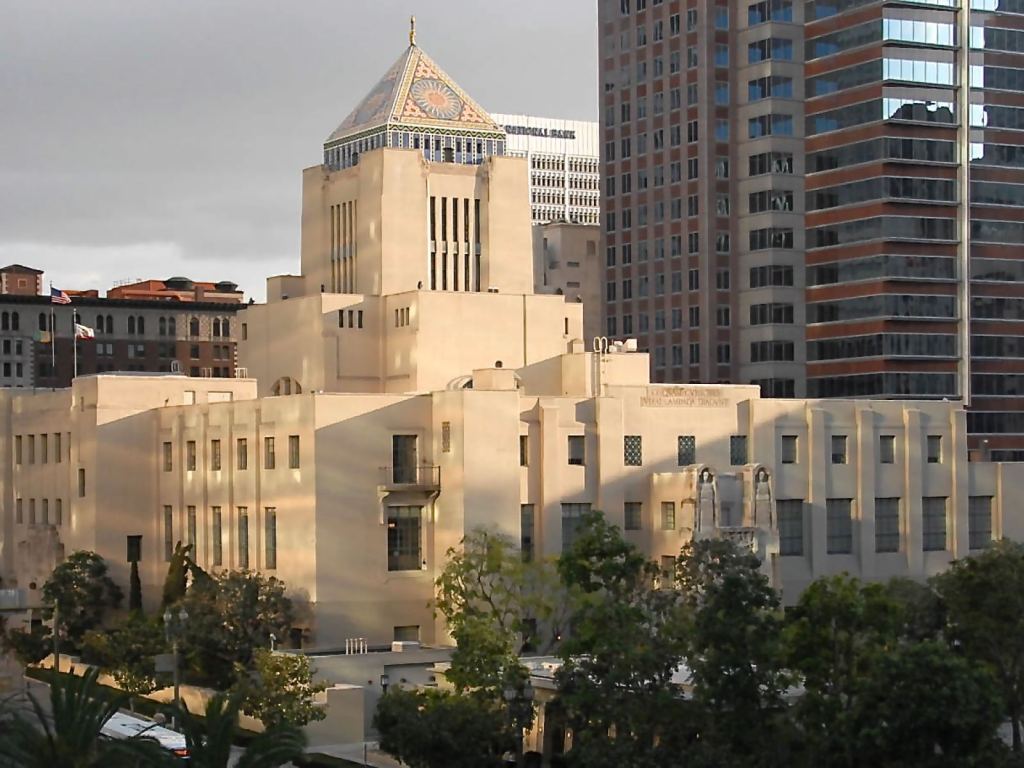
The Los Angeles Central Library at 5th and Flower Streets
Four years after the Covid lockdown put it on hold, seemingly permanently, the Central Library has restarted the guided mindful meditations on Thursday afternoons at 12:30. The meditations are conducted under the auspices of UCLA Health’s Mindfulness Education Center.
Today I attended for the third straight week and hope to continue. I find that the guided meditations ground me. Instead of endlessly planning the future or being swept up by my unfulfilled desires, I ground myself in the present. There is time for planning and for desires, but it helps first to immerse yourself in what I call the “isness” of your being.
This form of meditation is not connected with any religion or even any culture. It is presented solely as a discipline to free your mind from endless distractions. There is no required lotus position or any other position. You merely have to sit or lie down comfortably.
If you want to get a feel for what this is like, you can select one of the following prerecorded guided meditations from your computer, or select from a list from the UCLA Mindful website:
Many a times when, while trying to sleep, my mind is swirling around with plans for the next day or frustrations or unfulfilled desires, I’ve found the practice of meditation helps me drift off to sleep.
As we head toward the culmination of another anxious election season, I suddenly had an inkling of what could happen. Donald Trump has always relied on rallies where he speaks with a bigly group of mostly young supporters with posters and MAGA hats at his back.
These rallies vaguely resemble the rallies that Trump’s hero, Adolph Hitler, staged in the 1930s. Of course, they couldn’t hold a candle to the giant 1935 rally in Nuremberg which was filmed by Leni Riefenstahl and released under the title Triumph of the Will. Now that was a real rally, with over 700,000 supporters in attendance.
Hitler Rally in Nuremberg 1935
The thought came to me that the whole Trump moment in American history will end badly. The electorate is largely made up of two groups:
People who hate Trump with a passion
People who idolize Trump with a passion (but who will come to hate him when they wake up and find out they have been used)
What I think will happen at some future date is that those faces at MAGA rallies will become a mark of shame, and that people will scan photographs of the rallies with magnifying glasses to find neighbors they could blame for their predicament, which will probably get worse over time. (Even if it doesn’t, the voters will think that.)
I look at cars that bear political bumper stickers and think, “What happens if they park their car in a neighborhood which is strongly ‘anti-’ their candidate?” That’s one of the reasons my car is devoid of bumper stickers and decals.
In this election season, with all those overweening ambitions in play, I like to think of Percy Bysshe Shelley (1792-1822) and his poem “Ozymandias.” Can you guess why?
Ozymandias
I met a traveller from an antique land Who said: “Two vast and trunkless legs of stone Stand in the desert . . . Near them, on the sand, Half sunk, a shattered visage lies, whose frown, And wrinkled lip, and sneer of cold command, Tell that its sculptor well those passions read Which yet survive, stamped on these lifeless things, The hand that mocked them, and the heart that fed: And on the pedestal these words appear: ‘My name is Ozymandias, king of kings: Look on my works, ye Mighty, and despair!’ Nothing beside remains. Round the decay Of that colossal wreck, boundless and bare The lone and level sands stretch far away.”
The following short short story is from a collection of Antonio Tabucchi’s short stories entitled Message from the Shadows. The author, an Italian who lives in Portugal, is known for his diverse points of view, In this story, we see humanity from the perspective of a whale.
Postscript: A Whale’s View of Man
Always so feverish, and with those long limbs waving about. Not rounded at all, so they don’t have the majesty of complete, rounded shapes sufficient unto themselves, but little moving heads where all their strange life seems to be concentrated. They arrive sliding across the sea, but not swimming, as if they were birds almost, and they bring death with frailty and graceful ferocity. They’re silent for long periods, but then shout at each other with unexpected fury, a tangle of sounds that hardly vary and don’t have the perfection of our basic cries: the call, the love cry, the death lament. And how pitiful their lovemaking must be: and bristly, brusque almost, immediate, without a soft covering of fat, made easy by their threadlike shape, which excludes the heroic difficulties of union and the magnificent and tender efforts to achieve it.
They don’t like water, they’re afraid of it, and it’s hard to understand why they bother with it. Like us, they travel in herds, but they don’t bring their females, one imagines they must be elsewhere, but always invisible.
Sometimes they sing, but only for themselves, and their song isn’t a call to others, but a sort of longing lament. They soon get tired and when evening falls they lie down on the little islands that take them about and perhaps fall asleep or watch the moon. They slide silently by and you realize they are sad.
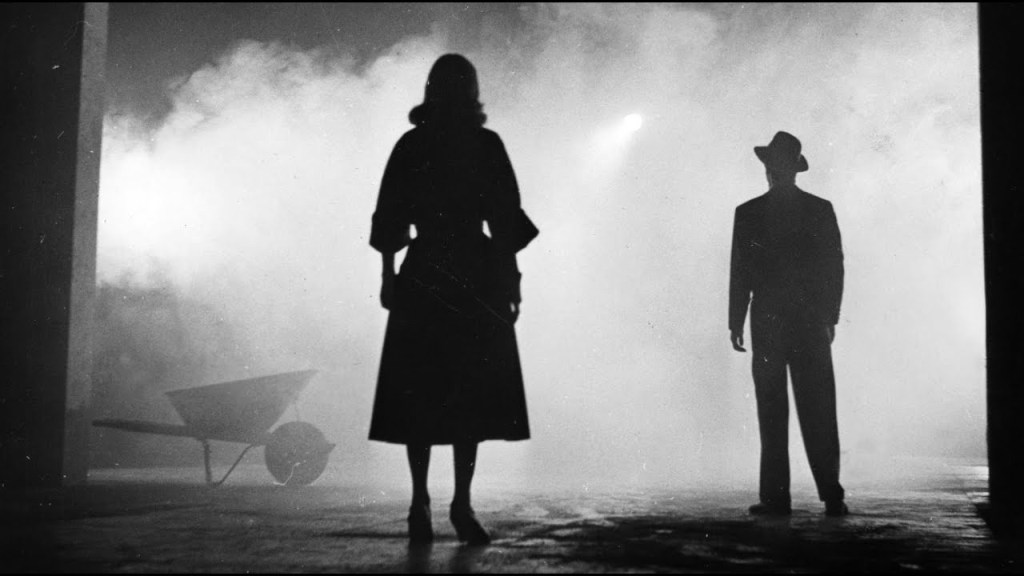
One of the great visual artists of the American film was John Alton (1901-1996), a cinematographer famous for the visual style of some of the best noir films. Born Johann Jacob Altmann in Sopron, Hungary, Alton was instrumental in creating a look across the films of different directors at different studios that became a quintessential characteristic of an entire American genre.
As he wrote in his book Painting with Light:
The director of photography visualizes the picture purely from a photographic point of view, as determined by lights and the moods of individual sequences and scenes. In other words, how to use angles, set-ups, lights, and camera as means to tell the story.
John Payne in Robert Florey’s The Crooked Way (1949)
In an otherwise unremarkable film I saw last night on Turner Classic Movies (TCM), Alton’s work lifted the film up to an entirely different level. United Artists’ The Crooked Way was a tale of a war hero amnesiac who, on investigating his pre-war life, finds he was a criminal. Alton’s images of Los Angeles, including a bail bond shop, a night club, and a war surplus warehouse made the film a feast for the eyes.
Still from Anthony Mann’s T-Men (1947)
Even in a movie shot for a poverty row studio like Eagle-Lion Pictures, Alton was superb. Of course, it helped that the director was Anthony Mann, whose noir credentials are impeccable.
To see a list of the noir films Alton photographed, check out this website and scroll halfway down for a list of eighteen of his noir masterpieces.
And just to demonstrate his versatility, Alton was also superb in working with color, such as in Allan Dwan’s Slightly Scarlet (1958) and Stanley Donen’s musicasl with Gene Kelly, An American in Paris (1951)










 Tarnmoor
You must be logged in to post a comment.