Beigli

Hungarian Ground Walnut and Poppy Seed Rolls (Beigli)

Hungarian Ground Walnut and Poppy Seed Rolls (Beigli)

Today was a combined Spring Festival and Mother’s Day Celebration at the San Fernando Grace Hungarian Reformed Church in Reseda.Martine and I always show up the first Sunday in May to help relieve the parishioners of their excellent home cooked food. Available was gulyás leves (better known as Hungarian Goulash, actually a beef and vegetable soup), Hungarian kolbasz sausage with red cabbage, barbecued pork (laci pecsenye), and langos (a fried bread concoction that Hungarians go gaga over). But the starring attraction were the many varieties of pastries, especially a type of custardy cheesecake not quite as sweet as the deli variety, and, of course, beigli.

When I was a kid in Cleveland, it was the beigli with ground walnut that I most particularly remembered. My Mom made it at least once a week, together with the ground poppy seed variety which I did not like nearly as much Although Martine made major inroads on the pastry table, including several varieties to take home, for the first time I passed up sampling any. I know what it tastes like. I love it. But I have Type 2 Diabetes and am fighting a difficult battle.

Still, we had a good time, watching a recitation, singing, and dancing presentation on the subject of Mother’s Day. Then, the local dancing master, Tibor, showed couples how to dance the csardás, the most famous of the Magyar folk dances.

Finally, there was a literary event in which the author of a book on the 1956 Hungarian Revolution had two reciters read passages about how he fled Budapest to Yugoslavia and finally settled in the United States. I didn’t understand very much, as my Hungarian is quite rudimentary, and both the book and the recitation were mostly above my head. Still, it’s good for me to reacquaint myself with my native tongue, however much I stumble my way through it.

Bad Luck With Restaurants

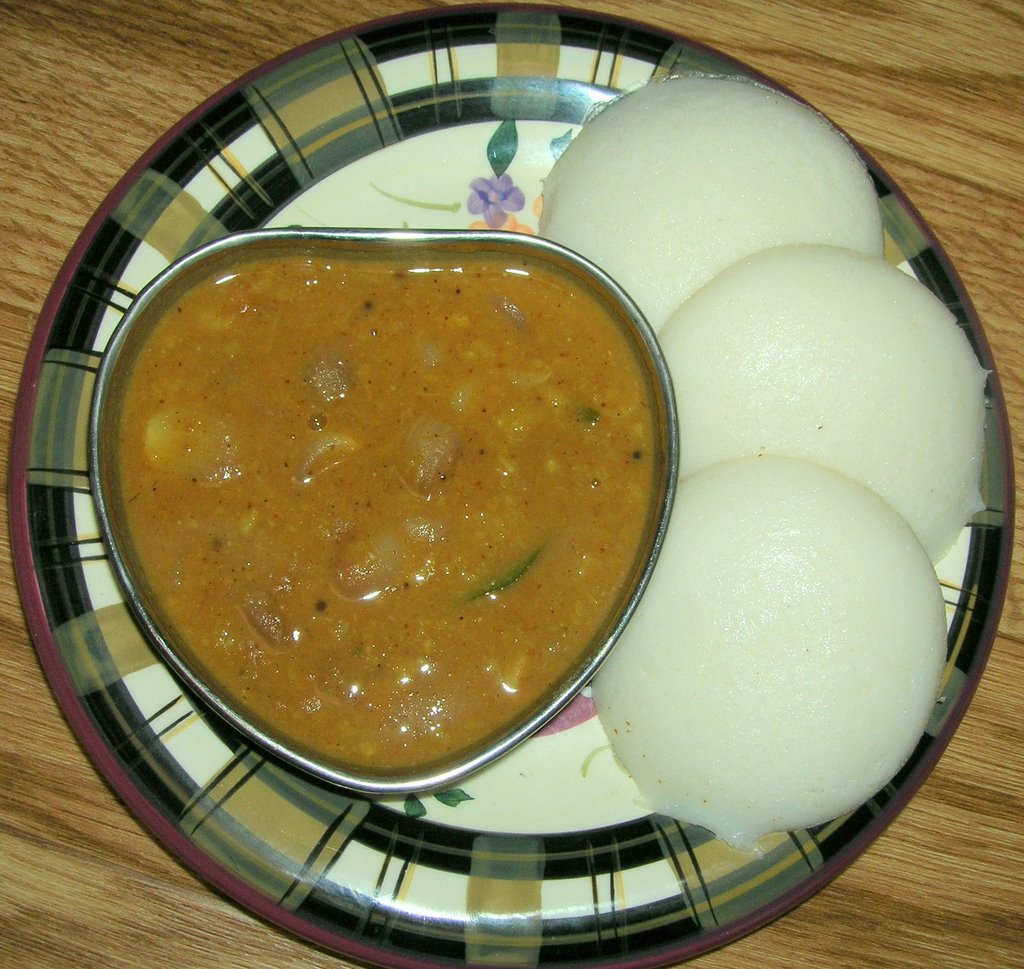
Sambar and Idlis

Sambar and Idlis

Los Angeles has its very own India community in Artesia, just off the Pioneer Blvd. exit on he 91 Freeway. Martine and I decided to eat lunch there and shop at the nearby Stater Brothers Supermarket. So we went to Woodlands Restaurant, which specializes in South Indian (or, to be even more specific, Keralan) cuisine. I knew I was taking a chance with Martine, because she prefers standard North Indian cuisine. While I was having a great meal with sambar (a kind of spicy vegetarian soup) and idlis (little rice “flying saucers”) and a tasty glass of salt lassi, Martine was trying all the dishes that worked for her at her favorite North Indian restaurants. Unfortunately, it didn’t work for her here: the chicken was cold, the rice pudding was hot and watery, and so on and so forth.

Add to that the fact that, not being a cook and having any real food sense, Martine usually has difficulties in the dishes she selects at restaurants. At any given restaurant—and only if she were well familiar with it—she will typically select only one, or at the most two, dishes. Since I have more food smarts, I can usually please myself at places she winds up hating. It’s a pity, because I would like to go back to Woodlands one of these days to try their uppamav, a delightful South Indian dish made with Cream of Wheat!


So You Think It’s Good for You?

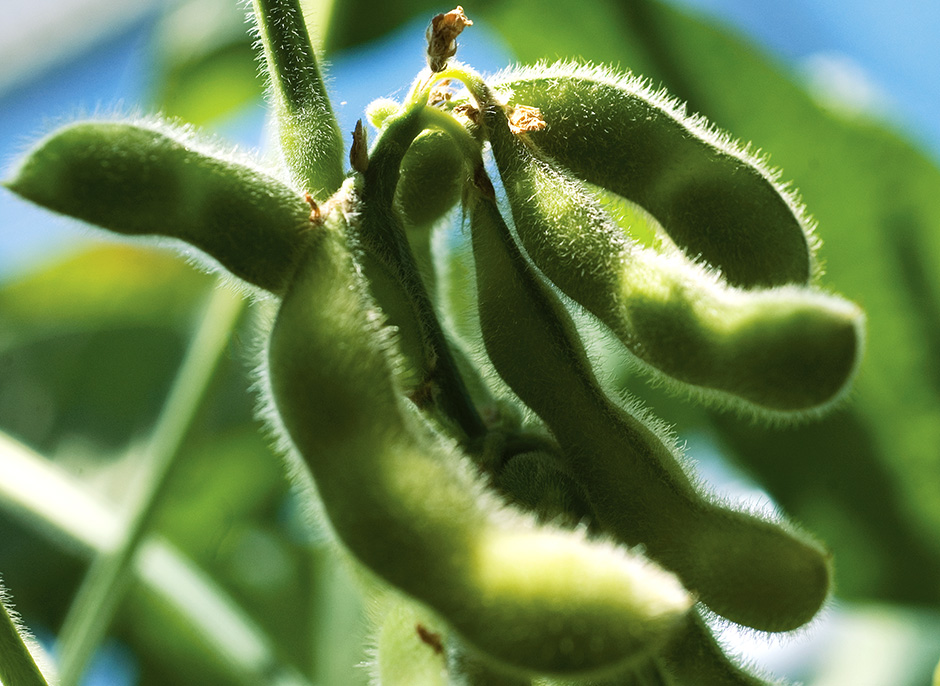
Soybeans

Soybeans

Unfortunately, we Americans tend to pay far too much attention to the news media, not only when it comes to straight news, but also feature stories about food and health. We’ve all seen the stories: Avoid ill health by drinking sugarless sodas, followed by how artificial sweeteners are worse for you than sugar. For decades, articles are trumpeted the benefits of protein from soybeans. Now there are an equal number of articles blaming soy for feminizing men by giving them man-boobs.

The number of news villains in our diet have included eggs, fats, tomatoes (long ago thought to be poisonous), cheeses, and smoked meats. I am reminded of the scene in Woody Allen’s film Sleeper (1973) in which two doctors are discussing Miles Monroe (played by Woody):

Dr. Melik: This morning for breakfast he requested something called “wheat germ, organic honey and tiger’s milk.”

Dr. Aragon: [chuckling] Oh, yes. Those are the charmed substances that some years ago were thought to contain life-preserving properties.

Dr. Melik: You mean there was no deep fat? No steak or cream pies or… hot fudge?

Dr. Aragon: Those were thought to be unhealthy… precisely the opposite of what we now know to be true.

Dr. Melik: Incredible.

Maybe deep fat, steak, cream pies, and hot fudge are bad for you, but I have my suspicions about wheat germ, organic honey, and tiger’s milk—which may be no better.

I have come to the conclusion that the best thing to do is to not get into a food rut. A bad food rut can include salads just as much as it could include cheeseburgers and fries. Eat meat. Eat eggs. Eat fruit. Eat vegetables. But know this: There are no magic foods that will cure what ails you. That is pure snake oil.


The Squid Test

Not the Loveliest of Sea Cretaures

Not the Loveliest of Sea Creatures

If lots of different categories of foods fail to pass your “Yuck!” test, it’s fairly certain that squid is on your “avoid at all costs” list. It’s a pity, because most people have never had any really fresh squid. They’re used to those rubbery breaded rings served with a generic tomato dipping sauce at some restaurants with pretensions to high class.

Today, I went to a new Italian restaurant in Westwood called the Donna Sophia Trattoria Napoletana and decided to give them the squid test. Their daily special was tagliatelle cooked in squid ink with calamari. I had never tried anything cooked in squid ink before, but I was feeling decidedly peckish, so I went for it. It was delicious. The calamari pieces were actually tender, and the tagliatelle was made from scratch. Sometimes it pays to take a chance.

Usually, the only places where I’ve had really tender calamari was in certain of the more ethnic Thai restaurants. It was great to see an Italian restaurant where they knew something about squid above and beyond keeping it in the freezer for several decades.

If Donna Sophia had failed to pass my squid test, I would reluctantly have concluded that the place was not very good. Fortunately, it passed with flying colors. It’s so unusual to see a new restaurant in Westwood that is not exclusively Burgers-and-Fries or rice-bowls.


TSF, or Starbucks Nation

The Most Emblematic Beverage Stop for the Thirty-Something Generation

The Most Emblematic Beverage Stop for the Thirty-Something Generation

It’s finally beginning to happen: The next generation is beginning to make its mark on restaurants and supermarkets/ Today, at Albertson’s Supermarket, I saw a large display of cold beverages featuring Red Bull and Starbucks drinks at $3-4 a pop. I noted to Martine that I pay about $8-10 for a pound of loose Indian black tea that will last me for upwards of eight months, for both cold and hot beverages.

Before going to Albertson’s, we had lunch at Truxton’s American Bistro. Perhaps a more appropriate name would be TSF: “Thirty-Something Food.” The new foodies love to mess around with the menu and its ingredients. Their iced tea was flavored with some chemical extract meant to imitate passion fruit—whatever that tastes like! But you better believe it was called organic, as if that made it taste like tea, which it does not. In fact, it obliterates the taste of the tea, such that I wonder why they bother adding any tea at all. The pizza had fresh basil, but I guess the chef thought it needed salt, a lot more salt. I felt that they were trying just a little too hard to appear unique.

It takes many years of experience to learn how to cook, especially when it comes to herbs and spices. We’ve all seen little kids at self-service soda machines: they try to mix Coke with Seven-Up with Root Beer with Mr. Pibb, with maybe a dash of raspberry iced tea for good measure. The end result of this type of experimentation is usually deplorable. I’m not saying that young chefs are quite in the same category, but sometimes it seems that way.

As the generations change, it is inevitable that the type of foods on offer will change as well. There will be a lot of dishes I will never try because the ingredients fight with one another more than complement one another. On the other hand, there are some successes, such as California Pizza Kitchen. Their chopped salads are superb, and some of their pizzas are excellent (especially the Sicilian). Martine refuses to go there because the menu contains too many of what she considers “experimental” combinations.

I suppose that the ultimate thirty-something places are Starbucks and Jamba Juice and their imitators, neither of which I patronize. I don’t drink coffee; and juice is verboten for all diabetes sufferers (juices concentrate the sugars and carbs and throw out the fiber).


The Yuck Factor

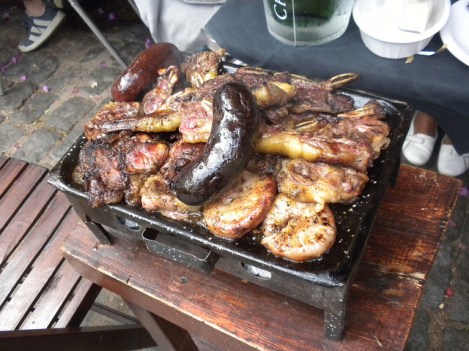
A Mixed Grill for a Couple in Colonia del Sacramento, Uruguay

A Mixed Grill for Two in Colonia del Sacramento, Uruguay

I shot the above in Colonia del Sacramento, Uruguay, in November 2011. It represents a mixed grill ordered by a young couple who graciously allowed me to photograph their lunch with a broad smile on their faces. It represents various cuts of beef, including sausages with a blood sausage in the middle accompanied by various organ meats.

The number of people who would find such a meal disgusting is growing by leaps and bounds, especially among the young. Let’s face it, meat can be gross—even if the animals are grass-fed the way South American beef and lamb typically are. American feedlots, if anything, result in even stranger meat, including such additives as “pink slime,” which was in the news recently, as well as various exotic antibiotics and hormones.

One of the best American growers with which I am familiar in the Harris Ranch located midway between Los Angeles and Sacramento on Interstate 5. Just north of the hotel and restaurant building is a huge feedlot whose odors have passersby on the freeway quickly pulling up their windows and recirculating their interior air for about two miles. And that is better than most beef you are likely to find at your neighborhood supermarket. I imagine that most Midwestern feedlots would be the mammalian equivalent of Dante’s Inferno.

Now Martine and I are both meat-eaters, but in a relatively small way. You might even say we’re part-time vegetarians. Would we ever become 100% vegetarians? Perhaps, if circumstances forced us, we would. In general, however, we shy away from vegetarian restaurants. It is not because we don’t like vegetarian dishes: It’s just that there is a certain vegetarian cuisine—particularly in the United States—which is almost offensively bland. If one is a vegetarian because one finds meat yucky, then one is likely to eat exclusively blah food.

One example of a vegetarian cuisine that I like is that of India. In fact, whenever I go to an Indian restaurant, I usually concentrate on the vegetarian dishes exclusively, unless some fish is on the menu. Indian food is almost never blah. (One exception: The Govinda’s Restaurants run by the Hare Krishnas, who have managed to banish all flavor from their menus.)

There are two vegetarian restaurants within walking distance of my office. I do not patronize either of them. As I am a diabetic, I have to avoid carbohydrates as much as possible; and American vegetarian food is usually fairly heavily laden with carbs.

As I write this, I am thinking of cooking a Chana Dhal next week (a curry with chick peas), if Martine is willing.

Thinking About Quebec

17th Century-Style Buildings by the Harbor in Quebec City

17th Century-Style Buildings by the Harbor in Quebec City

Today, Martine and I had dinner at a French Canadian restaurant in Westwood: Le Soleil on Westwood Boulevard. While I am dreaming of going to Peru, Martine would like to revisit the Province of Quebec and perhaps drive around a bit. It’s possible that I may yield to her: There is something about Quebec that draws out the Frenchwoman in her, and where else in North America can one feel so much like being in Europe?

What most people don’t know is that there is a part of Metropolitan France right off the south coast of Newfoundland. The islands of St. Pierre and Miquelon, a short ferry ride away from the town of Fortune, Newfoundland. The islands are all that remain of the extensive lands of New France lost to Britain in the French and Indian War. It is a little known fact that, during Prohibition, Chicago gangster Al Capone used the islands as a base for illegally importing wine and liquor into the United States. I don’t know if it’s feasible to include St. Pierre and Miquelon on a trip to Quebec, as they are many hundreds of miles apart; but perhaps some day….

I’m glad that Martine liked the Boeuf Bourguignon and Crême Brulée at Le Soleil. She tends to think that most French restaurants in L.A. are not sufficiently authentic, but this Quebecois restaurant seemed to have some of the real stuff.

Politics and Food

Sesame Green Onion Bread

Sesame Green Onion Bread

This last week, Martine watched a replay of an old Huell Howser visit to the China Islamic Restaurant in Rosemead. Now I used to go there some twenty years ago, but for some reason I thought the restaurant had gone out of business. A quick Internet check showed me that, no, it was still there.

Today, we drove out to Rosemead and I was able to indulge in what I used to eat there: sesame green onion bread (pictured above) and dough slice chow mein with lamb. I was in seventh heaven. I suspect, however, that my glucose reading this evening will be a tad on the high side, so I’ll have to compensate. Then again, I was waiting for twenty years to relive those flavors. So it goes.

Although I am not Muslim and do not find myself drawn to Islamic beliefs, I think that politics and religion have zero effect on my tastes in food. Even Martine, who is considerably to the right of me, loves hummus and chicken kebabs.

Afterwards, we drove to the 99 Ranch Market in San Gabriel for supplies to cook my own chow mein during the week. I was low on Kimlan Soy Sauce (my favorite), corn starch, bean sprouts, and Nanka Seimen chow mein noodles. The 99 Ranch Market is a huge Chinese supermarket with great prices for fruit and vegetables. The pork I bought there for the chow mein was also a good deal.

Martine was a bit put out by the crowds at the market, but I knew why the crowds were there.


Does It Pay To Take a Chance?

KFC in Keflavik

KFC in Keflavik

During my recent visit to Iceland, I saw a number of American fast food chains represented, including KFC (see above photograph), Subway, Quizno’s, and several others—but, curiously, no hamburger chains. McDonald’s was there, but is gone now. I guess they couldn’t make a go of it.

As I would avoid most of these chains at home, I didn’t care to patronize them on my vacation either. Mostly, I looked for fish dishes, which were always fresh and delicious. Once I had a hamburger on the main drag in Isafjördur at Hamraborg and found it by no means inferior to  American burgers. In fact, I thought the béchamel sauce was a nice touch.

Not all of Hamraborg’s offerings looked quite so appetizing:

A Local Specialty I Decided Not to Try

A Local Specialty I Decided Not to Try

It looked as if it were loaded with sugar anyhow.

As in California, the type of restaurants I preferred were one-of-a-kind. At Háholt in Mossfellsbær, for example, I had a long wait; so I passed by the KFC and Subway and found a delightful little place near the local Bonus Supermarket:

I Was Probably the First American To Eat Here

I Was Probably the First American To Eat Here

Now the sign doesn’t really tell you very much, does it? (I know the last line refers to coffee and cakes, however.) But I talked to the owner as he moved some tables and chairs outside and I decided to eat there. I had some great soup and a delicious piece of codfish with fresh vegetables. The owner was a bit of a health nut, and that fit in perfectly with my dietary restrictions. That was probably my best lunch in Iceland. I told the owner I was delighted not to have to eat at Subway or KFC, which were the only other choices within walking range.

Sometimes it pays to take a chance.


Iceland Is for Foodies

Fish is Number One in Iceland

Fish is Number One in Iceland

Fishing exports account for some 40% of Iceland’s export income and employs some 7% of the workforce. I remember riding a bus from Háholt In Mossfellsbær to Borgarnes with the first mate of a fishing trawler, who explained that he would be off for several weeks because of the rigid quota system employed by the fisheries. As soon as it was possible to go to sea without the danger of exceeding the quota, they would set sail.

Needless to say, I ate a lot of fish in Iceland, sometimes as often as twice a day. In addition to Icelandic cod, my favorite, there was ling cod, sea wolf, salt-water catfish, langoustines, mussels, shrimp, halibut, haddock, monkfish, and probably half a dozen other varieties. Since the vast majority of the population lives within sight of the North Atlantic, I could look out the window while I was eating fish and see the trawlers and other fishing vessels (such as the one above) parked in the harbor waiting for their next outing.

Unlike the United States, where seafood is usually the priciest item on the menu, in Iceland, it is usually the cheapest.

Many people don’t know this, but some fifty years ago, Iceland fought a “cod war” with the United Kingdom. It was the first country to declare an extended territorial limit, mainly to protect its fisheries from British fishing boats. Nets were cut by the Icelandic Coast Guard, and a British frigate once threaten to ram the offending ship. Fortunately, the two NATO nations avoided a shooting war.

In the end, the Brits lost, and the British fishing industry is now but a shadow of what it once was. Now all countries, including the United States and Britain, have extended territorial limits. One interesting result is the possibility that Iceland could become an oil-producing country. There is an possible oil field within the territorial limits called the Dragon Zone which Iceland and Norway are thinking of sharing, much to the dismay of the Chinese and Russians, who would like to exploit the resources for themselves.

Street Grunting

One would not think that Iceland would be a good place for what A People’s Guide to Mexico called “street grunting.” Tucked away near the old port is an 80-year-old hot dog stand called Bæjarin’s Beztu (roughly translated as “the best in town”).

They Sell Only Two Things: Pylsur and Soda

They Sell Only Two Things: Pylsur and Soda

Icelandic hot dogs are called pylsur. They are made with a combination of meats, including lamb, and are served in hot dog buns with ketchup, sweet mustard, fried onions, and remoulade, which includes mayonnaise and relish.

Generations of Reykjavík residents have made their way to Bjarin’s Beztu for a quick and relative cheap snack.

If you are in the boonies, not to worry: You can get decent pylsur at gast station roadhouses throughout the island. Also available are pizza, burgers, and fish and franskum (chips).

Skyr

Finally, there is one Icelandic dairy product that is widely available to which I became addicted, and that is skyr. While similar to yogurt, it is much creamier and richer in texture. Made with pasteurized skim milk, it can be found virtually everywhere, either plain or in various fruit flavors.

Plain Skyr. Yum!

Plain Skyr. Yum!

The above picture was taken by me on my first day in Iceland. I went into a downtown market and purchased the above tub of the ambrosial treat. You can find out more by going to the manufacturer’s website.

I don’t think I lost any weight during my recent trip, but I did have a lot of tasty and, for the most part, healthy food.