How to Stop Autoplay Videos

Yes, You Can Retain Control Over Videos

Yes, You Can Retain Control Over Videos

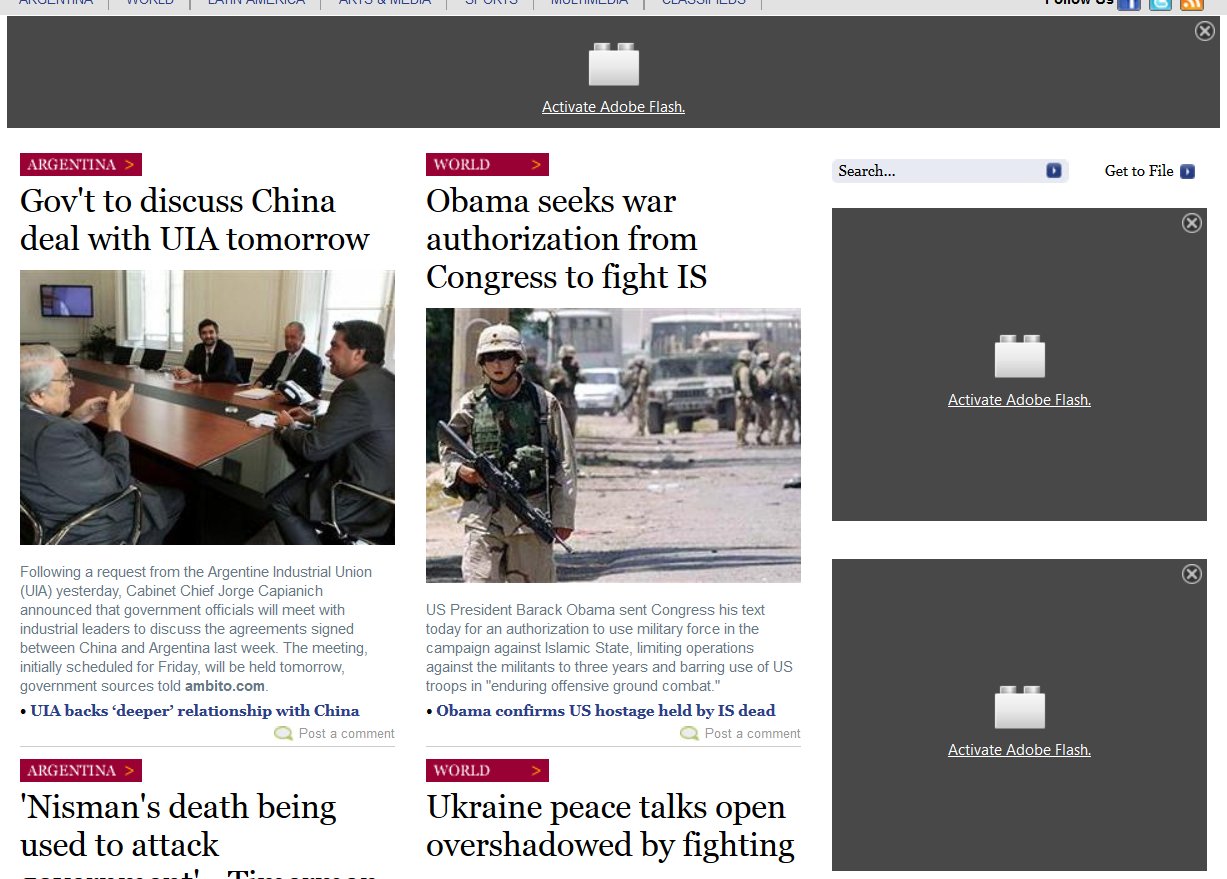
Last summer, I wrote a blog posting entitled Streaming Agony in which I bewailed the tendency of websites to push streaming videos in your face when you open websites—particularly prevalent among news websites. Most of these streaming videos are controlled by Adobe Shockwave. Using your Internet browser, you could request that the video be grayed out, as in the three examples in the above screen shot from the Buenos Aires Herald, and activated only when you specifically request it. By clicking on “Activate Adobe Flash,” you can see the video once, or grant blanket permission to the website.

Because I use Mozilla Firefox as my browser, I will reprint the instructions by Lincoln Spector from the February 2015 issue of PC World on “How to Stop Autoplay Videos” using this browser. If you should be a user of Google Chrome or Internet Explorer, reply at the bottom of this post and I will post the equivalent instructions for your browser. If you use Safari, you are out of luck.

Here are the instructions for suppressing autoplay videos on Firefox:

  1. Press Ctrl-L to go to the address bar and type in the local URL field: about:addons.
  2. Click Plugins in the left pane.
  3. Find Shockwave Flash in the list of plug-ins.
  4. Click the Always Activate pop-up menu on the right, and select Ask to Activate.

The article in PC World continues:

When you visit a page with an embedded Flash video, the video window will be in a box, but this time it will be white with Adobe’s Flash logo (a stylized letter ‘f’ in the center). A gray bar at the top of the page will give you options to continue blocking or allow the flash.

If you click Allow, you’ll get options to Allow Now or Allow and Remember. If you want to allow it at all, I recommend Allow Now.

Hopefully this will protect you from loud NSFW (Not Safe for Work) loud ads and most autoplay videos.

 

Doohickeys

This Does Not Look Like Standard English

This Does Not Look Like Standard English, Does It?

Rick Steves refers to them as “little doo-hickeys over some letters that affect pronunciation.” I call them diacritical marks, a sure sign that you are dealing with a foreign language. Sometimes you find them in English in words such as rôle, coöperate, or façade.Then you might think, “Gosh but this is old-fashioned!”

More than just doohickeys, diacritical marks are extensions of other countries’ alphabets. A couple weeks ago, I wrote a posting entitled “Dysinventions”, mostly of my dislike of touchscreen keyboards. In the post, I wrote:

I feel bad enough that there are some Eastern European diacritical marks I can’t use, such as an anacrusis or the Hungarian double-acute-accent over the “o” and “u” to indicate an extended vowel sound. In time, I will figure this out. But not on one of those touchscreen keyboards. I can imagine it would be gruelling just to type an average paragraph shifting between upper and lower case letters and numbers, let alone diacritical marks.

If I can’t make it look as if it were typeset, I would just as soon forget the whole thing. It just wouldn’t be me.

Well, I finally did figure it out. There is a great Internet resource called Typeit.Org which enables me to quote directly from twenty-six different character sets, including: Currencies, Czech, Danish, Dutch, Esperanto, Finnish, French, German, Greek, Icelandic, thye International Phonetic Alphabet (IPA) for English, the full IPA, Italian, Maori, Math, Norwegian, Polish, Portuguese, Romanian, Russian, Spanish, Symbols, Swedish, Turkish, and finally Welsh.

Now there is nothing I cannot type with my keyboard in any of the above configurations. Just so that I can control the type font, there is one additional step: I paste the text into Microsoft’s Notebook, which strips out Typeit’s default font information, and then copy and paste the result into WordPress.

At long last, I feel confident that I can print in Hungarian without misspelling such passages as:

Bár külön beállítási opció nincsen rá, egy egyszerű szintaxis használatával lehetséges a régi szótárból ismert teljes egyezésre, bármilyen egyezésre, vagy akár szó végére is keresni.

Note in particular that word egyszerű with its doubly accented “u”.

Please don’t worry that I’ll go crazy with this new tool. After all, nem akarom, hogy ellenátkok. (“I don’t want to befuddle you.”)


Spare Me the Fame

Why Would Anyone Want My Help in Setting Up a Blog?

Why Would Anyone Want My Help in Setting Up a Blog?

Mine is not a particularly striking looking website, yet each week I get numerous requests for information on how I put it together, together with questions as to whether I would link to their website. The odd thing is that I don’t believe these people, especially since:

  1. Their e-mail address indicates they are in some dubious business, such as selling designer knock-offs.
  2. Instead of referring to a recent posting, they seem to be linking to my media file, especially to photographs from postings of several months ago.
  3. They never say anything that would indicate they actually read what I write—never any link to any actual content.

You never see these requests because I erase over 99% of the entries identified by WordPress’s Akamai (means “smart” in Hawaiian pidgin) Spam filtering system, and that’s where these usually end up.

Another group of pseudo-comments wants to see me get a lot more hits and to be at the top of Google searches. Why? Obviously, I’m not into blogging for the fame. If thousands of people daily visited Tarnmoor, my life would turn to crap: Imagine having to filter through hundreds of comments.

If you found this site because it was on page ten of a Google search, and you like what I do, you are most welcome. If you want to tell the world what a great blogger I am, I would think you would be doing me a disservice. If I have to spend all my time tending to this site, I would just as soon give it up.

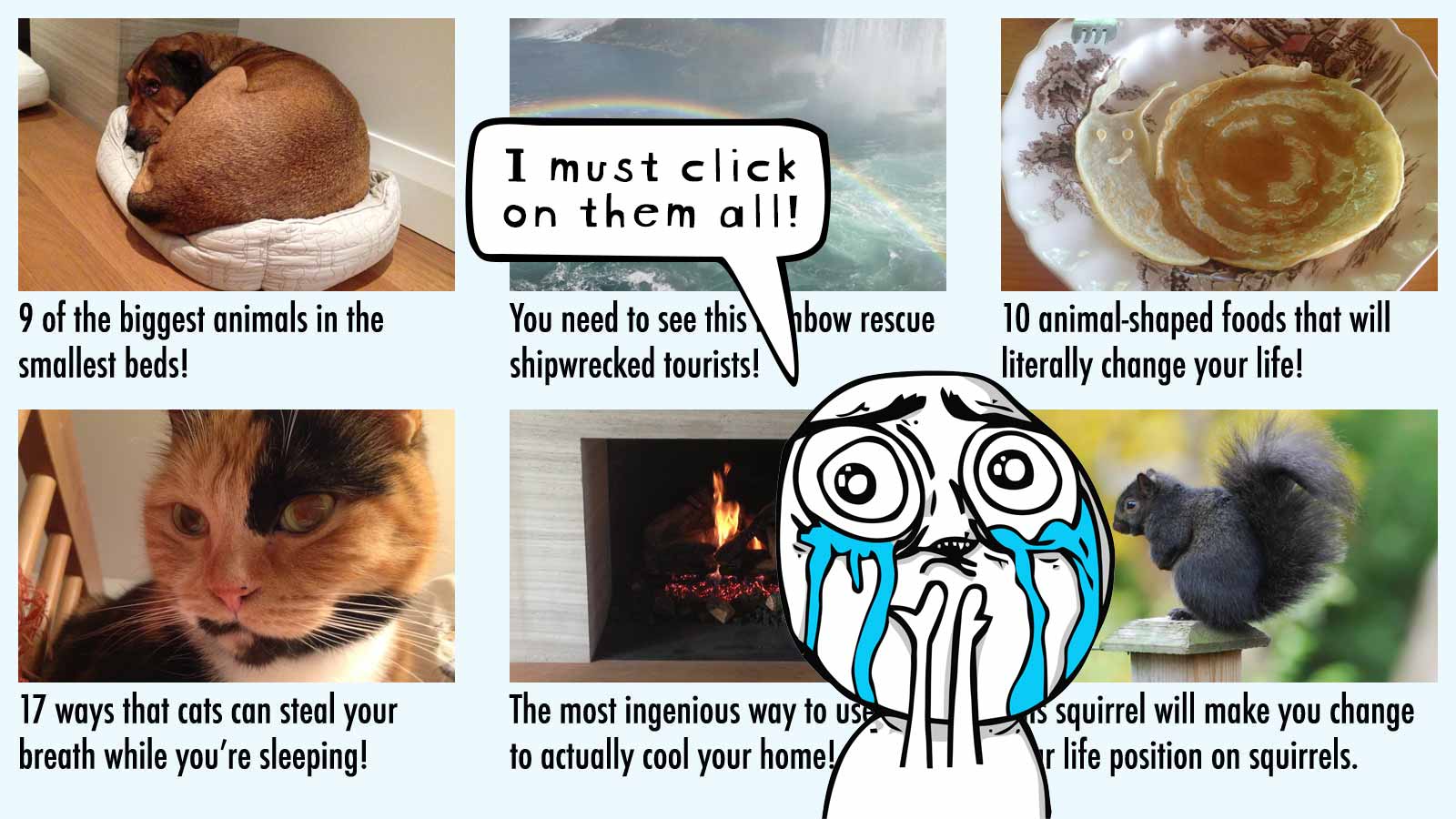
In fact, I like to write. I like to use the process to think things through. And I like interacting with my friends. So don’t offer any suggestions how I could crud up this site by using clickbait the way that Weather.Com and most news websites do. There’s no clickbait here, and no advertising. If you like what I write, well and good. If not, there are other places you can go.

Dysinventions

I Wish Touchscreen Keyboards Could Be Uninvented

I Wish Touchscreen Keyboards Could Be Uninvented

There are wonderful inventions that make things easy for people. Then there are what I call dysinventions, or bad inventions, that while seeming to advance technology actually represent a step backward. One prominent example is the touchscreen keyboard. I could see the thought forming in the inventor’s mind: “Why not get rid of the clunky keyboard and just have people hit letters on a keyboard that appears on the screen?”

Well now, that’s just ducky for texting, twittering, and other forms of second-tier communications; but I could not enter this blog on such a quasi-keyboard. Let’s take yesterday’s blog, for example. I would have to type the name of the Icelandic volcano Eyjafjallajökull without the umlaut over the “o”. Eyjafjallajokull would probably look okay to most people, but it is wrong to me; and I insist on absolute correctness. To get the letter, I hit Alt-0246 on my keyboard. To get the em dash in the third paragraph, I type Alt-0151 instead of the double hyphen (“- -”) using the old typewriter convention.

I feel bad enough that there are some Eastern European diacritical marks I can’t use, such as an anacrusis or the Hungarian double-acute-accent over the “o” and “u” to indicate an extended vowel sound. In time, I will figure this out. But not on one of those touchscreen keyboards. I can imagine it would be gruelling just to type an average paragraph shifting between upper and lower case letters and numbers, let alone diacritical marks.

If I can’t make it look as if it were typeset, I would just as soon forget the whole thing. It just wouldn’t be me.

And that is why I don’t travel with an iPad or similar “crippled computer.”

Don’t Become Clickbait

If This Is You, You’re in Big Trouble

If This Is You, You’re in Big Trouble

Clickbait is a relatively new word in the English language. According to Wikipedia:

Clickbait is a pejorative term describing web content that is aimed at generating online advertising revenue, especially at the expense of quality or accuracy, relying on sensationalist headlines to attract click-throughs and to encourage forwarding of the material over online social networks. Clickbait headlines typically aim to exploit the “curiosity gap,” providing just enough information to make the reader curious, but not enough to satisfy their [sic] curiosity without clicking through to the linked content.

The very existence of the concept shows that there are enough dimwitted Internet users without any capability to think critically to support a whole industry. Even standard news sites like the HuffPost and CNN are riddled with these attempts to grab the attention of readers and bog them down in an ultimately unsatisfying quest containing numerous listicles. You know, of course, what listicles are. Here are a few examples:

  • The ten most perverted actors in Hollywood
  • Five ways you can lower your taxes by as much as 20%
  • The seven most eye-opening celebrity costumes

You get the picture. And if you haven’t seen several hundred of these in “eye-grabbers” in the last week, you’re not half-trying.

Beware of These Come-Ons

Beware of These Come-Ons

Clickbaiting has gotten so bad that even Facebook was moved to intervene, and there is a hilarious take-off called ClickHole created by the folks who brought you The Onion.

What bothers me is that even supposedly legitimate news stories on the Internet and in newspapers are creating Clickbait-type headlines for stories that are just as unsatisfying as most clickthroughs. One finds these proliferating in articles about nutrition (“lose that ugly belly fat”), national and international news (“five things you must know about ISIS”—a typical listicle), exercise (”this simple exercise will guarantee weight loss”), and just about any other subject.

It is a constant temptation to indulge in this ignis fatuus (“swamp gas”) in a vain attempt to get better informed. The best course is to disbelieve anything that sounds too good to be true. And this relates to everything both on and outside of the Internet.


The Slow (or No) Road to Fame

The All-Too-Easy Road to Mediocrity

The All-Too-Easy Road to Stultifying Mediocrity

My congratulations to Brian Gordon of FowlLanguageComics.Com for a very funny cartoon.

I have gotten thousands of Spam e-mails offering cheap (pseudo-)pharmaceutical products and Louis Vuitton and other fashion knockoffs. Interspersed among them were comments that my website needed improvement. I was supposed to have a lot more pictures and a lot fewer words. And I was supposed to load much faster on Safari—whatever that is—than I currently do. Also I get a lot of questions from people asking for help setting up their own websites. (Good luck, guys!)

This website as it is is a reflection of who and what I am, not an attempt to get thousands of “likes” and “favorites” from people who not only do not mean anything to me, and with whom I do not necessarily care to interact.

Let’s face it: I’m a dinosaur. I don’t watch television, follow sports teams, listen to pop music, or give a flying f*ck about celebrities. Life is so pitifully short that I do not care to waste any of it going into the clickbait business. I have seen great websites fall into the click trap. When I feel I don’t have anything else to say, you can bury me. Until then, I will follow my different drummer to wherever he leads me.


R.I.P. E-Mail

Remember When E-Mail Was Really Great?

Remember When E-Mail Was Really Great?

When I return from Peru, I expect to find approximately 2,000 e-mails on each of three accounts that I have. Approximately 80% will be outright spam, and most of the rest are offers I will have no difficulty in mass deleting. How is it that such a fantastic communication medium has become so spoiled by hackers, hucksters, spammers, and others. When I scan my e-mail, I really am not really interested in enlarging my penis, ordering lookalikes of popular prescription drugs, or taking advantage of 20% sales (when I could save 100% by just deleting the offer).

Thanks to advances in viruses and malware, I find it safer by far to just delete—especially when the e-mail contains links or file attachments. Even some e-mails from my friends are suspicious: They could be used as bots for the distribution of virus payloads. The safest thing is to call the friend before following that link or loading that file.

Even when my inbox is filled with legitimate offers, merchants frequently feel that they need to hit you every day, usually with limited time offers that are invariably extended. Just because I ordered some printer toner from one vendor two years ago, I hear from them every day. Far from being appreciative of being reminded of their existence, I go out of my way to get my toner from other suppliers that don’t bug me to death.

Technology is always that way, it seems: For every three steps forward, there are two or three steps back. And it’s all because of human nature being what it is.

Support Our Troops in Garcinia Cambogia

It’s Somewhere Between Krung Thep and Aguas Calientes

I Think It’s Somewhere Between Krung Thep and Aguas Calientes

It’s all over the internet: You can lose weight, lengthen your dingdong, make the power company mad at you, date luscious Asian women, save money by buying stuff you don’t need, and taking advantage of Obama’s secret super-special refi plan.

The upshot is that, sometime over the last twenty years, we’ve let our brains drain out our ears or accidentally given ourselves lobotomies while on the way to the fridge to get more beer. Bring up any major news website, and you will see links to Motley Fool directing you to a twenty-minute video that purports to (but doesn’t actually) tell you why the Chinese economic miracle is over, or how you can make trillions by investing fifty cents in some odd 3-D printing stock for a company out of Liechtenstein.

Here they all are: everything that everybody really wants. Who cares about ISIS taking Baghdad or the Russian convoy to Ukraine being full of atomic waste? You can never be too rich or too thin—or too sexy, which I guess is a combination of both. (I mean, if an aging, decrepit troll like Donald Sterling can parade around with hot babes, so can you!)

We have become a nation of cheapsters. We don’t care about anything but massaging our pleasure principle, or, better yet, having our pleasure principle massaged by Girls Gone Wild.

What is Garcinia Cambogia anyway? Whatever it is, it sounds as if we should have boots on the ground there.

I Seem To Have Become Hispanic

I Didn’t Know One Could Change One’s Ethnicity

I Didn’t Know One Could Change One’s Ethnicity

For some reason, I seem to have spooked the marketing algorithms behind some web sites: Now I find myself getting ads in Spanish. Could it be because of all the Google searches I have done regarding my upcoming vacation in Peru? In any case, I am amused by the whole thing—provided I do not have to fear getting nabbed by the migra and deported to Tijuana.

I guess this is the way I look to the marketers:

Which One Do I Resemble Most?

Which One Do I Resemble Most?

The painting above is John Sonsini’s “Christian and Francisco” (2013), which hangs in the Autry National Center in Los Angeles’s Griffith Park, which Martine and I visited yesterday.

In the meantime, I hope to improve my colloquial Spanish so that I can be worthy of my new identity.


Streaming Agony

This Junk Is Everywhere

Video Is Great—When You Want It!

Over the last year, I’ve noticed that when I visit many websites, I automatically activate videos, usually advertising some sh*t I don’t want. Even if my mouse rolls over some areas of the screen, it is interpreted as a wish to be sold to. In that case, my first reaction is to turn down the sound; and then I hunt for active video screens and hit the stop button.

Webmasters are allowing advertisers to push them around. One instance is the “obliterad” that covers the screen and forces you to hit the X to shut it down. I have complained to several websites, but it was like asking them to empty their cash registers into a bag I am holding. They need the money, but they also need not to annoy their readers. I know I can get many more readers at Tarnmoor.Com if I started running ads, but the intention is not to become the most visited site on the Internet. In fact, greater popularity would force me to spend gobs of time interacting with people with whom I would prefer not to interact.

One easy way to counteract the automatically activated videos is for browsers to ask whether you want to run any videos. That way, I retain the ability to choose. YouTube is great, but I don’t need video when looking at a news story about Syria or our dysfunctional Congress.

Unfortunately, many of the news website stories involve activating a video. CNN, MBCNEWS, and others are trying to ram not only their stories, but their stupid ads down my throat. Do you wonder why I sometimes feeling like spewing back at them?

If, on this website, you see no ads or involuntary streaming video, it’s because I’m trying to apply the Golden Rule.