Four Englishmen Do Mexico

British Writer Graham Greene (1904-1991)

In the 1920s and 1930s, Mexico suddenly came to the attention of the English. There had been a messy revolution, numerous political assassinations, persecution of the Catholic Church, and the nationalization of the country’s petroleum assets. English writers seemed to want to understand Mexico, even if it meant an investment of several weeks to do so.

The results were pretty much a hodge-podge. Probably the most interesting works were by Graham Greene in his novel The Power and the Glory (1940) about the religious persecution in Tabasco and Chiapas and The Lawless Roads (1939), a travel book in which the author admits to loathing Mexico. “No hope anywhere. I have never been in a country where you are more aware all the time of hate,” this after he broke his glasses while on the road.

Also interesting is Aldous Huxley (1894-1963) with his tour of Mexico and Central America published in 1934 called Beyond the Mexique Bay.

D. H. Lawrence was hot and cold on the subject of Mexico. His Mornings in Mexico (1927) shows that he knew how to appreciate Mexico, whereas The Plumed Serpent (1926) is a weird and unconvincing novel.

Worst of the books was Evelyn Waugh’s Robbery Under Law: The Mexican Object-Lesson (1939), in which it is apparent that he is in a permanent snit on the subject of Mexico, and his sources were all obviously fascistic jackals. I read the first half of the book with its endless complaints of Lazaro Cardenas’s nationalization of the petroleum industry (was he possibly a disappointed investor?) and the United States’s hamfisted interventions during the Mexican Revolution. At no point did I feel that Waugh was seeing with his own eyes. (And yet, he was such a brilliant novelist. Go figure!)

Moral Unease

American Writer Renata Adler (Born 1937)

I found the following in Renata Adler’s Pitch Dark, which was published after her first novel, Speedboat:

We have the sins of silence here. Also the sins of loquacity and glibness. We have the sins of moderation, and also of excess. We have our sinner gluttons, and our sinner anorectics. We have the sins of going first, and of After you, Alphonse. We have the sins of impatience, and of patience. Of doing nothing, and of taking action. Of spontaneity and calculation. Of indecision, and of sitting in judgment on one’s peers. We try to be alert here for infractions, and when we find none, we know we have fallen among the sins of oversight, or of smugness. We have the sins of disobedience, and of just following orders. Of gravity and levity, of complacency, anxiety, indifference, obsession, interest. We have the sins of insincerity, and of telling unwelcome truths. We have the sins of ingratitude for our many blessings, and of taking joy in any moment of our lives. We have the sins of skepticism, and belief. Of promptness, and of being late. Of hopelessness, and of expecting anything. Of failing to think of the starving children in India, of dwelling on thoughts about those children, or to Uncle Bill, or Granny, or poor Joel, or whomever we are being asked to take another spoonful for. We have the sins of depression, and of being comforted. Of ignorance, and being well-informed. Of carelessness, and of exactitude. Of leading, following, opposing, taking no part in. Very few of us, it seems fair to say, are morally at ease.

The Night the Man with the Watermelon Died

The following is from Jack Kerouac’s Doctor Sax, about his youth in Lowell, Massachusetts. Here he describes a sobering scene in his typical jazzy style:

A man carrying a watermelon passed us, he wore a hat, a suit in a warm summer night; he was just on the boards of the bridge, refreshed, maybe from a long walk up slummy swilly Moody and its rantankling saloons with swinging doors, mopped his brow, or came up through Little Canada or Cheever or Aiken, rewarded by the bridge of eve and sighs of stone—the great massive charge of the ever stationary ever yearning cataracts and ghosts, this is his reward after a long dull hot dumb walk to the river thru houses—he strides on across the bridge—We stroll on behind him talking about the mysteries of life (inspired we were by moon and river), I remember I was so happy—something in the alchemy of the summernight, Ah Midsummer Night’s Dream, John a Dreams, the clink of clock on rock in river, roar—old gloor-merrimac figalitating down the mark all spread—I was happy too in the intensity of something we were talking about, something that was giving me joy.

Suddenly the man fell, we heard a great thump of his watermelon on wood planks and saw him fallen—Another man was there, also mysterious, but without watermelon, who bent to him quickly and solicitously as by assent and nod in the heavens and when I got there I saw the watermelon man staring at the waves below with shining eyes (‘Il’s meurt, he’s dying,’ my mother’s saying) and I see him breathing hard, feeble-bodied, the man holding him gravely watching him die, I’m completely terrified and yet I feel the profound pull and turn to see what he is staring at so deadly-earnest with his froth stiffness—I look down with him and there is the moon on shiny froth and rocks, there is the long eternity we have been seeking.

12 Desert Rats

Saguaro Cacti in the Arizona Desert

As I prepare for our road trip to Tucson this next week, I have been doing a lot of reading in preparation. It struck me that there are a lot of great books about or set in deserts. Here are an even dozen recommendations organized alphabetically by author:

  1. Abbey, Edward. Desert Solitaire: A Season in the Wilderness. A classic of the growing environmental movement and a threnody for the beauties that have been lost.
  2. Anonymous, Arabian Nights (or A Thousand and One Nights). Great stories about Sinbad, Ali Baba, and others.
  3. Austin, Mary. The Land of Little Rain. The author’s experiences in the Owens Valley along the Eastern Edge of the Sierra Nevada Mountains.
  4. Banham, Reyner. Scenes in America Deserta. Delightful essays about travels in the California deserts.
  5. Bissell, Tom. Chasing the Sea. A visit to one of the most desolate places on Earth, namely what used to be the Aral Sea in Uzbekistan.
  6. Bowden, Charles. Desierto. Essays about the desert of Southern Arizona and the State of Sonora in Mexico.
  7. Herbert, Frank. Dune. A great. sci-fi tale of a desert planet caught in the middle between warring factions in a corrupt empire.
  8. Lawrence, T. E. (“Lawrence of Arabia”). The Seven Pillars of Wisdom. A British officer convinces Arabs to revolt against their Ottoman oppressors in World War I.
  9. McCarthy, Cormac. Blood Meridian, or the Evening Redness in the West. Violence on the desert frontier among white settlers and Indians.
  10. Powell, John Wesley. The Exploration of the Colorado River and Its Canyons. The first American to navigate the length of the Colorado River.
  11. Theroux, Paul. On the Plain of Snakes. Unforgettable scenes along the border with Mexico, with chapters on the deserts of the State of Oaxaca.
  12. Thesiger, Wilfred. Arabian Sands. The author’s journeys throughout the Arabian peninsula.

As I write these, I become acutely aware that there are more titles I should include. Perhaps, as I read more, I will re-visit the subject later.

Januarius in March

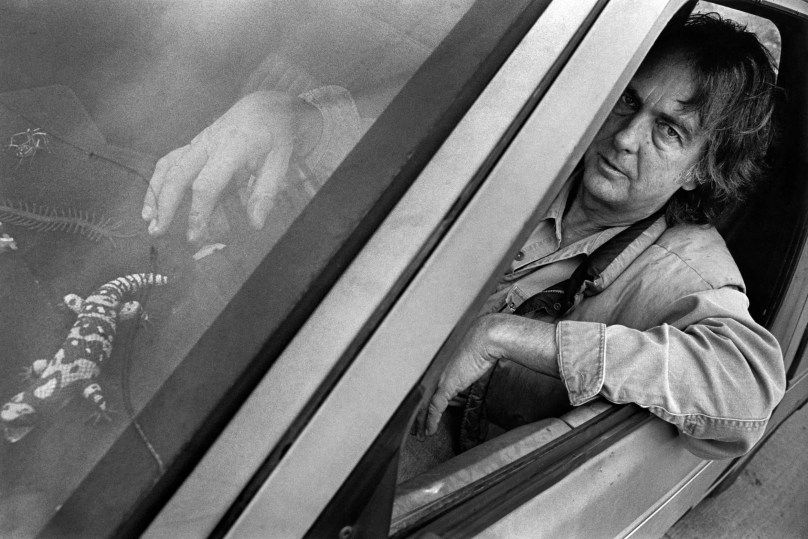
Arizona Writer Charles Bowden (1945-2014)

Typically, the only books I read during the month of January are by authors I have not before encountered. I call this my Januarius project. This last January, however, I was too ill to read more than two books—and that at the end of the month. So I decided to hold this year’s Januarius in March.

During this month, I read fifteen books by authors who were new to me:

  1. Lewis Grassic Gibbon, Sunset Song. This was the first (and most popular) volume of a trilogy entitled A Scots Quair. Hard times on a farm near Aberdeen before World War I.
  2. David R. Fideler, Breakfast with Seneca: A Stoic Guide to the Art of Living. Stoicism is one ancient philosophy applicable to modern times.
  3. Renata Adler, Speedboat. Consisting of seemingly unrelated scenes that manage somehow to hold together and be interesting.
  4. Sylvia Plath, The Bell Jar. A somewhat grim book featuring multiple suicide attempts.
  5. Fyodor Sologub, The Petty Demon. A 19th century Russian novel about an annoying school teacher in a country town.
  6. Martial, Epigrams. Amusing sardonic quips about life in Imperial Rome.
  7. Jean-Paul Clébert, Paris Vagabond. Paris seen from the eyes of a highly intelligent hobo.
  8. Edward Said, Orientalism. Intelligent critique of the whole concept of orientalism as being the result of colonialism.
  9. Demetrio Aguilera Malta, Seven Moons and Seven Serpents. Brazilian Magical Realism that allegorizes the whole South American experience.
  10. Jay Parini, Borges and Me: An Encounter. Imagine having to drive Jorge Luis Borges around the Scottish Highlands without ever having read any of his work.
  11. Ralph Waldo Emerson, Self-Reliance. It’s hard to believe that I’ve never before read any Emerson other than a couple of his poems.
  12. Charles Bowden, Desierto: Memories of the Future. The best book I read this month, about life in the Arizona and Sonora desert, the drug lords, mountain lions, and crooked developer/banker Charles Keating Jr.
  13. Andy Miller, The Year of Reading Dangerously: How Fifty Great Books (and Two Not-So-Great Ones) Saved My Life. The title says it all.
  14. Alexander Ostrovsky, The Storm. A 19th century Russian play in which the villain is a mother-in-law.
  15. Gao Yuan, Lure the Tiger Out oi the Mountains: The 36 Strategies of Ancient China. A somewhat lame attempt to show how ancient Chinese philosophy can improve your business acumen.

All in all, it was a good month with some writers I would like to revisit—particularly Charles Bowden. Next week, Martine and I are going to Tucson, Bowden’s home turf, where I plan to read some more of his work.

Classics of Travel Literature

I have always loved reading classical travel books—even if they were written long ago. Here is a list of some of my favorites, listed below in no particular order:

  • Matsuo Basho, The Narrow Road to the Deep North (1694). This is the earliest book on the list including a poetic rendering of the author’stravels to shrines in Japan, written in haiku.
  • Bruce Chatwin, In Patagonia (1977). A not entirely reliable account of the author’s journeys through Patagonia.
  • John Lloyd Stephens, Incidents of Travel in Central America, Chiapas, and Yucatan (1841). The book that made we want to go to Mexico. Great illustrations by Frederick Catherwood.
  • Paul Theroux, The Old Patagonian Express (1979). Still my favorite of his works, made me want to visit South America.
  • Freya Stark, The Valleys of the Assassins and Other Persian Travels (1934). She traveled alone throughout the Middle East and lived to be 100 years old.
  • Robnert Byron, The Road to Oxiana (1937). A travel book in which the author fails to reach his destination, but what he does see his so interesting that it doesn’t matter.
  • Sir Richard Francis Burton, Personal Narrative of a Pilgrimage to Al Medinah and Meccah (1855-1856). It took incredible gall for an Englishman to pass himself off as an Afghan physician and visit the holiest sites of Islam.
  • Jonathan Raban, Passage to Juneau: A Sea and Its Meanings (1999). Life doesn’t stop just because you want to pilot a yacht to Juneau, Alaska.
  • Ryszard Kapuściński, Travels with Herodotus (2007). A brilliant Polish travel writer tells how the ancient Grfeek historian informed him on his travels.
  • D. H. Lawrence, Sea and Sardinia (1921). It was written in just a few days, but it’s great anyhow.
  • Lawrence Durrell, Bitter Lemons (1957). The author of The Alexandria Quartet describes his years spent on the island of Cyprus in the Mediterranean.
  • Patrick Leigh Fermor, A Time of Gifts (1977). Travels through Central Europe just before the Second World War.

I cannot help but think some of my other favorites are missing. What you won’t find on this list are books like Eat, Pray, Love and such bourgeois fantasies as A Year in Provence. If that’s what you prefer in travel literature, I would prefer that you don’t undertake to read any of my recommendations. Ever.

Quid hoc ad Iphycli boves?

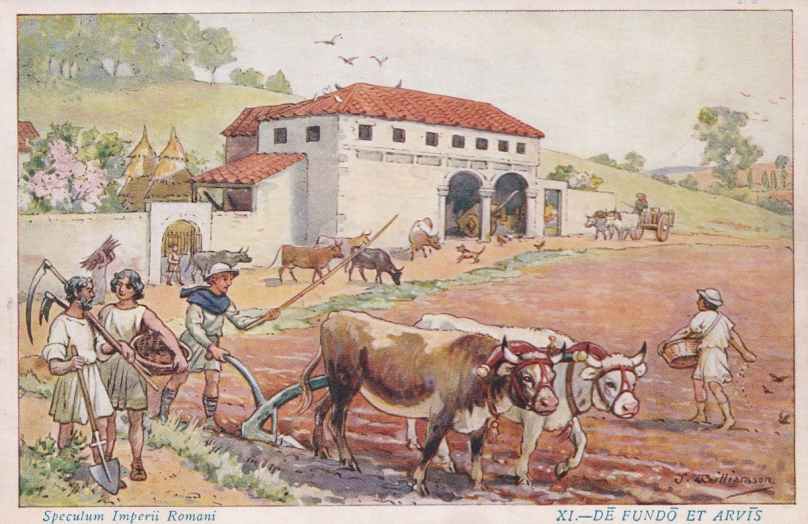
Old School Card Showing Cattle Farming in the Roman Forum

Roughly translated, the title of today’s post is “What has this to do with the cattle of Iphyclus?” or, more loosely, “Let us return tom the subject at hand.”

I am currently reading Sir Walter Scott’s Kenilworth (1821). Scott is famous for starting his novels slowly. I have just read fifty pages of densely packed plotting as Edmund Tressilian gets lost fleeing Cumnor and his horse throws a shoe. He meets up with an old scholar named Erasmus Holiday who converses mostly in Latin and who is delighted to meet anyone with even an imperfect knowledge of the old Romish tongue.

What Tressilian wants, quite simply, is the directions to the nearest blacksmith so he can continue on his way, but Erasmus is not willing to let go of him that easily. Finally, after numerous quotes from Latin classics, he deputes Hobgoblin (aka Flibbertigibbet), the son of his washerwoman, to show him the way to Wayland Smith, the local farrier.

And here we are detained still more by the rumors of said farrier being a tool of the devil as a result of his former association with a local mountebank.

Eventually Tressilian gets to his destination accompanied by Smith, who is now his servant.

There was a time when I would have been upset at the slow development of the story in Kenilworth, but now I am delighted. This is definitely a slow read, requiring frequent consultation with the notes and (yes) a detailed glossary.

In my old age, I now appreciate Scott’s divergence from the subject at hand. He is so damnably erudite and enjoys sharing it with us. Will Tressilian ever rescue the lovely Amy Robsart from the clutches of the evil Richard Varney? Eventually, I’ll find out; but, in the meantime, whether or not the cattle of Iphyclus enter the fray, I will enjoy every minute of this long and painstaking read.

Conspiracy of Silence

Costumes of the Knights of Calatrava

Around the time when Ferdinand and Isabella jointly ruled the Kingdoms of Aragon and Castile, there were three independent orders of knights: those of Santiago, Alcántara, and Calatrava. One of the commanders of the Knights of Calatrava, Fernán Gómez, is the feudal overlord of the village of Fuente Ovejuna (“The Well of Sheep”).

When Gómez goes on a rampage of torturing the peasants and raping the women of the village, the villagers resolve to assassinate him—first having promised not to reveal the names of the perpetrators, even under torture. When an investigative judge sent by the monarchy asks for the names of the murderers, all the villagers say, “Fuente Ovejuna did it!” Faced with a conspiracy of silence the villagers are let off the hook.

Around 1612, Spanish playwright Lope de Vega wrote a play called Fuente Ovejuna which memorializes the event.

There have been two interesting examples of similar events in which the unanimity of the populace prevented a judgment against the actual perpetrators.

In 1970, a group of Icelandic farmers took matters into their own hands when a governmental agency planned a dam that would affect a large swath of land along the Laxá River near Lake Mývatn in the north of the country. According to the Reykjavík Grapevine, this is what happened:

More than a hundred farmers officially claimed responsibility for the explosion, which annihilated a small dam in the river on August 25, 1970. The area’s inhabitants were determined to prevent the construction of a much bigger dam, which would have destroyed vast quantities of this natural area, as well as most of the surrounding farmlands.

The upshot was pretty much the same as in the Lope de Vega play:

“What makes the Laxá conflict peculiar is that those who resisted also succeeded,” Grímur says. “The planned dam was never built and the area was saved.” Four years later, parliament passed a law securing the protection of Laxá and Mývatn, contributing to the explosion’s status as “the most remarkable and powerful event in the history of environmentalism in Iceland,” as Sigurður Gizurarson, the bomber’s defence lawyer, put it.

Closer to home is the case of Ken McElroy, a small-town bully who regularly committed crimes against the inhabitants of Skidmore, Missouri, without serving time for his depredations. Until one day in 1981. The Wikipedia entry on McElroy tells the story:

On July 9, 1981, he appeared in a local bar, the D&G Tavern, armed with an M1 Garand rifle and bayonet, and later threatened to kill Bowenkamp [the local grocer].] The next day, McElroy was shot and killed in broad daylight as he sat with his wife Trena in his pickup truck on Skidmore’s main street. He was struck by bullets from at least two different firearms, in front of a crowd of people estimated as numbering between 30 and 46. Despite the many witnesses, nobody came forward to say who shot him. To date, no one has been charged in connection with McElroy’s death.

As I read Lope de Vega’s play, the other incidents came to mind. I found it interesting that they closely mirrored the Spanish events of some 500 years earlier.

PCs and Nizards

My First Book, Sort Of

Back when I was a toddler in my crib at 2814 East 120th Street in Cleveland, my mother used to tell me stories in Hungarian to help me drop off to sleep. When the stories were her own, they usually involved a fairy princess and a dark forest. But when she was running out of ideas, she would take out children’s story books from the city library on East 116th Street and translate the story into Hungarian while showing me the pictures.

One of them I remember very clearly was Dr. Seuss’s The King’s Stilts. Picture to yourself a kingdom that was below sea level, surrounded by tall dikes covered with trees. These trees were constantly under attack by flying nizards, which went after the roots.

Fortunately, there were legions of patrol cats (P.C.s) deputed by King Birtram to keep the nizards from destroying the trees and flooding the kingdom. When not busy signing proclamations, the king delighted to whizzing around his kingdom on a pair of red stilts.

One day, wicked Lord Droon decided to have the king’s stilts buried by Eric, the royal page, because he thought it was too infra dig for the monarch to be enjoying himself so much. The king was thereupon so despondent that he no longer gave orders to the patrol cats, and the nizards’ attacks were resulting in streams of water flooding into the kingdom.

Fortunately the story has a happy ending. Here, on YouTube, is the Dr. Seuss book, complete with words and pictures:

Naturally, I own a copy of the book. It is a constant reminder of my mother’s ingenuity and love.

Back to the Books

Enjoyable Books: Just the Thing I Need!

After a month of illness, I have finally returned to my first love: reading. I started with a reread of Lawrence Durrell’s Balthazar (the second volume of The Alexandria Quartet) and then picked up John Le Carré’s Agent Running in the Field.

On Thursday, I plan to resume my weekly visits to the Central Library in downtown Los Angeles. The combination of a guided Mindfulness Meditation session with access to the vast circulating holdings of the library is my indication that things are returning to normal. Plus, I have seven overdue books to return.

This January has been my worst month in many a year. Add to that the fact that it was Los Angeles’s worst month in thirty-one years. What happened in 1994 that was so bad? The Northridge Earthquake on January 17 of that year.