Originally, there was a historical Mullah Nasruddin. He was born in Turkey and lived between 1208 and 1284. Stories multiplied about him, and eventually he was widely known between the Balkans and China. In the 20th Century, Idries Shah published a charming series of books featuring anecdotes about the Mullah. Here are two of them:
TWO IN ONE
Nasruddin was taking a shortcut home through the cemetery, where a burial was in progress. As he walked past the group of mourners, he overheard one of them saying: “Today is a sad day for us all. We have buried an honest man and a politician.”
A sad day indeed, Nasruddin thought to himself. I didn’t realise that the situation was so dire that they are now compelled to bury two people in the same grave!
GOD’S WISDOM
One hot summer’s day, Nasruddin was relaxing in an orchard under the shade of an apricot tree. Looking around him, and marvelling at nature’s bounty, he wondered why apples, cherries, and other small fruit grew on trees, while large melons and pumpkins grew on vines at ground level.
Sometimes it is hard to understand god’s ways, he pondered. Imagine letting apricots, cherries, and apples grow on tall trees while large melons and pumpkins grow on delicate vines!
At that precise moment, the mullah’s reverie was interrupted by an unripe apricot falling from the tree and bouncing off his bald head. Roused from his musings, Nasruddin stood up, raised his hands and face towards heaven, and said humbly: “Forgive me, god, for questioning your wisdom. You are all-knowing and all-powerful. I would have been in a sorry state now if melons grew on trees.”
This is a re-post from October 20, 2022. I have just sat through four films directed by Jacques Tourneur on Turner Classic Movies (TCM), three of them produced by the great Val Lewton. He is the only producer who deserves to be called great. Most of the others are impediments to greater or lesser degrees.
There are horror films, and there are horror films. They can scare you out of your wits, like Curse of the Demon (1957) and Poltergeist (1982), or they can make you understand that the world is both light and dark in equal measure, like Val Lewton’s great films of the 1940s, such as The Cat People (1942).
Val Lewton, born Vladimir Ivanovich Leventon in Yalta, Russia, was interested in making low budget films to compete with Universal Pictures’ highly successful Frankenstein, Dracula, Mummy, and Wolf Man franchises. The title for The Cat People was assigned to Lewton by RKO, and Lewton went to work on a psychological thriller in which there is no overt violence. Perhaps the greatest scene takes place in a swimming pool in which a young woman is swimming all by herself at night. In the shadows, we imagine there is a black panther, but neither the swimmer nor we the viewers are absolutely sure.
Even though Halloween is just about over, I highly recommend all the following Lewton films:
The Cat People (1942)
I Walked with a Zombie (1943)
The Leopard Man (1943)
The Seventh Victim (1943)
The Ghost Ship (1943)
The Curse of the Cat People (1944)
The Body Snatcher (1945)
Isle of the Dead (1945)
Bedlam (1946)
All are great films worthy of being seen multiple times. They are short, thoughtful, extremely moody, and highly successful. Also available is a Turner Classics biopic about Lewton’s career called Shadows in the Dark narrated by Martin Scorsese. Martine and I watched it last night and recommend you see it.
In all of Hollywood’s history, Lewton was probably the only film producer who controlled his products as if he were the director. Even though Lewton directorial protegés Jacques Tourneur, Robert Wise, and Mark Robson went on to have brilliant careers, when one is watching a Lewton film, one recognizes it as a Lewton film.
From Ancient Greece Comes the Story About Who We Are
This is a reprint from a blog that I posted eight years ago. I would not change a word. Except: Note that I was not at the Santa Monica Library today.
In case you are not familiar with this ancient tale by Aesop, here is a retelling from a website called Fables of Aesop:
The Frogs were tired of governing themselves. They had so much freedom that it had spoiled them, and they did nothing but sit around croaking in a bored manner and wishing for a government that could entertain them with the pomp and display of royalty, and rule them in a way to make them know they were being ruled. No milk and water government for them, they declared. So they sent a petition to Jupiter asking for a king.
Jupiter saw what simple and foolish creatures they were, but to keep them quiet and make them think they had a king he threw down a huge log, which fell into the water with a great splash. The Frogs hid themselves among the reeds and grasses, thinking the new king to be some fearful giant. But they soon discovered how tame and peaceable King Log was. In a short time the younger Frogs were using him for a diving platform, while the older Frogs made him a meeting place, where they complained loudly to Jupiter about the government.
To teach the Frogs a lesson the ruler of the gods now sent a Crane to be king of Frogland. The Crane proved to be a very different sort of king from old King Log. He gobbled up the poor Frogs right and left and they soon saw what fools they had been. In mournful croaks they begged Jupiter to take away the cruel tyrant before they should all be destroyed.
“How now!” cried Jupiter “Are you not yet content? You have what you asked for and so you have only yourselves to blame for your misfortunes.”
In the archaic L’Estrange version, the moral is: “The mobile are uneasie without a ruler: they are as restless with one; and the oft’ner they shift, the worse they are; so that government or no government; a king of God’s making, or of the peoples, or none at all; the multitude are never to be satisfied.”
As I sat down reading in the Santa Monica Main Library this morning, I noticed that the people seated around me look as if they had lost their battle with life. One black man alternately wept and swore; and a bearded youth in a hoodie kept calling his family to beg money for his anxiety medications. The coffee shops are full of people with notebook computers, undoubtedly using social media to communicate with people they don’t know or really care about. The natives appear to be restless.
This restlessness is probably what elected our current President, who is very much like Aesop’s King Stork. He seems to be comfortable only with billionaires and despots. And what can we expect from him? The answer, in one word is covfefe, and lots of it—brown, gooey, and pungent.
The problem with American restaurants is that there are too many chefs and not enough cooks. Ever since the Food Network went on the air, people started paying too much attention to people with large white toques who like to mess around with food, forming little towers of quinoa with raspberry sauce and maybe a small amount of meat or fish. The less the foods appear to go together, the more renown the chef is likely to earn for his or her daring.
It’s become an epidemic. The tutsi-fruitsie is king. The ice tea is contaminated with passion fruit or other petrochemical waste. Side dishes avoid the usual rice or potatoes and provide instead broccolini with mashed yeast and ground Murano glass and Galena lead pellets.
Whenever I see some Culinary Institute of America (CIA) chef wearing a towering white toque, I know I’m in for a pretentious soaking. On the other hand, when I see what Hungarians call a szakács or szakácsnő (cook, masculine or feminine gender respectively), I know I am likely to have an excellent meal. There must be no toque or other sartorial trimmings. I want a good, honest cook who knows how to prepare food. And no little towers!
As for the Food Network, I hope they switch over to running “Antiques Roadshow” or “Pawn Stars.” Or maybe they can talk about Kim Kardashian or some other celebrity twinkie. They certainly have not done anything to improve the quality of food in this country.
Here’s a post from ten years ago this month. I’ve always meant to read up on the Etruscans, as I admire what I know of their view of life—even though I’m not known for smiling.
The whole world of the smiling girl in he above photo is long gone, but her smile still speaks to us. It tells us that, even in Ancient Rome, there was something to laugh about. When I took the picture on Friday, I did not note the provenance of the figurine, but I wonder if it was Etruscan. This ancient people is the only one that has allowed itself to be depicted as wreathed in smiles—very contrary to the picture we have of the dour Romans.
Below is a hollow funerary urn from the Banditaccia Necropolis showing a married couple, whose ashes are presumably commingled therein:
I guess my little figurine is not Etruscan.Their images always show them as having sharp features and almond eyes. The girl above is definitely Roman.
Not to change the subject, but it reminds me somewhat of the following poem by Robert Browning:
My Last Duchess
That’s my last Duchess painted on the wall, Looking as if she were alive. I call That piece a wonder, now: Frà Pandolf’s hands Worked busily a day, and there she stands. Will ‘t please you sit and look at her? I said ‘Frà Pandolf’ by design, for never read Strangers like you that pictured countenance, The depth and passion of its earnest glance, But to myself they turned (since none puts by The curtain I have drawn for you, but I) And seemed as they would ask me, if they durst, How such a glance came there; so, not the first Are you to turn and ask thus. Sir, ‘t was not Her husband’s presence only, called that spot Of joy into the Duchess’ cheek: perhaps Frà Pandolf chanced to say, ‘Her mantle laps Over my lady’s wrist too much,’ or ‘Paint Must never hope to reproduce the faint Half-flush that dies along her throat:’ such stuff Was courtesy, she thought, and cause enough For calling up that spot of joy. She had A heart—how shall I say?—too soon made glad, Too easily impressed; she liked whate’er She looked on, and her looks went everywhere. Sir, ‘t was all one! My favour at her breast, The dropping of the daylight in the West, The bough of cherries some officious fool Broke in the orchard for her, the white mule She rode with round the terrace—all and each Would draw from her alike the approving speech, Or blush, at least. She thanked men,—good! but thanked Somehow—I know not how—as if she ranked My gift of a nine-hundred-years-old name With anybody’s gift. Who’d stoop to blame This sort of trifling? Even had you skill In speech—(which I have not)—to make your will Quite clear to such an one, and say, ‘Just this Or that in you disgusts me; here you miss, Or there exceed the mark’—and if she let Herself be lessened so, nor plainly set Her wits to yours, forsooth, and made excuse, —E’en then would be some stooping; and I choose Never to stoop. Oh, sir, she smiled, no doubt, Whene’er I passed her; but who passed without Much the same smile? This grew; I gave commands; Then all smiles stopped together. There she stands As if alive. Will ‘t please you rise? We’ll meet The company below then. I repeat, The Count your master’s known munificence Is ample warrant that no just pretence Of mine for dowry will be disallowed; Though his fair daughter’s self, as I avowed At starting, is my object. Nay, we’ll go Together down, sir. Notice Neptune, though, Taming a sea-horse, thought a rarity, Which Claus of Innsbruck cast in bronze for me!
That line about “all smiles stopped together” is grimly humorous.
This is a repost from ten years ago today: August 4, 2014.
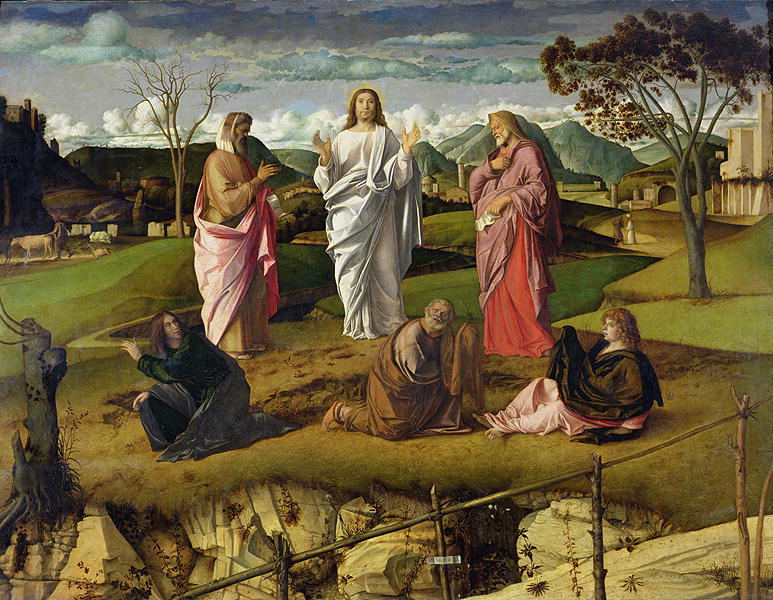
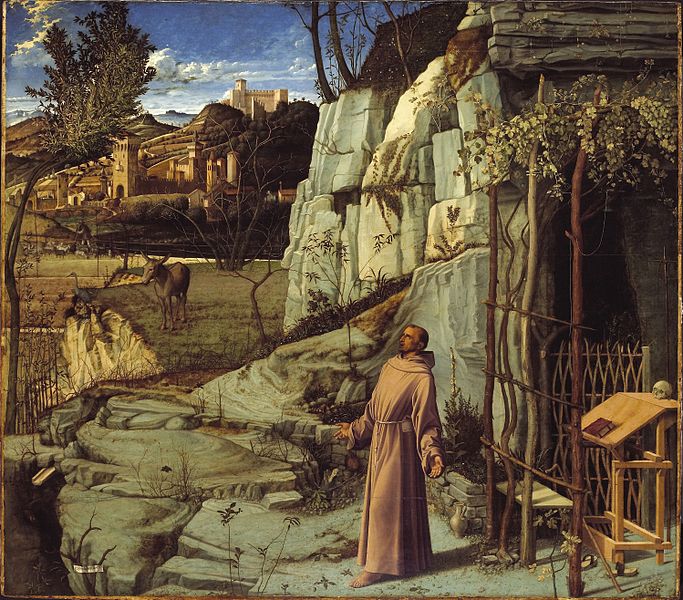
Yesterday, I was drawn to the television by a segment on “Sixty Minutes” about the noted German art forger, Wolfgang Beltracchi. When Bob Simon of CBS asked him what painters he couldn’t forge, Beltracchi, without hesitation, answered Bellini. I took him to mean Giovanni Bellini (1430-1516) and not his brother Gentile (they were both brothers-in-law of the great Andrea Mantegna). The only time I remember ever seeing or original Giovanni Bellini was at the Frick Collection in New York City, which has a superb “St. Francis in Ecstasy” also painted in 1480. I have included an image below.
There is such an incredible sense of detail in a Bellini oil that I feel as if I could pick a background segment (say 1/64th of the total) and enlarge it to full size without losing anything. And the detail would be almost as fascinating as the foreground. Look at that fence following the upward path in “The Transfiguration” (above), and note the minor variations from post to post. Look at that dead tree at the lower left, or that couple meeting in the upper right near the tree.
I can almost imagine Bellini in an ecstasy such as St. Francis in the painting below.
St. Francis in Ecstasy (1480) at the Frick Collection
This is a reprint of a blog posting from May 17, 2016. Martine and I were dismayed to hear of the passing of Roger Corman, who died in Santa Monica at the age of 98 on May 9 of this year. It never ceased to amaze me that one could produce and direct so many interesting films while working in what the film industry has called “poverty row.”
The first time I ever heard of him was when I was a student at Dartmouth. At that time (the mid 1960s) I subscribed to Films and Filming. One issue contained an article entitled “The Crown Prince of Z Films,” referring, of course, to Roger Corman. I was intrigued by what I was hearing of the cheapster director who made so many interesting films for American International Pictures. What I liked most were the Edgar Allan Poe adaptations, usually starring Vincent Price.
Perhaps my favorite was The Masque of the Red Death (1964), about the attempt by a group of dissipated nobles to escape the plague. There were others in the series, including House of Usher (1960), The Pit and the Pendulum (1961), Premature Burial (1962), The Raven (1963), and The Tomb of Ligeia (1964).
When I first met Martine in the late 1980s, I discovered that she was a hard-core Corman addict, liking such films as Attack of the Crab Monsters (1957) and the original The Little Shop of Horrors (1960), which was shot in under a week on a shoestring budget. There are in all about a dozen films he directed that are worth seeing and hold up well over the years. (He also made not a few clinkers, but that’s showbiz!) After he stopped directing around 1970 he continued to produce films and was responsible for some 300+ films over his half century career.
Roger Corman (1926-2024)
Other than the Poe features, I also enjoyed I, Mobster (1958), A Bucket of Blood (1959), The Intruder (1962) starring William Shatner, Tales of Terror (1962), X: The Man with the X-Ray Eyes (1963) starring Ray Milland, The Wild Angels (1966), The Trip (1967), and Bloody Mama (1970).
Corman introduced us to Jack Nicholson, Peter Fonda, Dennis Hopper, and Bruce Dern, to name just a few. In his films were such stars as Boris Karloff and Peter Lorre.
Perhaps I had a misspent youth, but I sure enjoyed it—and continue to do so….
Steve Martin and Dan Aykroyd as the Two Crazy Guys
The following repost is from April 25, 2013. It refers to the Tsarnaev brothers who used pressure-cooker bombs at the Boston Marathon that year.
You may recall those two Wild & Crazy guys from Czechoslovakia, the brothers Yortuk and Georg Festrunk, on Saturday Night Live. As they shimmied across the stage in search of “foxes, ” they displayed an exquisite misunderstanding what the United States was all about. In the case of Steve Martin and Dan Aykroyd, the result was comedy. In the case of Tamerlan and Dzhokhar Tsarnaev, two Chechen brothers from Dagestan, the result was death and disorder.
In the years to come, one of the greatest dangers to America will be the failure of immigrants from cultures vastly different from our own to adapt to the prevailing culture of the U.S. Even the mother returned to Russia, leaving several arrest warrants for shoplifting in her wake. The streets of America are not paved with gold. They are fraught with dangers not understood by people who have been influenced by our popular culture without understanding the particular demons that we in the States have to contend with in our daily lives.
After the Hungarian Revolution of 1956, my parents took in two sets of refugees. The first was a mother and son who thought that, now they were in America, everything would be golden. That ended badly when Feddike, the son, was sent to a juvenile correctional facility. Next was Lászlo, a young man in his twenties, who also quickly fell afoul of the law—whereupon my mother and father resolved not to take in any more refugees from the Mother Country.
I do not mean to imply that immigration is bad, but that American culture sends misleading vibes to the rest of the world. People who are not thoughtful and who think that just being on American soil is the solution to all their problems are more likely to go astray. No, they must be ready to roll up their sleeves and start working long and hard toward their goals.
The Tsarnaev brothers should be an object lesson to American officials that they have to probe more deeply than mere external circumstances when opening the doors of the henhouse to potential predators.
This is a repost from my Blog.Com site on January 26, 2009:
It was a recurring dream that I would have at least once a week. In November 1980, I spent a week at San Cristóbal de Las Casas in the State of Chiapas, Mexico. The town was known as a market town for the Highland Mayan peoples from San Juan Chamula, Zinacantán, Tenejapa, and other villages. In the city market, tourists are besieged by little Chamula girls selling crude handmade dolls. They come up to you, caress the doll, and coo to it softly. It was hard for anyone to resist. My Chamula doll is still propped up in my library in the Latin American literature section.
My revised edition of Michael Shawcross’s San Cristóbal de Las Casas City and Area Guide (San Cristóbal: Guadalupe de la Peña, June 1979) made reference to a local restaurant called Normita’s. In it, Shawcross wrote: “1E and 1S on Av. Benito Juárez. Pleasant, candle-lit atmosphere. Friendly owner (fine classical guitar-player). Try the Jalisco-style Pozole. The Huevos Motuleños are particularly fine. Beer/wine. Open afternoons and evenings only.” The 1E and 1S placed the restaurant one block southeast of the Zócalo.
Except, it wasn’t there. I had crawled all around the southeastern part of the city until I finally stumbled upon it. I spent all my small bills on the Jalisco-style Pozole, which was quite good and very filling. (If you’ve never had pozole, I suggest you try it on a cold day—and make sure it has a lot of hot chiles in it.)
When I emerged from a restaurant, I was accosted by a little Indian girl in tears carrying an empty plastic bucket. I could not give her anything because the smallest bill I had at the time was a 100-peso note, at the time worth about $12.00. Even if I were so warm-hearted as to have given it to her, her parents would probably have thought she stole it or did something nasty with one of the tourists, and then beaten her for her pains. I shook my head sadly and walked down the street, followed by the little girl, crying as if her world had tumbled down about her head. Had she lost something? Had she lost the money her parents had given her? I never knew.
That is my dream, being followed down a dark Mexican street by a poor little Indian girl with an empty plastic bucket, beseeching me for a few pesos which I didn’t have while drenched in tears.
This is a repost from Multiply.Com which I wrote some ten years ago:
Oh, oh! I’ve been thinking about Argentina again, and that means you’re going to hear about some more really obscure (but, IMHO fascinating) stuff.
To begin with, Argentina is such a Catholic country that it had to create additional saints native to its own soil. Let’s begin with La Difunta Correa, which means, literally, the Dead Correa:
According to popular legend, Deolinda Correa was a woman whose husband was forcibly recruited around the year 1840, during the Argentine civil wars. Becoming sick, he was then abandoned by the Montoneras [partisans]. In an attempt to reach her sick husband, Deolinda took her baby child and followed the tracks of the Montoneras through the desert of San Juan Province. When her supplies ran out, she died. Her body was found days later by gauchos that were driving cattle through, and to their astonishment found the baby still alive, feeding from the deceased woman’s “miraculously” ever-full breast. The men buried the body in present-day Vallecito, and took the baby with them. [from Wikipedia] All over the country, there are roadside shrines to La Difunta Correa, many surrounded by gifts left by truck drivers and travelers in a hope for a safe journey to their destination. Remember that Argentina is the eighth largest country on earth, and that distances can be farther than one ever imagines, especially on unpaved ripio roads.
There are two other popular saints with shrines all across the nation: Gauchito Gil (“Little Gaucho Gil”) and El Ángelito Milagroso, a.k.a. Miguel Ángel Gaitán.
Gauchito Gil hails from the state of La Rioja. A farmworker, Gil was seduced by a wealthy widow. When the police chief, who also had a thing for the widow, and her brothers came after Gil, he joined the army in the War of the Triple Alliance against Paraguay (perhaps the bloodiest war ever fought in the Americas, with the exception of our own Civil War). When he returned home, the Army came after him to join in one of Argentina’s many civil wars. Not to put too fine a point on it, the Gauchito deserted. He was discovered by the police, who wanted to execute him. Whereupon Gil prophesied to the head of the police detail that if he were merciful, the officer’s child, who was gravely ill, would get better. Instead of being shown mercy, Gil was executed.
When he returned home, the police officer found that his son was indeed very ill. So he prayed to Gauchito Gil, and his son got better. It was this police officer who returned to the scene of the execution, gave Gil a proper burial, and built a shrine in his memory. Today there are hundreds of such shrines scattered throughout the country.
By the way, the Gauchito is not the only deserter hero in Argentina’s past. Perhaps the national epic is Martin Fierro by José Hernández, about a gaucho who deserts from the so-called “Conquest of the Desert”—really a war of genocide against the native tribes of the Pampas—and is pursued by the police militia.
The Nineteenth Century in Argentina was unusually bloody, what with civil war, wars against the native peoples, and wars against other countries such as Paraguay and Brazil. So it is not unusual to find deserters as heroes, which is unthinkable in Europe and North America.
Finally, there is another La Rioja “saint” named Miguel Ángel Gaitán, El Ángelito Milagroso, who died at the tender age of one in 1967. When his body didn’t rot, the locals thought that meant it was supposed to be exposed for veneration—and so it was.









 Tarnmoor
You must be logged in to post a comment.